Mar 13, 2026 Artificial Intelligence
Generative AI for enterprises: A complete guide to strategy, implementation, and adoption
Mar 13, 2026 Artificial Intelligence
Table of Contents
Mar 13, 2026 Artificial Intelligence
Generative AI solutions for enterprises have been exceeding their limits as organizations have started unlocking their new potential. As per the recent reports of McKinsey, around 65% of respondents claimed to be using generative AI on a daily basis for their enterprises.
Most of the industries are turning from text prompts to autonomous actions. Around 40% of enterprises will consider the efficiency of task-related AI agents by the end of this year. Enterprise adoption is increasing, with around 78% of large organizations implementing AI solutions. However, only adoption is not taking you anywhere.
Many projects fail because businesses implement AI without a clear strategy and integration plan. This guide completely explains how you can adopt generative AI for enterprises. Starting from strategic planning to long-term governance, this guide includes everything.
Generative AI can be tagged as a subset of artificial intelligence that can build new content like images, text, audio, and videos. It assesses patterns from huge datasets like deep learning models and executes them during multiple user prompts.
It also uses ML that learns from the data patterns first without any input from humans. Gen AI learns what things are and uses such data to generate more effective things. There is a series of generative AI use cases that define its relevance in the recent age.
Here, you can go through some top gen AI models that can be easily implemented in your enterprises.
| Types of Gen AI Models | |
| Generative Adversarial Networks | It includes a generator and a discriminator to give rise to synthetic data. |
| Autoregressive Models | Builds data step-by-step with previous elements to predict the next one. |
| Variational Autoencoders | It compresses data & then decodes it to create better samples. |
| Transformer-based models | It breaks text into certain tokens & uses self-attention to analyze the context. |
Generative AI has become a foundational capability for digital enterprises instead of being just a technology trend. Gen AI benefits have already made many startups push their limits to another level. Some of the efficient ones have been given below.
Gen AI can easily automate your repetitive tasks like writing reports, analyzing data, or generating documentation. This allows your employees to prioritize more on high-value strategic tasks.
Organizations using AI automation often experience better efficiency and major reductions in their operational costs. They also hire AI developers to make the implementation more goal-oriented.
Generative AI enables intelligent customer interactions through conversational AI and virtual assistance. Such tools can offer 24/7 customer support while customizing the recommendations. This way, you can leverage faster response times while making your company prompt and responsible towards the audience.
AI models are capable of assessing a huge amount of structured and unstructured data and identifying patterns. This allows your enterprises to make faster and more informed decisions.
For example, enterprise generative AI implementation can generate predictive insights for supply chains, sales predictions, and market trends.
This high-end technology can give rise to new product ideas and assist you in research and development. Such capability can reduce innovation cycles while allowing your organization to test concepts faster. This way, you can launch your products faster in the market.
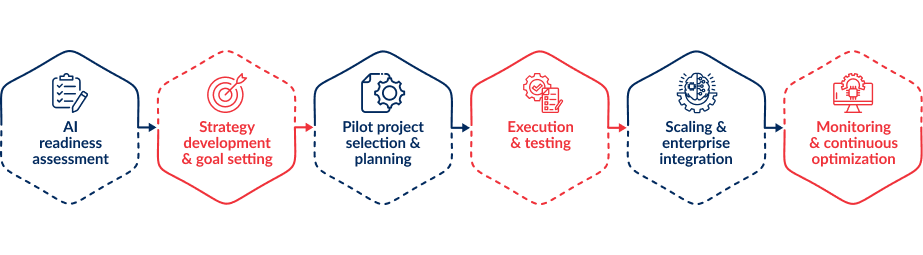
A generative AI strategy for enterprise implementation succeeds only when the execution process is clear and aligned with your objectives. Many enterprises fail to do this as their teams adopt different approaches. Many organizations are also leveraging the help of top AI development companies, whereas 90% of tech workers use AI tools.
Here, you can go through the complete generative AI implementation framework. Each phase includes proper business alignment, technical readiness, and governance design to ensure precise adoption. You can also consider the potential of professional AI development services to make the results more appealing to your audiences.
Powerful generative AI strategy implementation starts with a detailed understanding of your current operations and data maturity. You should also be aware of your organizational readiness. This phase discovers where value leaks today and what prevents transformation.
Enterprises must examine certain integral processes through aspects like what volume and cost sit in the process. You should also assess how structured and unstructured data you have, and how dependent the process is on human judgment.
Talking about the technical aspect, your team must assess the core systems and data stores along with integration patterns and API availability.
You should also assess your people’s readiness. Identify which team is already experimenting with AI and where it needs changes.
Now you are well aware of the baseline. Your enterprise has gone from scattered ideas to a structured portfolio. You also need to understand that not every promising use case needs instant investment.
You should value potential measures of revenue and app development cost. You should also measure the feasibility by assessing the data availability and technical complexities.
For your shortlisted initiatives, you should develop a one-page enterprise generative AI business case defining all its target users and workflows. This brings clarity before the engineering begins. It can also fuel your generative AI business strategy.
This ultimate phase defines how each use case will be built safely and cost-effectively. You can select prompting foundation models for low-risk tasks. You can initiate retrieval augmented generation for governed enterprise knowledge access.
Prefer domain-specific models for regulated and specialized workflows.
Architectural design goes beyond model selection. It involves agentic orchestration layers that access AI to reason through tasks and execute supervised workflows.
With proper strategy, architecture, and precise data aligned, you can build focused pilots that are implemented into real workflows. You can design pilots around your specific journeys, like agents handling customer interactions. AI capabilities are integrated directly into your existing tool to drive more adoption.
Some technical focus areas involve prompt design and Guardrails for sensitive tasks. Before launching the product, your team must define success metrics like time saved per task and error rate reduction. Pilots run long enough to reveal your performance patterns.
When pilots demonstrate the value, you need to begin scaling. This is where generative AI implementation turns into your enterprise capability. You can implement generative AI solutions for your business by allowing AI services into your systems through reliable APIs. This approach can strengthen your security and authentication.
Establish CI CD pipelines for prompts, configurations, and model versions. Define ownership for incident handling and support. You should also remember that continuous monitoring ensures better performance. For this approach, you should consider the help of an AI agent development service.
Regularly review your development cycles and refine the prompts. Train data and adjust the guardrails. Most importantly, you should pull back underperforming use cases.
This is the complete Generative AI implementation guide you need to follow for a successful project delivery.
Generative AI has been extensively infused into multiple industries by assisting them in automating their workflows and accelerating innovations. Many sectors have already been leveraging generative AI to encourage their efficiency while reducing operational costs. Some of the eminent ones have been listed below.
This sector is rapidly adopting the values of generative AI as compared to other industries. Hospitals and healthcare organizations have already understood the AI trends to generate medical documentation and assist in decision-making.
AI systems can easily analyze patient data while generating treatment insights for them. It can also personalize care recommendations while effectively improving healthcare outcomes. It has also boosted developers’ productivity by 50%.
This sector is adopting generative AI for fraud detection and risk assessment. AI-powered assistants can help your financial advisors assess market data and create investment insights. Most of the banks use AI to summarize their documents and automate the internal workflows.
As per the industry trends, most of the organizations are considering the help of generative AI development services for at least one of their departments.
Generative AI is capable of supporting your product design optimization, operational planning, and predictive maintenance. AI models can easily generate engineering designs while simulating the production processes. It offers insights that can help your manufacturers improve efficiency while reducing downtime.
E-commerce businesses are using Gen AI to generate product descriptions along with custom recommendations. It can also help you with pricing strategies and trend analysis. Around 75% of businesses value the efficiency of this technology, as per the recent statistics.
Media and entertainment companies are valuing generative AI for content creation, personalized media experiences, and visual effects. This sector also follows some of the top generative AI business ideas to keep up with the pace in the competitive landscape. AI-driven tools can help creators leverage quality content while exploring other easy formats.
Such industries are highlighting how AI has gone beyond the experimentation phase & has started boosting innovations among multiple sectors.
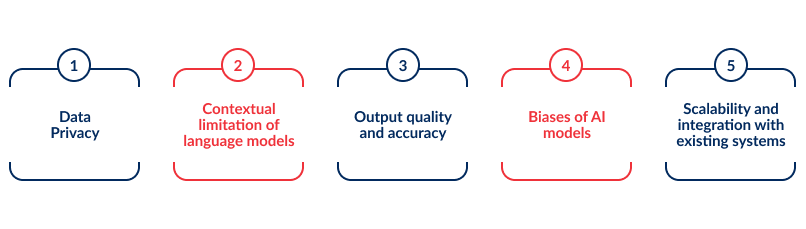
While generative AI for enterprises offers many benefits, there are many organizations that still face some unique challenges, as listed in this section.
Generative AI models require large sets of data to assess the industry requirements. Many organizations still struggle to find domain-specific datasets needed for authentic outputs. Without reliable and effective data, your AI systems might produce incorrect or misleading results.
Your AI models need to process sensitive business and customer data. This approach can give rise to data breaches and intellectual property exposure. It can also lead to regulatory violations. Here, you need to consider the help of professional AI consulting services. They will be able to implement strict security measures while sticking to reliable compliance frameworks.
Gen AI models might include biases through training datasets. This might lead to inauthentic decisions and impractical outcomes. Your enterprise must verify the AI systems on a daily basis and value – gen AI trends to avoid any bias.
Many organizations operate legacy systems that are mainly difficult to integrate with modern AI solutions. This is where you need customized architectures and APIs. Always partner with professional AI developers who can make you aware of such risks.
Companies that successfully scale generative AI always follow the best practices that have been listed in this section.
AI initiatives should always support your broader business goals instead of working randomly. For example, if you are considering app development for mobile phones, your team should understand AI in mobile app development.
Pilot projects allow your organization to test the ideas and innovations quickly and highlight values before you make any large-scale investments.
Human assessment ensures your AI outputs are accurate and meet the business objectives. You can consider the help of expert AI chatbot development services and other specialists as per your needs.
Responsible AI frameworks ensure fairness and transparency with other regulations. Your governance must include continuous monitoring and evaluation of AI systems properly.
Generative AI implementation costs generally fluctuate depending on the type of projects you are valuing. Here, you can go through the probable rates of generative AI for enterprises.
| Cost Aspects | Probable Charges |
| Strategy and Discovery | Around USD 150K |
| Data and Integration Foundation | Around USD 400K |
| Infrastructure Setup | Around USD 250K |
| Pilots | Around USD 700K |
| Run-rate Optimization | Around USD 250K |
| Post-Launch Adjustments | Around USD 200K |
All these charges might vary by region, vendor choices, and your project scopes. While implementation costs are predictable, uncontrolled inferences are now the fastest-growing hidden charge in scaled AI deployments.
Generative AI is expected to become an integral component of enterprise digital transformation. In the near future, enterprises are more likely to adopt AI copilots for employees and autonomous AI agents. Hyper-personalized customer experiences will take the market by storm, while AI-driven decision systems will influence your core functionalities.
However, the companies that succeed will not only adopt AI tools. They will redesign the workflows and will refine the organizational structures and AI capabilities.
AI is no longer a futuristic concept, as we can easily build innovative solutions through it. Generative AI is an offshoot of the same that can simplify your digital transformation. There is no better time than now for you to value generative AI for enterprise as compared to traditional methods of implementation.
Xicom, being the top generative AI development company, can help your enterprise leverage the benefits of gen AI through our complete services. Our AI experts thoroughly understand the AI model you have in mind and offer you a desirable final result aligned with your goals and principles. Contact us now and get free estimation.