Mar 3, 2026 Artificial Intelligence
AI in Business Operations: Practical Use Cases across Every Department
Mar 3, 2026 Artificial Intelligence
Table of Contents
Mar 3, 2026 Artificial Intelligence
In an era defined by quick technological advancements, artificial intelligence has been working as a transformative force in the business landscape. As per the current statistics, the global AI market size is at USD 375.93 billion in 2026, and it is going to double in recent years.
The race for integrating AI in business operations is not an experiment anymore. It has turned out to be a practical requirement for achieving efficient and goal-oriented operations. Your business might be dealing with complicated workflows while being under the constant pressure of doing more with limited resources. No doubt, traditional automation can manage your repetitive tasks. But it might fail to initiate better decisions when it includes cross-department coordination.
In this blog, we will break down some practical AI use cases across multiple departments. We will also learn about how businesses are leveraging the help of AI agent development companies to enhance their operations.
Business operations include all the tasks and activities that allow a company to run seamlessly. These tasks cover everything from making products to serving the customer base. It is very important to understand the major business concepts for efficiency. As we have discussed, traditional automation follows fixed rules; on the other hand, AI systems learn from data.
AI in business development can assess patterns while predicting the outcomes of multiple operational functions. AI in business operations means using technologies like natural language processing, machine learning, and AI agents to handle workflows while reducing manual efforts.
Such systems can work alongside your existing tools like CRM, ERP, and other supply chain platforms. Companies also understand the relevance of top AI tools for mobile app development for better compatibility.
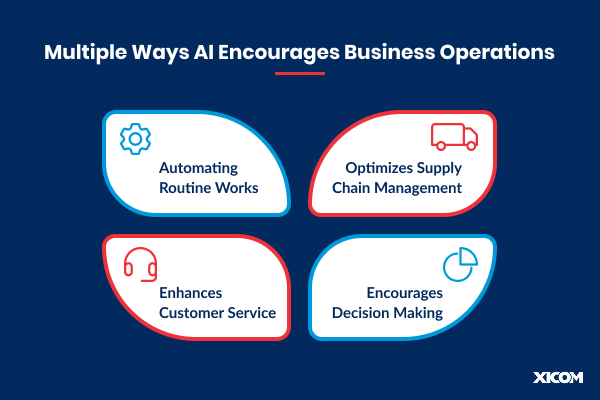
Here are the most relevant ways that explain how AI is transforming business operations. Such efficiency can help you go beyond ordinary work management.
AI can automate your repetitive efforts like scheduling & data entry, along with invoicing. This approach maintains consistency while lessening the chances of errors.
AI-centric virtual assistants & chatbots are capable of handling 24/7 customer support. This way, you can help answer the common queries and issues of your audience base.
AI can help you with demand forecasting and logistics, along with managing the inventory. It assesses the historical records and other market trends to accurately predict. This minimizes waste and prevents stockouts. It also ensures timely deliveries and cuts expenses.
AI can assess huge datasets to offer actionable insights. It identifies trends and patterns. This approach can help you make better decisions.
Recently, AI agents have also playing a massive role. The following systems are capable of monitoring the workflows. As per the recent study of McKinsey, around 62% claimed their companies are adopting the essentiality of AI agents.
You can also go through the essentiality of AI for startups to make your business grow in the right direction.
When we talk about AI in business operations, it covers a series of activities. Here, you can go through some practical examples of AI being used in multiple industries to improve accuracy and speed.
Your finance team always needs to handle a large volume of data, and they need to be very accurate. In recent years, AI has assisted the finance industry in moving from manual processing to proactive financial management.
Your operations team needs to deal with complicated workflows and remains under pressure to deliver on time. This is where AI business solutions can be a great fit.
The Human Resources team needs to have a good impression on your customers. But most of their time goes to repetitive and manual efforts. Top AI development companies are leveraging AI to make the HR team prioritize people over administrative work.
Sales operations mainly fall between data and revenue, and one of the most practically used cases includes lead scoring.
Your customer support team needs to be under constant pressure to resolve issues quickly while maintaining the quality of the project. This is why many companies hire AI developers to implement the systems in a better way.
Marketing operations leverage a series of data on a daily basis. Turning that data into clear actions can be a bit challenging.
Supply chain and logistics are complicated to handle in constantly changing conditions. AI can help you with demand forecasting in such conditions.
One such valuable use case for this department is incident analysis. AI is capable of predicting system logs and historical records to understand the potential failures before they take place.
AI can also prioritize business expansion and help in discovering new business models that you can’t think of.
These are some of the essential AI in business development – key areas of application and top use cases.
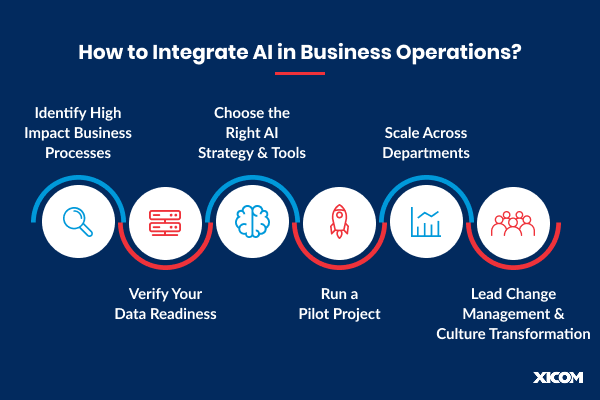
AI implementation doesn’t need to be risky and challenging. You just need to value high-impact areas and consider a structured approach for better performance. You can also leverage the benefits of hiring IT staff augmentation services to make the implementation more result-oriented.
Always identify the repetitive tasks your company is dealing with and decision-heavy workflows. Focus on areas where AI can save your time while improving efficiency.
It’s necessary for you to select the right datasets instead of gathering random information. Make sure that your data is reliable & clean. Identify the gaps that you need to fill while gathering data.
You can consider ML for predictions and forecasting. Use AI agents for workflow management and decision support. Prefer NLP systems for assessing text and to value customer feedback. Always select the approach that suits your business model & problem. Consider the help of a mobile app development service if you want your project to be seamless over multiple devices.
Always test AI on a smaller scale and verify its effectiveness. Identify its impact and gather feedback from teams to refine the system more efficiently.
Expand the solution to your other teams and departments to ensure it is working as a beneficial inclusion. Continuously monitor the performance and adjust the model and the processes with the changing requirements of your business.
Train your teams precisely to work along with your AI systems. It is important for your team to build its trust in AI recommendations. Encourage its adoption and proper usage across multiple organizations.
The future of AI in business operations is more inclined towards deeper automation and smarter decision-making. It is also going to encourage human-AI collaboration. Organizations are majorly adopting generative AI trends for content and workflow automation, while predictive analytics can help you anticipate demand and operational risks. Hyper automation will also connect multiple systems to align the complete process with minimum manual considerations.
Businesses are also valuing responsible AI while sticking to data privacy and ethical practices. AI in mobile app development is also becoming an essential addition in the current scenario. As tools are becoming more accessible, every type of business is using AI to maintain efficiency.
Artificial Intelligence plays a unique role in eliminating many challenges a business deals with. It is no longer about adopting AI for basic process automation. AI in business operations is about discovering potential opportunities that can help your team grow efficiently. Starting early can help your business gather clear advantages while staying ahead of the competition.
Xicom is here as your ultimate partner that can accelerate your business growth while balancing profitability. Our AI development services cover a series of industry segments to streamline the workflow. If you are willing to build custom AI software for your business, you can contact us now to discover the best quotes ever.