AI-Powered Dynamic Pricing: Models, Applications, and Implementation
Learn how AI-powered dynamic pricing uses demand forecasting, elasticity models and optimization to set smarter prices across retail, travel and more.
Nov 9, 2026 Artificial Intelligence, App Development
Quick Answer
Most AI apps cost between $30,000 and $300,000+ to build. A basic app built on existing AI models, such as a chatbot or assistant, typically costs $30,000 to $60,000. Mid-level apps with recommendations, document processing, or RAG cost $60,000 to $150,000. Advanced apps with custom models, computer vision, or real-time voice start around $150,000 and can exceed $300,000. Budget separately for monthly AI usage and yearly maintenance.
Budgeting for an AI app is harder than budgeting for a regular app. Two products with similar screens can differ in price by six figures, depending on what the AI underneath has to do, what data it needs, and how many people will use it every day.
Demand is not slowing down either. ChatGPT reached an estimated 100 million monthly users about two months after launch, according to a UBS analysis reported by Reuters. Since then, users have come to expect the same kind of intelligence in the apps they use for shopping, banking, healthcare, and work.
This guide breaks down the AI app development cost in practical terms: price ranges by complexity, the factors that move your budget, the running costs most estimates leave out, benchmarks by use case, and proven ways to spend less without cutting quality.
The cost to build an AI app depends mostly on how much intelligence the app needs and where that intelligence comes from. The table below shows typical ranges for a production-ready app, including discovery, UI/UX design, front-end and backend development, AI integration, testing, and launch.
| App Complexity | Typical Examples | Estimated Cost | Typical Timeline |
|---|---|---|---|
| Basic AI app | Chatbots, virtual assistants, smart search, and text summarization built on existing LLM APIs | $30,000 – $60,000 | 2 – 4 months |
| Mid-level AI app | Recommendation engines, RAG-based knowledge assistants, document processing, and content generation | $60,000 – $150,000 | 4 – 7 months |
| Advanced AI app | Custom-trained models, computer vision, real-time voice, and AI agents that act inside other systems | $150,000 – $300,000+ | 7 – 12+ months |
A simple way to estimate your own budget is this formula:
AI app development cost = (development hours × hourly rate) + data preparation + AI model and infrastructure costs + testing and compliance + post-launch maintenance
The first part of that formula works much like any other software project. If you want a baseline for the non-AI side, our guide on the cost to develop a mobile app covers it in detail. The remaining parts are where AI projects differ, and they are covered below.
Knowing what drives the budget helps you decide where to invest and where to hold back. These are the AI app development cost factors that have the biggest effect on the final number.
This single choice shapes most of your budget. Building on a pre-trained model is fast and affordable upfront, while training a model from scratch requires data, specialist skills, and computing power.
| Approach | How It Works | Cost Impact |
|---|---|---|
| Pre-trained model via API | The app calls a model such as GPT, Claude, or Gemini | Lowest upfront cost, with usage fees that grow with traffic |
| Retrieval-augmented generation (RAG) | The model answers using your own documents and data, without retraining | Moderate cost for data pipelines and a vector database |
| Fine-tuned model | An existing model is further trained on your domain data | Moderate to high, depending on data volume and training runs |
| Custom model | A model is designed and trained for your specific task | Highest cost for data, training, GPUs, and specialist engineers |
Many teams start with an API, add RAG development when answers need to reflect company data, and move to LLM fine-tuning only when accuracy or cost at scale demands it.
Broader requirements mean more features to design, build, and test. A focused AI chatbot that answers customer questions sits at the lower end of the range. Costs rise considerably when the app also needs image recognition, predictive analytics, voice interaction, or multi-step automation.
Advanced AI apps usually require:
Industry also matters. An AI shopping assistant for retail and ecommerce can often launch in the mid-level range, while a clinical or patient-facing app in healthcare needs extra validation and compliance work that pushes it toward the advanced range.
An AI model is only as good as the data behind it. If you build on a pre-trained model, data costs stay low. If you train or fine-tune your own model, you need large volumes of clean, structured, and labeled data, and every stage of preparing it adds to the budget.
| Data Phase (custom or fine-tuned models) | Estimated Cost |
|---|---|
| Raw data collection | $5,000 – $20,000 |
| Data cleaning and formatting | $10,000 – $30,000 |
| Data labeling for supervised learning | $15,000 – $50,000 |
| Legal and ethical compliance review | $5,000 – $15,000 |
These costs mainly apply to mid-level and advanced projects. A basic app built on an existing model usually skips most of them.
Hourly rates vary widely by region, and AI engineers command higher rates than general app developers. Typical market ranges look like this:
| Region | Typical Hourly Rate for AI Developers |
|---|---|
| United States | $100 – $180 |
| Western Europe and UK | $70 – $140 |
| Eastern Europe | $40 – $80 |
| India | $25 – $50 |
A cheaper, less experienced team can lower the upfront quote, but rework, missed deadlines, and quality issues often cost more later. Many US companies balance cost and quality by working with an offshore partner that has proven AI delivery experience. If you need specialists for a specific stage, you can also hire AI developers to extend your in-house team.
The tech stack affects both functionality and cost. It typically includes Python, frameworks such as PyTorch or TensorFlow, cloud platforms such as AWS, Google Cloud, or Azure, plus databases, vector stores, API integrations, security tools, and MLOps tooling for deploying and monitoring models. Depending on the scale of your app, setting up this layer can cost $10,000 to $50,000.
An AI app rarely works alone. Connecting it to your CRM, ERP, payment system, or a legacy database requires secure APIs, reliable data exchange, and careful testing. The more systems involved, and the older they are, the longer the timeline and the higher the cost.
Apps that handle personal, financial, or health data need extra safeguards such as encryption, access controls, audit logs, and documented data handling. In the US, that can mean HIPAA for health data or state privacy laws such as the CCPA, and GDPR applies if you serve users in Europe. Our guide to HIPAA-compliant app development explains what this involves for healthcare apps.
Most estimates focus on complexity, team size, and data. A few less visible costs can still stretch the budget and delay delivery if you do not plan for them.
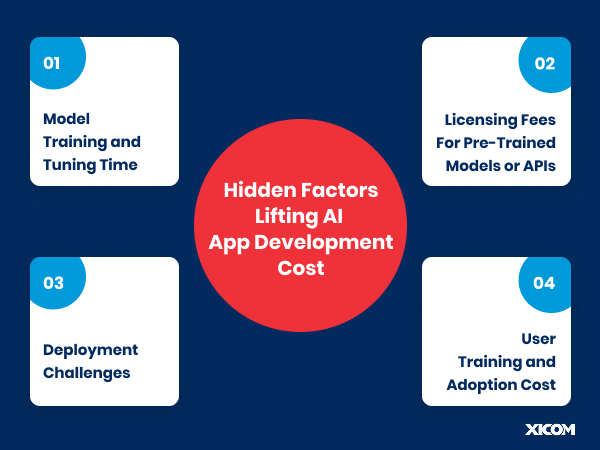
Getting reliable results usually takes several rounds of training, evaluation, and adjustment. Testing for accuracy and for incorrect or made-up answers takes real time, and the more accurate and personalized you want the app to be, the more effort and computing power it needs.
Proprietary models from providers such as OpenAI, Anthropic, and Google are usually billed by usage, so your bill grows with every active user and every request. Open-source models avoid per-request fees but need hosting and GPUs. Either way, this is a running cost that a regular app does not have.
If your app needs on-device intelligence, models must be compressed and optimized to run on phones or in offline environments. Apps that need real-time responses also need extra work on latency and scaling.
Enterprise AI apps often need onboarding, training materials, and support before employees use them confidently. Leaving this out of the plan can slow adoption and delay your return on investment.
Launch is not the end of the spending. The table below shows the main running costs. These are planning estimates, and actual figures depend on your model choice, traffic, and data volume.
| Running Cost | What It Covers | Typical Estimate |
|---|---|---|
| AI model usage | API calls to hosted models, priced by volume of requests | $200 – $10,000+ per month |
| Cloud hosting | Servers, storage, vector databases, and GPUs for self-hosted models | $500 – $15,000+ per month |
| Maintenance and monitoring | Bug fixes, performance tuning, model monitoring, and OS updates | 15% – 25% of the build cost per year |
| Model updates and retraining | Refreshing data and retraining custom models to keep accuracy high | $10,000 – $40,000 per year |
Model usage is the cost that surprises teams most often. Caching common answers, limiting response length, and sending simple tasks to smaller, cheaper models can bring it down considerably.
Here is how costs typically compare across popular types of AI apps. Each range covers a simpler version at the low end and a feature-rich, high-scale version at the top.
| AI App Use Case | Example Apps | AI Tech Used | What the AI Does | Est. Development Cost |
|---|---|---|---|---|
| AI Chatbots and Virtual Assistants | ChatGPT, Intercom Fin | LLMs, NLP | Holds human-like conversations, answers questions, and resolves support requests. | $30,000 – $150,000+ |
| AI Agents and Copilots | GitHub Copilot, Microsoft Copilot | LLMs, tool use, RAG | Plans and completes multi-step tasks across tools and business systems. | $60,000 – $300,000+ |
| AI Image Editing and Generation | Lensa AI, Canva Magic Studio | Generative AI, Computer Vision | Creates and enhances images with AI filters, avatars, and edits. | $60,000 – $250,000+ |
| AI Writing and Content Tools | Grammarly, Jasper | LLMs, NLP | Generates, edits, summarizes, and corrects text. | $40,000 – $200,000+ |
| AI Healthcare and Mental Health Apps | Wysa, Youper | NLP, Predictive Analytics | Tracks moods and symptoms and offers personalized guidance, with strict privacy controls. | $60,000 – $300,000+ |
| AI Recommendation Systems | Netflix, Spotify | ML, Data Mining | Suggests content, products, or music based on behavior and preferences. | $50,000 – $500,000+ |
| AI Voice Assistants and Speech AI | Google Assistant, Alexa | ASR, TTS, NLP | Understands spoken requests and replies in real time. | $50,000 – $400,000+ |
| AI-Powered Ecommerce Apps | Amazon, Meesho | ML, Recommendation Engines | Powers smart search, product suggestions, dynamic pricing, and demand forecasting. | $40,000 – $250,000+ |
| AI Productivity Tools | Notion AI, Otter.ai | NLP, ML, Automation | Summarizes meetings, drafts content, and automates routine workflows. | $50,000 – $200,000+ |
| AI Finance and Fintech Apps | Cleo | Predictive Modeling, Risk Scoring | Supports budgeting, credit scoring, and fraud detection with real-time analysis. | $60,000 – $500,000+ |
Regulated sectors sit at the higher end because of security and audit requirements. For example, fintech AI apps need explainable decisions and strong fraud controls, which add design and testing time.
An AI app does not need a seven-figure budget. Many startups launch a useful first version within the basic range of $30,000 to $60,000 by making a few smart choices early.
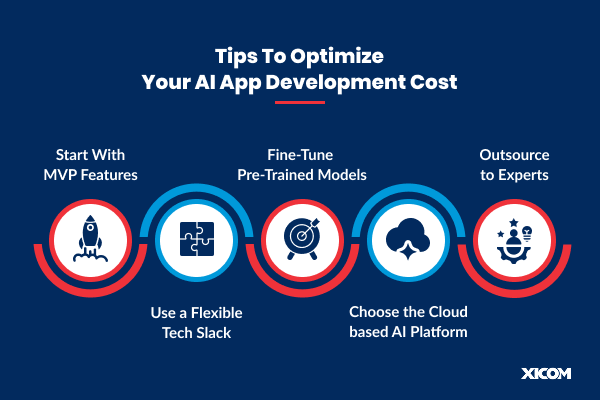
Launch with the one or two AI features that matter most, test them with real users, and expand based on feedback. An AI proof of concept or MVP also shows whether the idea works before you commit the full budget.
Choose modular, well-supported tools rather than the most advanced option for every layer. Low-code platforms can speed up prototypes and internal tools, while a modular architecture lets you swap models later without rebuilding the app.
Building a model from scratch is rarely necessary. Start with a proven model such as GPT, Claude, Llama, BERT, or YOLO and adapt it to your use case. Routing simple requests to smaller models keeps usage costs down as you grow.
Platforms such as Amazon Bedrock, Google Vertex AI, and Microsoft Foundry let you train and deploy models on demand, so you pay for what you use instead of buying and maintaining hardware.
An experienced partner saves on hiring and infrastructure and helps you avoid expensive wrong turns, such as training a custom model when an API would do. If you are still shaping the idea, AI consulting can help you choose the right approach before development starts.
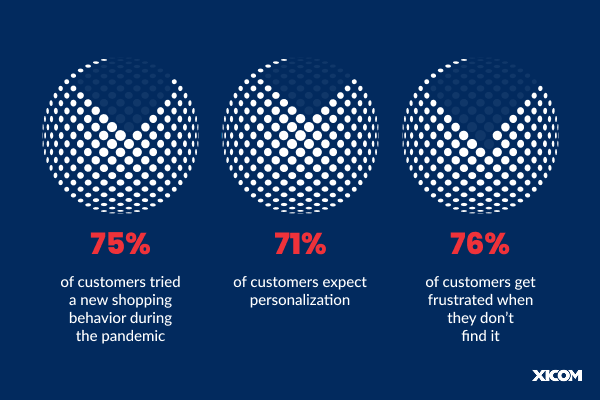
For most businesses, the bigger risk is falling behind competitors whose apps feel smarter. Three trends support the case for investing.
According to McKinsey, 71% of consumers expect companies to deliver personalized interactions. AI is what makes that possible at scale, from playlist suggestions on Spotify to the content feed on Instagram.
Allied Market Research projects the global mobile AI market will reach $84.80 billion by 2030, growing at a CAGR of 26.44%. Businesses that add AI early are better placed to win users as the market expands.
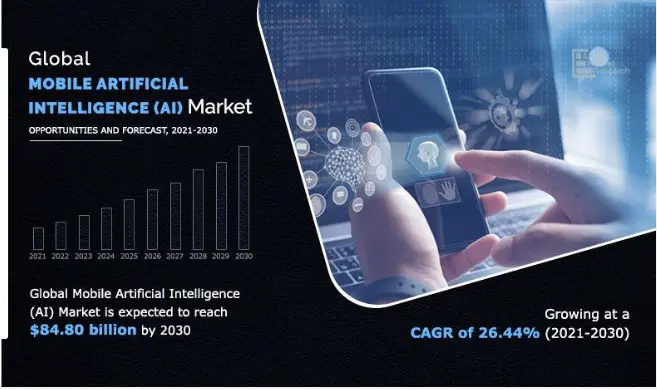
Source: alliedmarketresearch.com
Personalized recommendations, instant support, and predictive features give users reasons to return, while automation reduces the manual work behind support, operations, and reporting. Together, these benefits help an AI app pay back its development cost.
AI app development cost ranges from about $30,000 for a focused app built on existing models to $300,000+ for an advanced app with custom models. The surest way to stay on budget is to define your goals clearly, choose the simplest AI approach that meets them, launch an MVP, and plan for running costs from day one.
If you are ready to turn your idea into a working product, Xicom can help. As an AI development company with 20+ years of software delivery and 1,800+ projects completed, our team offers end-to-end AI app development services, from scoping and cost estimation to launch and ongoing support.
It typically costs $30,000 to $300,000+ to develop an AI app. Basic apps built on existing AI models cost $30,000 to $60,000, mid-level apps with recommendations or RAG cost $60,000 to $150,000, and advanced apps with custom models, computer vision, or real-time voice cost $150,000 to $300,000+.
Yes. Starting with an MVP built on pre-trained models and cloud AI platforms keeps most first releases within $30,000 to $60,000. You can then add features and scale based on real user feedback.
The biggest factor is the AI approach. Using an existing model through an API costs far less upfront than fine-tuning or training a custom model, which needs large labeled datasets, GPU time, and specialist engineers. Feature scope, integrations, compliance, and team location also have a major impact.
A basic AI app usually takes 2 to 4 months, a mid-level app 4 to 7 months, and an advanced app 7 to 12 months or more. Data preparation and model testing are the steps most likely to extend the timeline.
Plan for about 15% to 25% of the initial build cost per year for maintenance and monitoring, plus monthly AI usage and hosting costs. Usage fees for hosted models can range from a few hundred dollars to over $10,000 a month, depending on traffic.
An API is cheaper to start with because you skip data collection and training. A custom or fine-tuned model can become more cost-effective at very high usage or when you need specialized accuracy, but it requires a much larger upfront investment.
Adding a focused AI feature, such as a chatbot, smart search, or recommendations, to an existing app typically costs $15,000 to $60,000. The final cost depends on the feature, your current architecture, and how much data integration is needed.
Yes, in most cases. AI developers in India typically charge $25 to $50 per hour compared with $100 to $180 in the United States. Working with an experienced offshore partner lowers development cost while keeping quality high, as long as the team has proven AI delivery experience.

Based on this article's topic
Learn how AI-powered dynamic pricing uses demand forecasting, elasticity models and optimization to set smarter prices across retail, travel and more.
Learn how AI in business process optimization cuts cycle times and costs. Explore methods, use cases, ROI metrics and an implementation roadmap.
Learn how AI data engineering builds reliable pipelines for ML, generative AI and RAG, covering ingestion, data quality, storage, governance and scaling.