How Much Does it Cost to Make a Fitness App?
Oct 26, 2026 App Development
Oct 26, 2026 App Development
Oct 26, 2026 App Development
Quick Answer
Typical fitness app development cost for a custom app ranges from $25,000 to $50,000 for a simple tracker or workout app, $50,000 to $100,000 for a mid-level app with personalized plans, video, and wearable sync, and $100,000 to $200,000+ for an advanced platform with AI coaching, live classes, and health integrations. The final number depends on the features you choose, the platforms you launch on, and where your development team is based.
The market makes a strong case for building. According to Sensor Tower, health and fitness apps reached a record 3.6 billion downloads in 2024, and the US alone accounted for more than half of global consumer spending in the category. Sensor Tower expected in-app revenue for health and fitness apps to pass $4 billion in 2025, more than double what it was five years earlier.
This guide breaks down the cost to develop a fitness app by app type, feature, platform, and development phase, along with hidden costs, monetization models, and practical ways to keep your budget under control.
Planning a workout, nutrition, or AI coaching app? Xicom helps you hire mobile app developers who understand fitness tracking, wearables, and subscription apps, so your idea reaches users faster.
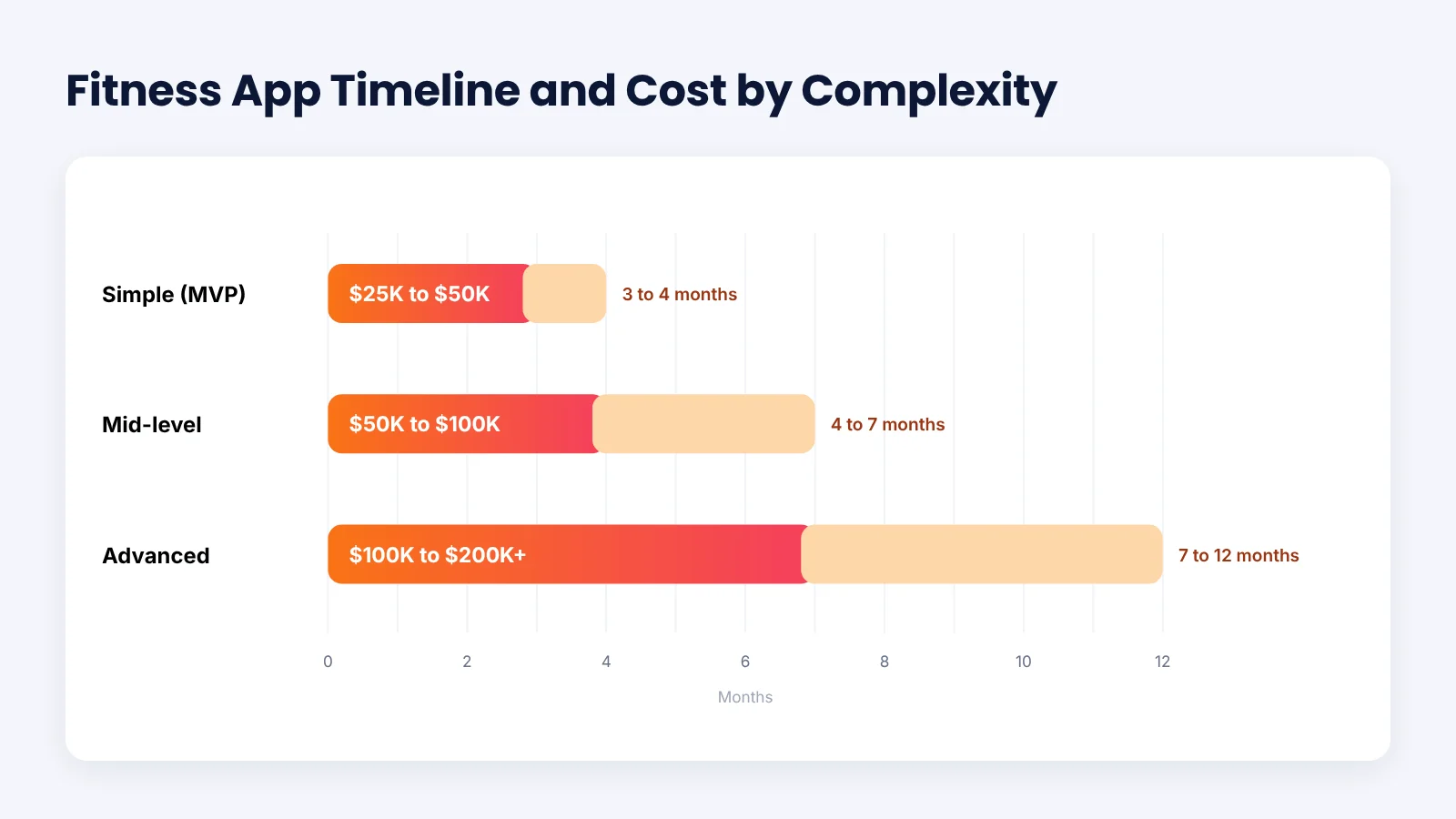
Here is a quick overview of fitness app development price ranges by complexity:
| App Complexity | Features Included | Timeline | Estimated Cost |
|---|---|---|---|
| Simple (MVP) | Sign-up, profiles and goals, activity tracking, pre-built workout plans, basic progress charts, push notifications | 3 – 4 months | $25,000 – $50,000 |
| Mid-level | Everything above plus video workouts, custom plans, nutrition logging, wearable sync, subscriptions, social features, admin panel | 4 – 7 months | $50,000 – $100,000 |
| Advanced | AI coaching and form feedback, live classes, trainer marketplace, advanced analytics, telehealth or clinical integrations | 7 – 12 months | $100,000 – $200,000+ |
Estimates assume a cross-platform build for iOS and Android by an experienced offshore team. US-based agencies typically quote two to three times higher for the same scope.
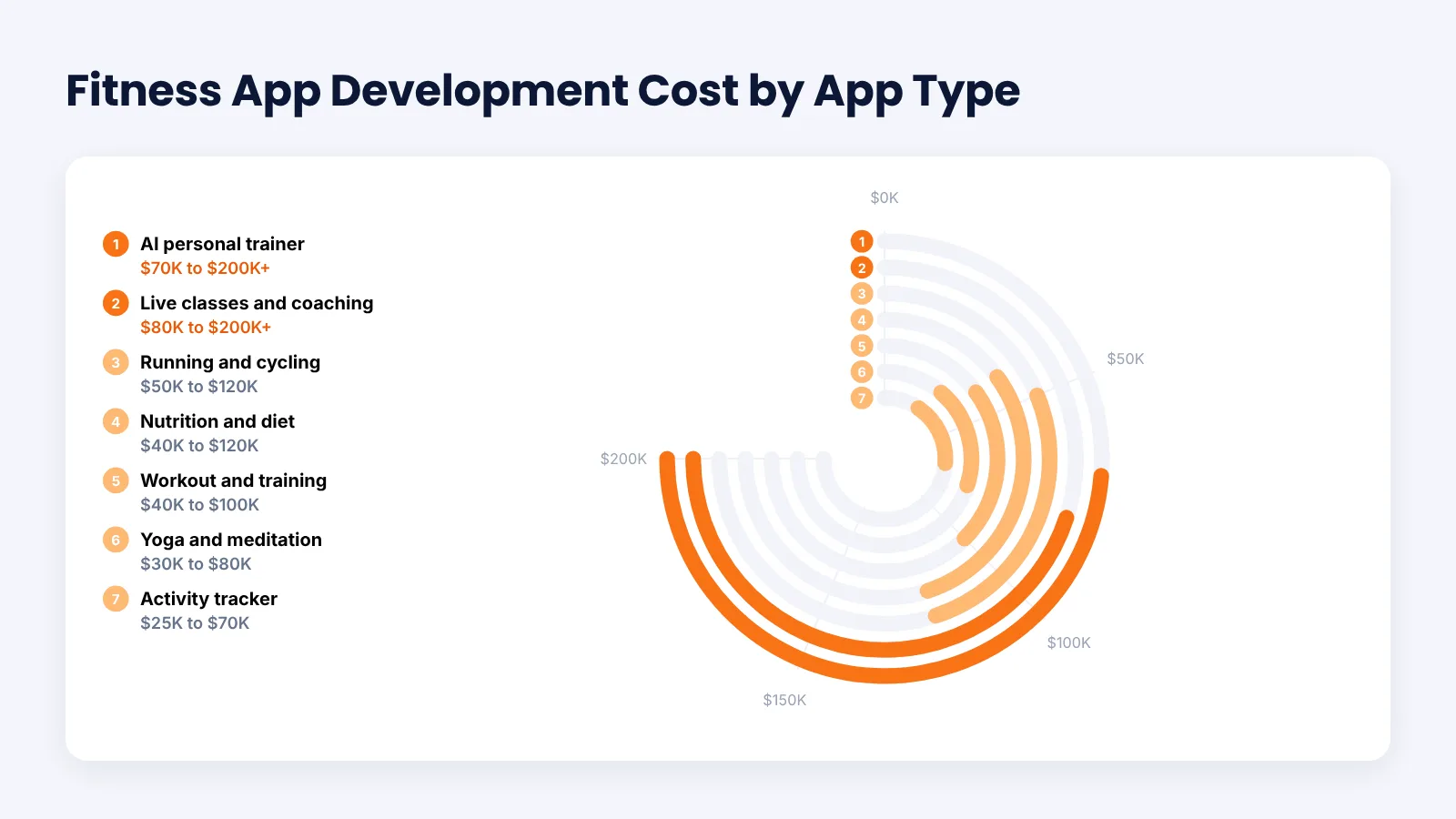
“Fitness app” covers many products, and each type has its own cost drivers.
| App Type | Examples | Main Cost Drivers | Estimated Cost |
|---|---|---|---|
| Activity and step tracker | Fitbit app, Sweatcoin | Sensor data, wearable sync, background tracking, rewards | $25,000 – $70,000 |
| Workout and training app | Nike Training Club, Freeletics | Video library, plan builder, progress tracking | $40,000 – $100,000 |
| Running and cycling app | Strava, Runna | GPS route tracking, maps, social feed, challenges | $50,000 – $120,000 |
| Nutrition and diet app | MyFitnessPal, Noom | Food database, barcode and photo logging, meal plans | $40,000 – $120,000 |
| Yoga and meditation app | Down Dog, Calm | Audio and video content, offline mode, subscriptions | $30,000 – $80,000 |
| Live classes and virtual coaching | Peloton, ClassPass | Live streaming, scheduling, trainer tools, payments | $80,000 – $200,000+ |
| AI personal trainer | Fitbod, Ladder | Adaptive plans, AI models, computer vision form checks | $70,000 – $200,000+ |
Live streaming is one of the most expensive features in this space because of video infrastructure and real-time interaction. Our guide to live streaming app development cost explains why.
Features are the biggest single driver of fitness app development cost. Here is roughly what each one adds to a cross-platform build.
| Feature | What It Does | Estimated Cost |
|---|---|---|
| Sign-up and onboarding | Email, phone, or social login plus a goal-setting questionnaire | $2,000 – $5,000 |
| User profiles and goals | Body stats, fitness level, preferences, and targets | $2,000 – $4,000 |
| Activity tracking | Steps, distance, calories, and active minutes | $4,000 – $10,000 |
| Workout plans and library | Exercise database, routines, timers, and instructions | $5,000 – $15,000 |
| Progress dashboard | Charts, streaks, personal records, and weekly reports | $3,000 – $8,000 |
| Push notifications and reminders | Workout reminders and motivational nudges | $1,500 – $4,000 |
| Subscriptions and in-app purchases | Free trials, premium tiers, and paywalls | $3,000 – $8,000 |
| Admin panel | Manage users, content, plans, and analytics | $5,000 – $15,000 |
AI features are worth considering early. In Sensor Tower’s analysis of AI-focused fitness apps in the US, the group grew downloads 59% and in-app revenue 28% year over year in Q2 2024. Our AI app development team can help you pick the smart features that will actually move retention.
So how much does it cost to build a fitness app for your specific idea? Beyond features, these five factors shape your final fitness app development cost.
Launching on both iOS and Android with separate native apps means two codebases. A cross-platform framework like Flutter or React Native shares most of the code and can lower the fitness mobile app development price by roughly 30% to 40%. Native development still makes sense when you need deep sensor access or advanced smartwatch features. Compare the options on our cross-platform app development page.
Most fitness apps read and write data through Apple HealthKit on iOS and Health Connect on Android. Google is phasing out its older Google Fit APIs, which it supports only until the end of 2026, and points developers to Health Connect instead. If you have an older app built on Google Fit, budget for that migration. Each additional device brand, such as Garmin, Oura, or WHOOP, adds integration work.
Workout videos, exercise animations, audio coaching, and recipe content are often a hidden line item. Filming a professional exercise library can cost as much as building the app itself, so plan whether you will produce, license, or use AI-assisted content.
Health and fitness data is sensitive. A general fitness app needs strong encryption, clear consent, and privacy compliance with laws such as GDPR and CCPA. If your app works with doctors, insurers, or patient data in the US, HIPAA compliance adds significant cost. Our HIPAA-compliant app development guide explains when it applies.
A typical team includes a project manager, a UI/UX designer, two mobile developers, a backend developer, and a QA engineer, plus an AI/ML engineer for smart features. US developers commonly bill $100 to $200 per hour, while experienced teams in India typically bill $25 to $60. That gap alone can change the cost to develop a fitness app by tens of thousands of dollars.
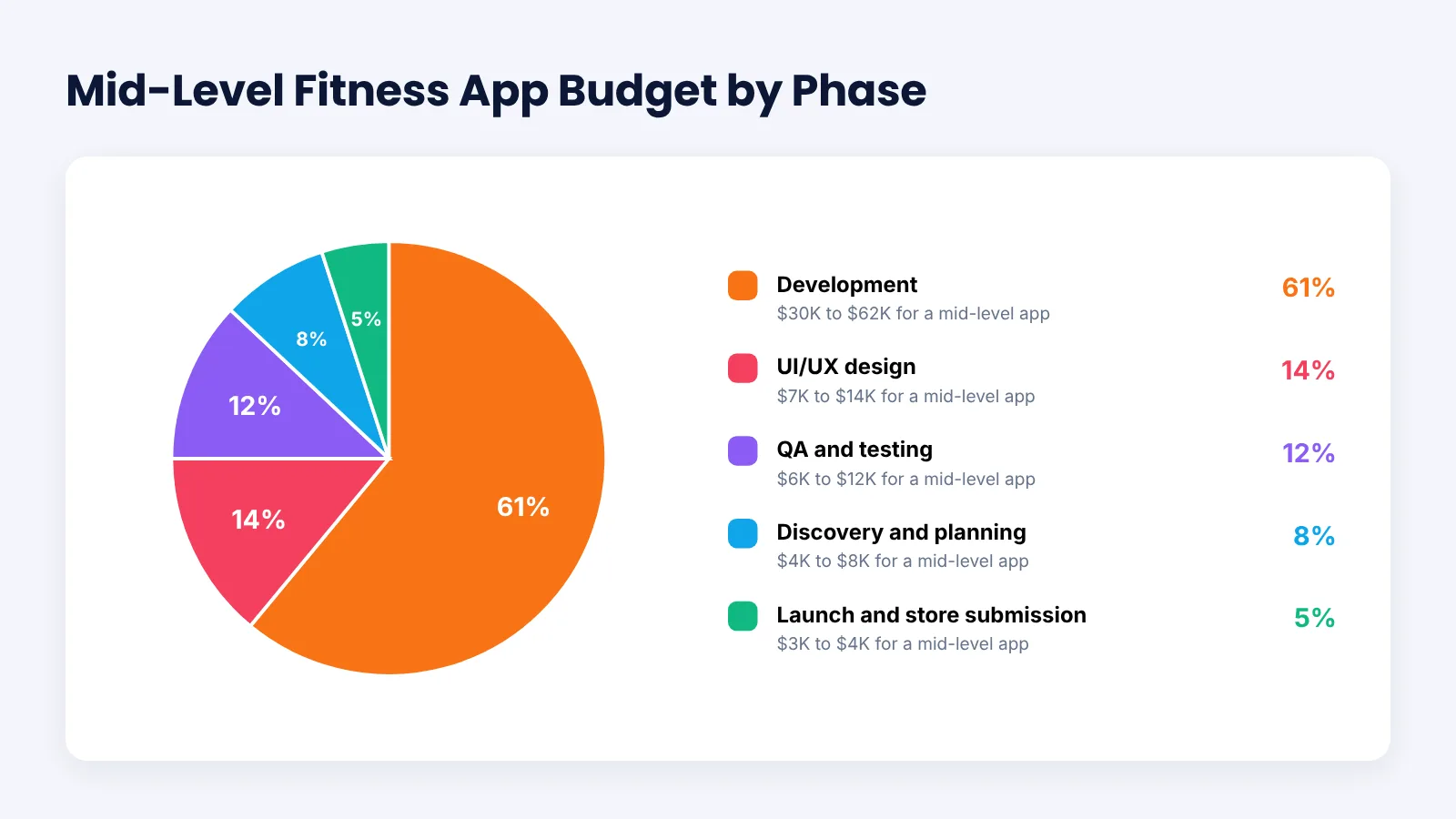
| Phase | Simple App | Mid-Level App | Advanced App |
|---|---|---|---|
| Discovery and planning | $2,000 – $4,000 | $4,000 – $8,000 | $8,000 – $15,000 |
| UI/UX design | $3,000 – $7,000 | $7,000 – $14,000 | $14,000 – $25,000 |
| App and backend development | $15,000 – $30,000 | $30,000 – $62,000 | $60,000 – $130,000+ |
| QA and testing | $3,000 – $6,000 | $6,000 – $12,000 | $12,000 – $20,000 |
| Launch and store submission | $2,000 – $3,000 | $3,000 – $4,000 | $6,000 – $10,000 |
| Total | $25,000 – $50,000 | $50,000 – $100,000 | $100,000 – $200,000+ |
When people ask how much does it cost to make a fitness app, they often forget the costs that continue after launch:
Your monetization model affects the build. Subscriptions need paywalls and trial logic, while marketplaces need trainer onboarding, scheduling, and payouts.
Wondering how much does it cost to create a fitness app on a tight budget? These steps keep spending under control without hurting quality:
Xicom has more than 20 years of experience building software for clients worldwide, with 1,800+ projects delivered for 750+ clients across 50+ countries and a 4.8 rating on Clutch. Our healthcare app development team builds fitness, wellness, and health tracking apps with secure data handling, wearable integrations, and AI features that keep users engaged.
Fitness app development cost ranges from about $25,000 for a focused MVP to $200,000 or more for an AI-powered platform with live classes and health integrations. The smartest path is to pick one clear use case, launch cross-platform, build on HealthKit and Health Connect, and add AI and premium features as your user base grows.
If you are ready to turn your fitness idea into an app, Xicom’s mobile app development team can help you plan, build, and launch it. Book a free consultation to get a detailed estimate.
A custom fitness app typically costs $25,000 to $50,000 for a simple app, $50,000 to $100,000 for a mid-level app with video, custom plans, and wearable sync, and $100,000 to $200,000 or more for an advanced platform with AI coaching and live classes.
Adding AI typically raises fitness app development cost by $10,000 to $60,000, depending on the feature. Adaptive workout plans and AI chat coaching sit at the lower end, while camera-based form correction using computer vision sits at the higher end.
A simple fitness app usually takes 3 to 4 months, a mid-level app takes 4 to 7 months, and an advanced app with AI coaching, live streaming, or health integrations can take 7 to 12 months.
The biggest factors are the feature set, the number of platforms and devices you support, health data and wearable integrations, content production, compliance requirements, and the location of your development team.
Yes. Our developers integrate Apple HealthKit, Android Health Connect, and devices such as Apple Watch, Wear OS watches, Garmin, and Fitbit, along with payment gateways, video platforms, and other third-party APIs.
We offer ongoing support and maintenance, including OS updates, bug fixes, performance monitoring, and new feature releases, so your fitness app stays competitive after launch.


Learn how to integrate Android AppFunctions into an AI-powered mobile app: what to expose, how to describe it for agents, permissions, testing and rollout.
How long does it take to develop an app? See typical timelines by complexity, phase, platform and app type, plus practical ways to launch sooner.
Swift vs Objective-C compared on safety, concurrency, performance, interop and hiring, plus a practical playbook for migrating legacy iOS code.