Jan 28, 2026 App Development
AI in Mobile App Development: Shifting Traditional Apps into Smart Solutions in 2026
Jan 28, 2026 App Development
Table of Contents
Jan 28, 2026 App Development
Integrating AI in mobile app development is no longer just about adopting the latest technology trend. It’s becoming a lifeline for businesses trying hard to survive in an overcrowded digital market.
If you’ve ever launched an app and watched users download it, only to abandon it days later, you’re not alone.
“A year ago, a health-tech startup founder named Raghav faced the same problem. His app had a beautiful UI, the latest features, and decent marketing support. Yet, 72% of the users dropped off within the first week. Why?
Because the app didn’t feel smart. It didn’t adapt, recommend, personalize, or predict as per users’ browsing, shopping, or scrolling behaviour. It behaved like every other traditional app- very static, generic, forgettable.”
And the numbers back this up:
Businesses across every industry are silently dealing with the same frustration:
It’s simple- you are still using traditional apps, which are no longer enough to meet the modern needs of users. In the digital-first era, users want apps that act smarter and faster. It should learn from, understand them, and evolve with them.
That’s exactly where introducing AI in Mobile App Development becomes a game-changer, turning conventional mobile apps into intelligent, proactive digital solutions.
If you’re all set to migrate from traditional apps to AI-driven mobile apps, then consider this blog, covering everything from benefits to the step-by-step process.
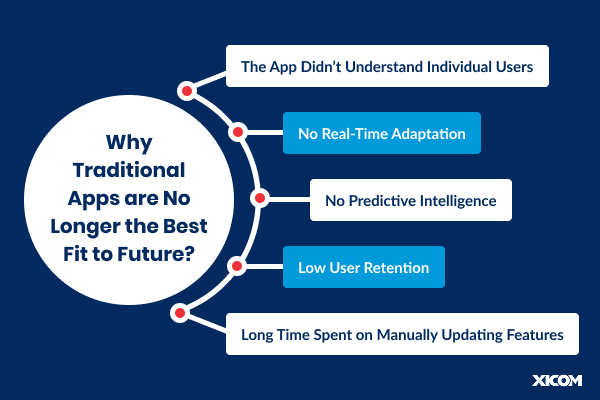
If you are thinking that only adopting top mobile app ideas will drive you to success, then you are in a big dilemma!
Traditional mobile apps were meant to the world where users are happy using simple features, static screens, and conducting basic interactions.
But that world doesn’t exist anymore!
Today’s modern users are expecting to use apps that can think, respond, and anticipate, just like a human assistant.
And this shift is exactly why AI in Mobile App Development is becoming a necessity rather than an add-on.
Let’s rewind to Raghav’s startup for a second.
He spent months building a fitness app that offered workout videos, calorie tracking, and weekly plans. On paper, it looked perfect. But users left because:
Every user got the same workout plan. The same nutrition suggestions. The same notifications.
In the other world, where Netflix-like AI-powered knows what you want before you click, are more ready to engage users. With this feature or AI capabilities in the app, Netflix has a 200% conversion rate.
If you want to know how much it costs to create an AI-powered app, then read the full guide “Cost to develop an AI App”.
If a user skipped workouts for two days, the app didn’t modify the plan or suggest anything that attracts user attention or convince them to stay connected with workout plans.
Let’s say, if someone preferred yoga over cardio, they didn’t learn that pattern. But, modern users expect apps to learn from their habits, rather than just offer what they offer to every other user. Users want their apps to act by giving attention to their specific habits.
Traditional apps only react; they don’t predict, don’t recommend, or personalize.
When 70% of user actions in top apps today come from AI-driven suggestions, a non-intelligent app feels outdated the moment it launches.
This is the silent killer that quickly makes your traditional apps go out of market, and you keep searching for the reasons why your app is not driving any business.
The biggest reasons behind poor user retention may include Static screens that lead to stagnant engagement. And stagnant engagement turns into high churn.
And for businesses, churn directly translates into more marketing spend and less ROI.
Traditional apps require constant manual efforts to update features, design, or the frontend of the app to stay relevant. Meanwhile, AI-powered apps improve autonomously as they learn from user behavior.
In a nutshell, traditional apps simply can’t meet modern expectations. And to survive in this constantly changing market, businesses should look forward to hiring AI developers who help develop apps that can learn, evolve, personalize, automate, recommend, and predict.
Read More: Understanding the average cost to hire AI developers.
When businesses think about upgrading their digital strategy, they often ask a basic question: “What exactly makes my app intelligent?”
The answer simply lies in how deeply the app can understand users, learn from their browsing behaviour, capable of making decisions, and improve on its own.
This is the core promise of AI in Mobile App Development that turns a static app into a dynamic and smart learning system that feels almost human.
Here are the AI features or capabilities that make your app act smarter…
Imagine opening an app that instantly recognizes your habits, preferences, and routines without you having to start browsing and draining your time searching for anything.
AI enables:
This is the biggest reason why mobile apps using top app development trends along with AI features have double retention rates.
Why wait for users to take action when your app can predict their next move? This is the real power of AI-driven smart applications.
AI can forecast:
This proactive intelligence helps businesses reduce drop-offs dramatically and is able to keep their users stick to the app.
Unlike traditional apps, users want quick answers to their questions. Adding the ability to talk to apps now with just a simple tap can make your app a first priority over traditional apps.
With NLP, apps can:
Best examples to refer to are Siri, Alexa, banking chatbots, and in-app assistants.
Mobile app development is no longer a complex thing. You already know what to include in app solutions to make it stand apart in the market. AI-powered vision lets apps “see and understand” images or surroundings.
Use cases include:
This is transforming eCommerce, fitness, gaming, and security apps.
If users liked X, they’ll probably like Y. AI learns from user behaviors and automatically serves recommendations that not just increase user retention but also dramatically increase sales as well.
This boosts:
These engines are the backbone of giant apps like YouTube, Amazon, Spotify, and Instagram that help drive more active users every day.
Unlike traditional apps that remain the same until updated, AI-enabled apps learn on the go.
Every interaction makes the system smarter:
This reduces the need for frequent manual updates and accelerates ROI.
In a nutshell, adding these capabilities creates a foundation that separates smart apps from outdated ones. But you might have two important questions here: “What’s the cost to develop a mobile app?” or how can businesses apply these capabilities practically?
Now that we know what makes an app “intelligent,” but it wont be enough.
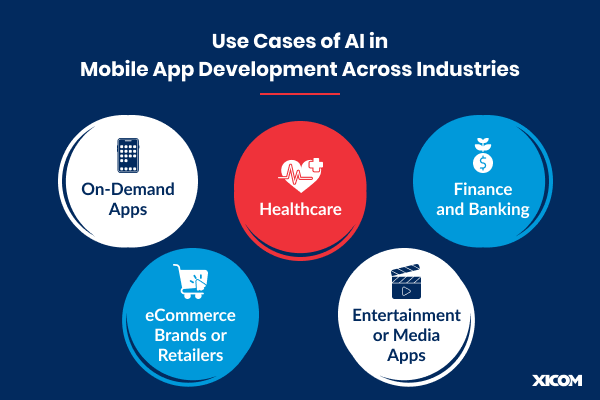
Let’s look at how different industries are already benefiting from AI in Mobile App Development:
Personalized shopping experience using the smart product recommendation engines!
Think of this, a user browses running shoes once, and suddenly the app starts recommending accessories, matching apparel, and exclusive discounts, without any manual setup.
This is AI in action!
What does AI do here in the app? –
Top industry ecommerce apps like Amazon or Walmart already rely heavily on AI to keep users browsing longer, buying more, and in return leveraging a great boost in conversions.
Started using virtual assistants and predictive diagnostics to transform the way they deliver care to patients!
Here’s what they do:
Using AI in healthcare can drastically change the way people look for care.
Contributing to detecting fraud, enabling smart budgeting options and providing instant customer support with AI chatbots!
AI is Fintech apps becoming the core of fintech apps by adding such capabilities:
On-demand apps need real-time data optimization for accurate processing.
If your question is how to build AI-powered marketplace apps and how delivery apps, ride-hailing apps, and service platforms depend on AI to optimize:
AI helps in reducing delivery costs, improving wait times, and enhancing customer satisfaction.
Ever wonder how YouTube knows what you want to watch next?
AI drives:
This leads to higher session time and stronger content engagement.
Across every industry, AI-equipped apps clearly outperform traditional ones. They offer real-time testing for speed, personalization, and automation; no static app can match.
Most businesses love the idea of AI-powered apps… until they ask the big question:
What are the top technologies working behind the apps to make them act intelligently?
If you’ve ever felt worries with the technical side, don’t worry, here’s the simplest and clearest classification of how AI in Mobile App Development works under the hood.
Let’s walk through it step by step.
AI models are working with the data. AI needs information to learn, and apps naturally generate tons of it.
So to make it work, your app collects data related to:
Raw data isn’t useful. The more refined your data is, the more accurate the answer will be. AI models require clean, structured, organized information.
So this stage involves:
Now, here’s the magic moment. AI models learn patterns from data using a combination of technologies:
During this stage, the system “practices” millions of times to understand user behavior.
For example, if a user watches fitness videos in the evening, the model learns to push recommendations at that time by analyzing what type of workout sessions they are more interested in watching.
Once trained, AI models are integrated into the app using:
The smooth integration of AI into a mobile app allows real-time intelligence inside your app.
With the seamless integration of AI in mobile apps, now the app can
This is where your app starts to feel alive and act smartly.
You may have a brilliant AI app idea, but the ultimate success lies in the expertise of AI app developers who go above and beyond your expectations to turn your idea into a robust solution.
Be it AI, ML, NLP or computer vision, Xicom has in-house engineers bringing hands-on expertise with the most advanced AI ecosystems.
Whether you’re building recommendation systems, predictive intelligence, chat-driven workflows, or generative solutions, the tech team at Xicom delivers enterprise standard services.
Unlike traditional typical vendors, Xicom is not just another software development company that enables you to outsource teams. They provide end-to-end product development strategies and solutions.
Their partnership with you to define:
Whether you want to build from scratch or enhance your existing system, we provides:
Depending upon your needs, we also guides you on what type of team structure best fits your project. The teams work as an extension of your organization, accelerating development without compromising quality.
We are among the early adopters of Generative AI development, enabling clients to launch features in app like:
Hire the tech team that best aligns with your budget and project needs with zero waiting and hidden costs.
There are no generic templates and no formula-based development.
Instead, you get:
Whether you need a transformation of your legacy system or a brand-new AI-first app, we ensures you get predictable outcomes and faster time-to-market.
At the end of this blog, you must have gained the insights about how AI in mobile app development is turning traditional apps into intelligent solutions. Businesses looking to stay competitive and trying hard to retain their users on app, should consider integrating AI capabilities in the existing app.
But integrating AI features can be a cost drainer; therefore, it is important to partner with an AI development company that can guide you what features you need to prioritize initially. If you are all set to accelerate your AI journey with confidence then Xicom can be your trusted tech partner.