How Much Does It Cost to Develop an App? Cost Breakdown
Oct 14, 2026 App Development
Oct 14, 2026 App Development
Oct 14, 2026 App Development
Quick Answer
Mobile app development cost runs about $15,000 to $36,000 for a simple app, $36,000 to $112,000 for a medium-complexity app and $84,000 to $152,000+ for a complex app with an offshore team. A US-based agency typically charges about three times more for the same hours. Industry data from reviewed client projects puts the most common budget at $10,000 to $49,999 and the average at $90,780 over about 11 months (updated 06 November 2026). Plan separately for store fees, cloud, payments and yearly maintenance.
How much does it cost to develop an app? Search the question and you will find answers from $5,000 to $500,000. Both ends can be true, because two quotes for “an app like Uber” can describe different products built by different teams. The price depends on what the app does, how many people use it in different roles, which systems it connects to and who builds it.
This guide is for US businesses planning an iOS and Android app and wanting a budget they can defend. It shows cost ranges that add up, a mobile app development cost breakdown by phase and app type, three apps priced end to end, the fees Apple and Google charge and what an app costs to run after launch. All prices are in US dollars and exclude sales tax, and our methodology explains how every figure was built.
The cost to develop a mobile app depends mostly on complexity: the number of screens and user roles, whether the app needs its own backend and admin panel, and how many third-party services it connects to. The table below groups typical projects into three tiers and prices each at both rate bands.
| App Complexity | What It Usually Includes | Hours | Offshore Team ($30 to $40/hr) | US Agency ($100 to $150/hr) | Timeline |
|---|---|---|---|---|---|
| Simple | 5 to 10 screens, one user role, light backend, basic analytics. Examples: MVPs, trackers, content and internal tools. | 500 to 900 | $15,000 to $36,000 | $50,000 to $135,000 | 2 to 3 months |
| Medium | 15 to 40 screens, user accounts, a backend with admin panel, payments, notifications, one or two integrations. Examples: booking and e-commerce apps. | 1,200 to 2,800 | $36,000 to $112,000 | $120,000 to $420,000 | 4 to 6 months |
| Complex | 40+ screens, several user roles, real-time tracking, offline sync, AI features, heavy integrations or strict compliance. | 2,800 to 3,800+ | $84,000 to $152,000+ | $280,000 to $570,000+ | 6 to 9+ months |
You can sanity-check any quote with one formula: estimated hours × blended hourly rate + fixed costs. Fixed costs are store fees, cloud hosting, third-party services (payments, SMS, maps, AI models) and compliance work, and they don’t shrink when you negotiate the rate. A 1,400-hour app costs $42,000 to $56,000 at offshore rates and $140,000 to $210,000 with a US agency. Same hours, different rate.
Hours are not spread evenly across a project. Here is a typical app development cost breakdown for a 1,400-hour medium app, the midpoint of the booking app priced later in this guide. Shares are ranges, so the rows don’t add to one fixed total, but your vendor’s split should look close to this.
| Phase | What It Covers | Share of Hours | Offshore Team | US Agency |
|---|---|---|---|---|
| Discovery and scoping | User flows, feature list, technical plan, hour estimate | 5% to 10% (70 to 140 hrs) | $2,100 to $5,600 | $7,000 to $21,000 |
| UI/UX design | Wireframes, clickable prototype, design system | 10% to 15% (140 to 210 hrs) | $4,200 to $8,400 | $14,000 to $31,500 |
| App and backend development | iOS and Android app, APIs, database, admin panel, integrations | 50% to 60% (700 to 840 hrs) | $21,000 to $33,600 | $70,000 to $126,000 |
| QA and security testing | Device testing, automated tests on key flows, security checks | 15% to 20% (210 to 280 hrs) | $6,300 to $11,200 | $21,000 to $42,000 |
| Deployment and project management | Store submission, release setup, sprint planning and reporting | 5% to 10% (70 to 140 hrs) | $2,100 to $5,600 | $7,000 to $21,000 |
Discovery is the smallest line and the one most often skipped, but it sets the hour count for everything after it. A quote that skips discovery is usually a guess.
Every category has its own must-have features, and those features drive the cost of app development more than the category name does. Each row uses estimated hours × the two rate bands. Use them as starting points for a first release on iOS and Android.
| App Type | Features That Drive Cost | Hours | Offshore Team | US Agency |
|---|---|---|---|---|
| Simple MVP, one user role | Core journey, login, basic admin | 500 to 900 | $15,000 to $36,000 | $50,000 to $135,000 |
| Booking or business app | Scheduling, payments, SMS reminders, staff admin panel | 1,200 to 1,600 | $36,000 to $64,000 | $120,000 to $240,000 |
| Edtech | Video, assessments, teacher roles; COPPA consent if children under 13 use it | 1,600 to 2,400 | $48,000 to $96,000 | $160,000 to $360,000 |
| E-commerce and D2C | Catalog, cart, checkout, order tracking, CRM integration, admin panel | 2,000 to 2,800 | $60,000 to $112,000 | $200,000 to $420,000 |
| SaaS companion app | Multi-tenancy, role management, SSO, API integrations | 2,000 to 3,200 | $60,000 to $128,000 | $200,000 to $480,000 |
| Healthcare | HIPAA safeguards or the FTC Health Breach Notification Rule, EHR integration | 1,600 to 3,600 | $48,000 to $144,000 | $160,000 to $540,000 |
| On-demand, like Uber | Separate rider and driver apps, live tracking, payouts | 2,400 to 3,400 | $72,000 to $136,000 | $240,000 to $510,000 |
| Logistics and field service | Offline sync, maps, photos and signatures, role-based access, AI assistant | 2,800 to 3,800 | $84,000 to $152,000 | $280,000 to $570,000 |
| Fintech | Identity verification, PCI DSS scope, security testing | 2,800 to 4,000 | $84,000 to $160,000 | $280,000 to $600,000 |
Industry doesn’t set the price, but it changes the hour count through compliance, integrations and security testing. If you already know your category, our ecommerce and fintech app development teams can scope it with you.
Tiers are useful, but a worked example shows what really sits behind the cost to build a mobile app. “Build plus first 12 months live” includes $124 in store setup: Apple’s $99 annual fee and Google Play’s $25 one-time fee.
How the AI cost is calculated. Assume 200 technicians asking 20 questions a day for 22 working days: 88,000 requests a month. Each request uses about 3,000 input tokens and 400 output tokens, so 264 million input and 35.2 million output tokens a month. At Anthropic’s list prices (checked 12 October 2026), Claude Haiku 5.5 ($0.10 input, $0.50 output per million tokens) costs $44 a month and Claude Sonnet 5.5 ($2 input, $10 output) costs $880 a month. Model choice moves this line by 20x, and prompt caching lowers it further.
Each feature adds design, development and testing time, and each user role (customer, staff, driver, admin) multiplies flows, permissions and test cases. Real-time chat, video, offline sync and anything involving payments or sensitive data cost far more than they look. A clear first-release feature list is the most effective way to control cost.
Business logic, databases, admin panels and reporting often take as many hours as the app itself. Apps that only store data on the device are much cheaper than apps with user accounts, shared data and an admin team behind them.
Payments, CRMs, EHRs, shipping and maps each need build work, error handling and testing. One integration is small; five of them add weeks. An integration nobody planned for is one of the most common causes of budget overruns.
Custom UI and motion cost more than a well-applied design system. Spend design budget on the journeys that drive revenue, such as onboarding and checkout, and use standard components elsewhere.
AI adds two kinds of cost: build hours for the feature and usage fees for the model. As the field-service example shows, the usage line can range from $44 to $880 a month for the same workload depending on the model, so choose the model per task. Our AI app development team can help you pick the right mix.
US apps can carry HIPAA safeguards when they handle protected health information for a provider, the FTC Health Breach Notification Rule for consumer health apps outside HIPAA, COPPA consent flows for children under 13, PCI DSS when card data is stored or processed, and state privacy laws such as CCPA. Each adds design, development and testing hours.
Rates are the biggest multiplier in mobile app development cost. Here is what sits behind the two rate bands used in this guide.
| Team | Typical Hourly Rate (USD) | Basis |
|---|---|---|
| Offshore team | $30 to $40 blended | Xicom’s published dedicated app developer rates: $25 junior, $35 mid-level, $45 senior |
| US in-house developer (loaded cost) | About $93 | BLS median wage of $135,980 (May 2025), about $65.38 an hour, plus benefits at 30% of compensation (BLS, June 2026) |
| US-based agency | $100 to $150 | Set just above the loaded in-house cost to cover management, QA and margin; major metros can run higher |
| Industry data from reviewed projects | $25 to $49 | Self-reported by clients and blended across locations, so it sits below a fully US-based team |
US mobile developers also earn more than the overall median: the Stack Overflow Developer Survey 2025 shows median total compensation of $170,000. Many US companies use a hybrid model, keeping product ownership in-house and using an offshore team for engineering, QA and maintenance. If you need to add capacity, you can hire mobile app developers on a dedicated basis.
A simple app usually takes 2 to 3 months, a medium app 4 to 6 months and a complex app 6 to 9 months or more. Design, backend and app development overlap in practice, so phases run partly in parallel.
| Phase | Key Activities | Simple App | Medium App |
|---|---|---|---|
| Discovery | Requirements, user flows, architecture, hour estimate | 1 to 2 weeks | 2 to 3 weeks |
| UI/UX design | Wireframes, prototypes, visual design, design system | 2 to 3 weeks | 4 to 6 weeks |
| Development | iOS and Android app, backend, integrations, admin panel | 5 to 8 weeks | 10 to 18 weeks |
| QA and launch | Testing, beta builds, App Store and Google Play review and release | 1 to 2 weeks | 2 to 4 weeks |
| Total | Phases overlap | 2 to 3 months | 4 to 6 months |
Most quotes cover the build only. These app development costs arrive after launch. Prices were checked on 13 October 2026.
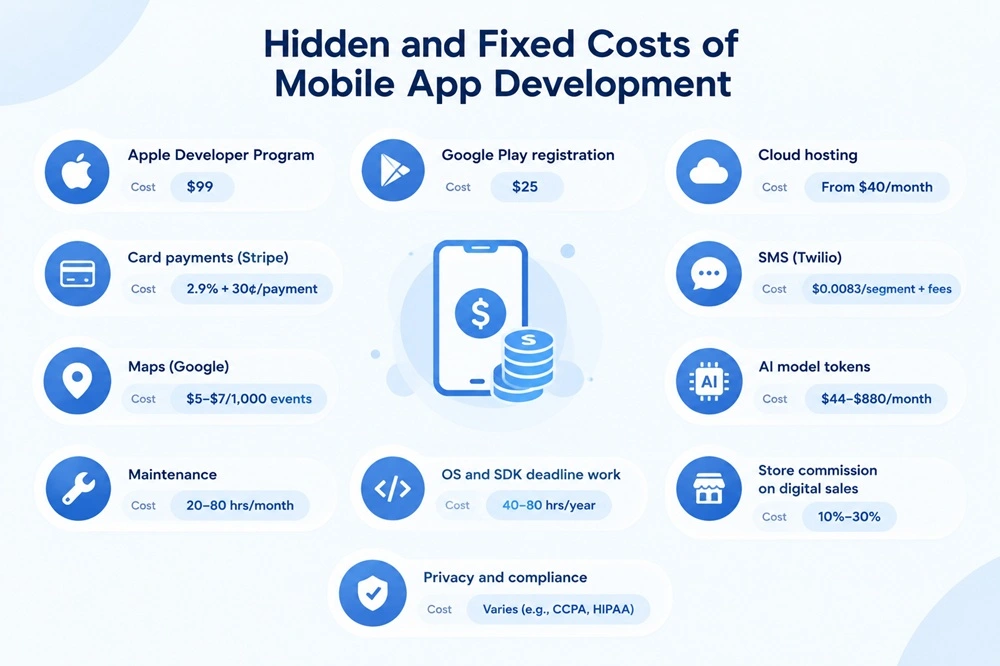
Publishing requires Apple’s Developer Program at $99 a year and a Google Play registration at $25 once. These are the only costs you can’t reduce.
This only applies if you sell digital goods or subscriptions inside the app. Physical goods and services, like deliveries or bookings, pay no store commission.
Check both rate cards on the day you set your budget.
Plan maintenance in hours, not percentages: 20 to 80 hours a month depending on the app, plus 40 to 80 hours a year for platform deadlines. Google Play requires new apps and updates to target Android 16 (API level 36). Apple has required Xcode 26 and the iOS 26 SDK since 28 April 2026, and uploads must use the iOS 27 SDK from April 2027. Every year brings a new deadline.
| Cost | US Price | Can You Control It? |
|---|---|---|
| Cloud hosting | From $40 a month | Partly, through architecture |
| Card payments (Stripe) | 2.9% + 30¢ per payment | Partly, through provider choice |
| SMS (Twilio) | $0.0083 per segment + $0.0025 to $0.005 carrier fee | Partly |
| Maps (Google) | 10,000 free events a month per SKU, then $5 to $7 per 1,000 | Partly |
| AI model tokens | $44 to $880 a month for 88,000 requests | Yes, through model choice |
| Privacy and compliance | CCPA and other state laws, COPPA, HIPAA where they apply | No |
Here is the booking app (Scenario A), built offshore, across three years. Two lines are assumptions: 40 to 80 hours a year of OS and SDK deadline work, and 40 to 80 hours once for a privacy and security review before scaling.
| Line Item | Year 0 (Build) | Year 1 | Year 2 |
|---|---|---|---|
| Build | $36,000 to $64,000 | None | None |
| Store accounts | $124 | $99 | $99 |
| Cloud and maintenance | None | $7,680 to $14,880 | $7,680 to $14,880 |
| Platform deadline work | None | $1,200 to $3,200 | $1,200 to $3,200 |
| Privacy and security review | None | $1,200 to $3,200 | None |
| Total | $36,124 to $64,124 | $10,179 to $21,379 | $8,979 to $18,179 |
Three-year total: $55,282 to $103,682. The build is only about two thirds of it. Payment, SMS and store fees scale with usage and come on top.
Platform choice moves the cost to develop an app less than most people expect. Here is the booking app priced on each option. Hourly rates don’t change by operating system, so an iPhone app costs about the same to build as an Android one; building separate native apps for both roughly doubles the project.
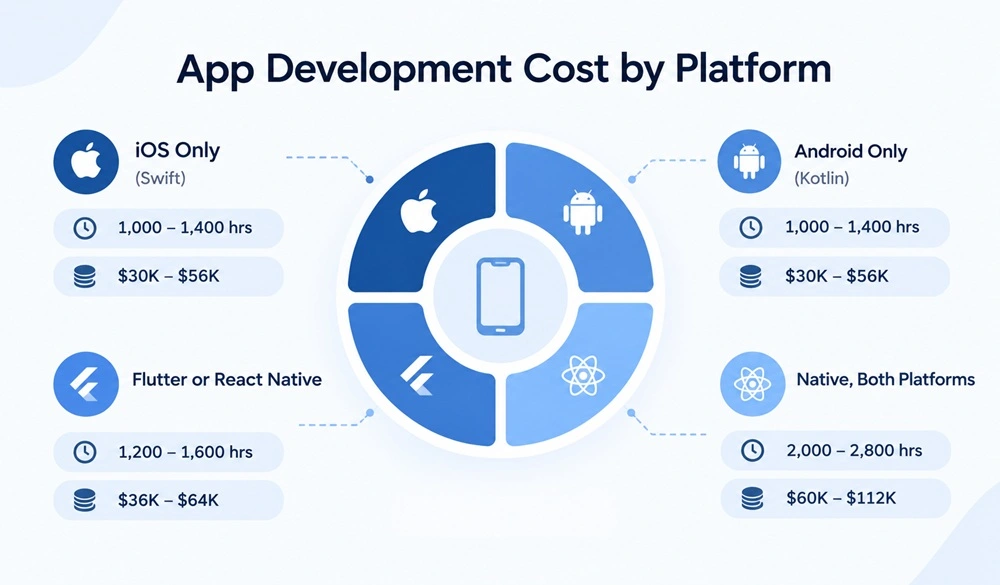
| Approach | Hours | Offshore Team | US Agency | Best For |
|---|---|---|---|---|
| iOS only (Swift) | 1,000 to 1,400 | $30,000 to $56,000 | $100,000 to $210,000 | Users mostly on iPhone |
| Android only (Kotlin) | 1,000 to 1,400 | $30,000 to $56,000 | $100,000 to $210,000 | Company-issued Android devices or a mostly Android audience |
| Native, both platforms | 2,000 to 2,800 | $60,000 to $112,000 | $200,000 to $420,000 | Heavy device hardware, demanding graphics, platform-specific polish |
| Cross-platform (Flutter or React Native) | 1,200 to 1,600 | $36,000 to $64,000 | $120,000 to $240,000 | Most MVPs and growth-stage apps on both platforms |
If you need both platforms at launch, cross-platform app development is usually the most cost-effective route. For platform-specific detail, see our iOS app development cost and Android app development cost guides.
If you build it yourself, the cost to create a mobile app drops to fixed fees plus your time: Apple’s $99 a year and Google’s $25 one-time fee. No-code tools add a subscription, and Bubble’s paid plans start at $59 a month billed annually. No-code works well for testing an idea with early users; once you need offline mode, deep device features or complex integrations, most teams move to custom code.
We built every mobile application development cost in this guide from scope up, not from agency price tiers. Each app was broken into screens, user roles, integrations and testing, estimated in hours by role, then multiplied by two rate bands based on independent project data from reviewed agencies, US wage data from the Bureau of Labor Statistics and Xicom’s published developer rates. Running costs come from each provider’s own pricing page (Apple, Google, AWS, Stripe, Twilio, Google Maps and Anthropic), checked in October 2026. Hour ranges are planning assumptions, not quotes, and exclude tax, marketing and legal costs.
Our mobile app development pricing starts with scope, not hours. Every estimate separates labor from fixed lines such as store fees, cloud and APIs, and includes first-year running costs, so the number you approve is the number you spend. Xicom’s mobile app development services cover discovery, UI/UX design, iOS, Android and cross-platform development, backend and integrations, store launch and ongoing maintenance.
Your mobile app development cost comes down to hours multiplied by a rate, plus fixed costs no vendor can negotiate away. For most US businesses, a focused first version runs $36,000 to $64,000 offshore or $120,000 to $240,000 with a US agency, and the build is only about two thirds of three-year spend. Choose a mobile app development company that shows the hours behind its number, lists fixed costs separately and includes first-year running costs in the quote.
Most mobile app projects cost $10,000 to $49,999, and the average is $90,780, based on independent data from reviewed client projects. In our worked examples, a booking app of 1,200 to 1,600 hours costs $36,000 to $64,000 with an offshore team or $120,000 to $240,000 with a US agency.
Industry data from reviewed client projects puts agency rates at $25 to $49 per hour, a self-reported blended figure. BLS data puts the median US software developer wage at $135,980 (May 2025), roughly $93 an hour once benefits are added. US agencies charge above that to cover management, QA and margin.
About the same as an Android app, because hourly rates don’t change by operating system. In our estimates, an iOS-only booking app of 1,000 to 1,400 hours costs $30,000 to $56,000 offshore or $100,000 to $210,000 with a US agency, plus Apple’s $99 yearly developer fee.
An on-demand app needs separate rider and driver apps, live tracking, payments, payouts and an admin panel. We estimate 2,400 to 3,400 hours for a first version: $72,000 to $136,000 with an offshore team or $240,000 to $510,000 with a US agency, before maps, SMS and payment fees.
A simple app usually takes 2 to 3 months, a medium app 4 to 6 months and a complex app 6 to 9 months or more. A paid discovery phase, a cross-platform build and managed services for payments and notifications shorten the timeline.
Plan in hours, not percentages. In our booking app example, cloud plus 20 to 30 maintenance hours a month costs $7,680 to $14,880 a year offshore. Add 40 to 80 hours a year for Apple and Google SDK deadlines. Over three years, the build is about two thirds of total cost.
Only on digital goods and subscriptions. Google lists 10% plus a 5% billing fee on US subscriptions and 20% plus 5% on other new-install purchases. Apple charges 30% on in-app purchases, or 15% for small businesses. Physical goods and services, like deliveries or bookings, pay no store commission.
Usually, for the same hours. Our examples use $30 to $40 per hour offshore against $100 to $150 for a US agency, so a $36,000 to $64,000 offshore build costs $120,000 to $240,000 onshore. Ask any vendor about time-zone overlap, IP ownership and security certifications before comparing prices.
A complete quote covers discovery, UI/UX design, app and backend development, QA, deployment and project management, priced as hours multiplied by a rate. Store fees, cloud hosting, payments, SMS, maps and AI usage should be listed separately, along with first-year maintenance. If a quote shows only one total, ask for the hours by role and phase.
Most vendors use estimated hours multiplied by a blended hourly rate, plus fixed costs. Fixed-price contracts use the same math with a risk buffer added, while time-and-materials contracts bill actual hours. Either way, ask for the hour estimate by role so you can compare quotes on the same basis.

Based on this article's topic
How long does it take to develop an app? See typical timelines by complexity, phase, platform and app type, plus practical ways to launch sooner.
Swift vs Objective-C compared on safety, concurrency, performance, interop and hiring, plus a practical playbook for migrating legacy iOS code.

See how on-device AI works in mobile apps, which Android, iOS and cross-platform frameworks to use, real use cases and the steps to build.