Apr 9, 2026 Artificial Intelligence
In recent years, many companies are still not sure about which platform to pick between Azure AI and AWS AI because of their incredible capabilities. Both platforms offer high-end artificial intelligence tools and approach problems differently. So, what works perfectly for one business might frustrate the other one in terms of the competitive edge. As per the recent data, around 90% of companies are exploring the usage of AI technology. With such widespread adoption, it becomes essential to pick the right platform to fuel your business management.
Artificial intelligence is significantly influencing the core operations of many businesses and engineering workflows. Its growth rate is at 37.3% as per the current trends. Looking at cloud AI, the infrastructure spending was close to USD 99 billion in the previous year.
Among several cloud platforms, Microsoft Azure & Amazon Web Services can remain unique due to their unmatched offerings. So, picking between these two platforms can be a bit challenging.
The platform you pick directly influences your scalability, cost, and integration with your active systems. This blog can offer you a clear comparison between these two platforms and how the convenience of AI development services can boost your usage.
A Detailed Overview of Azure AI
Microsoft Azure is known for its huge AI ecosystem designed for businesses that demand high-quality applications without starting from scratch. One of the main benefits of Azure is that it includes machine learning and pre-built AI capabilities within a single environment. As per the recent statistics, around 85% of Fortune 500 companies are adopting Azure solutions.
This makes it useful for companies looking to move beyond experimentation and build AI into real workflows and customer experiences instead of being an individual tool. Azure AI is a set of services that values multiple stages of the AI development cycle. You should hire AI experts to make the deployment more enterprise-driven and error-free.
Azure Machine Learning
This is Microsoft’s dedicated platform for building and managing machine learning models in the cloud. It is curated to support the complete machine learning lifecycle. This means your team can use it not only for model development but also for testing and continuous improvement. For more such deep knowledge, you can go through generative AI use cases that work to the core.
One of the major practical advantages is that it helps streamline development through reusable pipelines and automation, along with built-in support for MLOps practices.
Azure AI Services
Azure AI services can be tagged as a collection of pre-built APIs that cover specific capabilities that include multiple aspects, as given here.
- Azure AI vision offers image and video analysis for use cases like automatic image captioning, facial recognition, and data extraction. This happens through data extraction via optical character recognition.
- Azure AI speech is a range of ready-made models that enable you to infuse your applications with speech capabilities, including translation and conversational AI. For more convenient ideas, you can also search for some AI business ideas.
- Azure Language is a cloud-based NLP service that delivers features like text summarization, sentiment analysis, and conversational language understanding.
- Azure AI decision is a set of services that enable you to attach AI-powered decision-making abilities to your applications.
Azure AI Bot Service
This service is designed for building and deploying conversational bots across applications and websites, along with communication channels. What makes it specifically practical for businesses is that it can support both developer-led chatbot builds and more accessible low-code development paths through Microsoft’s broader ecosystem.
If your organization is searching for AI chatbot development and agent development, this service can become one of the applicable parts of Azure’s AI stack.
Azure Open AI Service
This allows you to implement OpenAI’s incredible language models into your apps through the REST API. This can make you aware of a series of features, like image generation and coding, without creating them from scratch. This is why many businesses value recent AI trends to strengthen their decision-making abilities.
Azure AI Foundry
It was formerly known as Azure AI Studio and is a unified workspace for designing, customizing, and launching AI applications and agents. Further, you can fetch several AI tools for mobile app development. Other than this, access a suite of enterprise-grade AI models and frameworks within a flexible environment.
Azure Databricks
This is a cloud-based data analytics platform. It accesses engineers, data scientists, and analysts to collaborate on large data sets. Databricks offers seamless integration with Azure AI services while unlocking features for real-time analytics and personalized services.
A Detailed Overview of AWS AI
This platform offers one of the most incredible AI and machine learning ecosystems in the cloud market. Instead of valuing a single product, AWS offers a series of tools and infrastructure layers that support everything from ML experimentation to huge AI app deployments.
Around 2.38 million businesses have bought AWS cloud services to improve their performance. Instead of pushing businesses into a tightly closed ecosystem, AWS offers you more control over how AI systems are built and scaled.
Amazon SageMaker
It is an integrated hub for building, training, and deploying ML models. Any AI agent development services can get a detailed suite of tools and infrastructure to speed up their ML workflows. You can also encourage data preparation and launch secure AI solutions.
Because of such qualities, SageMaker is often a strong preference for businesses investing in advanced AI services.
Amazon AI Services
Amazon offers a series of ML tools designed to help your business assess and extract data from multiple resources.
- Amazon Polly is a cloud service that can convert your text speech while supporting a series of voice types and languages. This service can help you build speech-enabled apps quickly. However, you need to be aware of the detailed AI app development cost.
- Amazon Lex is an AWS service for generating conversational interfaces. This is the technology behind Amazon’s Alexa. Using this, you can integrate AI agents into your applications for human-like interactions using speech or text. Many developers also go through the differences between chatbots & conversational AI for a more detailed approach.
Amazon Bedrock
This is a fully managed AWS service for generative AI development. It offers access to a range of foundation models from leading AI companies through a single API. You can customize such models to rapidly build custom generative AI solutions.
Amazon Q
It is an enterprise-level generative AI assistant. It can help your business work faster and smarter across systems. Using Amazon Q, employees of all levels can get tailored support and data analysis along with code assistance.
Differences between Azure AI and AWS AI
Both these platforms can go well with your business for building intelligent apps and launching modern AI-rich solutions. However, if we compare them effectively, the difference is not just about tools. This is all about how they assist your business growth.
1. Azure AI is Good for Enterprise Integration, and AWS Offers Flexibility
Azure AI can serve incredible results if your team is well aware of the Microsoft ecosystem and uses it in daily operations. Teams that are prompt with Microsoft 365 and Dynamics can consider the potential of Azure AI, which can go well with your existing system. This can also improve your product development lifecycle.
On the other hand, AWS AI is effective for teams that desire more control over cloud architecture and deployment logic. This flexibility is important for companies that demand customized digital products. You can also hire developers to make the adoption process much smoother.
2. Azure AI Remains Business-Ready while AWS AI is Developer-Driven
Azure AI is generally easier for organizations that want to move from strategy to execution without risking the implementation. It is mainly useful for generating internal copilots and workflow-based AI solutions. This makes Azure an attractive choice for you if you are exploring how to build an AI copilot for enterprises.
AWS often appeals more to engineering-led teams that want to customize model pipelines and product-level AI experiences. If your goal is to deeply embed AI into a software platform, AWS can offer you all the opportunities for innovation.
3. Their Approach to RAG Development Differs
Both platforms can support RAG development, but they do this differently. Azure AI works especially for businesses that want to build retrieval-powered assistants around internal documents or knowledge systems.
AWS is better suited for businesses that want to create more customized retrieval pipelines and external-facing AI products. Many businesses also hire AI developers to ensure greater infrastructure control.
4. AWS is Comparatively Better for AI-led Product Builds
If your AI strategy is directly connected to mobile app development or intelligent app features, AWS can be more adaptable than Azure. It has a modular cloud environment that works well for companies that want scalable AI-powered apps.
This aligns closely with the growing relevance of AI in mobile app development, as businesses are willing to leverage smarter applications.
5. Ease of Use
The ecosystem of AWS AI can be complex for many users, as it consists of a range of tools. However, you can go through tutorials that can make your learning more goal-oriented. On the other hand, Azure AI has always remained user-friendly with Microsoft cloud infrastructure. This is how the benefits of AI for startups have been fueling up.
6. Pricing
Both Azure and AWS come with a competitive range. But, Azure has been a consistent choice for businesses attached to the ecosystem of Microsoft. Likewise, AWS offers a large pool of AI tools, which might justify the price for more complicated applications. This is why you need to consider the assistance of AI consulting services for a more detailed pricing approach.
Where Azure AI and AWS AI Offer the Most Business Value?
Picking between these two platforms becomes much easier when you stop looking only at the platform features. If you assess their business outcomes, it can be much more valuable. In many real-world cases, companies are not going for cloud AI for the sake of experimentation.
They prefer a platform to solve their operational challenges and hire experts for better solutions. So, it is better to examine the kind of AI transformation your business actually requires.
For Businesses Planning Long-term AI Implementation
Both platforms can easily support modern AI adoption. But the right pick depends on the nature of your goals. If your business is planning to go beyond basic automation, it is necessary to regard scalable architecture. This is especially needed for companies that are exploring agentic AI for businesses. Here, AI systems are expected to do more than just offer generic answers.
For Healthcare Facilities
In healthcare & diagnostics, AWS & Azure AI can both support intelligent document processing & clinical data analysis, along with imaging workflows & research. Businesses exploring this space should understand how AI in medicine is already reshaping this area.
For Food Supply Chain
The delivery ecosystems and inventory-rich operations in food processing are effectively using AI for better forecasting and automation. This is where both platforms can offer you data-driven automation along with predictive decision-making. A closer look at AI in the food industry can easily make you learn the effectiveness of customer-focused experiences.
For Logistics
Transportation is another area where the platform decision matters because AI use cases generally include real-time data, predictive maintenance, and route optimization. Azure AI and AWS AI can clearly support you in scaling while streamlining your data. Further, AI in transportation can improve your operational efficiency.
For Property-led Businesses
Real estate businesses are also becoming prominent in areas like property discovery, virtual assistance, and market forecasting. Azure and AWS can support such applications while helping you attract a larger number of customers. So, AI in real estate can easily engage your customers while converting them into your loyal buyers.
Business Looking for Autonomous AI Systems
With years of AI adoption, many companies are no longer limiting themselves to copilots or knowledge assistants. They are now valuing systems that can complete tasks with minimal human input. You can easily go through the influence of Azure AI and AWS in such scenarios by going through detailed agentic AI use cases.
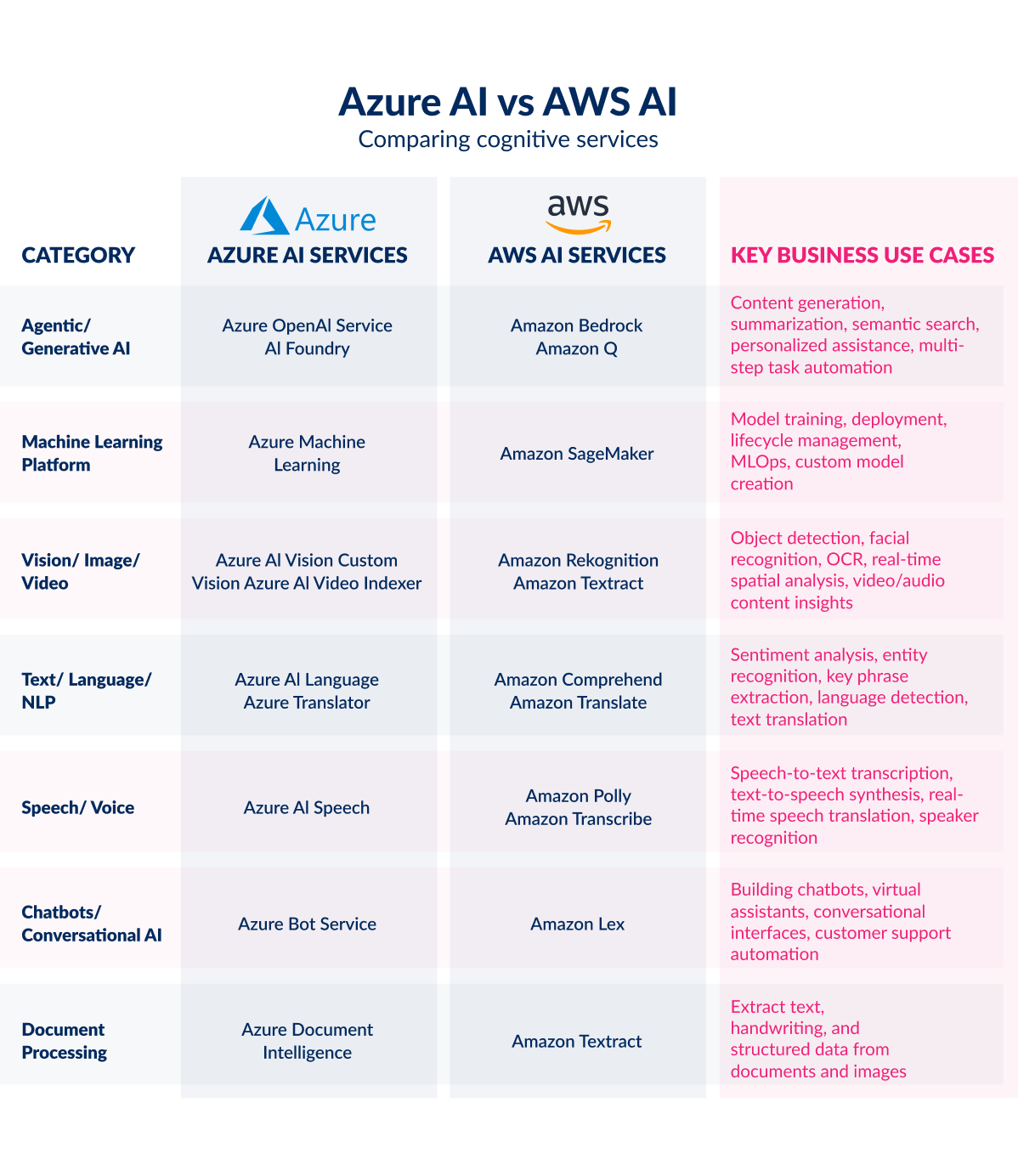
Azure AI vs AWS AI: A Short Comparison
Here is a short comparison that can help you analyze the features of Azure AI and AWS AI.
| Comparison Elements | Azure AI | AWS AI |
| Reliable for | Companies are already using Microsoft tools. | Businesses that need flexible AI development environments. |
| Adoption | Easier for companies already working with Microsoft. | Best for teams comfortable with cloud architecture. |
| Pre-built AI services | Offers a strong suite for speech and decision intelligence. | Broad range of AI APIs for vision and document processing. |
| Mobile app development fit | Useful when AI needs to connect with enterprise workflows. | Often better for AI-powered app experiences. |
| Ideal Business type | Enterprise or large organizations. | Digital product companies and technically mature teams. |
Which AI Platform Should You Pick?
We have already covered the major grounds in this guide. So, it’s important to note that the right platform for your business completely depends on multiple factors, including your industry and needs. You can also hire professionals to be strong with your needs and ideologies.
When to Prefer Azure AI?
You can go for Azure AI if,
- Your business relies heavily on the Microsoft ecosystem.
- You prefer enterprise-level compliance and security.
- You demand an interactive and user-friendly platform.
- You want access to OpenAI models.
When to Prefer AWS AI?
You can pick AWS AI if,
- Your infrastructure is AWS-native.
- Your company values flexibility.
- Your team has deep technical expertise.
- You desire to scale fast.
How to Pick the Right Cloud AI Platform?
After going through the detailed aspects of Azure AI and AWS AI, you might be well aware of their tools, flexibility, and eminent use cases. So, now you need to think about which platform can help your business build user AI faster with no errors and risks. Here, you can go through some detailed steps that can assist you in picking the right cloud platform to gain a competitive edge.
Start with Actual Use Cases
One of the major mistakes businesses make is picking a cloud AI platform based on popularity instead of use-case alignment. So, before you hire developers or any platform, define what you are actually building. If your AI roadmap is centered on internal operations, Azure AI can be reliable. If you are more into product-led approaches, go for AWS AI.
Assess Your Existing Technology Usage
If your team is good at handling Microsoft tools and Azure services, preferring Azure AI can help you with seamless implementation. This is very important to understand because AI systems don’t work alone. They need to understand your data sources and assess your internal flows and security relevance for more detailed operations. The more naturally your AI platform fits into the environments, the easier the implementation can become.
Think About Your Future Projects
Many businesses start with one AI initiative and quickly realize it opens the door to many aspects. Your company might begin with a chatbot and might later expand to AI search and task automation. So, hire professionals and consider their assistance to pick a platform that not only supports your current use case but also your future roadmap.
Verify Security and Governance
It is easy to get excited about AI features and overlook the essential side of implementation. So, before choosing a platform, make sure to verify the cost to hire AI developers. You also need to think about how your user access will be managed for the best results. Companies need to be alert about their data protection to prevent themselves from any breaches. This consideration is critical for businesses in finance & healthcare.
Challenges You Might Face with Such Platform Adoptions
While both these platforms can be effective, their adoptions might not always be result-driven.
- One of the significant challenges can be platform complexity, especially for companies without any clear AI strategy and technical expertise.
- Your implementation approaches can also become difficult if the existing systems and workflows are not data-driven.
- Cost management can be another issue as AI deployment often includes infrastructure and optimization expenses.
- In addition to this, businesses must address governance and compliance from the very beginning.
- Without the right planning of AI development experts, even the most advanced AI platform can become difficult to implement effectively.
Conclusion
Cloud-based AI development is quickly changing the business aspect and enabling you to generate scalable and high-performing applications. So, picking between these two platforms is not just about selecting the most popular platform. It is all about relying upon a system that aligns with your business objectives and long-term values.
The right decision completely depends on what you want to generate and how your teams will operate with the system without any risks. You can consider the help of experts, who can help you choose platforms strategically while thinking about your business growth.
If you are planning to build AI-powered solutions and need thorough technical direction, Xicom is here at your service. As experts in both Azure and AWS, we can help you at every step of your cloud AI development process, starting from building AI apps to managing security. Schedule your bookings now and leverage our IT expertise.

Make your ideas turn into reality
With our AI & mobile app solutions
Explore related services
Based on this article's topic