Aug 27, 2025 Artificial Intelligence
Still wondering whether you should build an AI copilot for Enterprises? Well, no matter how far we have come in terms of technology, some of the enterprises are still struggling with productivity gaps and operational inefficiencies.
According to McKinsey, employees are spending nearly 1.8 hours per day (9.3 hours per week) just searching for internal information – which is a clear loss in value and efficiency. In other terms, every fifth employee is effectively off the clock, hunting for answers instead of contributing real value to the business.
This is where enterprises are choosing to build an AI copilot. But what’s so different about it? The smart enterprise assistants are intentionally crafted to automate routine workflows. With these agents, enterprises can get real-time insights, and able to make faster decisions.
AI copilots work smoothly with systems like CRM, ERP, and HRMS. Their primary role is to eliminate repetitive tasks. They enhance cross-team synergy. They also free employees to focus on high-impact work.
Unlike generic AI assistants, enterprise AI copilots are built for specific business needs. They boost efficiency. They cut operational costs. And they adapt quickly to changing market conditions.
According to the reports, enterprises shifted to copilot results into:
- 70% of Copilot users said they are more productive.
- 68% said, copilot helped them jump-start the creative process.
- 72% said it helped them generate innovative ideas while writing.
- 22% of people said it saves more than 30 minutes a day.
- 85% of enterprises respond that copilot reduced the efforts to complete the tasks.
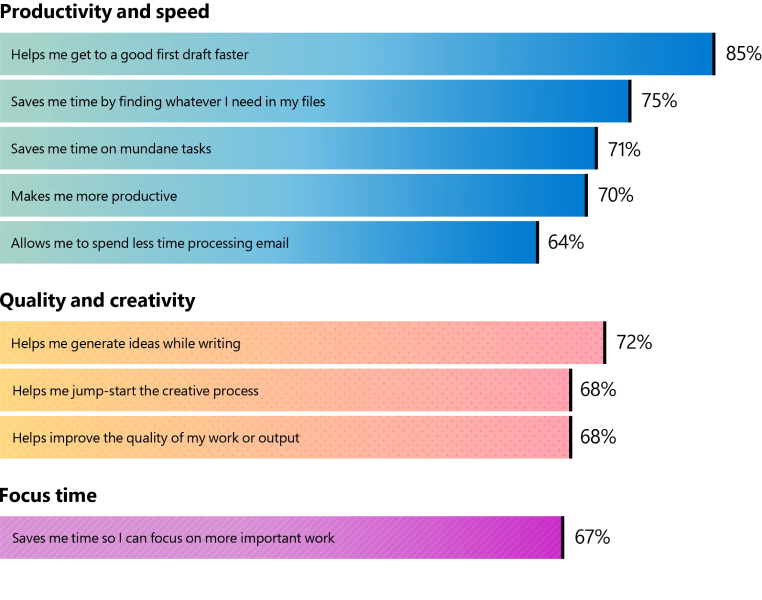
Source: microsoft
If you are also struggling with low productivity, lack of growth or decision making, then let’s understand how AI copilots help you with that. Moreover, in this blog, we are covering how to build an AI copilot for enterprises, it’s development process, features and cost.
Let’s get started…
What is an AI Copilot for Enterprises?
An AI copilot for enterprises is a smart digital assistant. It helps organizations boost efficiency. It automates processes. It also enables faster decisions.
Unlike generic tools like ChatGPT or chatbots, enterprise AI copilots are built differently. They are designed to fit business logic. They also integrate seamlessly with existing systems. These copilots work smoothly with CRM, ERP, HRMS, and project management tools.
Think of it like a co-pilot in a cockpit. A pilot relies on a co-pilot to manage tasks. The co-pilot provides support and reduces errors. In the same way, employees can depend on an AI copilot. It streamlines daily work and ensures accuracy.
Most enterprises bleed due to inefficiencies. Some lack the right resources. Others keep hiring more people just to get a clear view of their business. Both approaches drain budgets and slow down growth. Traditional workflows make it worse. Employees waste hours switching between tools. They spend time searching for information. They repeat manual tasks again and again. By integrating systems with tools like enterprise search, enterprises can further reduce information silos and ensure teams get instant access to relevant data. This situation ultimately leads to:
- Lost productivity – valuable time wasted on low-value work.
- Delayed decisions – teams can’t act fast due to scattered data.
- Employee frustration – burnout from repetitive, uninspiring tasks.
- Rising costs – inefficiency translates into direct financial loss.
An AI copilot for enterprises directly addresses these pain points. It is not a generic chatbot, it’s a context-aware, role-based AI assistant that works within your existing ecosystem.
Here’s what it brings to the table:
- Automates the complex tasks like report generation, routine scheduling, data entry.
- Guides better decisions by providing real-time insights from enterprise data.
- Understands your workflows and automates processes and adapts to industry-specific language.
- Works across tools and integrates seamlessly with enterprise applications.
- Keeps data safe as AI agents built with compliance and security in mind.
Instead of replacing employees, an AI-powered enterprise assistant empowers them. Sales teams close deals faster. HR resolves queries instantly. Managers make confident decisions with real-time insights.
In short, an AI copilot turns scattered, slow operations into a streamlined, high-performance enterprise engine.
Read More: AI Business Ideas to explore how enterprises are already using AI to stay competitive.
How Do AI Copilots for Enterprises Work in Competitive Era?
No doubt, enterprises are constantly operating under high-pressure environments. Teams are juggling with multiple tools, managing vast data, and face mounting expectations for faster delivery. But ultimately fail to match the evolving needs of the users with conventional systems.
Many organizations still hesitate to modernize their legacy systems and are afraid of adopting next-gen technologies. The result?
- High operational costs due to repetitive manual work which eats up long hours to complete tasks.
- Information silos as teams lack access to unified, real-time insights.
- Slow decision-making because leaders can’t act quickly with fragmented or complex data.
- Employees feel dissatisfied when they are overburdened with routine, low-value tasks.
These challenges block scalability. They reduce competitiveness. They directly hurt the bottom line.An AI copilot for enterprises removes these barriers. It embeds intelligence into daily workflows. It shifts the focus from manual effort to value-driven execution.
Ready to supercharge productivity?
Build an AI Copilot for your enterprise with Xicom and streamline operations like never before.
How AI Copilots can Help Enterprises Win the Situation:
- Uplift Productivity by 10X by automating routine tasks, freeing employees to focus on strategic work.
- Save Costs by up to 60% as it reduces dependency on manual processes and minimizes errors.
- Ensuring Faster Decision-Making by providing instant, data-backed recommendations across departments.
- Enhance Customer Experience: Powers personalized interactions and faster query resolution.
- Ensure Strict Compliance by monitoring sensitive data and flags risks in real time.
- Offering Scalable Operations as it integrates with enterprise systems, ensuring smooth expansion without bottlenecks.
For example, a customer support team equipped with an AI-powered enterprise assistant can reduce ticket resolution time by 30–40%. The AI copilot especially developed to handle customer support can automatically reply to bulk of queries dynamically. With this, enterprises can quickly lift up customer satisfaction while minimizing the cost of recruiting support teams. In the same way, sales teams can leverage AI copilots to address customer needs and be able to close deals faster without any fuss.
In a nutshell, making a decision to build an enterprise AI copilot is no longer an optional thing. In fact, enterprises who are aiming to stay agile, competitive and cost-efficient are actively investing into these copilots.
Let’s discover how AI Trends are shaping the future of enterprise automation.
Essential Features to Create a Successful AI Copilot for Enterprises
So finally you made a decision to create a copilot agent for your enterprise. However, when enterprises think about copilots, the goal isn’t just automation, it’s solving real bottlenecks that slow business down. To make out the most from these agents, make sure an AI-powered enterprise assistant must come equipped with features that address everyday pain points.
1. Integrate Natural Language Understanding (NLU): Employees waste time learning new tools or navigating complex dashboards. This is where copilot lets staff use simple, everyday commands. No training is required.
2. Automating Workflows: YWith a manual process, the team wastes hours on repetitive tasks like reporting, scheduling, and data entry. An AI copilot automates these tasks and frees resources for strategic work. The best part is, instead of randomly automating the processes, these copilots are trained with pre-defined rules and fine-tune it in a way to understand the intent of the workflow to generate accurate results.
3. Seamless Integration with Enterprise Systems: Enterprise data is scattered across CRM, ERP, HRMS, and legacy apps. However, AI copilot for enterprises are designed in a way to easily connect with all enterprise tools, reducing data management complexity and providing unified visibility.
4. Data Analytics & Insights : Leaders often struggle with slow, fragmented decision-making. To provide real insights of your business, copilots constantly monitor the data and make accurate forecasts. Depending upon the data, it provides recommendations and enables you to make informed decisions.
5. Personalization & Context Awareness: Rather than general AI assistants that fail to engage users, AI copilots for enterprises are adapted to specific roles or industries. AI Copilot for enterprises are delivering customized responses and suggestions based on roles, departments, or business needs.
6. Collaboration Support: Meetings and communication eat up significant time. Meetings and communication eat up significant time. With seamless integration of Copilot into your workflow can save huge efforts in drafting summaries and track action items.
7. Security & Compliance: Enterprises are strongly evolved around the data. Having holes in your data storing system can cause a serious blunder. This is where AI Copilot ensures enterprise-grade security and encrypts data.
By adopting the advanced security features of AI Copilot, enterprises can easily transform their operations into scalable, intelligent, and cost-efficient ecosystems.
Read More: AI App Development Cost to understand budget planning for AI-powered solutions.
Step-by-Step Process to Build an AI Copilot for Enterprises
So how to build an AI Copilot for enterprises? Crafting an enterprise AI copilot isn’t just about deploying a chatbot. It’s about creating purposefully AI agents that are secure, scalable and intelligent enough to understand the intent of the task. Moreover, it must align with the business goals and workflows.
So if you are looking to get started with the AI copilot, look forward to hiring an AI development company that follows the simple process of building AI copilots for enterprise.
1. Define Business Objectives & Use Cases
Many enterprises rush to start a project without a clear goal. But before you build enterprise AI copilot it is important to identify specific pain points. Identify your priority. Whether you want to increase sales, improving customer service or removing HR bottlenecks. Set measurable targets. For example, automate 40% of reports. Or reduce ticket resolution time by 30%.
2. Collect and Prepare Data For Copilots
Enterprise data is often scattered, unstructured, and siloed. This is where AI development company gather data from CRM, ERP, HRMS, and external sources. They clean, label, and prepare datasets so the AI copilot can understand and respond accurately.
3. Choose the Right AI Model
Instead deploying the standard copilot, we customize AI agents that aligns with your requirements. It includes LLMs, NLP models, or custom machine learning frameworks. For example, LLM Development Services ensure your copilot understands enterprise language at scale.
4. Copilot Architecture & Design
Each AI assistant is built with a user-friendly and modular design. We ensure frictionless navigation and use APIs that support seamless integration into existing enterprise tools.
5. Integration with Enterprise Systems
Usually data complexities block real-time insights. We ensure the copilot connects with ERP, CRM, HRMS, and project management software. This creates a unified, intelligent enterprise ecosystem.
6. Feature Development
As we are developing AI copilots for enterprises, therefore each feature is aligned with business-critical needs. We add features like automation, role-based personalization, predictive analytics, and compliance monitoring to match enterprise workflows.
7. Testing & Validation
Before final deployment, we conduct deep testing in different scenarios. We test the copilots for accuracy, scalability, and compliance. Validate data privacy across industry standards like GDPR, HIPAA, or SOC 2.
8. Deployment & Scaling
After deep testing of AI copilot, we deploy it on cloud or hybrid infrastructure. As teams started using the AI copilots, we started gathering the data and evolving with time.
9. Continuous Monitoring & Improvement
AI copilots become outdated if not retrained. So we up a feedback loop, constantly monitoring its performance, retrain models, and roll out upgrades to keep the copilot relevant with modern needs.
Also, if you are ready to deploy the AI copilot but not sure about budget, then here is a cost to hire AI developers guide to understand the expertise required for enterprise AI projects and their average cost.
How Much Does It Cost to Build an AI Copilot for Enterprises?
When enterprises plan to build an AI copilot, the first question is always: “How much will it cost?” The answer depends on multiple factors, technology choices, scope of features, and level of integration. Building a basic copilot might be affordable, but scaling it for enterprise-grade performance requires careful investment.
But the ultimate question is “what drives the AI copilot development cost for enterprises?”
Key Cost Drivers in Enterprise AI Copilot Development
| Cost Driver | Business Challenge | Action to Optimize |
| Scope of Features | Adding too many features upfront increases costs. | Start with an MVP (automation, reporting, NLU) and scale gradually. |
| AI Models & Tech Stack | Off-the-shelf models may lack enterprise accuracy. | Invest in custom LLM / ML development services for better performance. |
| Integration with Systems | Legacy ERP/CRM integration causes hidden costs. | Plan for APIs, middleware, and secure connectors early. |
| Data Preparation & Security | Cleaning and securing enterprise data is resource-heavy. | Allocate budget for GDPR, HIPAA, SOC 2 compliance. |
| Team Expertise | Inexperienced teams cause overruns and rework. | Hire an AI development company or expert AI developers. |
| Maintenance & Scaling | Post-launch upkeep is often underestimated. | Budget 15–20% annually for retraining, monitoring, and cloud costs. |
Estimated Development Cost to Create AI Copilot for Enterprises
To get started with an AI copilot, enterprises are still hesitating because of overspending. So here’s an estimated cost to develop an AI copilot to help you decide what level of copilot your enterprise needed and how to set a budget.
- To build a MVP AI Copilot, you need to invest nearly $50,000 – $100,000 which covers all must-have features like automation, insights, and basic integrations.
- In case, you are looking to create a Full-Scale Enterprise AI Copilot, then make sure you are planning a budget of $150,000 – $500,000+. It can cover advanced features, cross-tool integration, compliance, and enterprise-grade security.
- To make your copilots run effectively, you need to include Maintenance and Ongoing Costs which takes up to 15–20% of the entire development cost annually for updates, retraining, and infrastructure.
So how can you smartly budget the AI Copilot development? Usually, enterprises rush to launch a Copilot and ignore planning the budget at the initial stage. This ultimately makes them end up with blunder or half-baked copilots that fail adoption. It is recommended to follow a well-structured approach to ensure long-term ROI and scalability.
Want to reduce costs and boost efficiency?
Let Xicom help you design a custom AI Copilot tailored to your business needs.
Real-World Use Cases of AI Copilot in Enterprises
In this modern era, AI copilots have started delivering tangible results to enterprises in various industries. By embedding intelligence into everyday workflows, they address bottlenecks that slow enterprises down and create opportunities for faster growth.
1. Customer Support
Many businesses deal with extended ticket resolution times and the need to manage support teams. An AI copilot improves the process by dynamically automating routine responses, prioritizing urgent instances, and recommending solutions in real time.

Source: masterofcode
This not only reduces the workload on agents but also accelerates resolution speed by 30–40%, directly boosting customer satisfaction. Companies in eCommerce and retail approached to Generative AI development company are already seeing measurable improvements, as highlighted in our guide on AI in Ecommerce.
2. Sales & Marketing
Sales teams lose long hours searching for client data and creating proposals. However, AI-enabled copilots are proving to be a game changer. It provides fast access to client knowledge, predicts purchasing habits, and generates personalised pitches at scale.
Using AI copilot for company operations leads to faster deal closes and improved conversion rates. Many businesses using AI in this field are aligned with larger AI trends that are altering modern sales methods.
3. Human Resources (HR)
HR processes take a substantial amount of time, from reviewing resumes to dealing with repetitive employee queries. A business AI copilot can automate applicant shortlisting, help with onboarding, and answer to HR-related inquiries promptly.
This improves efficiency while giving HR professionals more time to focus on talent engagement. The benefits mirror the advancements seen in AI in Education, where automation is transforming onboarding and training processes.
4. Finance & Operations
Manual financial forecasting and compliance checks are quite risky. An AI copilot helps CFOs and finance teams with automated compliance monitoring. It sends fraud detection alerts. It also delivers real-time budget analysis.
This not only ensures accuracy but also improves agility in planning. Many of these benefits are already visible in sectors adopting AI in Banking and fintech innovation.
5. IT & Product Development
IT teams are frequently bogged down with debugging, monitoring, and incident response. An AI copilot improves productivity by recognizing anomalies early on, providing solutions, and automating monotonous chores.
This lowers downtime and accelerates product development cycles. With organizations progressively adopting current frameworks, copilots built on top AI programming languages are becoming essential innovation facilitators.
How Xicom Can Help You Build an AI Copilot for Your Enterprise
Building an AI copilot for enterprises goes beyond technology. To ensure that your copilot responds accurately, it is important that you hire a tech partner that understands your business challenges and expectations. As a trusted AI development company, Xicom helps organizations design copilots that not just automate workflows, but also enhance decision-making, and transform operations.
1. Offering Certified Experts in AI Technologies
We are backed by a certified team of AI developers who go above and beyond your expectations to drive product excellence. Our team brings deep knowledge in Generative AI, Machine Learning development services, NLP Development Services, and LLM Development Services.
Whether you want a conversational copilot, a predictive analytics tool, or a domain-specific assistant, we deliver tailored solutions. These capabilities are already unlocking new opportunities, as shown in AI in Supply Chain & Logistics, where predictive copilots optimize demand forecasting with perfection.
2. Delivering Solutions That Aligns Your Goals
Every enterprise is struggling with unique hurdles. Whether it’s complex data, unstructured workflows, or compliance needs, Xicom builds enterprise AI solutions that work smoothly with ERP, CRM, HRMS, and custom apps. This makes your copilot more than a tool, it becomes a vital part of your business.
3. Cost-Optimized Development Approach
When it comes to developing an AI Copilot, enterprises are often afraid of managing AI copilot development costs. At Xicom, we create staged roadmaps that enable firms to start lean with an MVP and then scale smartly.
With flexible models, you can hire AI developers, extend teams with backend specialists, or engage a full-stack app development company – keeping investments predictable and ROI-driven.
4. Providing End-to-End Development Support
From ideation to deployment and ongoing optimization, Xicom offers complete support throughout the AI development process for enterprises.
Our teams continuously retrain and fine-tune copilots as business needs evolve to ensure lasting impact. This approach mirrors how AI in Manufacturing has advanced from basic automation to predictive, adaptive intelligence.
Partnering with Xicom means building more than an AI copilot – you’re creating a strategic enterprise assistant that drives growth.
Conclusion
Enterprises operating under the pressure of serving customers at lightning-fast speed and answering their queries perfectly should adopt an AI copilot. An AI copilot is no longer a futuristic idea – it’s a practical next-gen solution that has already been driving measurable ROI across industries. From automating workflows to enabling the handling of bulk queries within seconds, copilots are quickly becoming an integral part of modern enterprise operations.
However, the ultimate success depends upon hiring an AI development company, one who understands both AI technologies and enterprise complexities. At Xicom, we combine our expertise in Generative AI development, Machine Learning, NLP, and LLM services with a proven enterprise-first approach.
Our simple goal is to help you build an AI-powered assistant that accelerates your business transformation. If you are ready for the digital transformation, then contact us now.

Make your ideas turn into reality
With our AI & mobile app solutions
Explore related services
Based on this article's topic