How Much Does It Cost to Develop an AI App? Full Breakdown, Factors & Estimations
AI app development cost ranges from $30,000 to $300,000+. See costs by complexity and use case, running costs, timelines, and tips to cut your budget.
Nov 5, 2026 App Development
The biggest mobile app development trends for 2027 are on-device AI, apps that AI agents can operate, generative AI features, password less sign-in with passkeys, and adaptive layouts for foldables. Cross-platform frameworks, new payment rails, and wearables round out the list.
The common thread is a shift in how people reach an app. More users will ask an assistant to do a task than will tap through screens to do it themselves. Apps that expose their features to those assistants, and run AI locally for speed and privacy, will be the ones that get used.
Below are latest mobile app trends that matter for product owners planning a 2027 roadmap, with current data for each and what it means for your build.
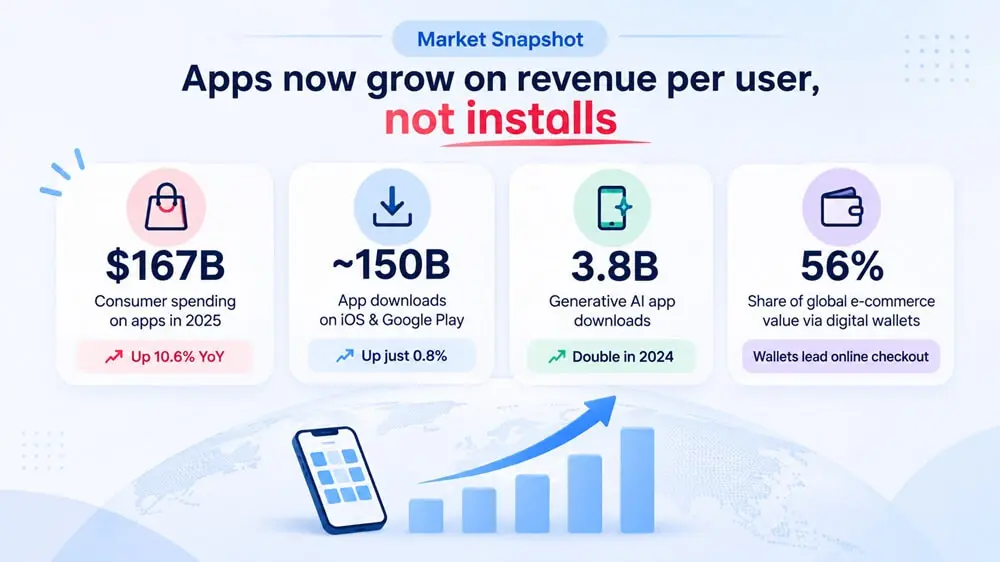
The app market has stopped growing on installs and started growing on revenue per user. Downloads were nearly flat in 2025, while consumer spending rose about 10%, and generative AI apps drove much of that gain.
| Metric | Latest figure |
|---|---|
| Consumer spending on apps (in-app purchases + subscriptions), 2025 | $167 billion, up 10.6% YoY |
| Non-game app spending vs games, 2025 | Non-game apps passed games for the first time |
| App downloads (iOS + Google Play), 2025 | Nearly 150 billion, up 0.8% YoY |
| Generative AI app downloads, 2025 | 3.8 billion, double 2024 |
| India app downloads, 2025 | 25.5 billion, the largest of any country |
| Unique mobile subscribers, 2026 | About 5.8 billion, roughly 70% of the world |
| GenAI-capable share of smartphone shipments | 45% in 2026, forecast 52% in 2027 |
| Digital wallet share of global e-commerce value, 2025 | 56% |
For product owners, the takeaway is simple. Winning in 2027 means more value from each user, through AI features, smoother payments and better retention, rather than chasing raw installs.
Also Read: Top AI Trends
These mobile app development trends are grouped from the most urgent (AI) to platform, payment and compliance shifts that will shape budgets next year.
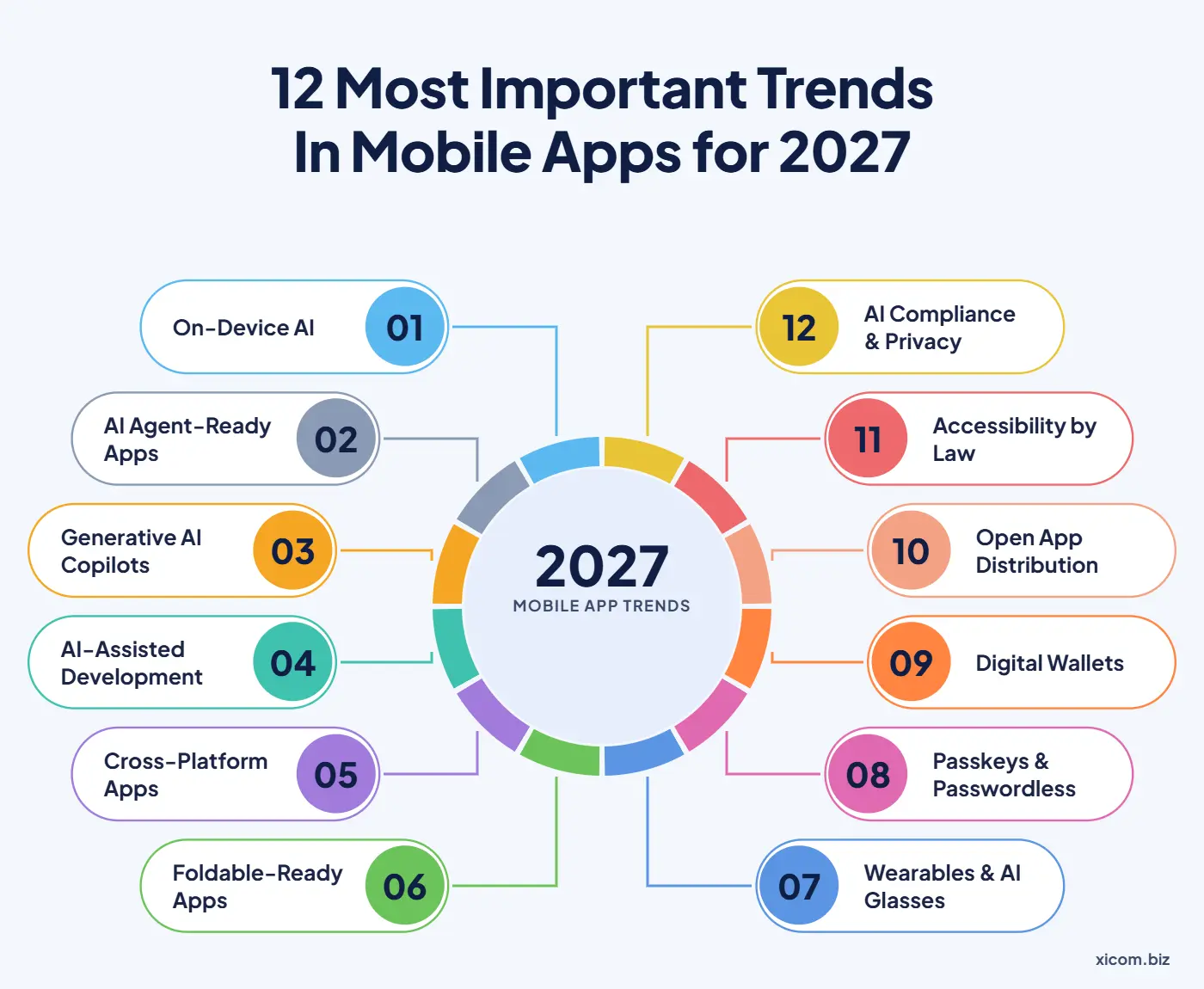
AI is moving from the cloud onto the phone itself. Counterpoint Research expects GenAI-capable phones to make up 45% of smartphone shipments in 2026 and 52% in 2027, which means most new phones sold next year can run AI models locally.
Platform owners are opening this hardware to developers. At WWDC 2026, Apple expanded its Foundation Models framework and added a Core AI framework for running custom models on Apple devices (MacRumors). On Android, Gemini Nano plays the same role.
What it means for your app: Features like summarization, smart replies, image tagging and offline search can run with no server cost, lower latency and no user data leaving the device. Plan a hybrid setup: small tasks on-device, heavier reasoning in the cloud.
The next interface for many apps is an assistant, not a screen. Google’s AppFunctions lets Android apps expose features such as “create task” or “send message” as tools that agents like Gemini can call. Google describes it as the mobile equivalent of tools in the Model Context Protocol (MCP). It runs on Android 16 and above, with Gemini integration in private preview as of May 2026.
Apple is moving the same way. Its WWDC 2026 updates tie App Intents more closely to the new Siri, so apps can be invoked by voice and by cross-app requests.
What it means for your app: If an agent cannot see what your app does, users who work through assistants will skip it. List your highest-value actions, expose them through App Intents and AppFunctions, and test how reliably an assistant completes them. Teams building this often pair it with AI agent development work on the backend.
Users now expect AI help inside the apps they already use. Generative AI apps reached 3.8 billion downloads in 2025, double the year before, according to Sensor Tower data. That demand is spreading to banking, retail, travel and productivity apps as built-in assistants.
Apple’s Foundation Models framework now also routes requests to server models, including Claude and Gemini, so developers can mix on-device and cloud AI through one API (MacRumors).
What it means for your app: Start with one narrow copilot that removes a real task, such as drafting a support reply or building a shopping list from a photo. Measure task completion, not just usage. Xicom’s AI app development services cover this kind of feature work for existing apps.
AI is also changing how apps get built. Xcode 27 added agentic coding tools at WWDC 2026, and Android Studio ships Gemini-based assistance. Coding agents now write tests, refactor screens and fix build errors.
What it means for your app: Faster delivery is real, but so is the risk of unreviewed code reaching production. Keep human code review, automated tests and security scanning in the pipeline. Budget the time saved toward QA and performance work rather than cutting it.
Cross-platform is now the default for most business apps. Flutter and React Native’s New Architecture have closed much of the performance gap with native code. Kotlin Multiplatform (KMP) is the fastest riser: JetBrains reports that KMP’s share among cross-platform developers more than doubled in a year, and its presence among the top 10,000 App Store apps nearly tripled between early 2024 and mid-2026.
What it means for your app: Choose by team and product, not hype. Flutter suits a single branded UI, React Native suits JavaScript teams, and KMP suits teams that want shared business logic with fully native screens.
Foldables just got their biggest boost. Apple unveiled its first foldable iPhone at its September 9, 2026 event (Fox Business). Counterpoint Research expects cumulative foldable shipments to pass 100 million by the end of 2026 and annual shipments to grow another 37% in 2027.
What it means for your app: iPad-like layouts on phones are now an iOS problem too, not just Android. Build adaptive layouts that respond to window size, keep state when the device folds or unfolds, and support side-by-side multitasking.
The phone is no longer the only screen. Counterpoint Research reports global smart glasses shipments grew 212% year over year in the first half of 2026, with Meta holding about 84% of the market. Most of these glasses have no display and rely on voice, audio and the camera.
What it means for your app: Design short, voice-first interactions that work on a watch, earbuds or glasses, then hand off to the phone for anything complex. Notifications, quick actions and hands-free capture are the best starting points.
Passwordless sign-in has gone mainstream. The FIDO Alliance estimated in May 2026 that 5 billion passkeys are in use worldwide. Its State of Passkeys 2026 survey found 75% of consumers have enabled a passkey on at least one account.
What it means for your app: Passkeys cut sign-in friction and remove the biggest phishing risk at once. Add passkey sign-up and sign-in through Apple’s and Google’s credential APIs, keep a recovery path, and prompt existing users to upgrade after a successful login.
Wallets are now the leading way people pay online. Digital wallets made up 56% of global e-commerce value and 33% of in-store value in 2025, per Worldpay’s Global Payments Report 2026. In India, UPI processed 25.47 billion transactions worth ₹31.53 lakh crore in October 2026 alone (NPCI data via Free Press Journal).
What it means for your app: Treat Apple Pay, Google Pay and local rails such as UPI as standard checkout options, not extras. Fewer checkout steps directly lift conversion, especially on mobile.
App store rules are loosening. A 2025 US court ruling in Epic v. Apple required Apple to allow links to outside payment options, and the EU’s Digital Markets Act requires Apple to allow alternative app stores and payment methods in Europe. Fee terms are still being contested in court and by regulators, so they differ by region and keep changing.
What it means for your app: Subscription and content apps can test web checkout links to lower store fees. Build payment logic so it can switch by region, and review the current rules in each market before launch.
Inclusive design is now mandatory in some markets. The European Accessibility Act has applied since June 28, 2025, and it covers e-commerce, banking, transport and other consumer apps sold in the EU. Non-EU companies serving EU customers are in scope too.
What it means for your app: Build screen-reader support, dynamic text sizes, sufficient contrast and keyboard and switch access from the first sprint. Retrofitting accessibility later costs far more than designing for it.
As apps add AI, regulators are adding rules. Under the EU AI Act, as amended by the 2026 Digital Omnibus, labelling rules for AI-generated content apply from December 2, 2026. High-risk obligations for standalone systems, such as credit scoring and hiring tools, apply from December 2, 2027.
What it means for your app: Map which AI features touch personal data or high-risk decisions, document how models are tested, and keep human review where outcomes affect people. On-device processing (Trend 1) also helps by keeping sensitive data on the phone. Xicom’s AI governance consulting team helps product teams set this up before launch.
No app needs all development trends at once. Start with the two or three that match your users and revenue model, then plan the rest into your roadmap.
| App type | Start with | Plan next |
|---|---|---|
| Ecommerce and retail | Digital wallets, generative AI copilots, accessibility | Agent-ready actions, passkeys |
| Banking and fintech | Passkeys, AI compliance, accessibility | On-device AI, real-time payments |
| Healthcare | Privacy and AI compliance, on-device AI | Wearables, voice-first agents |
| Productivity and SaaS | Agent-ready actions, generative AI copilots | Foldables and large screens |
| Media and subscriptions | Open distribution and payment links, personalization through on-device AI | Foldables, wearables |
| Startups building an MVP | Cross-platform build, AI-assisted development | Generative AI copilot |
A simple filter helps: favor trends that cut user effort in your core flow, and defer anything that only adds novelty.
Also Read: Generative AI Trends
Xicom is an AI-first mobile app development company with 20+ years of delivery experience, 1,800+ projects and 750+ clients across 50+ countries. Our 350+ engineers build native iOS and Android apps as well as cross-platform apps in Flutter and React Native.
For 2027 roadmaps, we typically help in three ways:
The mobile app development trends for 2027 point in one direction: apps that do more for the user with less effort. On-device AI, agent-ready actions and in-app copilots change how people reach your features. Passkeys, wallets and adaptive layouts remove friction once they arrive. Accessibility and AI rules set the guardrails.
The top mobile app development trends in 2027 are on-device AI, apps built for AI agents, generative AI copilots, AI-assisted development, mature cross-platform frameworks and foldable-ready layouts. Wearables, passkeys, digital wallets, open app distribution, accessibility rules and AI compliance complete the list.
An agent-ready app exposes its key actions, such as booking, searching or creating an item, so AI assistants can call them directly. On Android this is done with AppFunctions, and on iOS with App Intents. Users can then complete tasks by asking an assistant instead of tapping through screens.
Cross-platform suits most business apps, because Flutter, React Native and Kotlin Multiplatform now come close to native performance at lower cost. Choose native when your app depends heavily on device hardware, advanced graphics or the newest platform features on day one.
Cost depends on the feature, the data involved and whether the model runs on-device or in the cloud. A single on-device feature costs far less than a custom model with backend infrastructure. See our guide to AI app development cost for typical ranges.
Yes, if your users skew toward premium devices. With Apple entering the category alongside Samsung, Google and Huawei, adaptive layouts that handle folding, unfolding and multitasking are becoming a baseline expectation.
Xicom audits existing apps against current trends, builds new features such as on-device AI, passkeys and wallet checkout, and provides dedicated mobile developers. With 1,800+ projects delivered, the team can take a feature from plan to production.

Based on this article's topic
AI app development cost ranges from $30,000 to $300,000+. See costs by complexity and use case, running costs, timelines, and tips to cut your budget.

Hotel booking app development cost runs $21,000 to $200,000+ offshore. See costs by app type and phase, PMS integration, running costs and OTA savings.
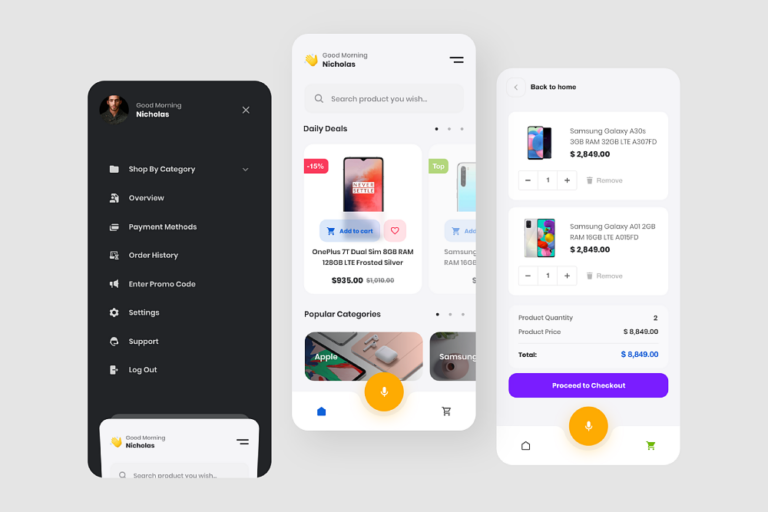
Marketplace app development cost ranges from $40,000 to $300,000+. See costs by tier and feature, AI add-ons, payment fees, and how to build an app like Amazon.