17 Healthcare Business Ideas for 2027: AI, Startup and Small Business Ideas
Nov 11, 2026 App Development
Nov 11, 2026 App Development
Nov 11, 2026 App Development
The most promising healthcare business ideas for 2027 sit where rising demand meets new rules and new technology: AI tools that cut paperwork for clinicians, remote patient monitoring, virtual mental health care, senior care at home and the software that connects it all. Most of these ideas can start as one focused app or service and grow from there.
The timing is strong. CMS projects US health spending to grow an average of 5.8% a year and reach $8.6 trillion by 2033 (Becker’s, citing CMS). In a March 2026 survey, 81% of physicians said they use AI at work. And January 1, 2027 is the date many health plans must start offering new prior authorization and data-sharing APIs under a CMS interoperability rule, which opens room for new software businesses.
Our team builds healthcare, telemedicine and AI applications, and this guide reflects the questions founders and providers bring to us most often: which ideas have real demand, what each one takes to launch, and where regulation shapes the product. Every statistic below links to its original source, so you can check it before you build a plan around it.
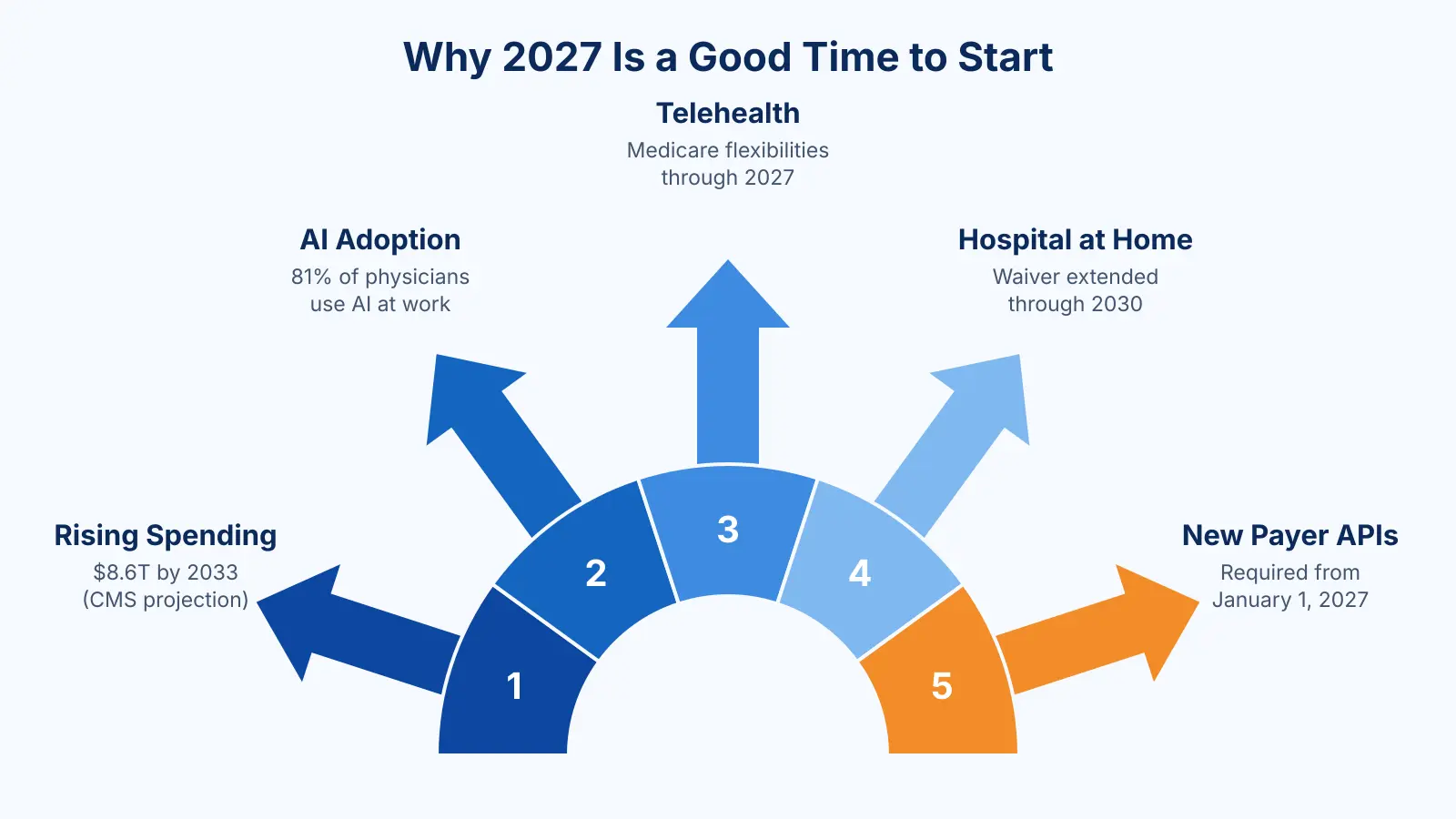
2027 is a good time to start a healthcare business because spending keeps growing, clinicians are short on time, AI adoption has gone mainstream, and several US policy changes now favor virtual and home-based care. Here is what the latest data shows.
Have a healthcare business idea you want to test? Talk to our team about scope, compliance and the fastest way to get a working version in front of real users.
Before you commit to any business idea in the healthcare industry, check four things: the problem, the payer, the regulations and the systems you must connect to. Ideas that skip these checks often stall after the first pilot.
Talk to clinicians, front-desk staff or patients before you build. The best healthcare startup ideas remove a task people already do every day, such as writing visit notes, chasing insurance approvals or reminding patients to take readings.
In healthcare, the user is often not the buyer. A patient app may be paid for by an employer, a health plan or a clinic. Decide early whether you will charge patients directly, sell to providers, bill insurers through existing codes or sell to employers.
Any product that handles patient health information in the US must meet HIPAA requirements. Software that diagnoses or treats a condition may fall under FDA oversight, and clinical services need state licensing. Our guide to HIPAA-compliant app development covers the technical side.
Providers will not adopt a tool that lives outside their electronic health record (EHR). Budget time for EHR integration and the FHIR data standard, which the CMS rule above relies on for its new APIs.
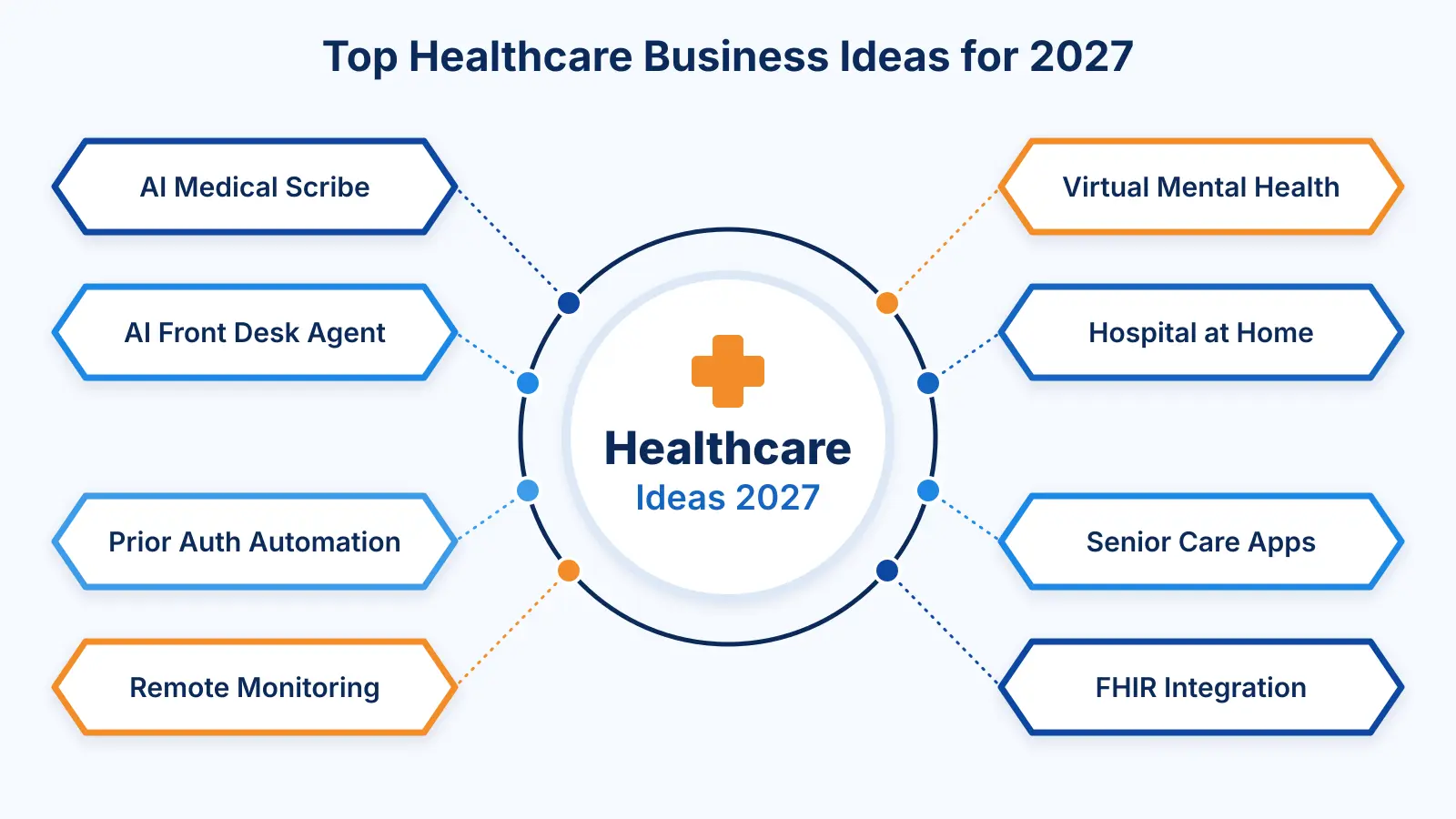
These health tech startup ideas are grouped from the most AI-driven to the more traditional. The table gives a quick overview, and each idea is explained below.
| Healthcare business idea | Main customer | Why it fits 2027 |
|---|---|---|
| AI medical scribe for small practices | Clinics, specialists | Documentation is a top AI use among physicians |
| AI front desk and patient intake agent | Clinics, dental offices | Staff shortages and missed calls cost revenue |
| Prior authorization and billing automation | Providers, billing companies | New payer APIs from January 1, 2027 |
| Remote patient monitoring for chronic care | Primary care, cardiology | New 2026 Medicare RPM codes |
| Virtual mental health care | Patients, employers | Telehealth flexibilities through 2027 |
| Hospital-at-home technology | Health systems | Waiver extended through 2030 |
| Senior care and aging-in-place apps | Families, home care agencies | Growing older population |
| Weight and metabolic health programs | Patients, employers | High demand for long-term support |
| Women’s health platform | Patients, employers | Underserved needs such as menopause care |
| Digital physical therapy | Employers, health plans | Proven virtual care model |
| Wearable health data platform | Providers, patients | More connected devices in daily use |
| FHIR integration services | Payers, providers, startups | 2027 interoperability deadlines |
| AI patient navigation and triage | Health systems, payers | Patients need help finding the right care |
| Wellness practitioner marketplace | Consumers, practitioners | Demand for on-demand wellness support |
| Medical supplies e-commerce | Clinics, consumers | More care delivered at home |
| Non-emergency medical transportation | Patients, providers | Missed appointments cost clinics money |
| Health data analytics for insurers | Insurers | Pressure to manage risk and fraud |
An AI medical scribe listens to a patient visit, with consent, and drafts the clinical note for the doctor to review and sign. In the AMA’s 2026 survey, writing notes and documenting charts were among the most common ways physicians already use AI.
Large health systems already buy tools such as Abridge and Microsoft Dragon Copilot. The opening for a startup is narrower specialties and smaller practices, such as behavioral health, dental, physical therapy or veterinary care, where note formats differ and big vendors pay less attention. Building one well takes speech recognition, a tuned language model and secure EHR integration, which is typical AI development work.
Many clinics lose patients because nobody answers the phone. An AI front desk agent answers calls and messages, books and reschedules appointments, collects intake forms, checks insurance details and sends reminders, then hands complex cases to staff.
This is one of the more practical AI healthcare business ideas, because it does not make clinical decisions and pays for itself through fewer missed appointments. It works best when built as a voice and chat AI agent connected to the practice’s scheduling system.
Under the CMS Interoperability and Prior Authorization Final Rule, Medicare Advantage plans, Medicaid and CHIP programs and certain marketplace plans must make prior authorization decisions within 72 hours for urgent requests and 7 days for standard ones since January 1, 2026. They must also offer a Prior Authorization API, generally from January 1, 2027 (CMS).
That creates room for tools that help providers submit requests electronically, track their status and prepare supporting documents with AI. The same platform can grow into broader revenue cycle work, such as claim checks and denial management.
Remote patient monitoring (RPM) uses connected devices such as blood pressure cuffs, glucose meters and scales to send readings to a care team between visits. The new 2026 codes let practices bill for patients who send readings on as few as 2 days a month, which makes RPM viable for more patients.
A strong RPM business combines device logistics, a patient app, a clinician dashboard with alerts and billing reports. Focus on one condition first, such as hypertension or heart failure, before expanding.
Demand for therapy and psychiatry still outpaces supply in many areas, and the 2027 telehealth extension also delays in-person visit requirements for certain Medicare mental health services. Startups can focus on a specific group, such as teens, new parents, veterans or employees in high-stress jobs, rather than competing head-on with large platforms.
Products range from therapist matching and video sessions to guided self-help programs between appointments. For more angles, see our list of mental health app ideas.
Hospital-at-home programs treat eligible patients in their own homes with daily clinician visits and remote monitoring. With the waiver now extended through 2030, health systems can plan long-term programs, and they need software to run them.
Useful products include patient eligibility screening, command center dashboards, visit scheduling for nurses and paramedics, and logistics for equipment, meals and medications.
Older adults increasingly want to stay at home, and their families want to know they are safe. Apps in this space combine virtual doctor visits, medication reminders, fall alerts and a shared dashboard for family caregivers.
Design matters more here than in most apps: large text, simple navigation and voice control. If you plan a care app with video visits, our breakdown of telemedicine app development cost is a useful starting point.
Interest in weight management has grown sharply with newer obesity medications. The lasting business opportunity is not the prescription itself but the support around it: nutrition coaching, lifestyle tracking, side-effect check-ins and long-term habit programs, run alongside licensed clinicians.
Programs sold to employers and health plans tend to be more stable than direct-to-consumer subscriptions, because buyers can measure outcomes over time.
Women’s health covers fertility, pregnancy, postpartum care, menopause and conditions such as PCOS and endometriosis, many of which have long been underserved. Strong startups pick one life stage, offer access to specialists through telehealth, and add tracking and education between visits.
Back, joint and muscle pain is one of the most common reasons people miss work. Digital physical therapy apps guide patients through exercises at home, often using phone cameras or sensors to check form, with a licensed physical therapist reviewing progress.
Companies such as Hinge Health and Sword Health have shown that employers and health plans will pay for this model. Smaller startups can focus on post-surgery recovery, sports injuries or older adults.
Smartwatches, rings and continuous glucose monitors produce large amounts of health data, but most of it never reaches a clinician in a useful form. A wearable data platform collects readings from several devices, turns them into clear trends and flags what needs attention.
Because users switch between iPhone and Android, a cross-platform app is usually the most practical way to reach both from one codebase.
The CMS rule requires Patient Access, Provider Access and Payer-to-Payer APIs, generally from January 1, 2027. Many smaller health plans, clinics and digital health startups do not have the in-house skills to build and maintain FHIR integrations.
An integration service or ready-made connector product can sell to all of them. It is less visible than a consumer app, but it solves a problem buyers must address by a fixed date.
Patients often do not know whether they need urgent care, a primary care visit or self-care at home. An AI navigation tool asks structured questions, explains options and routes people to the right service, such as a nurse line, telehealth visit or in-network clinic.
Keep the product focused on navigation and education unless you are ready for clinical validation, since software that diagnoses conditions may need FDA review. A well-built AI chatbot with clinician-approved content and clear escalation rules is a sensible starting point.
A marketplace connects consumers with verified nutritionists, physiotherapists, health coaches and other wellness professionals. Users can compare profiles, book sessions and leave reviews, while practitioners get scheduling and payment tools.
Trust is the core feature, so invest in credential checks from the start. Our guide on the cost to create a self-care app covers related features.
As more care moves home, patients and small clinics need an easy way to order supplies, from wound care and mobility aids to monitoring devices. Success depends on reliable logistics, secure payments and, for some products, handling prescriptions and insurance billing correctly.
Patients with limited mobility often miss dialysis, therapy and follow-up appointments because they cannot get there. A transportation app that books accessible rides, works with clinics and handles billing for eligible patients fills a real gap and reduces costly no-shows.
Insurers hold large amounts of claims and clinical data but struggle to turn it into decisions. An analytics platform can help them predict risk, spot unusual billing patterns that may signal fraud and design better plans, with strict controls on who can see personal data.
Ready to turn your healthcare idea into a working product? Share your idea with our team and get a practical plan covering features, compliance and timeline.
The AI healthcare business ideas with the clearest demand in 2027 are the ones that take repetitive work off clinicians and staff, while leaving clinical decisions to people. From the list above, these rely most on AI:
Not every healthcare business needs a software platform. These small business ideas for healthcare can start with a small team and grow locally. Licensing rules vary by state, so check local requirements before you launch.
| Small business idea | What it involves | Key requirement |
|---|---|---|
| Medical billing and coding service | Handling claims and billing for small practices | Coding certification and HIPAA safeguards |
| Non-medical home care agency | Helping older adults with daily tasks at home | State licensing, caregiver training and insurance |
| Mobile phlebotomy service | Drawing blood samples at homes and workplaces | Certified phlebotomists and lab partnerships |
| Healthcare staffing agency | Placing nurses and allied health workers | Credential checks and facility contracts |
| Health coaching practice | Coaching on nutrition, sleep and chronic conditions | Recognized certification and clear scope limits |
| Medical courier service | Delivering lab samples, records and supplies | Handling and chain-of-custody procedures |
Many of these grow faster with a simple app for scheduling, tracking and payments, which you can build with a small team of mobile app developers.
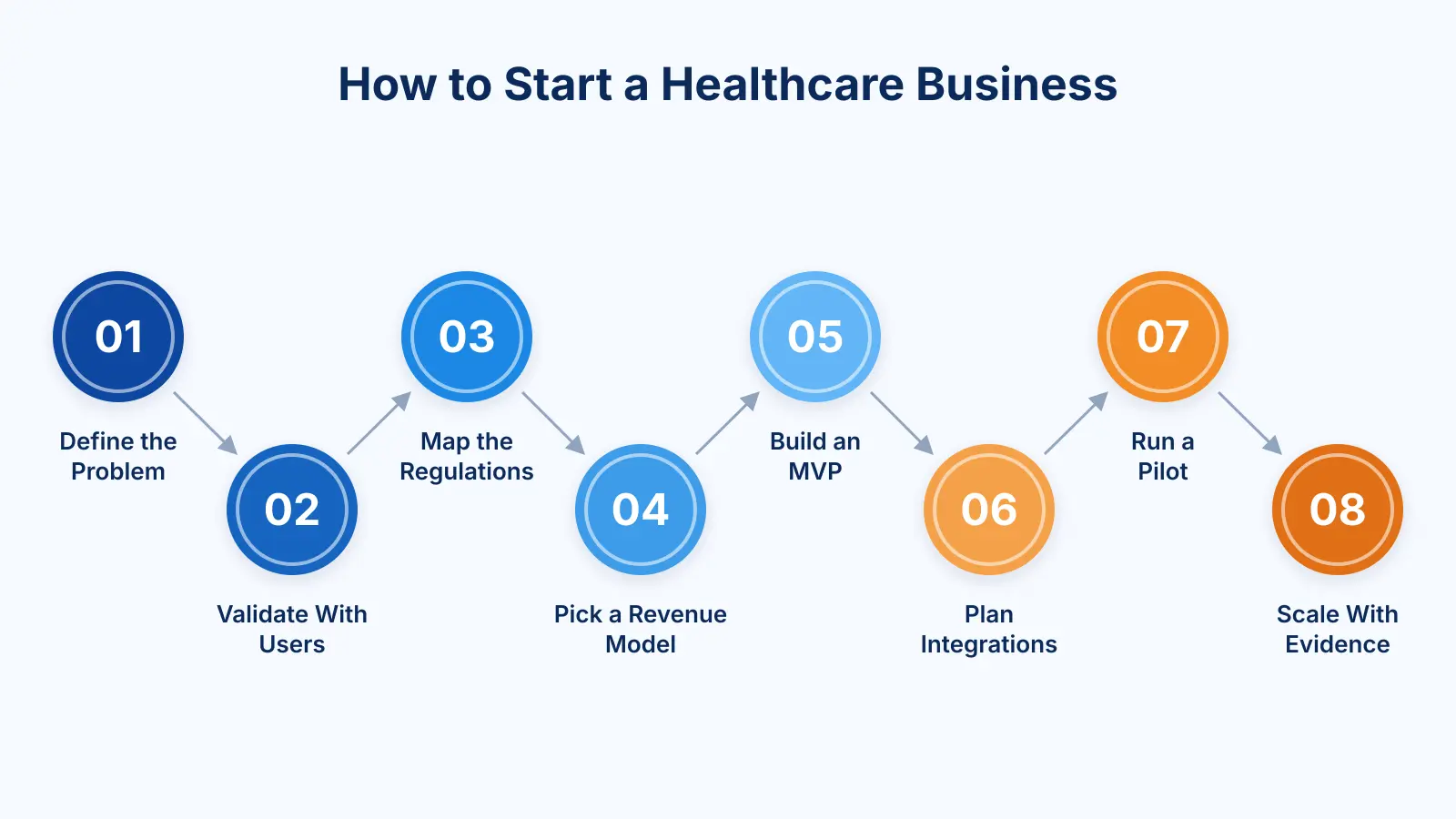
To start a healthcare business, pick one problem for one type of customer, confirm the rules that apply, build a small working version and test it with real users before you scale. These eight steps cover the process for most healthcare business startup ideas.
If you need engineering capacity beyond your core team, you can hire software developers with healthcare experience for the build phase.
The technologies below are behind most of the business ideas in healthcare listed in this guide.
AI has moved from pilots to daily use in documentation, patient messaging and administrative work. The next step is AI agents that complete multi-step tasks, such as gathering records for a prior authorization request, with staff approving the final result.
Connected devices now support chronic care, hospital-at-home programs and post-surgery follow-up. New billing codes make it easier for practices to adopt them.
Federal rules are pushing health plans and providers to share data through standard APIs. This lowers the barrier for new apps that need access to patient records and claims.
Some software is now authorized as a treatment in its own right. In 2021, the FDA granted marketing authorization to a VR-based program for chronic low back pain, now known as RelieVRx. VR is also used to train clinicians with realistic simulations.
Genetic testing helps clinicians identify disease risk earlier and choose treatments that fit each patient. Software that explains results clearly to patients and doctors remains an open opportunity.
Studying established apps shows which business models work. Each example below offers a lesson for founders.
| App | What it does | Lesson for founders |
|---|---|---|
| Teladoc Health | Virtual medical and mental health visits | Employer and health plan contracts can drive scale |
| Zocdoc | Doctor search and appointment booking | Solving a simple access problem can build a large marketplace |
| Headspace | Meditation, sleep and mental health support | Consumer apps can expand into employer benefits |
| Hinge Health | Digital physical therapy for joint and back pain | Measurable outcomes help win employer buyers |
| Abridge | AI documentation of patient visits | AI that saves clinicians time gets adopted fastest |
| mySugr | Diabetes logging and insights, owned by Roche | Focusing on one condition creates loyal users |
| Epocrates | Drug and clinical reference for clinicians | Tools built for professionals can last for decades |
Read More: Top Mobile App Ideas for Startups and Entrepreneurs
The best healthcare business ideas for 2027 solve one clear problem for one clear customer and fit the rules already taking shape, from telehealth flexibilities through 2027 to new payer APIs and hospital-at-home programs through 2030. AI tools that save clinicians time, remote care for chronic conditions and services for older adults have the strongest tailwinds.
Start small, validate with the people who will use your product, and plan for compliance and integration from the beginning. If you would like a second opinion on your idea or help building it, our software development team works with healthcare startups and providers, and you can contact us for a project estimate.
The strongest healthcare business ideas for 2027 include AI medical scribes, AI front desk agents, prior authorization automation, remote patient monitoring, virtual mental health care, hospital-at-home technology and senior care apps. Each solves a clear problem and benefits from current trends such as wider AI adoption, Medicare telehealth flexibilities through 2027 and new payer API requirements from January 2027.
Good small business ideas for healthcare include medical billing and coding services, non-medical home care agencies, mobile phlebotomy, healthcare staffing, health coaching and medical courier services. They need less capital than software platforms, but most depend on state licensing, certifications and HIPAA safeguards, so check local rules before launching.
Practical AI healthcare business ideas include AI medical scribes that draft visit notes, AI agents that handle calls and scheduling, prior authorization automation, AI patient navigation tools, and analytics for remote monitoring and insurance claims. The most successful ones save clinicians and staff time while keeping clinical decisions with qualified people.
Start by choosing one problem for one type of customer and validating it with clinicians or patients. Then map the regulations that apply, such as HIPAA, state licensing and possible FDA oversight, choose a revenue model, build a focused MVP, plan EHR and device integrations, and run a pilot before you scale.
Profitability depends on the model more than the category. Businesses with recurring revenue and clear payers, such as software sold to providers, remote patient monitoring billed through Medicare codes, revenue cycle services and employer-paid virtual care programs, tend to be more predictable than one-time consumer purchases.
In the US, apps that create, store or share protected health information for or on behalf of covered entities such as providers and health plans must meet HIPAA requirements. That includes encryption, access controls, audit logs and business associate agreements with vendors. Some consumer wellness apps fall outside HIPAA but may still face FTC and state privacy rules.
Small teams do best with narrow, software-first ideas such as an AI scribe for one medical specialty, a front desk agent for dental or physical therapy clinics, a FHIR integration service, or a remote monitoring app for one chronic condition. These need fewer staff than clinical services and can be sold to many similar customers.

Based on this article's topic

Jetpack Compose in 2027: learn what it is, how it compares with XML, why Android 17 is Compose-first, and how to plan your Android app migration and costs.

SwiftUI vs UIKit in 2027: compare cost, speed, AI features and foldable support to choose the right framework for your iOS app, with a clear migration path.

Kotlin vs Java for Android in 2027: compare Compose support, null safety, AI features, cost and migration to pick the right language for your app.