Apr 7, 2026 Artificial Intelligence
Agentic RAG or Retrieval-Augmented Generation is an advanced AI framework. Here, autonomous agents use LLMs to actively plan, retrieve, and synthesize data from multiple sources. Unlike traditional RAG, it highlights iterative reasoning and tool-calling along with self-correction to carry out complicated or multi-step queries. It can work incredibly well in dynamic environments where you desire extreme accuracy.
As per the recent reports, companies that implement Agentic RAG for RFP responses have claimed improved rates by around 15 to 20%. This is because the responses were more consistent and detailed. Agentic RAG holds immense potential for various applications and can empower users to understand complex topics easily.
As AI systems continue to evolve across industries and products, businesses are moving from experimental use cases to more structured and production-rich implementations. This shift is also visible in broader innovation patterns of agentic RAG as discussed in modern AI trends.
In this blog, we will go through the detailed aspects of agentic RAG while exploring its inner workings, applications, and the benefits it offers. We will also discuss how it differs from traditional RAG and how to integrate it properly.
A Detailed View on What is Agentic RAG?
Agentic RAG is an advanced AI architecture that combines retrieval augmented generation with agent-like behavior. RAG allows your AI system to retrieve necessary external information before generating any answer. This can prevent you from errors while improving factual accuracy with the help of AI development firms.
On the other hand, Agentic AI refers to the systems that can make decisions, choose tools, break tasks into steps, & evaluate the outcomes while determining what to do next. When such capabilities are combined, you reveal an AI system that can plan, reason, & respond more intelligently.
This is how Agentic RAG is different from a standard AI assistant. Instead of processing as a search-powered chatbot, it behaves more like a task-aware digital agent.
Significant Features of Agentic RAG
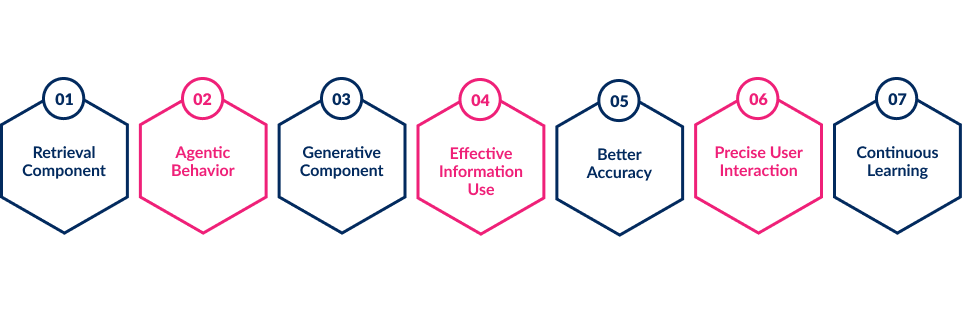
Agentic RAG comes with a series of features that keep it unique in the marketplace while expanding its usage among AI development professionals. Some of the effective ones have been listed in this section.
a. Retrieval Component
Agentic RAG pulls relevant information from a knowledge base or database to offer factual accuracy and contextual governance for the generative process. It upgrades the retrieval process by assessing the context of the input query while enabling more precise and effective results.
b. Agentic Behavior
The following model highlights agencies by deciding which information to retrieve as per the query or context. This allows it to generate more customized and relevant responses while allowing you to choose top AI tools for mobile app development or other services.
c. Generative Component
After the system retrieves necessary data, the generative model uses advanced NLP techniques to generate context-aware responses. It completely depends on the generative AI use cases and the data it retrieves.
d. Effective Information Use
Agentic RAG completely adapts to new information while retrieving the most up-to-date data. This makes it suitable for applications that need consistently updated knowledge.
e. Better Accuracy
By combining retrieval with generation, agentic RAG lessens the chances of errors while improving the reliability of the responses it gives rise to.
f. Precise User Interaction
Agentic RAG can engage in real-time and ensure interactive dialogue through the retrieval component to generate data as per the input given by you.
g. Continuous Learning
From time to time, intelligent agents continue to encourage their capabilities while enhancing their knowledge base and ability. This is to handle complicated problems while assessing new data and futuristic challenges.
Ready to Build Smarter AI Systems with Agentic RAG?
Collaborate with Xicom to develop advanced AI solutions that combine retrieval, reasoning, and automation for scalable and efficient business operations.
Why is Agentic RAG Gaining So Much Attention?
The reason RAG is gaining popularity in the market is that real business problems have been demanding more than one-step tasks.
- Most companies are not looking for AI to just answer their isolated FAQs. You might demand systems that can support your employees while assisting customers.
- The systems should also assess your business data while working across multiple tools.
- A standard retrieval pipeline can be effective, but it may lag behind when your task includes multiple data sources, missing context, and multi-step reasoning.
- This is why businesses are relying upon detailed RAG development services. This process is way beyond basic chatbots and holds more intelligent architectures.
- As per the current statistics, around 43% of companies are considering adopting agentic AI by the end of 2026.
- Agentic RAG fits the need because it offers AI systems the ability to behave more strategically.
- Instead of considering one user input and producing answers, it can assist you through a problem, more like a human assistant.
- Simply agentic AI for businesses is expected to support your complete workflows instead of simply generating text.
Major Difference between Agentic RAG vs. Traditional RAG
Here, you are going through some key features where agentic RAG highlights empowering advancements over its traditional form.
| Components | Traditional RAG | Agentic RAG |
| Static Nature | Less knowledge about context and static retrieval decision making. | It examines conversation history and adjusts strategies as per context. |
| Prompt Engineering | It completely depends upon manual prompt engineering and techniques of viable optimization. | Ensures dynamic adjustments of prompts as per your objectives and the context. |
| Overhead | Inefficient retrieval and extreme text generation. | Optimizes retrievals and lessens extra text generation while minimizing the cost. |
| Decision Making | Static rules administer response creation. | Consider the decision for information retrieval and assess the data quality. |
| Multi-step Complexity | Requires extra classifiers and models | Handles multi-step reasoning and tool usage. |
This can help you achieve a system that can retrieve, reason, and act with more business awareness. If you are also comparing different conversational AI approaches before building it, you must understand chatbots vs. conversational AI for your business.
Businesses should also evaluate how AI can support growth, efficiency, and faster execution. This efficient business perspective is one of the major reasons AI adoption continues to rise among fast-moving companies. These are the components that make companies exploring AI chatbot development look beyond basic support bots.
Types of Agentic RAG as Per Multiple Functions
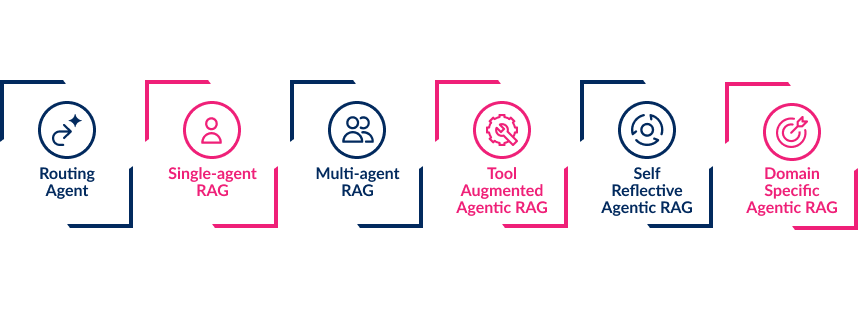
RAG agents can be categorized according to their function while offering a series of capabilities ranging from simple to complicated values. They can serve multiple purposes while making you aware of the benefits of AI for your startups. Here you can go through some of the most valuable ones.
1. Routing Agent
This type employs a large Language Model to assess which downstream RAG pipeline to follow. This process includes agentic reasoning, whereas the LLM values the input query to make an informed decision about selecting the most suitable RAG pipeline. This highlights the fundamental and the basic form of agentic reasoning.
2. Single-agent RAG
This is the most accessible form of Agentic RAG. In this, one AI agent manages the main workflow. It receives queries and decides how to process information and context to generate responses. This model works well for businesses that want to improve internal search and support workflows without going for a complex system. It is a strong starting point for organizations beginning their RAG AI agent development.
3. Multi-agent RAG
In more advanced systems, multiple agents work together. Instead of asking one AI component to handle everything, this type can be distributed across specialized agents. One may value retrieval, and the other one might summarize findings and validate the relevance.
Multi-agent architectures are becoming more common in businesses building copilots and internal assistants. It also helps with process automation systems that need higher reliability and effective modularity.
4. Tool-Augmented Agentic RAG
This type of agentic RAG goes beyond document retrieval and accesses the AI to use tools. This means your system can do more than just adopt information. It can also interact with business platforms like dashboards, CRMs, APIs, etc. This is where agentic RAG becomes more valuable for workflow automation and business productivity.
5. Self-reflective Agentic RAG
In this model, AI doesn’t just retrieve information and generate a response. It also assesses whether the response is actually good enough before returning it to the user. This is the reason many developers consider this form of AI for mobile development.
In some implementations, it might re-check the source relevance while identifying the gaps in reasoning.
6. Domain-Specific Agentic RAG
This is another significant type for which you need to hire developers. In this, the architecture is designed around a specific industry, workflow, or business function instead of being a generic AI assistant.
For more detailed approaches, you can go through the integral agentic AI use cases among multiple industries.
Real-World Applications of Agentic RAG
The best way to understand the business value of Agentic RAG is to look at where it is actually used over multiple industries. This is not a technical concept anymore. Agentic RAG is increasingly being used as a practical foundation for modern AI products and valuable generative AI development. Let us go through some of its incredible applications.
1. Enterprise Knowledge Assistants
This is one of the most common and practical applications of agentic AI. Many organizations store crucial information across multiple formats and systems, including policy documents, along with product manuals and SPOs. This problem is not always a lack of information.
The problem is that you might struggle to find the right data when you need it the most. Agentic RAG can solve this issue by helping the AI assistant access internal knowledge and explain it in simpler terms. You can also hire AI professionals to make the usage more goal-oriented.
2. AI Copilots for Your Business Team
Around 62% of organizations are experimenting with AI agents, while 235 are already scaling agents in at least one of their functions. So, agentic RAG is also becoming an essential building block for enterprise copilots.
A support copilot can assess knowledge base entries and policy documents before suggesting a better customer response. A product or operations copilot can combine internal documentation with real-time business tools to help teams make quicker and more informed decisions. However, consider the help of experts to build an AI copilot for enterprises.
3. Customer Support and Automation
Customer support is another essential area where agentic RAG is creating real business value. Traditional support bots often lag behind as they are mainly scripted. Agentic RAG can improve your customers’ experience by accessing the system to retrieve the right support information.
However, to enrich your customer support, you need to go through valuable AI business ideas. This approach can lead you towards faster response times and more useful self-service channels.
4. Research Support
This is another incredible application of agentic AI that can encourage your business decision-making. Many teams generally spend most of their time gathering information from different sources. Agentic RAG can significantly reduce the effort.
It assists you with use cases like market research assistants and competitor analysis tools. For example, you are developing an AI app, so it becomes necessary for you to assess the AI app development cost. This is why the system becomes more useful for strategies, operations, and executive support functions.
Industry-Specific Applications of Agentic RAG
Apart from internal assistants and SaaS products, agentic RAG is also becoming relevant across industry-specific business environments.
1. Healthcare
Healthcare professionals generally work with a series of sensitive and quality data. Doctors and support teams might need fast access to treatments and patient guidance, along with operational documents and insurance workflows. Agentic RAG can support healthcare environments through patient support assistants and hospital knowledge systems.
Instead of depending upon confusing searches across documents and systems, your healthcare teams can use AI in medical work for relevant information and to respond more intelligently.
2. Real Estate
This is another strong use case for agentic RAG as the industry completely depends on listings, client communication, documentation, and market comparisons. Agentic RAG can help you with property recommendation assistance and internal sales knowledge.
It can also make you aware of market intelligence summaries. Such a type of AI support in real estate can boost your internal productivity while helping you become property-focused.
3. Transportation and Logistics
This business mainly deals with route planning, dispatch workflows, and operational guidelines. This makes them a strong fit for Agentic RAG-powered systems. This system can retrieve and explain data quickly across distributed operations.
As logistics environments generally depend on speed and accuracy, AI in transportation can support your decisions in real time and offer you a major operational advantage.
4. Food and Hospitality Operations
Food businesses are also willing to adopt more advanced AI systems to support operations and customer engagement. Agentic AI in the food industry can help you with internal operations support, customer service automation, franchise training assistants, etc. This makes it specifically useful in environments where consistency, speed, and operational clarity matter.
Basic Steps to Implement Agentic RAG
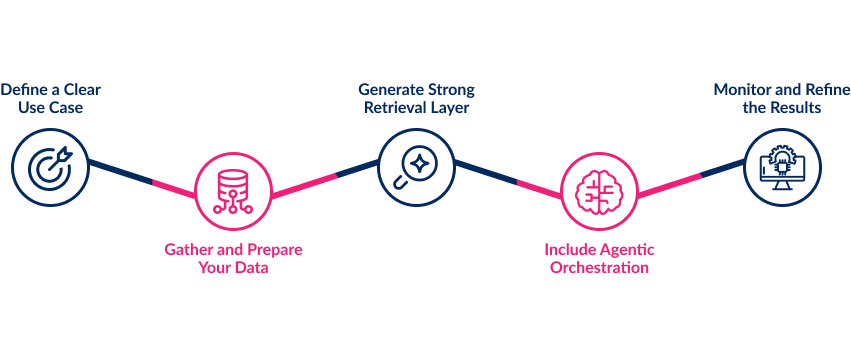
To implement agentic RAG in a better way, you need to consider the potential of professional AI consulting services. Here are the steps they follow for better and more useful integration.
1. Define a Clear Use Case
When you contact AI developers, they can help you identify the exact problem that the system is meant to resolve. This could be customer support automation, business research, or workflow assistance. Starting with a focused use case can make your implementation more practical.
2. Gather and Prepare Your Data
Agentic RAG completely depends on the quality of information it accesses. Your business needs to gather and structure necessary data sources like internal documents and product manuals, along with support tickets and FAQs. These records are essential before you build the system.
3. Generate Strong Retrieval Layer
Once your data is ready, you need to be careful when setting up the retrieval infrastructure. This includes arranging the documents properly while adding Metadata in a vector database. This ensures the system can gather more relevant data quickly and effectively.
4. Include Agentic Orchestration
This is the major step that makes the system agentic instead of just searchable. The AI should be able to decide how to handle multiple tasks or when to retrieve more contexts. Further, it can also decide a follow-up logic before creating any response. Consider the help of professional AI development experts for more futuristic results.
5. Monitor and Refine the Results
Before you deploy the system, it should be tested properly through real business queries and edge cases. Ongoing evaluation encourages improved answer quality and ensures the AI remains reliable with your business development. You can hire developersto help businesses build smarter and context-aware AI solutions.
Take the Next Step Toward Intelligent Automation
Leverage Xicom’s expertise to build powerful Agentic RAG solutions tailored to your business needs and future growth.
How to Know if Your Business Requires Agentic RAG?
Every business doesn’t require an advanced AI architecture from the initial phase. In some cases, a simple chatbot or basic automation can do the work. However, if your business is handling a series of data, agentic RAG can be a useful solution for you.
- One of the major signs is when your teams spend too much time searching for data across multiple systems.
- If employees are regularly switching between internal documents, support logs, dashboards, and business tools just to complete one task.
- An agentic RAG system can help you centralize the process while making the information much easier to access.
- It is also a reliable solution if your current AI assistant or chatbot gives generic and inconsistent answers.
- Standard bots generally work well for simple queries but struggle when your query needs multiple sources and a step-by-step assessment.
- It can also help you solve problems by enabling the system to assess, retrieve, & respond to queries more intelligently.
- Simply, if your goal is to generate AI that can do more than answer basic questions, agentic RAG is worth exploring.
Common Mistakes Businesses Make When Implementing Agentic RAG
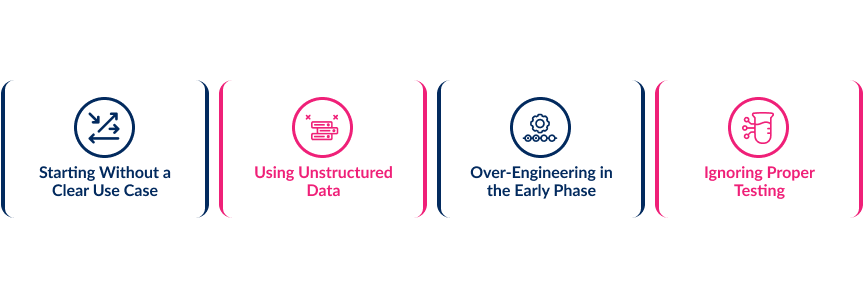
While agentic RAG delivers a series of benefits, it can also deliver a series of mistakes if you consider the implementation process inconveniently. Some of the major mistakes have been listed below for your knowledge.
1. Starting Without a Clear Use Case
Many businesses try to build a broad AI assistant before assessing the exact issue it needs to solve. This step often leads to weak adoption and unclear business value. So, it’s better to hire experts for valuable insights.
2. Using Unstructured Data
Even the best AI system might struggle if it is outdated or includes irrelevant information. Clean and organized data is necessary to gain reliable output in the competitive market.
3. Over-Engineering in the Early Phase
Many teams try to jump into the complex multi-agent architectures before validating a simple workflow. Starting with complicated approaches can lead to better and more long-term results.
4. Ignoring Proper Testing
Without testing real business queries, it can be difficult for you to understand whether the system is actually useful or accurate. So, make sure to implement testing for better agentic RAG usage.
Future Trends of Agentic RAG
Agentic RAG is going to play a major role in the next generation of business AI systems. As organizations are going beyond experimental AI tools, the demand is shifting towards solutions that gather trusted information and support real workflows.
- In the coming years, it is expected to be widely used for intelligent customer support and industry-specific AI solutions.
- Instead of working as isolated assistants, these systems will become more deeply integrated into your daily business operations.
- Agentic RAG also has a strong future potential to make AI outputs more reliable. Further, businesses will prioritize solutions that offer better accuracy and decision support.
- However, make sure to hire AI professionals to keep the process more practical and aligned with your real business needs.
- As per the recent statistics, around 73% of APAC employees consider that AI agents will be extremely viable in the next three to five years.
Conclusion
The emergence of agentic RAG represents a serious advancement in RAG technology. By implementing agentic capabilities, you can ensure your intelligent systems are capable of reasoning over retrieved data while synthesizing insights. This changing approach becomes the foundation for the development of sophisticated research assistants and virtual tools for complex information landscapes.
Whether your goal is to improve your internal knowledge access or to develop industry-specific AI products, you must be aware of the cost to hire AI developers. They can help you leverage the most valuable usage of Agentic RAG while making your business applications reliable.
If you are looking forward to making your business context-aware and future-rich, hire AI developers who guarantee results. Xicom can be your ultimate partner that helps organizations turn advanced AI ideas into practical business solutions through tailored AI development efforts. So, contact us now and start your RAG development today.

Make your ideas turn into reality
With our AI & mobile app solutions
Explore related services
Based on this article's topic