Jul 3, 2026 Artificial Intelligence, Software Development
Key Takeaways
- 78% of organizations now use AI in at least one business function, per McKinsey, framework selection has moved from an experimental decision to one that directly affects development speed, cost, and long-term maintainability.
- Frameworks stack in layers (classical ML, deep learning, NLP, computer vision, LLM orchestration, multi-agent, MLOps) and most real systems draw on two or three layers stitched together, not just one.
- The fastest way to pick the right layer is to state the problem in one plain sentence with no technology named-“predict which customers will churn” is classical ML, “answer employee questions from our documents” is the application layer.
- PyTorch is the framework least often regretted for new deep learning projects, given its dynamic, Python-native style and the size of its ecosystem, though TensorFlow still holds ground in established production pipelines.
- A framework is a library you build with and fully control; a platform is a managed environment you build within and pay for convenience- the real decision hinges on deployment target, team expertise, and total cost of ownership, not license price.
- Total cost of ownership matters more than the “free” label on open source, the license is usually the smallest line item; engineer time, learning curve, and eventual migration cost are what actually add up.
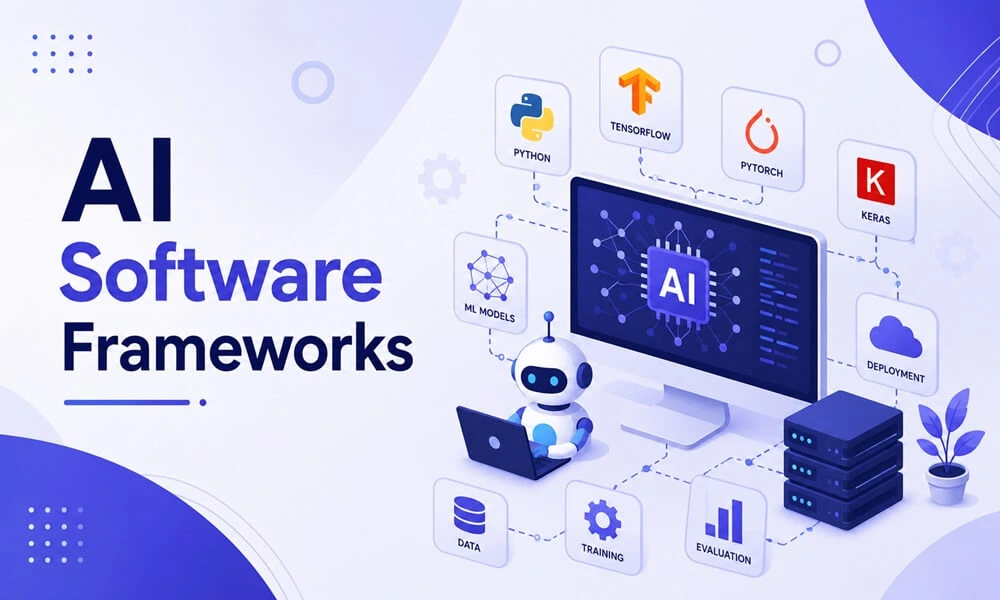
AI software frameworks provide the foundation for developing modern AI applications. They offer the libraries, APIs, runtime environments, and development tools needed to build, train, deploy, and manage AI models without requiring developers to implement complex capabilities such as automatic differentiation, distributed computing, hardware acceleration, and model optimization from scratch. By abstracting this complexity, frameworks accelerate development while improving performance, scalability, and reliability.
Their role has become increasingly important as enterprise AI adoption continues to grow. According to the McKinsey 2025 State of AI report, 78% of organizations now use AI in at least one business function, reflecting AI’s transition from experimental projects to production systems. As organizations scale their AI initiatives, the framework they choose directly impacts development speed, deployment flexibility, infrastructure costs, integration capabilities, and long-term maintainability.
This guide explores the different types of AI software frameworks, their core components, selection criteria, licensing models, and their role in building scalable AI systems.
What Is a Software Framework for AI?
An AI software framework is a software foundation that provides the libraries, runtime components, APIs, and development abstractions required to build AI applications. Rather than implementing numerical computation, optimization routines, and execution logic for every project, an AI software development company can accelerate delivery by using standardized components maintained by these frameworks, enabling faster, scalable, and more efficient AI solution development.
Underlying infrastructure remains largely abstracted from application code. Automatic differentiation engines compute gradients during training, execution runtimes distribute workloads across available hardware, and optimized libraries perform matrix operations that would otherwise require thousands of lines of specialized implementation.
Although individual frameworks target different AI disciplines, most encompass a common set of capabilities. Engineering effort shifts from infrastructure construction to application design once these capabilities are available. Teams can concentrate on model architecture, domain-specific logic, and system integration rather than maintaining the computational foundation that modern AI workloads demand.
Core Components of an AI Software Framework
Although capabilities vary, most AI frameworks include:
| Component | Purpose |
|---|---|
| Libraries | Provide reusable functions for AI tasks |
| APIs | Allow applications to communicate with AI models and external services |
| Model management | Supports training, saving, loading, and versioning models |
| Data processing tools | Prepare and transform datasets for training |
| Optimization tools | Improve model performance and training efficiency |
| Deployment support | Package and serve models in production environments |
| Documentation and community resources | Help developers learn and troubleshoot |
These components significantly reduce development effort while promoting consistency across AI projects.
Why AI Applications Need Software Frameworks
Building AI without a framework is possible but almost no one does it, because the framework absorbs work that would otherwise fall on the team:
- It removes undifferentiated heavy lifting. Gradient computation, GPU memory management, and parallel execution are hard to implement correctly, identical across projects, and solved once and reliably by a framework rather than reinvented by every team that needs them.
- It accelerates development. Work that might take weeks of low-level engineering can often be assembled in hours from prebuilt components, which shortens the path from idea to working prototype and lets a team test whether an approach is viable before committing to it.
- It provides access to pretrained models. Modern frameworks and their surrounding libraries make it straightforward to adapt an existing model rather than train one from scratch, which is frequently the difference between a project that is feasible and one that is not.
- It handles scale. Training and serving large models across many machines is a genuinely hard distributed-systems problem, and frameworks make it tractable without every team building the infrastructure for sharding, parallelism, and coordination itself.
- It reduces risk. Widely used frameworks are exercised by millions of users across countless scenarios, so common failure modes have already been found and fixed, whereas bespoke infrastructure carries bugs that only you will ever hit and only you can fix.
- It future-proofs the work. Because a mature framework tracks new hardware, new model types, and new optimization techniques on your behalf, code written against it inherits improvements over time without a rewrite, whereas bespoke infrastructure has to be updated by hand every time the underlying technology moves.
- It brings a community and a standard. A widely used framework means shared conventions, abundant documentation, worked examples, and a large pool of engineers who already know it, an ecosystem effect that often matters more day to day than any single feature.
The net effect is that frameworks let teams compete on the merits of their actual problem rather than on infrastructure that has been built many times before.
Also Read: AI Agents vs Agentic AI
AI Software Frameworks: Types and Examples
“AI framework” is not one category but several, arranged as a stack of layers, each solving a different problem and combining with the others rather than competing. Placing a problem at the wrong layer is the source of most poor decisions, because it cannot be fixed by tuning the tool.
| Framework Type | Purpose | Examples |
|---|---|---|
| Machine Learning Frameworks | Build predictive models using traditional machine learning algorithms. | Scikit-learn, XGBoost, LightGBM |
| Deep Learning Frameworks | Build and train neural networks for complex AI applications. | TensorFlow, PyTorch, JAX |
| Natural Language Processing (NLP) Frameworks | Process, analyze, and generate human language. | Hugging Face Transformers, spaCy, Flair |
| Computer Vision Frameworks | Develop AI applications that interpret images and videos. | OpenCV, Detectron2, OpenMMLab |
| Speech AI Frameworks | Build applications for speech recognition, transcription, and text-to-speech. | NVIDIA NeMo, SpeechBrain, Kaldi |
| LLM Orchestration Frameworks | Build applications powered by large language models using prompts, memory, retrieval, and tools. | LangChain, LlamaIndex, Haystack |
| Multi-Agent AI Frameworks | Coordinate multiple AI agents to collaborate on complex tasks and workflows. | CrewAI, AutoGen, LangGraph |
| Generative AI Frameworks | Develop applications that generate text, images, audio, video, or code. | Hugging Face Diffusers, NVIDIA NeMo, Semantic Kernel |
| MLOps and Deployment Frameworks | Deploy, monitor, and manage AI models in production. | MLflow, Kubeflow, Ray Serve |
| Edge AI Frameworks | Optimize and deploy AI models on edge devices with limited resources. | TensorFlow Lite, ONNX Runtime, OpenVINO |
| AutoML Frameworks | Automate model selection, feature engineering, and hyperparameter tuning. | AutoGluon, H2O.ai, Auto-sklearn |
| Reinforcement Learning Frameworks | Train AI agents through interactions with dynamic environments. | Ray RLlib, Stable-Baselines3, TF-Agents |
On the deep learning layer, which draws the most debate: PyTorch is the default across most research and industry for its dynamic, Python-native style and vast ecosystem; TensorFlow persists where an established production pipeline favors it; JAX suits high-performance and large-scale work built on composable function transformations. For most new projects PyTorch is the choice least often regretted. The application and agent layer, by contrast, is the youngest and most volatile, which has direct consequences for how heavily you should commit to any single tool within it.
To find your layer, state the problem in one sentence naming no technology. “Predict which customers will churn from their history” is classical ML; “answer employee questions from our internal documents” is the application layer. The layer eliminates most options before any tool comparison begins, and most real systems draw on only two or three layers stitched together.
How to Choose the Right AI Framework
Within a layer, the choice comes down to a few questions that genuinely change the answer, not the syntax and benchmark debates that fill forums:
- Where will it run, and who will operate it? The deployment target constrains the framework more than any feature, because a model bound for a device, a high-traffic API, and an overnight batch job impose completely different requirements; fix this first, since retrofitting a serving story onto a framework chosen for other reasons is a common and costly late surprise.
- How mature must it be on day one? Some tools optimize for fast experimentation and others for stable production, so match the tool to the phase and be willing to use different tools for the prototype and the production system rather than forcing one to do both badly.
- How much does the ecosystem carry for you? Ask concretely how many pretrained models, integrations, and answered questions already exist for your specific use case, because that determines whether your problem has largely been solved already or whether you will be the first to hit every wall.
- How easily can you leave? Every framework is a bet, and in a fast-moving field some bets age badly, so the real question is not whether you will want to switch but how much it will cost when you do.
- What is the true cost of running it? A framework that trains a model cheaply can still be expensive to serve, so weigh the ongoing compute, latency, and operational burden of the running system, not just the effort to build it.
As a worked example, an internal assistant answering staff questions from company documents fails the one-sentence test into the application layer, which rules out the training-framework debate entirely; the target is a modest internal API, so heavyweight serving is unnecessary; the ecosystem for document retrieval is mature; and a thin internal interface preserves the option to switch. The decision resolves in an afternoon.
Also Read: AI App Development Cost
AI Frameworks vs. AI Platforms: Which Should You Choose?
A framework is a library you build with; a platform is a managed environment you build within. Frameworks trade convenience for control and portability; platforms trade some flexibility and a degree of lock-in for integrated infrastructure you do not have to operate.
| Dimension | AI Framework | AI Platform |
|---|---|---|
| Nature | A library you assemble into your own stack | A managed environment with training, deployment, and monitoring included |
| Control | High; you own and can change every part of the stack | Lower; the provider owns much of it and sets the boundaries |
| Setup and operations | Your responsibility, which demands engineering capacity | Largely handled for you, which is the main thing you are paying for |
| Portability | High; it runs wherever you run it | Lower; your system is tied to the provider and its services |
| Cost shape | Mostly your engineers’ time and the infrastructure you run | Mostly provider fees that scale with usage, predictable but not always cheap |
| Best suited to | Custom needs, portability, and cost control at scale | Speed, small teams, and shipping without deep infrastructure expertise |
The decision usually resolves along a few clear lines:
Choose an AI framework when:
- You need maximum customization.
- Your team has AI development expertise.
- You are building unique AI applications.
- You want greater control over model architecture.
- You already have deployment infrastructure.
Frameworks provide flexibility that is often essential for research projects and highly customized enterprise solutions.
Choose an AI platform when:
- You want managed infrastructure.
- Your team wants faster deployment.
- Operational simplicity is a priority.
- Multiple teams need to collaborate.
- Built-in governance and monitoring are important.
Use both when:
- You need to build custom AI models while simplifying deployment and management.
- Your organization has separate development and operations teams.
- You want to scale AI applications across multiple environments.
- Your projects require enterprise features such as monitoring, security, governance, and compliance.
- You want to accelerate development without sacrificing flexibility or control.
Open-source vs. Proprietary AI Frameworks
Most dominant frameworks are open source, but proprietary offerings still matter, particularly when bundled inside commercial platforms, and the choice has real consequences for cost, control and risk:
Pros of open-source
No licensing cost, full transparency in how the tool works, freedom to modify it, no vendor lock-in, and a huge community producing documentation, integrations and fixes. The mainstream frameworks in every layer are open-source which is why their ecosystems run so deep.
Pros of proprietary
Vendor support, service level guarantees, integrated tooling, and sometimes capabilities or performance you can’t get anywhere else, which can be worth paying for for teams that value a single accountable provider.
Open-source costs
You have to run, secure and support the tool, so “free” is only about licensing, not total cost of ownership which still includes learning curve, maintenance and the engineers who run it.
Proprietary costs
They include licensing fees, less transparency, limited ability to modify the tool, and lock-in that can make leaving later, sometimes substantially, more expensive.
Security and compliance cut both ways
open-source allows you to view and audit the code directly, while proprietary tools might have the certifications and guarantees that regulated environments require. The right answer depends on who has to sign off on the system.
A reasonable default would be to build the core of the system with open-source frameworks to maintain control and portability, and to selectively use proprietary tools only where their support and integration are worth the price. In any case look at the total cost of ownership, not the license cost, as the license is usually the smallest line item and the engineers, the learning time and eventual migration are the large ones.
Layering Multiple AI Software Frameworks
Many AI applications use multiple frameworks, with each handling a specific stage of the AI development lifecycle, such as model training, LLM orchestration, or deployment.
Why Layer AI Frameworks?
AI frameworks are designed to solve different problems. For example, one framework may be optimized for training deep learning models, while another simplifies LLM orchestration or production deployment.
Using multiple frameworks allows organizations to:
- Leverage the strengths of specialized tools.
- Build modular AI architectures.
- Separate model development, orchestration, and deployment into distinct layers.
- Replace or upgrade individual frameworks without redesigning the entire application.
- Scale specific components independently as workloads grow.
- Integrate different AI capabilities into a single workflow.
Common Framework Combinations
| Framework Combination | Purpose |
|---|---|
| PyTorch + MLflow | Train models and manage deployment and lifecycle. |
| TensorFlow + Kubeflow | Build, deploy, and manage machine learning workflows. |
| LangChain + LlamaIndex | Develop Retrieval-Augmented Generation (RAG) applications. |
| LangChain + CrewAI | Combine LLM orchestration with multi-agent workflows. |
| PyTorch + OpenCV | Build computer vision applications. |
Using multiple frameworks enables organizations to build AI applications that are easier to develop, maintain, and scale by assigning each framework a specific responsibility.
Also Read: Top AI Development Companies
Conclusion
Software frameworks for AI are best understood not as competitors for a single crown but as a layered stack, from the classical libraries that handle tabular data, through the deep learning engines that train networks and the model libraries that supply pretrained ones, up to the application frameworks that turn models into products and the serving infrastructure that runs them. Almost every serious system draws on several of these layers at once.
The discipline that produces good outcomes stays the same regardless of which tools are in fashion: name the layer your problem belongs to, fix your deployment target early, default to the well-supported mainstream option unless you have a real reason to deviate, weigh framework against platform and open-source against proprietary on total cost of ownership rather than headline price, and keep the fast-moving layers loosely coupled so you can adapt. The individual AI software frameworks will keep changing; the practice of matching the tool to the problem, guarding against lock-in, and spending your effort where the product actually lives will outlast any particular one of them.
Build AI solutions on the right foundation. Whether you’re developing machine learning models, LLM applications, or enterprise AI systems, Xicom helps you select, build, and scale with the right AI frameworks for long-term success.
FAQs
1. What are AI software frameworks?
AI software frameworks are pre-built libraries and tools that help developers design, train, and deploy machine learning and AI models without writing every algorithm from scratch.
2. Which AI software framework should a beginner start with?
PyTorch is a common starting point for deep learning because of its readable syntax and strong community support. For classical machine learning on tabular data, Scikit-learn is usually the simpler first step.
3. Do I need a different framework for every type of AI project?
Not necessarily. Some frameworks like PyTorch and TensorFlow are flexible enough to support multiple use cases, from computer vision to NLP. Specialized frameworks become more useful as the task gets more specific, such as speech AI or multi-agent orchestration.
4. How do I choose between building on a framework versus a platform?
It comes down to control versus speed. Choose a framework if you need portability and custom control over your stack. Choose a platform if your team wants to ship faster without managing infrastructure.
5. What is the difference between an AI framework and an AI platform?
An AI framework is a library you assemble into your own stack, giving you full control over the code. An AI platform is a managed environment that handles training, deployment, and monitoring for you, trading some control for speed.

Make your ideas turn into reality
With our AI & mobile app solutions
Explore related services
Based on this article's topic