Jun 30, 2026 Artificial Intelligence
The legal industry is going through a major change as there has been increased interest in the application of artificial intelligence within the field of legal services. AI has enabled law firms to enhance their efficiency and improve decision-making by automating various tasks.
In recent years, the utilisation of AI in the legal field has grown significantly. As per the American Bar Association’s legal technology survey report for 2024, the usage of AI in legal practice has increased from 11 percent in 2023 to 30 percent in 2024, and this indicates growing trust among legal professionals in AI-based solutions. Moreover, it should be noted that Thomson Reuters has also stated that 26 percent of legal firms are utilising generative AI, while 78 percent think it will become an important part of their workflow within the next five years.
Because legal business organisations have been facing the challenge of dealing with increasingly large amounts of paperwork, regulation issues, and high expectations from clients, artificial intelligence has become a very helpful technology in helping companies operate more efficiently. In this article, we will consider the role of AI in legal organisations and its possible applications in the future.
Why is AI Becoming Essential in the Legal Industry?
The role of AI in legal businesses has grown remarkably over time. The high workload, compliance issues, and rising expectations from clients are creating a need for more efficient and effective operational solutions in legal firms.
Some of the key factors driving AI adoption in the legal industry include:
- Large volumes of legal documents and contracts
- The need for faster legal research and case analysis
- Growing regulatory and compliance obligations
- Pressure to reduce operational costs
- High demand for quicker client responses
- The need to improve overall efficiency and productivity
AI technologies are gaining prominence within the legal industry, and this trend will continue due to the use of artificial intelligence solutions by organizations. Businesses utilizing AI from the very beginning can function effectively, improve services offered, and have enough time for other legal proceedings.
Ready to Bring AI into Your Legal Operations?
Xicom builds AI-powered legal tools for contract review, case research, and document automation, engineered for accuracy and built with human oversight at every decision point.
Use Cases of AI in the Legal Industry
1. AI in Legal Research
Legal experts devote a lot of their time to searching for case laws, precedents, regulation papers, and court judgements. With Natural Language Processing (NLP) and the semantic search capabilities of AI, legal queries can be understood by the system, and the data can be retrieved from the huge legal database. Legal research with the help of AI will make the task easy to conduct the analysis of the legal dataset and collect useful information within seconds. This reduces research time, improves accuracy, and allows legal teams to focus more on case preparation and strategic decision-making.
2. Contract Review and Analysis
Contract review is an essential yet time-sensitive task for the legal department. AI leverages machine learning algorithms to determine contract clauses, inconsistencies, and potential risks. AI can analyze contracts, identify important contract clauses, and pinpoint any inconsistencies that might exist in the document. Contract review with AI is an efficient way to go through a large number of contracts without the chance of overlooking things.
3. Legal Document Automation
Legal organizations tend to write a lot of contracts, agreements, reports for compliance, and other standard documents. The technology of generative AI or large language models (LLMs) can be used in the process of creating and personalizing legal documents with the help of predefined parameters and templates. This helps in reducing the workload of repetitive tasks, making the documentation process quick and easy.
4. E-Discovery
E-discovery is the top AI use case in law. AI technology allows for rapid analysis of large numbers of emails, agreements, messages, and other documents to find relevant material for legal cases. AI is useful because it helps to automate review and classification of documents and hence save time and money in litigation processes.
5. Compliance Monitoring
It is difficult for legal businesses to comply with regulations that keep on changing. AI-based compliance solutions use real-time monitoring and automation of rules to track regulatory changes and detect any compliance risks. The compliance solutions can help in monitoring regulatory changes, tracking changes in the legal requirements, and detecting any compliance risks. It will help organizations take proactive steps to reduce any compliance risks and adhere to the government regulations.
6. Due Diligence
Due diligence usually involves looking at and examining huge amounts of legal, financial, and corporate documentation. AI utilizes the technology of document intelligence and data extraction to analyze and summarize information efficiently. By using artificial intelligence, one can classify, extract, and summarize pertinent information automatically, thus facilitating the process of reviewing and making it much faster. This allows conducting a comprehensive analysis while saving time on manually examining documents.
7. Predictive Legal Analytics
AI is capable of analyzing historical data of past cases and trends in laws and court rulings to draw connections and produce insights. Machine learning algorithms can be used to analyze the relationships within legal data that will aid in risk analysis and prediction of outcomes. Using this, legal experts are able to determine risks and predict case outcomes, making better strategic decisions.
8. AI-Powered Legal Chatbots
The chatbots of AI can help in providing answers to the questions that are being asked by the customers regularly, collect information, schedule appointments, and give immediate responses to the most common questions. These technologies depend upon Natural Language Processing (NLP) and conversational AI in order to understand the client’s queries. Access to legal services becomes easier for clients through these technologies, as they receive faster support.
9. Intellectual Property Management
The management of intellectual property such as patents, trademarks, copyrights, and other assets involves a lot of research and surveillance. The adoption of AI allows for pattern recognition and data analysis in order to find similarities, to detect infringements, and to monitor intellectual property portfolios. This allows for easy research on trademarks, patent database analysis, possible infringement detection, and the monitoring of intellectual property portfolios, helping organisations protect their assets more effectively while reducing the time and effort required for manual reviews.
10. Legal Workflow Automation
Many hours are spent by law firms on doing administrative activities such as case management, scheduling, documentation, and reporting on the status. Technology tools such as Robotic Process Automation (RPA) and Artificial Intelligence-based workflow management assist in automating these routine processes. It assists organizations in being more efficient in their operations and minimizes manual efforts while enabling lawyers to focus on serving their clients better.
How AI is Transforming Law Firm Operations
There have been many changes in the operations of law firms due to AI, which is making their jobs easier and increasing their efficiency. There were many processes that took up hours of their time, but now those tasks can easily be done with the assistance of AI technologies.
This will make it possible for the legal firms to use their time to focus on more productive tasks such as meeting with clients and making strategies for cases. The growing adoption of AI in business operations can also be used in managing documents and facilitating decision-making using data-driven information.
One more major effect of AI is its contribution to boosting cooperation between legal professionals. Legal experts will be able to perform tasks faster due to having more access to data and thanks to the automation of their processes.
Consequently, law firms will be able to increase their productivity, cut costs, and provide a more efficient service experience.
Benefits of AI in Legal Businesses
- Increased Speed in Legal Analysis and Preparation of Cases: AI technology enables a marked reduction in the amount of time spent analysing case law, precedents, and legislation. This leads to an increased speed in preparing cases.
- Improved Contract Accuracy and Risk Detection: Using AI-based contract review software can help in finding gaps in contracts, inconsistencies and legal risks that can go unnoticed while reviewing them manually.
- Effective Compliance Management: As regulations keep changing from time to time, AI assists in identifying compliance needs and avoiding any non-compliance issues for companies doing business legally.
- Better Client Service and Response Times: The use of artificial intelligence enables legal firms to respond promptly to the needs of their clients. This is because such firms can have automated responses that will help them get back to clients faster.
How is AI Enhancing Client Experience in Legal Services?
Client demands have drastically evolved with individuals and organizations desiring quicker, transparent, and more convenient legal services. Artificial Intelligence (AI) has been instrumental in ensuring that legal enterprises keep up with clients’ demands through better communication and efficient service provision.
- Faster Responses to Client Queries: With the help of AI-driven virtual assistants and chatbots, it is possible to respond to regular clients’ questions and give them basic information. Thus, it is possible to provide faster services without additional workload.
- Improved Accessibility to Legal Services: The application of AI will help make legal information more understandable for clients by making it easy for them to comprehend the legal process. This increases accessibility and helps clients to make informed decisions.
- Greater Transparency Throughout Legal Processes: Through the use of an AI system, one can receive up-to-date information on the status of their cases and any documents that are required. This keeps clients informed and reduces uncertainty throughout the legal process.
- More Personalised Client Interactions: Through the analysis of client data and past interactions, AI can assist law firms in offering customized recommendations and support to their clients.
Challenges and Considerations for AI Adoption
There are many problems that persist for legal enterprises, including larger amounts of legal documents, compliance problems, higher operating expenses, and demanding clients. While AI can help tackle most of these problems, businesses should plan out their implementation of AI technology in order to reap its benefits.
1. Data Privacy and Confidentiality
In legal businesses, there exists a large amount of data that is confidential. While developing and deploying AI systems, one needs to make sure that confidentiality is maintained in accordance with the prevailing data privacy laws.
2. Accuracy and Human Oversight
AI is capable of performing many functions in law, but it should not fully substitute legal expertise. All outputs created using AI need to be verified by legal experts to minimise errors and to ensure accuracy.
3. Regulatory and Ethical Considerations
When using AI in legal services, there are several regulatory and ethical issues that arise in relation to the technology. Companies need to ensure that their AI is applied in an ethical manner that is responsible, transparent, and in compliance with applicable regulations.
4. Integration with Existing Systems
Using AI usually involves integrating the technology into the current legal technology environment and infrastructure. Careful planning and implementation are essential to maximise the value of AI investments.
5. AI Hallucination Risk
It is possible for generative AI models to create inaccurate, misleading, or even fictitious information. This condition is referred to as AI hallucination. When incorrect legal references, case citations, or regulations are used within the legal industry, there are numerous risks. It is the main reason why AI outputs need to be verified by legal experts before being used.
6. Algorithmic Bias
AI technologies are based on historical data that might contain certain biases. Without proper monitoring, these biases may significantly impact legal research, risk assessments, and decision-making. It is necessary to ensure the development and testing of AI models in legal businesses.
Future Trends of AI in the Legal Industry
The incorporation of AI in legal sector will increase in the future as the companies become more concerned with efficiency, accuracy, and customer experience. As more legal professionals explore how AI is transforming the legal profession, its usage will also increase.
1. Growing Adoption of Generative AI
Generative AI is predicted to be one of the key elements of modern legal processes. With the ability to draft documents, summarise case files, write reports, and conduct legal research, generative AI can provide significant assistance to lawyers in making their work easier, faster, and more productive.
2. Rise of Legal Tech AI Solutions
The development of legal tech AI solutions allows companies to shift from simple automation to the implementation of more advanced tools that help with legal research, contract analysis, compliance monitoring, and case preparation. With the evolution of these technologies, legal teams will easily be able to handle workload in a better and more accurate way.
3. Increased Use of Predictive Analytics
Predictive analytics is set to see increased use in the legal industry. Through analysis of past cases, court decisions, and trends in law, the use of artificial intelligence would assist people in making risk assessments, spotting patterns, and even decision-making. The increasing use of AI for law firms will aid organizations in making better business and legal decisions.
4. Greater Focus on Responsible and Ethical AI
With the increasing adoption of AI in legal industry, organizations will become increasingly focused on data privacy, transparency, security, and regulation. They will need to ensure that their application of AI in the legal industry remains responsible and ethical through proper governance and human oversight.
5. Rise of Agentic AI in Legal Operations
Agentic AI systems can independently perform multi-step tasks, make decisions based on predefined objectives, and interact with multiple tools and data sources. Some of the most impactful Agentic AI use cases in the legal industry include legal research, compliance monitoring, document analysis, and workflow management with minimal human intervention. Unlike traditional AI, agentic AI handles multi-step tasks efficiently by passing outputs between different stages of a process. It also allows for human intervention wherever required, ensuring accountability for key decisions. As the technology matures, Agentic AI use cases are expected to expand, making the technology an important part of next-generation legal operations.
Ready to Bring AI into Your Legal Operations?
Xicom builds AI-powered legal tools for contract review, case research, and document automation, engineered for accuracy and built with human oversight at every decision point.
How Can Xicom Help Build AI-Powered Legal Solutions?
As the importance of AI in legal industry continues to grow, organisations need technology partners that can build secure, scalable, and intelligent solutions tailored to their operational needs. At Xicom, we help businesses leverage AI applications in law through custom-built platforms designed to improve efficiency, accuracy, and decision-making.
Our AI development services enable legal organisations to automate document processing, streamline compliance management, enhance legal research, and optimise workflow automation. We also develop AI-powered chatbots for legal AI firms, intelligent document management systems, predictive analysis platforms, and other solutions that address real business challenges within the legal industry.
With more than 20 years of digital engineering experience, a team of 350+ technology experts, and 38+ enterprise AI solutions engineered, Xicom has helped businesses accelerate digital transformation through innovative AI-powered solutions. Our expertise spans artificial intelligence, machine learning, Natural Language Processing (NLP), and workflow automation, enabling us to deliver secure, scalable, and future-ready legal technology solutions.
Whether organisations are looking to improve operational efficiency, enhance client experiences, or unlock new opportunities through AI for legal operations, Xicom provides the technical expertise required to successfully implement and scale AI-driven legal solutions.
Conclusion
The application of artificial intelligence in law is no longer a futuristic prospect. The integration of AI in various areas of the law, including legal research, contract management, compliance, and workflow management, is becoming more common among organisations due to the efficiencies that can be achieved by doing so. With businesses exploring AI applications in law, the opportunities for innovation and operational improvement continue to rise.
Irrespective of whether you’re trying to measure the importance of AI in legal services or implementing advanced AI for legal purposes, having the right technology partner is vital. At Xicom, we assist organisations in creating smart and secure solutions according to their specific legal business needs.
Ready to transform your legal operations through the power of AI? Get in touch with our AI development company team to learn about custom AI solutions that can bring success to your organisation by improving productivity, streamlining processes, and delivering better outcomes.
Frequently Asked Questions
What are the benefits of AI in legal industry?
There are various advantages associated with the use of artificial intelligence in the legal sector, including improved research, automation of documents, enhanced compliance management, decreased workload, better customer experience, and the ability for legal experts to concentrate on higher-level tasks.
How is AI transforming the legal profession?
The implementation of AI is changing the legal profession through automation of repetitive processes, fast legal research, enhanced contract analysis, and data-based decision-making. Legal experts can become more productive through such changes, as they will be offering faster services.
What are the most common use cases of AI applications in law?
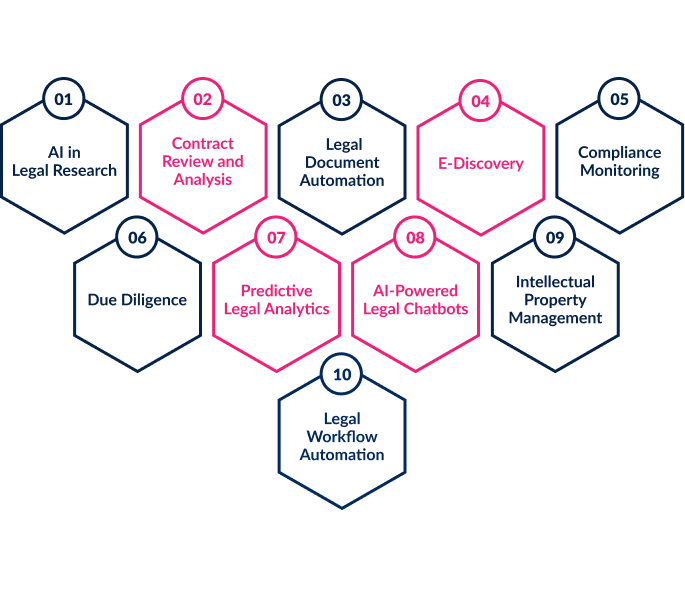
Among the most popular AI applications in law are legal research, contract review, document automation, compliance monitoring, e-discovery, predictive legal analytics, intellectual property management, and legal workflow automation.
How does Xicom support AI use cases in legal industry?
Xicom assists legal companies in creating tailor-made AI solutions that meet their unique business needs. We have the capability to automate legal processes, AI document management systems, predictive analysis, legal research systems, and AI chatbots.
What is the future of AI in the legal industry?
The future of AI in the legal industry will see the use of more advanced automation tools, predictive analytics, intelligent document management systems, and AI-based legal help tools. With advances in AI technology, legal organizations can become more efficient, make better decisions, and provide an improved experience to their clients while remaining compliant with regulations.
Is AI secure for handling legal data?
AI can be secure for handling legal data by employing appropriate measures like data encryption, data protection, and privacy measures. Legal organizations need to make sure that AI is used responsibly to prevent any exposure of clients’ confidential data.
What is the difference between Agentic AI and traditional AI?
The traditional AI systems are programmed to perform certain activities according to defined directions and require human intervention for decision making and performing the activity. In comparison, Agentic AI can perform a workflow process on its own without the need of any human guidance for decision-making or executing any activity. In the field of law, Agentic AI can perform difficult processes like research and documentation independently, while also allowing human oversight for critical decisions.

Make your ideas turn into reality
With our AI & mobile app solutions
Explore related services
Based on this article's topic