
×
Banking App Development Services
Xicom delivers modern engineering for financial institutions, digital banks, and fintech scale-ups. We build resilient mobile banking apps designed to meet rigorous security protocols, comply with dynamic regulatory frameworks, and process high-volume transactions with near-zero latency.
Consult Our Experts
- 20+ Years in Business
- 350+ IT Experts
- 750+ Enterprise Clients
- CMMi Level 3 Certified
- ISO 9001:2015
- Top 1% on TrustPilot
-
 4.8 on Clutch
Our valued Brands & Agencies
















Our banking app development is built on regulated-first engineering practices that strengthen security, compliance, and audit-readiness from day one. Each engagement is grounded in a threat model and compliance map specific to your operating markets, helping institutions launch faster, stay audit-ready, and scale with confidence.
Our Core Capabilities
- Secure Architecture Reviews: Threat modeling and security testing built into every sprint, not a pre-launch audit.
- PCI DSS: Required for any app that touches card data or payment routing.
- GDPR / Regional Data Protection Laws: Govern how customer financial data is stored, processed, and shared.
- PSD2 / Open Banking Standards: Determine how your app connects to third-party financial APIs (EU and UK markets).
- SOC 2: Demonstrates operational controls to enterprise partners and auditors.
- AML/KYC Frameworks: Built into onboarding flows, not bolted on afterward.
Frameworks, Governance, and Engineering Standards We Build Around

PCI DSS

NIST AI
Risk Management Framework

ISO/IEC 23894

ISO/IEC 42001

FATCA

PSD2

ISO 27001

MRM
(Model Governance Frameworks)

CCPA

XAI
(Explainable AI)

SAMA CSF
(Cyber Security Framework)

GDPR
Banking App Development Services for Financial Institutions
As a custom banking app development company, each engagement is scoped around your existing systems, your compliance obligations, and the customer problem you're actually trying to solve.

Core Banking Solutions
For institutions replacing or extending legacy cores, we build modular core banking solutions that handle account origination, ledgers, interest calculation, and transaction processing. We favor API-first architecture so the core can plug into your existing branch systems without a rip-and-replace migration, keeping disruption to daily operations minimal throughout the transition.
Digital Banking Solutions
We build the full retail banking layer, including onboarding, dashboards, budgeting tools, statements, and customer support, as a connected digital banking solutions suite rather than isolated features bolted together after the fact. The goal is a single coherent product a customer can navigate end to end without ever needing a support call.
Digital Wallet Platforms
For challenger banks and embedded finance products, we architect neobank platforms and digital wallets from the ground up: virtual card issuance, instant account provisioning, multi-currency ledgers, and spend controls. This is where a banking application development company's experience in regulatory sandboxes actually matters, since neobanks get audited differently than incumbents.
API Integrations
Most banking apps today are integration-heavy rather than self-contained, relying on dozens of external services to function end to end. We connect your app to payment gateways, credit bureaus, KYC verification services, and open banking APIs, treating each third-party dependency as a first-class architecture decision with fallback handling built in from day one.
Banking Automation Solutions
We automate the operational load that eats staff time: reconciliation, fraud flagging, loan underwriting workflows, and customer onboarding, all built to reduce manual bottlenecks without cutting corners on compliance. Our banking automation solutions include human review checkpoints exactly where regulation requires them, and straight-through processing everywhere else to keep operations moving fast.
AI-Driven Risk & Fraud Detection
We build transaction-monitoring models trained on your historical data to flag anomalies in real time, reducing false positives that frustrate legitimate customers while catching the subtle patterns rule-based systems tend to miss entirely. These models improve continuously as more transaction data flows through them, sharpening detection accuracy without adding friction to genuine transactions.
Banking App Consulting Services
Not every engagement starts with a build. Our banking app consulting services cover technical due diligence, architecture audits of existing apps, vendor selection, and compliance gap analysis for institutions still deciding what to build, buy, or fix first, before committing budget and engineering time to a direction that might not be the right one.
Accelerating enterprise transformation through AI and digital engineering.
20+
Years in Business
350+
IT Professionals
ISO 9001 Certified
NASSCOM & STPI Accreditation
NASSCOM & STPI Accreditation
750+
Clients Worldwide
1800+
Projects Executed
Core Modernization
Monolithic legacy systems slow down feature rollouts and block integrations with modern fintech tools. We build lightweight microservice wrappers and API layers around your existing core banking system, exposing essential ledger functions through secure REST and GraphQL endpoints, without touching or rewriting the underlying base system code.
Onboarding Friction
Manual identity checks during account opening drive prospective customers away before they finish signing up. We embed automated identity verification pipelines combining liveness detection, instant document scanning through optical character recognition, and real-time watchlist checks, cutting onboarding time from days to minutes while keeping compliance fully intact.
Instant Payment Fraud
Instant payment networks settle funds in seconds, leaving fraud teams almost no window to catch suspicious transfers before money moves. We build risk-scoring engines that evaluate device fingerprints, location signals, spending behavior, and biometric markers in under 100 milliseconds, flagging suspicious transactions before settlement completes without slowing down legitimate transfers.
Treasury Bottlenecks
Corporate customers face multi-day delays waiting on layered internal sign-offs for wire transfers and foreign currency movements. We build secure enterprise portals with custom role-based permissions, configurable approval workflows, and native connections to global payment rails like SWIFT and SEPA, giving treasury teams real-time visibility and control.
Support Ticket Overload
Routine requests like balance checks, card freezes, and billing disputes flood call centers and push up cost-per-contact metrics. We connect authenticated virtual assistants directly to core account APIs, enabling automated resolution for common tasks and freeing human agents to focus on complex issues that require real judgment.
Data Silos
Customer data trapped in separate systems for savings, loans, cards, and investments stops banks from building a unified customer view. We build centralized data platforms with real-time APIs that pull information from every account type into one profile, powering personalized recommendations and consistent service across every channel.
Proven results with our Banking app development services
Explore how our custom banking app development services help financial institutions build secure, scalable digital platforms, backed by real client engagements and measurable business outcomes.
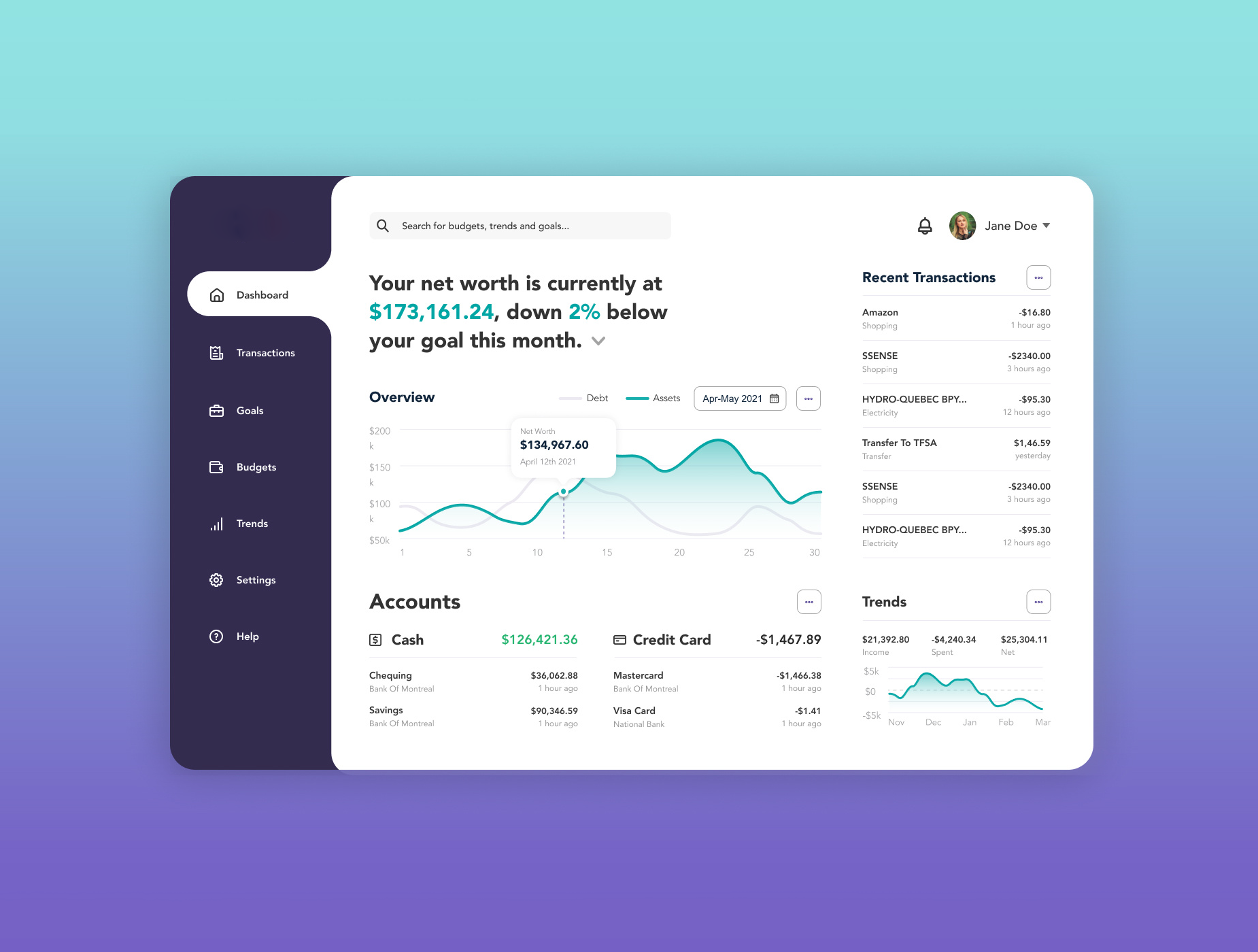
Parity AI AI Finance Platform
The Challenge
Users had no single platform to consolidate banking, investments, debt, and insurance data. Existing financial advisory software was fragmented, expensive, and lacked real-time intelligence.
Our Approach
We developed Parity AI as a full-stack financial wellness platform with secure multi-source data aggregation, behavioral analytics, predictive forecasting, and an AI recommendation engine that delivers personalized financial guidance in real time.
The Result
- Unified financial dashboard covering banking, investments, and debt in one software platform
- AI-driven recommendations triggered by user behavior and life events
- Built-in financial literacy module delivering actionable, context-aware insights
Deep Fintech Domain Expertise
Our senior developers and architects have spent two decades on financial software, credit unions, global banks, and fintech startups alike. That background means we're not learning your industry's vocabulary on your dime; we already know where the edge cases hide.
Compliance-First Security Architecture
Audit readiness isn't something we bolt on before launch. We build with zero-trust network design, HSM-backed encryption keys, dynamic data masking, and detailed logging woven into every component from the start, so passing a strict audit never means a scramble.
Rapid Prototyping & Scalable Rollouts
We turn requirements into something you can actually click through fast. Our MVPs are production-grade, not throwaway demos. We build scalable apps so you can collect real user feedback early and prove the business case before committing the budget.
Flexible Team Engagement Models
Some clients want a full dedicated team. Others need a couple of specialists to fill a gap on staff, or the whole project handed off end to end. We shape the contract around your budget and pace, not the other way around.
Regulatory Fluency Across Markets
Compliance requirements shift depending on where your customers sit; PCI DSS, GDPR, PSD2, and regional data residency rules don't overlap cleanly. We map these obligations into the architecture at the start, so your app isn't retrofitted for a market it was never built for.
Post-Launch
A lot of vendors disappear once the app ships. We stay on for monitoring, security patching, and performance tuning after go-live, because a banking app's risk profile keeps shifting as threats, regulations, and usage patterns change long after launch day.
Ready to build a Banking App that holds up under regulatory and customer scrutiny?
Your next banking app needs to satisfy auditors, regulators, and customers who'll delete it after one bad experience. Xicom's banking app developers handle both sides of that equation, from core architecture to the interface your customers touch every day.
Frameworks & Tools we use for Banking App development
Our banking app development team uses the right tools and frameworks to build secure, scalable, and compliant applications. This modern technology stack enables efficient development, seamless integrations, optimized performance, and easier maintenance throughout the application lifecycle.
 Swift
Swift  Kotlin
  Flutter
  React Native
  Xcode
Xcode  Android Studio
  .NET
.NET Python
 Node.jS
 Java
Java  Temenos
  Mambu
Mambu FIS
FIS Finastra
 HTML5
HTML5  Css
Css  Javascript
  Angular
  Next.js
  Vue.js
  TestFlight
  Detox
Detox  Selenium
  Appium
  POSTMAN
  JMeter
  SAP
SAP Plaid
Plaid Salesforce
 Jumio
Jumio Onfido
 Feedzai
Our end-to-end Banking App development process
We follow a structured banking app development process that helps financial institutions identify opportunities, build secure solutions, integrate them with existing systems, and optimize long-term performance while aligning every stage with business and regulatory requirements.
1
Discover
We evaluate your legacy stack, business rules, compliance obligations, and integration points to identify the right approach before writing a single spec.
2
Design
Our designers build wireframes and clickable prototypes, mapping every transaction flow and embedding accessibility requirements from the very start.
3
Develop
Our engineers build and test each service independently through microservices architecture, shipping a working build every sprint with continuous code review.
4
Secure
We run static and dynamic code analysis, automated vulnerability scans, and third-party penetration testing to validate against PCI DSS and SOC 2.
5
Deploy & Optimize
We script infrastructure-as-code deployments with rollback paths ready, then monitor performance, patch fast, and evolve the codebase as regulations shift.
Hire Mobile App Developers
Dedicated mobile application developers who build, secure, and ship production-ready banking apps across phones, tablets, and web.
- Kotlin & Swift
- Biometric Authentication & Encryption
- Core Banking API Integration
- PCI DSS & SOC 2 Compliance
Hire React Native Developers
Cross-platform experts who use a single JavaScript codebase to build secure, compliant banking apps for iOS and Android.
- One Codebase for Android and iOS
- Redux & State Management
- REST & GraphQL API Integration
- Push Notifications & Fraud Alerts
Hire Flutter App Developers
Our Flutter experts produce a single, pixel-perfect Dart codebase that runs natively across platforms without compromising security.
- Custom Widget Development
- Firebase & Backend Integration
- State Management (Bloc, Riverpod)
- ecure Store Deployment
Client testimonials and reviews showcasing the value we consistently deliver
Explore how our clients describe their journey with us, reflecting strong collaboration, effective execution, and consistent outcomes delivered across engagements. See how our delivery framework ensures consistency from initiation through to successful completion.
❝
Parity AI
We came to Xicom with an ambitious goal: make institutional-grade financial planning accessible to everyone through AI. Xicom went beyond the brief, blending conversational AI and predictive analytics into an effortless platform. Parity AI is exactly what we envisioned.

❝
RadioFX
Xicom took the time to understand what our stations and listeners actually need, building something tailored rather than generic. Live chat and polls are now core to how we connect with our audience — the app has become a true extension of our on-air presence.


❝
StudyBuddy
Xicom built exactly what our students needed: a secure space to connect, collaborate, and find tutoring support in one place. Their understanding of student behavior shows in how naturally everything fits together — StudyBuddy is something students genuinely rely on.

❝
BoxxDocks
Xicom helped us bring BoxxDocks to life exactly as we envisioned it. Their team understood the complexity of AI powered real-time asset tracking and delivered a platform that's both powerful and genuinely easy to use.


❝
TodayFit
We are very happy with their services. I cannot recommend them highly enough. The value, ability, and delivery that we have seen has been superb, and we look forward to continuing this relationship.


❝
SmartVend AI
Their team built SmartVend from the ground up, combining hardware integration, real-time inventory sync, and a centralized dashboard that completely changed how we operate. We couldn't have asked for a more capable technical partner.

❝
Tap Retail
Partnering with Xicom to develop our Tap Retail app and website was one of the best decisions we made. Their team demonstrated exceptional professionalism, technical expertise, and a deep understanding of our business goals.


❝
GoGmGo
Partnering with Xicom was a game-changer for us. They didn't just build software, they helped us redefine how we run our business. Their proactive support and deep domain knowledge gave us the confidence to innovate faster.

❝
DENVEN
Working with Xicom has been a transformative experience. Their team quickly understood our challenges and delivered a scalable, intuitive solution. I highly recommend Xicom to any organization seeking future-ready, high-performance digital products.

Top tech insights of our blog
Explore latest tech stories & News
✦ AI-First Company
Deep Insights into Emerging Technology and Innovation!
Stay ahead in the digital world with our latest insights covering AI trends, industry developments, and expert advice on building smarter businesses.
1800+
Projects
20+
Years Experience
Frequently AskedQuestions
How much does banking app development cost?
It really depends on what you're building. A simple digital wallet app usually falls somewhere between $40,000 and $80,000. If you're looking at an enterprise-grade platform with core system integrations, fraud detection, and AI-driven features across multiple platforms, expect a range closer to $100,000 to $250,000 or more.
How long does it take to build a banking application?
An MVP covering core account management and payments usually takes a few months from kickoff to launch. Add fraud detection, multi-currency support, and third-party integrations, and the timeline stretches out from there.
How do you ensure security and compliance in banking applications?
Encryption, access controls, and audit logging go into the architecture from the very start, not as an afterthought. Before anything goes live, we run it through penetration testing and a compliance review, checked against whichever standards apply to your markets, whether that's PCI DSS, GDPR, PSD2, or others.
Can you integrate banking apps with existing financial systems and APIs?
Yes. We connect apps to core banking systems, payment gateways, credit bureaus, KYC providers, and open banking APIs on a regular basis. We also build in fallback handling so your app doesn't break the moment a third-party service has an outage.
What technologies do you use for banking app development?
It varies from project to project, but our go-to setup usually includes native iOS and Android development or a cross-platform framework on the client side, a microservices backend, and cloud infrastructure with encryption applied both at rest and in transit.
Can banking applications support multi-currency and global payment systems?
Yes. We build multi-currency ledgers and connect them to FX providers and international payment rails, so cross-border transactions and settlement work the way your customers expect.
Why should businesses choose Xicom for banking app development services?
Two decades of software delivery experience paired with real, hands-on banking and fintech domain knowledge is a combination not every vendor can offer. With ISO 9001 process discipline and a track record spanning 750+ clients, you get a partner that treats compliance and security as core engineering work from day one, not a checklist to run through before launch.
Do you provide post-launch support and maintenance services?
Yes. Once your app is live, we stick around for monitoring, security patching, performance tuning, and feature updates. Banking apps aren't a set-it-and-forget-it product; compliance rules and threat patterns keep moving, so the app has to keep moving with them.
Can you build secure neobanking and digital wallet platforms?
Yes. Our neobank and digital wallet builds cover virtual card issuance, instant account provisioning, and spend controls, all built to the compliance bar regulators hold digital-first banks to.
Every award marks a milestone in our journey of excellence
As AI-first digital engineering company, Xicom has earned global recognition for delivering innovative, scalable, and high-performing technology solutions. Our awards reflect the trust of clients and industry leaders alike.