×
Job Portal Development Company
Launch a job board, recruitment marketplace, or career portal that candidates return to and employers pay for. Our job portal development services cover search, applications, employer dashboards, ATS integrations, and AI-assisted matching, delivered as a secure, scalable platform built around your hiring model.
Plan Your Job Portal
- 20+ Years in Business
- 350+ IT Experts
- 750+ Enterprise Clients
- CMMi Level 3 Certified
- ISO 9001:2015
- Top 1% on TrustPilot
-
 4.8 on Clutch
Our valued Brands & Agencies
















Job portal development services from first listing to final hire
A recruitment platform succeeds when candidates find relevant roles quickly and employers receive applicants worth interviewing. As a job portal development company, we design and engineer every layer that makes that happen, whether you are starting a new job board or rebuilding one that has outgrown its first version.

Custom Job Portal Development
Off-the-shelf job board scripts are quick to install and hard to differentiate. As a custom job portal development company, we build the platform around your niche, pricing, and hiring workflow: candidate and employer accounts, job posting rules, search, applications, and an admin console your team can run without developer help. The architecture is planned to scale from a few hundred listings to many thousands.

Job Board & Marketplace Development
Revenue on a job board comes from employers, so the posting and billing experience matters as much as the candidate side. We build pay-per-post and subscription plans, featured and sponsored listings, resume database access, job slot packages, and invoicing. For two-sided marketplaces, we add employer verification, recruiter profiles, and moderation tools that keep spam listings out.

Staffing & Agency Platforms
Agencies juggle clients, open requisitions, candidate pipelines, and placements at the same time. We build branded portals where clients submit and track job orders, recruiters manage shortlists and submittals, and candidates apply, upload documents, and see their status. Placement tracking, shift or contract scheduling, and client reporting can be added for staffing firms.

ATS Integration & Resume Parsing
Recruiters should not copy applicants from one system to another. We connect your portal to applicant tracking systems and HRIS platforms through APIs and webhooks, or build lightweight ATS pipelines inside the portal when you need them. Resume parsing turns uploaded PDFs and Word files into structured profiles with skills, experience, and education that recruiters can search and filter.

AI Matching & Semantic Search
Keyword search misses a "client success manager" when the candidate typed "account manager." Working with our AI integration team, we add semantic job search, job recommendations, candidate ranking for recruiters, and recruitment chatbots. Each feature is scoped with clear criteria, human review of hiring decisions, and bias testing, because matching models reflect the data they learn from.

Job Portal App Development
Many candidates search and apply from their phones, often in short sessions. Our job portal app development services deliver iOS and Android apps with saved searches, push alerts for new matches, one-tap applications, and in-app chat with recruiters. As a custom mobile app development company, we choose native or cross-platform builds based on your audience, budget, and release plan.

Modernization & Ongoing Support
Older job portals often slow down as listings grow, rank poorly for job searches, and break on mobile. We audit the code, search, and hosting, then modernize in phases: rebuilt search, a faster frontend, data migration that keeps job URLs intact, and a move to scalable cloud infrastructure. After launch, we handle monitoring, security patches, and new features.
Accelerating enterprise transformation through AI and digital engineering.
20+
Years in Business
350+
IT Professionals
ISO 9001 Certified
NASSCOM & STPI Accreditation
NASSCOM & STPI Accreditation
750+
Clients Worldwide
1800+
Projects Executed
WHO WE BUILD FOR
Recruitment platforms for every kind of hiring business
A niche job board, a staffing agency, and a Fortune 500 careers team all need a job portal, but they serve different users, earn revenue differently, and connect to different HR systems. As a job portal development company, we shape the platform around the business behind it.
Discuss Your Job Portal
01
Niche & Industry Job Boards

Focused boards for sectors such as healthcare, technology, trucking, or hospitality, with industry-specific filters, credential fields, and employer plans priced for that market.
02
Recruitment Agencies & Staffing Firms
Client portals for job orders, recruiter pipelines, candidate submittals, and placement tracking, so agencies manage every requisition in one system.
03
Enterprise Career Portals
Branded career sites and internal mobility portals connected to your ATS and HRIS, with single sign-on, multi-location job search, and talent community sign-ups.
04
Freelance & Gig Marketplaces
Project posting, proposals, contracts, milestone payments, and ratings for platforms that match businesses with freelancers or shift workers.
05
Campus & Early-Career Platforms
Internship and graduate job portals for universities and career services teams, with student profiles, employer events, and placement reporting.
06
HR Tech & White-Label Job Board SaaS
Multi-tenant platforms that let associations, publishers, or HR vendors launch branded job boards for many customers from one codebase.
Have a recruitment platform idea or a job portal that needs rebuilding?
Tell us who your candidates and employers are, how you plan to earn revenue, and which HR systems you already use. Our team will review it and come back with a recommended architecture, a phased feature plan, and the next steps for your job portal development project.
Technology stack for job portal development
Job portals live or die on search speed, relevance, and reliability during traffic peaks. Across our custom job portal app development services, we pair proven web and mobile frameworks with search engines built for large job indexes, add AI services only where they improve matching, and connect the ATS, payment, and messaging providers your users expect. The final stack is chosen around your scale, team, and existing systems.
 React
Next.js
 TypeScript
 React Native
 Flutter
 Swift
 Kotlin
 Node.js
 Python
PHP (Laravel)
 Java (Spring Boot)
 .NET Core
GraphQL
Elasticsearch
OpenSearch
 PostgreSQL
 MongoDB
 Redis
 Apache Kafka
OpenAI API
Anthropic Claude
pgvector
spaCy
scikit-learn
Schema.org JobPosting
 Stripe
PayPal
 OAuth 2.0
SAML SSO
Sign in with LinkedIn
 AES-256
 Twilio
 Firebase Cloud Messaging
SendGrid
WebRTC
Google Calendar API
Microsoft Graph
Google Maps Platform
 AWS
 Microsoft Azure
 Google Cloud
 Docker
 Kubernetes
 Terraform
 Datadog
8 features
Candidate Experience
- Job search by title, skill, and location
- Filters for pay, remote, and job type
- Resume upload with profile autofill
- Saved searches and job alerts
- Personalized job recommendations
- One-click and quick-apply flows
- Application status tracking
- Messaging with recruiters
8 features
Employer & Recruiter Tools
- Company profiles and branded pages
- Job posting with screening questions
- Applicant pipeline and stages
- Resume database search
- Candidate ranking and shortlists
- Interview scheduling and reminders
- Team accounts and approvals
- Plans, credits, and invoices
8 features
Admin & Operations
- Employer verification and moderation
- Job imports, feeds, and expiry rules
- Pricing plans and promotions
- Taxonomy for skills and categories
- SEO and job structured data controls
- Traffic, application, and revenue analytics
- Consent and data retention settings
- Roles, permissions, and audit logs
How we deliver job portal development projects
Recruitment platforms go off schedule when pricing, data sources, and ATS access are decided late. We settle those early, then build in short sprints you can review.
-
Discovery & Scope
We define your audience, revenue model, job sources, and HR systems, and list privacy and hiring rule requirements before agreeing on scope.
-
UX & Architecture
We prototype search, apply, and posting flows, plan the search index and data model, and share a phased roadmap with a written estimate.
-
Build & Integrate
We build the portal, apps, admin panel, and APIs in agile sprints, then connect ATS, payment, messaging, and job feed providers.
-
Testing & Readiness
Our QA team runs functional, load, security, and accessibility tests, and checks AI features for accuracy and bias.
-
Launch & Growth
We launch, monitor search and application metrics, ship updates, and scale infrastructure as listings and traffic grow.
-
01Platform typeLower effortNiche job board with one employer planHigher effortMulti-tenant recruitment SaaS or gig marketplace
-
02PlatformsLower effortResponsive web portalHigher effortWeb plus candidate and recruiter mobile apps
-
03SearchLower effortKeyword search with standard filtersHigher effortSemantic search across a large job index
-
04IntegrationsLower effortOne payment provider and email serviceHigher effortSeveral ATS, HRIS, and background check APIs
-
05AI featuresLower effortResume parsing with a proven serviceHigher effortCustom matching, chatbots, and bias audits
-
06MonetizationLower effortPay-per-post listingsHigher effortSubscriptions, credits, and marketplace payouts
-
07Existing dataLower effortNew platform with no legacy dataHigher effortMigrating jobs, resumes, and URLs from an old portal
-
08After launchLower effortBug fixes and security updatesHigher effortOngoing feature work, scaling, and model tuning
Job Portal App Case Study
JobMinglr, United States
Machine learning job-matching app for job seekers and employers
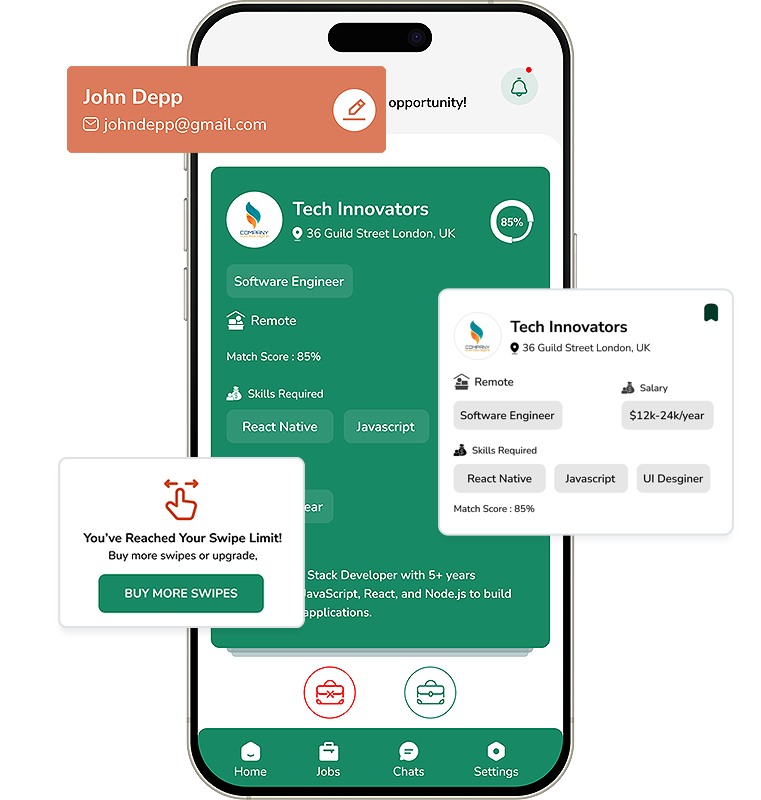
JobMinglr saw that existing job search tools were not matching people to roles accurately. Job seekers received irrelevant recommendations, employers had limited filtering, applications were slow, and neither side had real-time tracking or notifications.
Xicom designed and developed iOS and Android apps with three connected panels: a job seeker panel with ML-powered recommendations, a resume builder, profile customization, real-time alerts, and in-app applications; an employer panel with candidate filters, applicant notifications, detailed profiles, and interview scheduling; and an admin panel for users, job approvals, analytics, and reporting.
45%Better job matching accuracy
35%Shorter time-to-hire
40%Higher job seeker engagement
25%More successful placements
Why choose Xicom as your job portal development company?
Hiring platforms combine marketplace economics, search engineering, HR integrations, and sensitive personal data. As a job portal app development company, we bring those skills into one delivery team, so your portal works for candidates, earns from employers, and holds up as it grows.
WHY CHOOSE US
Hands-On Recruitment Platform Experience
Our team built JobMinglr, a job-matching app with separate job seeker, employer, and admin experiences, so we already understand the trade-offs between candidate convenience, employer filtering, and moderation.
That recruitment work sits on two decades of custom software development under CMMi Level 3 delivery practices, for startups, agencies, and enterprises in the USA and worldwide.
01
Built for Search and Scale
We design the search index, caching, and job data model early, so filters stay fast and listings stay current as jobs, candidates, and traffic grow.
02
Candidate Data Handled Responsibly
Encryption, consent records, retention rules, and role-based access are built in. Our delivery processes are certified to ISO/IEC 27001 and SOC 2 Type II.
03
Practical, Accountable AI
Our custom AI development team adds matching, parsing, and chatbots only where they help, with human review, explainable criteria, and bias testing built into delivery.
04
Engagement That Fits Your Stage
Validate a niche board with a fixed-price MVP, extend your team when you hire mobile app developers from us, or grow the platform with a dedicated product team.
Client testimonials and reviews showcasing the value we consistently deliver
Explore how our clients describe their journey with us, reflecting strong collaboration, effective execution, and consistent outcomes delivered across engagements. See how our delivery framework ensures consistency from initiation through to successful completion.
❝
Parity AI
We came to Xicom with an ambitious goal: make institutional-grade financial planning accessible to everyone through AI. Xicom went beyond the brief, blending conversational AI and predictive analytics into an effortless platform. Parity AI is exactly what we envisioned.

❝
RadioFX
Xicom took the time to understand what our stations and listeners actually need, building something tailored rather than generic. Live chat and polls are now core to how we connect with our audience — the app has become a true extension of our on-air presence.


❝
StudyBuddy
Xicom built exactly what our students needed: a secure space to connect, collaborate, and find tutoring support in one place. Their understanding of student behavior shows in how naturally everything fits together — StudyBuddy is something students genuinely rely on.

❝
BoxxDocks
Xicom helped us bring BoxxDocks to life exactly as we envisioned it. Their team understood the complexity of AI powered real-time asset tracking and delivered a platform that's both powerful and genuinely easy to use.


❝
TodayFit
We are very happy with their services. I cannot recommend them highly enough. The value, ability, and delivery that we have seen has been superb, and we look forward to continuing this relationship.


❝
SmartVend AI
Their team built SmartVend from the ground up, combining hardware integration, real-time inventory sync, and a centralized dashboard that completely changed how we operate. We couldn't have asked for a more capable technical partner.

❝
Tap Retail
Partnering with Xicom to develop our Tap Retail app and website was one of the best decisions we made. Their team demonstrated exceptional professionalism, technical expertise, and a deep understanding of our business goals.


❝
GoGmGo
Partnering with Xicom was a game-changer for us. They didn't just build software, they helped us redefine how we run our business. Their proactive support and deep domain knowledge gave us the confidence to innovate faster.

❝
DENVEN
Working with Xicom has been a transformative experience. Their team quickly understood our challenges and delivered a scalable, intuitive solution. I highly recommend Xicom to any organization seeking future-ready, high-performance digital products.

Top tech insights of our blog
Explore latest tech stories & News
✦ AI-First Company
Deep Insights into Emerging Technology and Innovation!
Stay ahead in the digital world with our latest insights covering AI trends, industry developments, and expert advice on building smarter businesses.
1800+
Projects
20+
Years Experience
Frequently Asked Questions
What does a job portal development company do?
A job portal development company plans, designs, builds, and maintains online recruitment platforms: job boards, recruitment marketplaces, staffing agency portals, and enterprise career sites. The work covers candidate and employer experiences, job search and filtering, application management, payments, integrations with applicant tracking systems and HR software, security, and support after launch. Xicom handles each of these stages for startups, agencies, and enterprises.
What is the difference between a job portal, a job board, and an applicant tracking system?
A job board is the public listing and search experience where employers post jobs and candidates apply. A job portal usually goes further, adding candidate and employer accounts, dashboards, messaging, and paid plans. An applicant tracking system (ATS) is the internal tool recruiters use to move applicants through screening, interviews, and offers. Many custom projects combine a public job portal with ATS features or connect the portal to an ATS the employer already uses.
How much does custom job portal development cost?
Cost depends on the platform type, the number of user roles, whether you need web and mobile apps, which ATS, HRIS, and payment systems you integrate, and how much AI matching or resume parsing is in scope. A niche job board with posting, search, and employer plans costs far less than a multi-tenant recruitment SaaS with ATS sync and AI features. Xicom provides a written estimate after a short scoping phase.
How long does it take to build a job portal?
A focused MVP with job posting, search and filters, candidate profiles, applications, and employer billing typically takes a few months. Platforms with mobile apps, ATS or HRIS integrations, AI matching, multi-tenant career sites, or large job imports take longer. Integration access and the quality of existing job and candidate data often decide the schedule, so both are reviewed in the first weeks.
Can you add AI candidate matching and resume parsing to a job portal?
Yes. Xicom builds resume parsing that extracts skills, experience, and education into structured profiles, semantic job search that understands related titles and skills, and matching that ranks jobs for candidates and candidates for recruiters. These features assist people rather than make hiring decisions. Recruiters keep final review, matching criteria are documented, and outputs are tested for bias before and after launch.
Can the job portal integrate with our ATS or HR software?
Yes. Xicom connects job portals to applicant tracking systems, HRIS platforms, background check and assessment providers, calendars, and email or SMS services through their APIs, webhooks, or unified HR APIs. Jobs, applications, and candidate status can stay in sync in both directions. Available options depend on what each vendor exposes, which is confirmed during discovery.
How do you protect candidate data and meet US hiring rules?
Candidate profiles and resumes contain personal information, so Xicom builds with encryption, role-based access, consent records, data retention controls, and audit logs. Privacy requirements such as the CCPA, and GDPR for EU candidates, are mapped during discovery. Where automated tools help screen or rank candidates, rules such as New York City's Local Law 144 may require bias audits and candidate notices, so these are planned with your legal or compliance team.
Will our job listings appear in Google search results for jobs?
Xicom adds JobPosting structured data, clean job URLs, XML sitemaps, and expiry handling so listings are eligible for Google's job search experience and can be shared with job aggregators through feeds. Eligibility depends on meeting Google's content and structured data guidelines, and inclusion is decided by Google, not guaranteed by the developer.
Has Xicom built recruitment or job search software before?
Yes. Xicom designed and developed JobMinglr, a job-matching app for a US client available on Android and iOS. It includes job seeker, employer, and admin panels with machine learning job recommendations, a resume builder, real-time alerts, employer candidate filters, and interview scheduling, built with React Native and Node.js.
Can you modernize or take over an existing job portal?
Yes. Xicom audits existing job portals for code quality, performance, security, and search visibility, then plans a phased upgrade. That can mean moving to a modern frontend, rebuilding search, migrating jobs and candidate data, adding mobile apps, or moving hosting to the cloud, while keeping the live platform and its job URLs running during the transition.
Every award marks a milestone in our journey of excellence
As an AI-first digital engineering company, Xicom has earned global recognition for delivering innovative, scalable, and high-performing technology solutions. Our awards reflect the trust of clients and industry leaders alike.