×
Restaurant App Development Company
Every order placed through a third-party app costs you a commission and a piece of the guest relationship. As a restaurant app development company for independent restaurants, chains, cafes, and franchise groups, Xicom builds branded iOS, Android, and web apps for online ordering, table reservations, loyalty, and contactless dining, connected to your POS and kitchen.
Plan Your Restaurant App
- 20+ Years in Business
- 350+ IT Experts
- 750+ Enterprise Clients
- CMMi Level 3 Certified
- ISO 9001:2015
- Top 1% on TrustPilot
-
 4.8 on Clutch
Our valued Brands & Agencies
















Restaurants run on thin margins and busy shifts, so an app cannot add work for the team. It has to show the right menu at every location, send clean tickets to the kitchen, and stay fast when the Friday dinner rush hits. Xicom designs around your service flow first, then builds the app to fit it.
What Every Restaurant App We Build Handles Well
- Rush-Hour Performance Autoscaling services, cached menus, and order throttling by pickup slot keep checkout fast and stop the kitchen from being flooded at peak times.
- Menu & Order Accuracy Real-time POS sync for prices, modifiers, sold-out items, and allergen notes means guests only order what the kitchen can actually make.
- Secure Payments & Guest Data Tokenized cards, digital wallets, consent-based marketing, and role-based staff access protect payment details and guest profiles.
- Guest Data You Own Direct ordering builds your own record of guest preferences and order history, ready for loyalty offers and targeted campaigns.
Restaurant app compliance standards we build to align with

PCI DSS

GDPR

CCPA

SOC 2

ISO 27001

OWASP MASVS

WCAG 2.2

OAuth 2.0
Restaurant app development services built around the guest
From the first menu tap to the next visit, these are the restaurant app devlopment services we deliver as a restaurant mobile app development company, each scoped to your service style and existing systems.
Branded Online Ordering Apps
Guests abandon an order when the menu is slow or checkout asks too much. We build ordering apps for iOS, Android, and web with photo menus, modifiers, dietary filters, saved favorites, one-tap reorder, and scheduled pickup or delivery. Native or cross-platform builds are chosen around your budget, and every screen is designed for a short path from menu to paid order.
Table Reservation & Waitlist Apps
Empty tables and no-shows cost more than most owners track. We build reservation apps with live table availability, party size and seating preferences, deposits or card holds for busy nights, digital waitlists with text alerts, and a host view of the floor. Guests book in seconds, and your team sees covers coming before the doors open.
QR, Table-Side & Kiosk Ordering
Busy floors run smoother when guests can order and pay without waiting for a server. We build QR code menus, table-side ordering on staff handhelds, and self-service kiosks with upsell prompts, split bills, tips, and pay-at-table. Orders carry the table number straight to the kitchen, so servers spend more time on hospitality and less on the order pad.
Loyalty, Rewards & Guest CRM
Regulars are your most profitable guests, so the app should give them a reason to return. We build points and tier programs, digital punch cards, birthday rewards, referral offers, and gift cards, backed by a guest CRM that segments by visit frequency and order history. Push and SMS campaigns go to the right guests instead of everyone.
POS, Kitchen & Third-Party Integrations
An app that does not talk to your POS creates double entry and missed tickets. We connect POS systems such as Toast, Square, or Clover where partner APIs allow, kitchen display systems, payment gateways like Stripe or Adyen, Apple Pay and Google Pay, inventory and accounting tools, and on-demand delivery networks such as DoorDash Drive or Uber Direct.
AI Features for Menus, Demand & Service
Order history can tell you what to prep and what to promote. With our AI development team, we add personalized menu suggestions, demand forecasting for prep and staffing, review sentiment analysis across platforms, and chatbots that handle bookings and common questions. Each model ships with monitoring so you can check its accuracy over time. Our guide to AI in the food industry covers more use cases.
Accelerating enterprise transformation through AI and digital engineering.
20+
Years in Business
350+
IT Professionals
ISO 9001 Certified
NASSCOM & STPI Accreditation
NASSCOM & STPI Accreditation
750+
Clients Worldwide
1800+
Projects Executed
Who We Build For
Restaurant apps shaped around how you serve guests.
A fine-dining room, a coffee chain, and a cloud kitchen all serve food, but their guests want very different things from an app. As a custom restaurant app development company, we start with your service style and build only what your guests and staff will use.
Discuss Your RestaurantIndependent & Full-Service Restaurants
Independent owners need tools that work without an IT team. We build apps for reservations, pickup ordering, gift cards, and simple loyalty, with a back office the manager can update from a phone between services.
Quick-Service & Fast-Casual Chains
Speed and consistency matter most at QSR scale. We build order-ahead apps with pickup time slots, curbside check-in, drive-thru order codes, and kiosk ordering, plus central menu control so every location shows the right prices and availability.
Cafes, Coffee Shops & Bakeries
Morning rushes leave little room for long lines. We build mobile order-and-pay apps with saved drink customizations, stored-value wallets, and stamp-style rewards, so regulars skip the queue and come back more often.
Franchises & Multi-Brand Groups
Groups need brand control at the top and flexibility at each location. We build multi-location and multi-brand platforms with shared customer accounts, location-level menus and hours, franchisee dashboards, and consolidated reporting.
Cloud Kitchens & Virtual Brands
Delivery-only kitchens often run several brands from one line. We build ordering storefronts for each brand that feed a single kitchen display, so the team sees every ticket in one queue and owners can compare margins by brand.
Catering & Corporate Dining
Large orders need lead times, deposits, and approvals. We build catering ordering with event menus and scheduling, plus business accounts where companies fund employee meals and receive one consolidated invoice.
Pick the ordering model that fits your service
Two questions shape most restaurant apps: where does the guest eat, and when do they order? Your answers decide which screens and integrations you need first, how the kitchen receives orders, and which features can wait for a later release.
Order ahead for pickup
Guests order and pay in the app, then collect at the counter, curbside, or drive-thru at a chosen time.
You need: Ordering app, pickup slots, POS sync, order dashboardDirect delivery
Guests order from your brand, and a courier network or your own drivers bring the food to their door.
You need: Ordering app, delivery zones, courier API or driver app, adminDine-in ordering and payment
Guests scan a table QR code or use a kiosk to order, add to their tab, split the bill, and pay without waiting.
You need: QR or kiosk menu, table mapping, KDS link, pay-at-tableReservation-led dining
Full-service and fine-dining rooms where the key moment is booking a table, then building a relationship with the guest.
You need: Booking app, waitlist, host view, guest CRM and loyaltyReady to launch a restaurant app guests order from directly?
Whether you want to cut marketplace commissions, fill more tables, or roll out one app across every location, we can turn your goals into a phased build plan. Tell us how your restaurant runs, and our team will map the features, integrations, and launch steps.
The technical backbone behind every ticket your kitchen fires
Guests only see a menu and a confirmation screen. Behind them, several systems have to agree on what is available, what was paid, and when the kitchen should start cooking. Expand each layer to see what runs underneath every order.
Menus, prices, modifiers, and sold-out items flow from your POS to the app, so a dish marked unavailable in the kitchen disappears from the app within moments.
Each location can keep its own hours, prices, and specials while sharing one brand-level menu structure managed from the admin panel.
- Two-way POS menu sync
- Location-level pricing and hours
- Instant sold-out updates
Cards and wallets are tokenized through the payment gateway, so card numbers never reach your servers. Failed payments are retried safely without charging the guest twice.
Split bills, tips, service charges, taxes, gift cards, and stored-value balances are handled in one checkout flow.
- PCI DSS validated gateways
- Duplicate-charge protection
- Split bills and tipping
App orders reach the kitchen display or ticket printer like any other order, routed to the right station and timed to the guest's pickup or delivery slot.
Order throttling limits how many orders each time slot accepts, so the kitchen stays on pace during peak service instead of falling behind.
- Kitchen display integration
- Station-level ticket routing
- Time-slot order limits
Restaurant app case study from Xicom
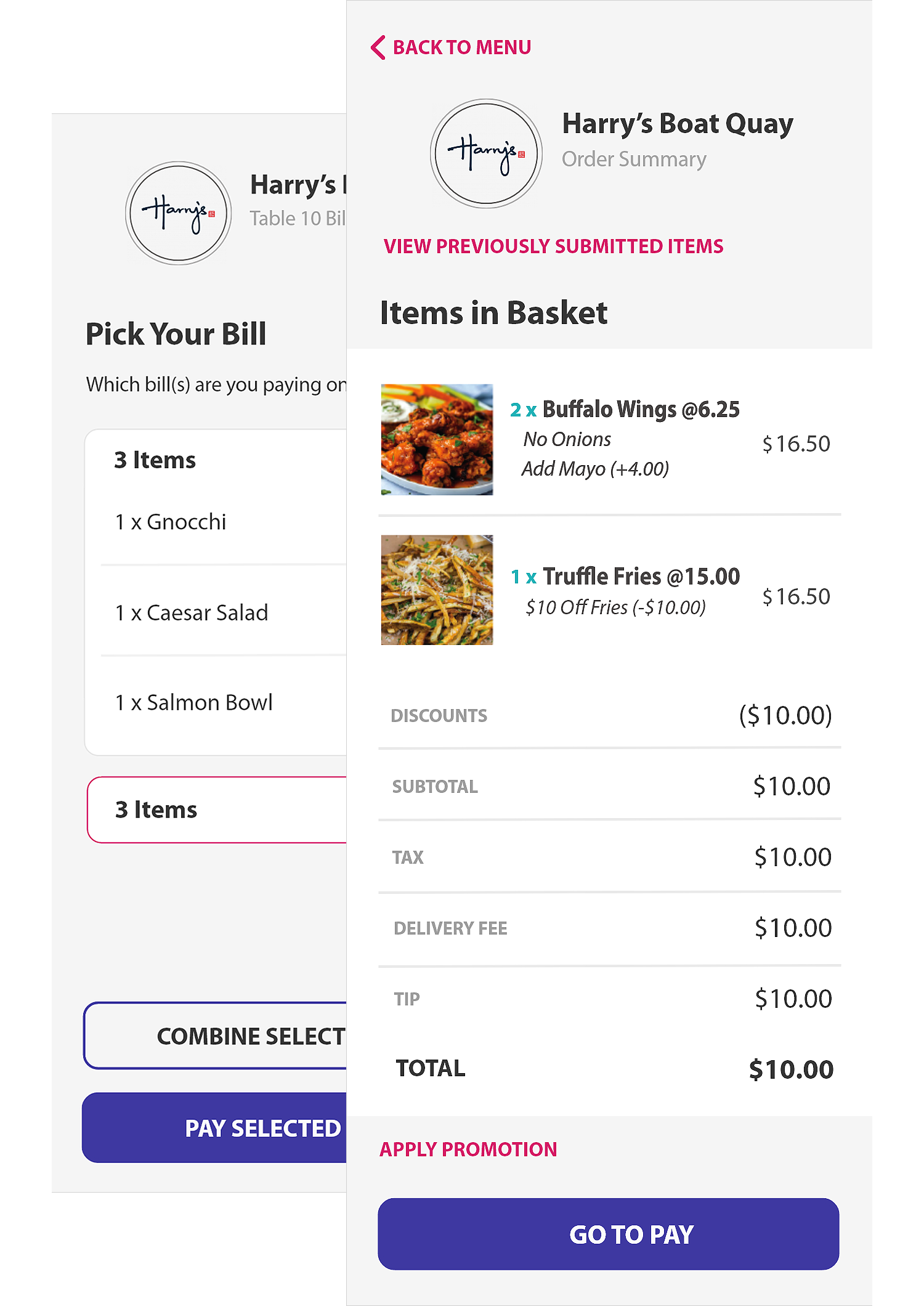
GoGmGo shows our restaurant technology work at scale: a Singapore-based F&B operating platform that brings POS, inventory, HR, finance, and guest feedback together across hundreds of outlets.
GoGmGo F&B POS and CRM
The Challenge
GoGmGo needed one platform to run F&B businesses across many stores and brands. Legacy tools gave no real-time view of store performance, caused reconciliation errors between outlets, and offered limited offline POS support, so sales suffered during outages.
Our Approach
We built a cloud platform in React Native and Node.js on MongoDB, with AI/ML for automated reconciliation. It includes an offline-capable POS, real-time inventory and recipe margin tracking, a staff app for shifts and payroll, multi-entity reporting, and a review aggregator for guest feedback.
The Result
- 99.9% POS uptime with offline capability
- 65% improvement in inventory accuracy
- Scaled to 300+ outlets on one cloud system
How one order moves through your restaurant
Restaurant app features are easiest to understand in the order a guest meets them. Here is a typical order from first tap to next visit, and which part of the system does the work at each step.
1
Browse & Customize
The guest picks a location, browses the live menu, and adds modifiers, notes, and rewards.
2
Pay & Confirm
Card or wallet payment, a pickup, delivery, or table choice, and an instant confirmation with timing.
3
Fire to Kitchen
The order reaches the POS and kitchen display, routed to the right station at the right time.
4
Serve or Hand Off
Ready alerts for pickup, table delivery for dine-in, or a courier booked for delivery orders.
5
Reward & Return
Points are added, feedback is requested, and order history shapes the next personalized offer.
What shapes restaurant app development cost
Restaurant app development cost depends less on screen count and more on the number of locations, the systems the app must connect to, and how many ways guests can order. Most restaurants build in phases. Here is what each phase typically adds, so you can see where scope and budget grow.
Phase 1
Launch
Move regulars to direct ordering
- Ordering app on iOS, Android, or web
- Live menu with modifiers
- Pickup ordering and time slots
- Card and wallet payments
- Order dashboard for staff
Phase 2
Grow
Bring guests back more often
- Loyalty, rewards, and gift cards
- POS and kitchen display sync
- Reservations and waitlist
- Delivery through a courier API
- Push and SMS campaigns
Phase 3
Scale
Run every location well
- Multi-location and franchise controls
- QR, table-side, and kiosk ordering
- Multi-brand storefronts
- Catering and business accounts
- AI recommendations and forecasting
How we take a restaurant app from idea to first order
As a restaurant application development company, we plan every release around real service conditions, so the app fits how your front of house and kitchen already work and holds up on your busiest nights.
Discover
Menu Mapping
Service flow, menus, locations, and POS needs reviewed.
1 to 2 Weeks
Design
Guest & Staff UX
Guest app and staff screens tested with real guests and staff.
2 to 3 Weeks
Build
Ordering & POS
Sprints for ordering, payments, loyalty, and POS sync.
Agile Sprints
Validate
Rush-Hour QA
Payment, menu edge case, and peak order volume testing.
Pre-Launch
Launch
Soft Launch
Live at one or two locations, then rolled out chain-wide.
OngoingWhy choose Xicom as your restaurant app development company
Restaurant apps need polished guest experiences, reliable POS integration, and payments that work on the busiest night of the week. Xicom has delivered software for 20+ years, with 1,800+ projects for 750+ clients across 50+ countries, including restaurant and F&B platforms in production.
We Have Shipped F&B Apps in Production
Beyond GoGmGo, we built LunchServed, a dining app for table booking, meal pre-ordering, bill splitting, and company-funded employee meals, and the Keeta food delivery app. You start with a team that already understands restaurant workflows.
We Design for Kitchen and Floor Staff, Not Just Guests
An app that delights guests but slows down the line will not last a week. We design staff screens for fast order acceptance, clear tickets, and quick menu changes, and we test them with the people who use them during service.
Certified Security Practices in Our Delivery
Xicom holds ISO/IEC 27001 and SOC 2 Type II certifications, and those controls shape how our teams handle your code, credentials, and test data. For your app, we tokenize payments through PCI DSS validated gateways, limit staff access to guest data by role, and log admin actions for audits.
Engagement That Matches Your Stage
Independent restaurants often start with a fixed-price first release, while chains extending existing systems usually prefer time and material. We support all three engagement models, hold a 4.8 rating on Clutch, and stay on after launch to support your mobile apps and backend as you add locations.
Restaurant app development tech stack
Restaurant apps depend on fast menus, reliable order events, and accurate location data for store finders and delivery zones. We pair proven mobile frameworks with event-driven backends and well-tested databases, then add the POS, payment, and messaging integrations your restaurant uses. The final stack depends on your scale and existing systems.
 React Native
 Flutter
 Swift
 Kotlin
 React
 Next.js
 TypeScript
 Angular
 Node.js
 Python
 Go
 Firebase
WebSockets
 Apache Kafka
 PostgreSQL + PostGIS
 MongoDB
 Redis
Elasticsearch
Google Maps Platform
Mapbox
 AWS
 Google Cloud
 Microsoft Azure
 Docker
 Kubernetes
 Terraform
Client testimonials and reviews showcasing the value we consistently deliver
Explore how our clients describe their journey with us, reflecting strong collaboration, effective execution, and consistent outcomes delivered across engagements. See how our delivery framework ensures consistency from initiation through to successful completion.
❝
Parity AI
We came to Xicom with an ambitious goal: make institutional-grade financial planning accessible to everyone through AI. Xicom went beyond the brief, blending conversational AI and predictive analytics into an effortless platform. Parity AI is exactly what we envisioned.

❝
RadioFX
Xicom took the time to understand what our stations and listeners actually need, building something tailored rather than generic. Live chat and polls are now core to how we connect with our audience — the app has become a true extension of our on-air presence.


❝
StudyBuddy
Xicom built exactly what our students needed: a secure space to connect, collaborate, and find tutoring support in one place. Their understanding of student behavior shows in how naturally everything fits together — StudyBuddy is something students genuinely rely on.
❝
BoxxDocks
Xicom helped us bring BoxxDocks to life exactly as we envisioned it. Their team understood the complexity of AI powered real-time asset tracking and delivered a platform that's both powerful and genuinely easy to use.

❝
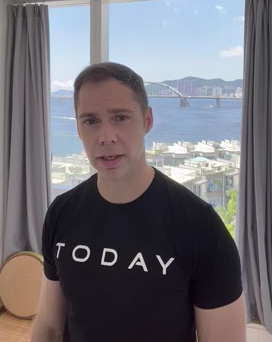
TodayFit
We are very happy with their services. I cannot recommend them highly enough. The value, ability, and delivery that we have seen has been superb, and we look forward to continuing this relationship.


❝
SmartVend AI
Their team built SmartVend from the ground up, combining hardware integration, real-time inventory sync, and a centralized dashboard that completely changed how we operate. We couldn't have asked for a more capable technical partner.

❝
Tap Retail
Partnering with Xicom to develop our Tap Retail app and website was one of the best decisions we made. Their team demonstrated exceptional professionalism, technical expertise, and a deep understanding of our business goals.


❝
GoGmGo
Partnering with Xicom was a game-changer for us. They didn't just build software, they helped us redefine how we run our business. Their proactive support and deep domain knowledge gave us the confidence to innovate faster.

❝
DENVEN
Working with Xicom has been a transformative experience. Their team quickly understood our challenges and delivered a scalable, intuitive solution. I highly recommend Xicom to any organization seeking future-ready, high-performance digital products.

Top tech insights of our blog
Explore latest tech stories & News
✦ AI-First Company
Deep Insights into Emerging Technology and Innovation!
Stay ahead in the digital world with our latest insights covering AI trends, industry developments, and expert advice on building smarter businesses.
1800+
Projects
20+
Years Experience
Frequently Asked Questions
What does a restaurant app development company build?
A restaurant app development company builds the guest-facing app for ordering, reservations, payments, and loyalty, plus the tools behind it: a menu and order dashboard for staff, an admin panel for owners, and the backend that connects everything to your POS and kitchen. Xicom also handles app store launch and ongoing support.
How much does it cost to develop a restaurant app?
Cost depends on the features you launch with, how many platforms you target, which POS and delivery systems the app must connect to, the number of locations and languages, and any AI features. A pickup-ordering app for one restaurant costs far less than a multi-brand platform with loyalty and delivery. We share a written estimate after a short scoping phase.
How long does it take to build a restaurant app?
An app with menu browsing, ordering, payments, and an order dashboard usually takes a few months. Reservations, loyalty, POS sync across many locations, and delivery add time. We recommend launching at one or two locations first, because real service reveals menu and kitchen timing issues that testing alone cannot.
Should we build our own app or rely on DoorDash and Uber Eats?
Most restaurants benefit from both. Marketplaces help new guests find you, while a branded app lets regulars order directly, without marketplace commission on each order, and gives you their contact details and order history for loyalty and marketing. Many restaurants list on marketplaces and use their own app to move repeat guests to direct ordering.
Can the app handle delivery without our own drivers?
Yes. Your app can book a courier for each order through on-demand delivery networks such as DoorDash Drive or Uber Direct, so guests order from your brand while a partner handles the drive. Restaurants with steady volume can add their own driver app later. We help you compare both options against your order volume and margins.
Can the app integrate with our POS and kitchen systems?
Yes. We integrate POS systems such as Toast, Square, or Clover where partner APIs allow, along with kitchen display systems, loyalty, CRM, inventory, and accounting tools. App orders reach the kitchen like any other ticket, and menu, price, and availability changes made in the POS appear in the app without manual updates.
Should we build a native or cross-platform restaurant app?
Cross-platform frameworks such as React Native or Flutter suit most restaurant apps, because one codebase serves iOS and Android and keeps menus and features in sync on both. Native Swift or Kotlin development makes sense for kiosk hardware, deep device integration, or very high performance needs. We recommend an approach after reviewing your features and budget.
How do you keep payments and guest data secure?
Card payments are tokenized through PCI DSS validated gateways, so card numbers never touch your servers. We encrypt data in transit and at rest, limit staff access by role, collect marketing consent, and log admin actions. Xicom holds ISO/IEC 27001 and SOC 2 Type II certifications, and security testing is part of every release.
Which engagement models does Xicom offer?
We offer Fixed Price for well-defined first releases, Time and Material for integration-heavy or evolving scopes, and Dedicated Team for long-term product development. Many restaurant clients start with a fixed-price launch at a few locations, then add dedicated mobile app developers as locations and features grow.
Do you provide support after launch?
Yes. After launch we monitor uptime, failed orders, payment errors, and app crashes, release OS and security updates, keep POS and delivery integrations current as partner APIs change, and add features as you open new locations. We also handle app store updates and review requirements.
Every award marks a milestone in our journey of excellence
As an AI-first digital engineering company, Xicom has earned global recognition for delivering innovative, scalable, and high-performing technology solutions. Our awards reflect the trust of clients and industry leaders alike.