×
Taxi Booking App Development Company
Xicom is a taxi booking app development company for fleet operators, ride-hailing startups, and corporate mobility providers. We build rider apps, driver apps, and dispatch panels with real-time tracking, accurate ETAs, and secure in-app payments, designed to keep matching fast when demand peaks and drivers are scarce.
Plan Your Taxi App
- 20+ Years in Business
- 350+ IT Experts
- 750+ Enterprise Clients
- CMMi Level 3 Certified
- ISO 9001:2015
- Top 1% on TrustPilot
-
 4.8 on Clutch
Our valued Brands & Agencies
















Riders leave the moment a booking spins without a driver, and drivers leave when trips feel unfair. Xicom builds dispatch logic, payment security, and safety features into the core of your platform, so it meets transport authority rules and keeps both sides of the marketplace moving.
Our Core Business-Driven Capabilities
- PCI DSS Payment Security: Tokenizes cards, wallets, and payouts through compliant gateways so no raw card data touches your servers.
- Real-Time Dispatch Engine: Matches riders to the nearest suitable driver using live location, vehicle type, and acceptance history.
- Rider & Driver Safety Controls: Adds SOS alerts, trip sharing, driver document checks, and masked phone numbers to every ride.
- GDPR & CCPA Location Privacy: Limits location retention, captures consent, and gives riders control over their trip history and personal data.
Taxi app compliance standards we follow

PCI DSS

GDPR

CCPA

ISO 27001

SOC 2

OWASP MASVS
Mobile App Security

WCAG
Accessibility Guidelines

RTA Dubai
(Transport Authority Rules)

NYC TLC
(Taxi & Limousine Commission)

OAuth 2.0
Secure Authentication
Taxi booking app development services for every side of the ride
A ride involves three apps working as one: rider, driver, and dispatch. These are the taxi booking app development services we deliver for each piece of the trip.

Rider App Development
Riders judge your app in the few seconds between tapping Book and seeing a driver. We build rider apps with fast pickup selection, upfront fares, live driver tracking, ride scheduling, and multiple payment options including cards, wallets, and cash. Saved places, ride history, and in-app ratings make repeat bookings faster, which is where long-term ride volume actually comes from.

Driver App Development
Drivers stay on platforms that respect their time and pay them clearly. Our driver apps include trip requests with pickup distance, turn-by-turn navigation, earnings dashboards, document upload for verification, and shift availability controls. Battery-efficient location tracking keeps the app running through long shifts without draining phones mid-trip, so drivers stay online when you need them most.

Dispatch & Admin Panel Development
Operators cannot fix what they cannot see. We build web-based dispatch panels with a live map of every vehicle, manual booking for phone and corporate requests, fare and zone management, driver onboarding workflows, and reporting on trips, revenue, and cancellations. Support teams get full trip timelines that resolve rider and driver complaints without guesswork.

Smart Matching & ETA Engines
A slow or unfair match costs you both the rider and the driver. We develop matching algorithms that weigh distance, traffic, vehicle type, and driver acceptance patterns, with ETA calculations based on live road conditions through Google Maps or Mapbox. Surge and zone-based pricing rules are configurable from the admin panel, so operations can react without a code release.

Payments, Wallets & Driver Payouts
A failed payment at drop-off turns a good ride into a support ticket. We integrate Stripe, Braintree, Razorpay, and regional gateways with tokenized cards, in-app wallets, promo codes, split fares, and tipping. Automated driver payouts and commission rules keep your finance team out of spreadsheet reconciliation at the end of every week.

Corporate & Multi-Service Mobility
Many taxi businesses grow by adding services rather than cities. We extend platforms with corporate accounts and invoicing, airport transfers, hourly rentals, EV and premium vehicle classes, and parcel delivery modules, all running on the same driver network and dispatch engine, so each new revenue line launches without a separate product.
Accelerating enterprise transformation through AI and digital engineering.
20+
Years in Business
350+
IT Professionals
ISO 9001 Certified
NASSCOM & STPI Accreditation
NASSCOM & STPI Accreditation
750+
Clients Worldwide
1800+
Projects Executed
Taxi Fleet Digitization
Traditional fleets often run on radio dispatch and phone bookings. We give them branded rider apps, driver apps, and a dispatch console that keep existing phone bookings flowing while moving new demand onto mobile, without forcing drivers to juggle two tools during a shift.
Ride-Hailing Marketplaces
Peer-driver marketplaces depend on balancing supply and demand in real time. We build platforms with driver onboarding and background-check integrations, dynamic pricing, incentive programs, and multi-city configuration for startups planning to expand market by market.
Corporate & Employee Transport
Companies moving staff need control over who rides, where, and on whose budget. We build corporate ride platforms with employee policies, approval rules, cost-center billing, and scheduled shuttle routes that HR and finance teams can manage from one dashboard.

Airport & Outstation Transfers
Pre-booked transfers fail when flights land late and nobody adjusts. We build booking systems with flight tracking, meet-and-greet notes, fixed fares by route, and driver assignment ahead of pickup, so long-distance and airport trips run on schedule even when arrivals slip.

Bike & Auto Rickshaw Taxi Apps
Two- and three-wheeler rides need lighter apps and different pricing. Our cab booking app development for this segment is tuned for short urban trips, entry-level Android devices, cash-heavy payments, and dense pickup points in traffic-heavy cities where speed matters more than features.

White-Label Taxi Platforms
Some operators launch in several regions under different brands. We build configurable taxi platforms with brand-level theming, separate pricing per market, and shared backend infrastructure, so each new launch is a setup task for your team rather than a fresh build.
Case studies of mobility clients gaining ground with custom taxi apps
This project shows what our taxi app development work delivers in production: faster matching at peak hours and a platform built to grow across markets.
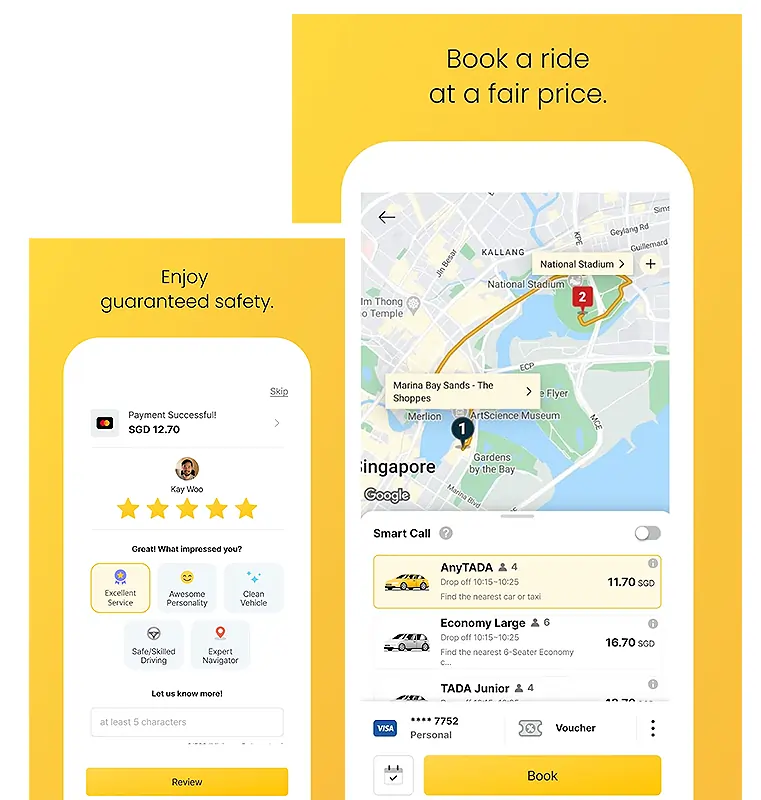
TADA Taxi Booking App
The Challenge
TADA faced unbalanced ride distribution, delayed driver matching during peak hours, no taxi option, limited suburban coverage, and backend scalability issues that pushed users to drop off and kept booking volumes low across its markets.
Our Approach
We built a multi-modal ride-hailing platform with Flutter and Node.js on MongoDB, a Smart Call feature using predictive analytics to improve rider-driver matching, real-time tracking through the Google Maps API, taxi, EV, and SUV modules localized per region, and a dedicated driver portal.
The Result
- 10x increase in user base in Singapore within 12 months of launch
- 35% faster ride matching during peak hours
- Taxi, EV, and SUV ride options with wider suburban coverage
Ready to launch a Taxi App riders come back to?
From a single-city launch to a multi-service mobility platform, we build taxi apps with the dispatch logic, payment security, and driver tools to perform under peak demand. Tell us how your fleet operates, and we will map out the build.
Core technologies and Mobility infrastructure we deploy
Taxi apps depend on location data that updates every few seconds, payments that never double-charge, and backends that handle the evening rush without lag. These are the frameworks, mapping services, real-time tools, and payment APIs we use for taxi app development.
 Swift (iOS)
 Kotlin (Android)
 Flutter
 React Native
 React.js
 Angular
 Next.js
 TypeScript
 Node.js
 Python
 Java
 Go
Google Maps Platform
Mapbox
HERE Location Services
OSRM
Socket.IO
 Firebase
 Apache Kafka
 Redis
MQTT
 MongoDB
 PostgreSQL
 AWS
 Google Cloud
 Kubernetes
 Stripe
Braintree
Razorpay
 Twilio
Firebase Cloud Messaging
Our end-to-end process for taxi booking app development services
Taxi platforms have to work in real streets, with real traffic and patchy mobile networks. Our process tests for those conditions early, so the app you launch behaves the way it did in the demo.
1
Market & Ops Discovery
We map your service area, vehicle types, fare rules, driver supply model, and local transport regulations, then deliver a spec covering apps, dispatch logic, integrations, timeline, and team size.
2
Architecture & Security
Our architects design location pipelines, matching services, and payment flows, with tokenized payments, masked contact details, and role-based admin access built in from the start.
3
Development & Integration
We build rider, driver, and admin apps in parallel sprints, integrating maps, payment gateways, SMS, and push notifications so complete trips can be tested end to end early.
4
Field Testing
Beyond lab testing, we run live trips in your city on real devices and networks, checking GPS drift, ETA accuracy, and payment retries under realistic conditions before launch.
5
Launch & Scale Support
We support app store releases and phased city launches, then monitor matching times, cancellations, and server load, tuning the platform as ride volume grows.
We Have Shipped Ride-Hailing in Production
Our team built TADA, a multi-modal ride-hailing platform with smart matching, real-time tracking, and taxi, EV, and SUV modules across markets. That experience shapes every new build: we already know where dispatch logic breaks, how GPS behaves in dense cities, and which payment edge cases generate the most support tickets after launch.
Driver Experience Gets Equal Attention
Your platform is only as good as the drivers who keep it running. We design driver apps around clear earnings, fair trip distribution, low battery drain, and fast document verification, because driver churn quietly limits growth long before rider demand does. Feedback from drivers flows into the admin panel, so problems surface early.
Real-Time Systems Done Properly
Location updates, trip states, and payments all change by the second. We use event-driven backends, persistent socket connections, and idempotent payment calls, so a dropped network or a duplicate tap never creates a phantom ride or a double charge. These details decide whether your app holds up during the evening rush.
We Stay Through Every City Launch
Expanding to a new city brings new fare rules, regulations, and map quirks. We stay on after launch to handle new markets, app store updates, gateway changes, and performance tuning, so your team can focus on driver acquisition and marketing instead of maintaining infrastructure.
Client testimonials and reviews showcasing the value we consistently deliver
Explore how our clients describe their journey with us, reflecting strong collaboration, effective execution, and consistent outcomes delivered across engagements. See how our delivery framework ensures consistency from initiation through to successful completion.
❝
Parity AI
We came to Xicom with an ambitious goal: make institutional-grade financial planning accessible to everyone through AI. Xicom went beyond the brief, blending conversational AI and predictive analytics into an effortless platform. Parity AI is exactly what we envisioned.

❝
RadioFX
Xicom took the time to understand what our stations and listeners actually need, building something tailored rather than generic. Live chat and polls are now core to how we connect with our audience — the app has become a true extension of our on-air presence.


❝
StudyBuddy
Xicom built exactly what our students needed: a secure space to connect, collaborate, and find tutoring support in one place. Their understanding of student behavior shows in how naturally everything fits together — StudyBuddy is something students genuinely rely on.

❝
BoxxDocks
Xicom helped us bring BoxxDocks to life exactly as we envisioned it. Their team understood the complexity of AI powered real-time asset tracking and delivered a platform that's both powerful and genuinely easy to use.


❝
TodayFit
We are very happy with their services. I cannot recommend them highly enough. The value, ability, and delivery that we have seen has been superb, and we look forward to continuing this relationship.


❝
SmartVend AI
Their team built SmartVend from the ground up, combining hardware integration, real-time inventory sync, and a centralized dashboard that completely changed how we operate. We couldn't have asked for a more capable technical partner.

❝
Tap Retail
Partnering with Xicom to develop our Tap Retail app and website was one of the best decisions we made. Their team demonstrated exceptional professionalism, technical expertise, and a deep understanding of our business goals.


❝
GoGmGo
Partnering with Xicom was a game-changer for us. They didn't just build software, they helped us redefine how we run our business. Their proactive support and deep domain knowledge gave us the confidence to innovate faster.

❝
DENVEN
Working with Xicom has been a transformative experience. Their team quickly understood our challenges and delivered a scalable, intuitive solution. I highly recommend Xicom to any organization seeking future-ready, high-performance digital products.

Top tech insights of our blog
Explore latest tech stories & News
✦ AI-First Company
Deep Insights into Emerging Technology and Innovation!
Stay ahead in the digital world with our latest insights covering AI trends, industry developments, and expert advice on building smarter businesses.
1800+
Projects
20+
Years Experience
Frequently Asked Questions
Do you build taxi booking app MVPs?
Yes. Xicom builds taxi app MVPs with the core flows that prove demand: rider booking, driver acceptance, live tracking, fare calculation, and payments. Once ride volume validates the model, we add features like surge pricing, scheduled rides, and corporate accounts without rebuilding the foundation.
How do I choose a taxi booking app development company?
Look for a team that has shipped a live ride-hailing product, not just mockups. Ask how they handle dispatch logic, GPS accuracy, and payment failures, and review their case studies and client testimonials. Also confirm they can support you after launch as you expand to new cities.
How much does taxi app development cost?
Cost depends on the number of apps (rider, driver, admin), matching complexity, payment and map integrations, platform choice, and how many cities or service types you launch with. A single-city MVP costs less than a multi-service platform. Share your requirements for a project-specific quote.
How long does it take to build a taxi booking app?
Timelines vary with scope. An MVP covering booking, tracking, and payments moves faster than a platform with corporate accounts, multiple vehicle classes, and multi-city pricing. Field testing and app store review also affect the schedule. We provide a detailed timeline after discovery.
Do you build taxi apps for both iOS and Android?
Yes. We build native apps in Swift and Kotlin or cross-platform apps in Flutter and React Native, depending on your budget and performance needs. The dispatch and admin panel is a web application that runs in any browser. Learn more about our mobile app development services.
How do you keep rider data and payments secure?
We tokenize payments through PCI DSS compliant gateways, encrypt data in transit and at rest, mask phone numbers between riders and drivers, and restrict admin access by role. Location data handling is aligned with GDPR and CCPA, including consent capture and retention limits.
Can you integrate with our existing dispatch or fleet system?
Yes. We connect new apps to existing dispatch software, fleet telematics, accounting tools, and corporate booking systems through APIs. Where a legacy system has no API, we build a middleware layer so phone bookings and app bookings land in the same dispatch queue.
Can the app support multiple vehicle types and services?
Yes. Platforms can support standard taxis, premium cars, EVs, bikes, and auto rickshaws, along with rentals, airport transfers, and parcel delivery. Each service gets its own pricing rules and vehicle requirements while sharing one driver network and dispatch engine.
What engagement models do you support?
Xicom offers three models: Fixed Price for clearly scoped launches, Time & Material for evolving platforms and multi-city rollouts, and Dedicated Team for ongoing product development. We help you choose the model that fits your launch plan and budget structure.
Do you provide support after the app goes live?
Yes. We monitor server performance and matching times, release app updates for new OS versions, patch security issues, and add features as your business grows. We also support new city launches with updated fare rules, zones, and regional payment gateways.
Every award marks a milestone in our journey of excellence
As an AI-first digital engineering company, Xicom has earned global recognition for delivering innovative, scalable, and high-performing technology solutions. Our awards reflect the trust of clients and industry leaders alike.