Sep 17, 2026 Artificial Intelligence
Retrieval-augmented generation (RAG) is moving from a prototype technique to a production architecture for enterprise AI. Gartner predicts that 40% of enterprise applications will feature task-specific AI agents by the end of 2026, up from less than 5% in 2025. As organizations connect AI to internal knowledge and business workflows, the quality of the retrieval layer becomes a practical engineering concern rather than a model-selection detail.
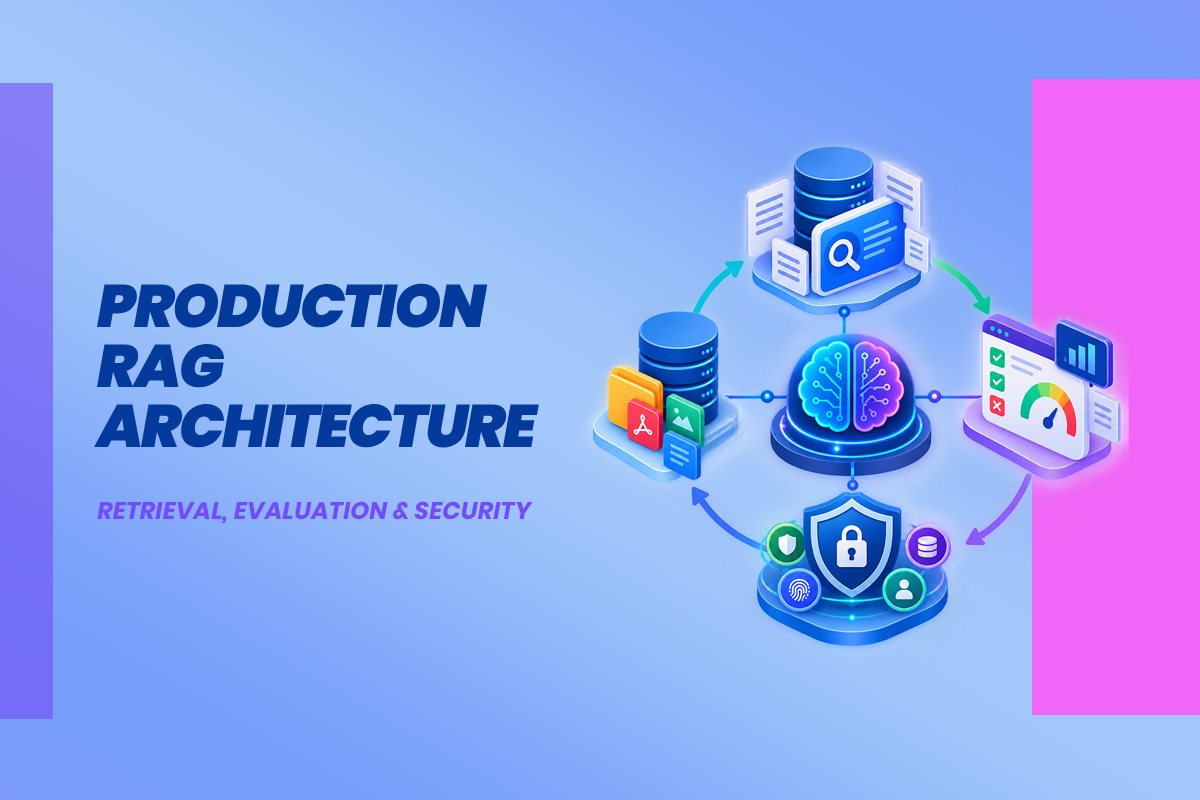
A production RAG system must answer three questions consistently: did it retrieve the right information, did it produce a response supported by that information, and did it expose only information the user was authorized to receive? These questions place retrieval, evaluation, and security at the center of the architecture.
The challenge is that enterprise knowledge is rarely clean or static. Information is distributed across documents, databases, applications, knowledge bases, and collaboration systems. Content changes, permissions differ, and similar documents may represent different versions of the truth. Production RAG therefore needs more than embeddings and a language model. It needs a controlled path from source data to retrieval, context construction, generation, and ongoing operation.
Why Production RAG Requires More Than a Vector Database
A basic RAG demonstration can be built quickly: ingest documents, create embeddings, retrieve the nearest chunks, and pass them to a language model. That approach is useful for proving the concept, but it leaves several production questions unanswered.
What happens when a document is updated? What if two sources disagree? What if the user cannot access one of the retrieved documents? What should the system do when no relevant evidence exists? These questions become more important as RAG moves from an isolated demonstration into applications that support employees, customers, business processes, and decision-making.
Production RAG addresses these concerns through explicit architecture and controls. The knowledge pipeline, retrieval engine, generation layer, security model, evaluation process, and operational monitoring need defined responsibilities. This separation also makes failures easier to diagnose because engineers can determine whether a problem originated in source data, retrieval, context construction, generation, or access control.
| Area | Production requirement | |
|---|---|---|
| Knowledge | Controlled ingestion, parsing, metadata, versioning, and refresh | Keeps retrieved information usable and current |
| Retrieval | Search, filtering, ranking, and evidence thresholds | Determines what reaches the model |
| Generation | Grounded prompting, citations and fallback behavior | Reduces unsupported responses |
| Security | Identity, authorization, isolation and audit | Protects enterprise information |
| Evaluation | Representative tests and repeatable metrics | Makes quality measurable |
| Operations | Tracing, monitoring, latency and cost controls | Supports reliable production operation |
The Architecture Behind Production RAG
A practical production architecture separates the path from enterprise sources to the final response. Source systems remain authoritative; the RAG pipeline prepares their content for retrieval; the retrieval layer selects evidence; and the application controls how that evidence is used. This prevents the language model from becoming the system of record or the security boundary.
| Layer | Primary responsibility | Key production concern |
|---|---|---|
| Source systems | Provide authoritative content and records | Ownership, freshness and permissions |
| Ingestion | Extract, clean and prepare content | Parsing and update handling |
| Knowledge store | Store chunks, metadata and representations | Indexing, retention and versioning |
| Retrieval | Find and rank evidence | Relevance, access filters and latency |
| Generation | Produce the response | Grounding and output constraints |
| Application | Apply business rules and present results | Authorization and workflow control |
Retrieval Architecture
The retrieval architecture determines how enterprise questions are converted into relevant, authorized evidence for the generation layer. A production design typically combines multiple retrieval methods, metadata, ranking, and access controls rather than relying on vector similarity alone.
Retrieval as the Core RAG Layer
Retrieval is the first major production concern because a language model cannot reliably use information that never reaches its context. A larger model does not solve a missing-evidence problem. The retrieval layer therefore needs to be designed around the questions users ask and the structure of the enterprise information behind them.
Many enterprise queries contain both semantic and exact-match elements. A user may ask for the policy governing a particular product, refer to an exact contract number, or combine a natural-language question with a version identifier. A single vector search strategy may not handle all of these requirements effectively.
Hybrid retrieval can combine semantic matching with lexical search, while metadata filters narrow results using known attributes such as product, region, date, department, document type, or classification. Reranking can then improve the ordering of plausible candidates when the initial retrieval stage produces more results than the model should consume.
| Method | Strength | Typical use |
|---|---|---|
| Keyword / lexical | Strong for exact terms and identifiers | Policies, codes, names, and legal language |
| Dense vector | Strong semantic matching | Natural-language questions |
| Hybrid | Combines lexical and semantic signals | General enterprise search |
| Metadata filtering | Restricts the candidate space | Date, region, team or classification |
| Reranking | Improves ordering of retrieved candidates | Ambiguous or high-value queries |
| Structured retrieval | Returns exact records | Transactions, metrics and master data |
The Retrieval Pipeline
A production request should pass through explicit stages rather than moving directly from a user question to a vector database. Each stage creates an opportunity to improve relevance or enforce a control. More importantly, the stages make the system observable. When an answer fails, engineers can identify where the failure occurred.
| Stage | Purpose | Practical control |
|---|---|---|
| Authenticate | Identify the requesting user | Validate identity before protected retrieval |
| Authorize | Determine eligible content | Apply permissions before context assembly |
| Retrieve | Find candidate evidence | Optimize recall and latency |
| Rerank | Prioritize stronger candidates | Use selectively based on measured value |
| Threshold | Reject weak evidence | Allow controlled no-answer behavior |
| Generate | Produce the response | Require grounding and defined fallback behavior |
The important design principle is that retrieval should not be treated as a binary operation. A system should recognize when its evidence is weak. If the top results do not meet an established relevance threshold, returning a controlled limitation or asking for clarification can be safer than generating an answer from marginal matches.
Chunking, Metadata and Source Quality
Chunking is often treated as a configuration setting, but it is better understood as a content-design decision. A technical manual, contract, policy, and support article do not carry meaning in the same way. Splitting every source into identically sized blocks can separate important context or combine unrelated material.
A useful chunk should contain enough information to be understood when retrieved independently while remaining small enough for efficient context construction. Headings, section relationships, table context, and source references should be retained wherever they help explain the meaning of the content.
| Content type | Practical approach | Metadata to retain |
|---|---|---|
| Policies | Preserve sections and qualifying conditions | Policy ID, version, effective date, owner |
| Technical documents | Chunk by logical sections and retain headings | Product, version, document type |
| Contracts | Keep clauses with relevant definitions | Contract, party, jurisdiction, date |
| Support content | Keep issue, question and resolution together | Product, issue type, status |
| Tables | Keep headers and table context with rows | Source, section, table and version |
Metadata is also an architectural control point. It can filter results, enforce access policies, identify current versions, trace citations, and investigate retrieval errors. In a large enterprise corpus, good metadata is often as important operationally as the embedding representation itself.
Beyond Basic Retrieval
Not every RAG application needs an agentic AI retrieval architecture. For a simple internal knowledge assistant, well-designed hybrid retrieval may be sufficient. Complexity becomes justified when a question requires multiple retrieval steps, several sources, structured data, or reasoning about which source to consult next.
| Requirement | Approach to consider |
|---|---|
| Exact terminology | Hybrid lexical and semantic retrieval |
| Several relevant sources | Multi-stage retrieval and synthesis |
| Complex multi-part question | Query decomposition or controlled agentic retrieval |
| Structured business data | Controlled database or API access |
| High-stakes answers | Reranking, thresholds, citations and human review |
The distinction between document retrieval and structured access is particularly important. A question about a transaction, account value, inventory count, or other structured record may be better answered through a controlled database or API than by retrieving a document that happens to contain the same information.
Evaluation
Evaluation determines whether a production RAG system is actually retrieving useful evidence and generating reliable responses. It should cover the retrieval pipeline and final output separately, using representative queries, measurable metrics, and repeatable tests to identify regressions as data, models, and retrieval strategies change.
Evaluating Retrieval and Response Quality
Production RAG needs an evaluation framework that separates retrieval quality from answer quality. Otherwise, teams can spend time changing prompts or models when the real problem is that the correct evidence was never retrieved.
| Evaluation area | What to measure | Question it answers |
|---|---|---|
| Retrieval recall | Relevant evidence in top K | Did the system find what it needed? |
| Retrieval precision | Proportion of useful retrieved content | How much noise entered the context? |
| Ranking | Position and quality of relevant results | Did the strongest evidence appear early? |
| Grounding | Claims supported by retrieved evidence | Is the answer traceable? |
| Abstention | Behavior when evidence is insufficient | Does the system avoid forced answers? |
| End-to-end accuracy | Correctness against approved evidence | Is the final response useful and correct? |
NIST’s AI Risk Management Framework places measurement and ongoing risk management at the center of responsible AI operations. For RAG, this means establishing a measurable baseline before production and repeating evaluation as the system changes.
Building a Representative Test Set
A test set should resemble production traffic. If it contains only clean, frequently asked questions, it will overstate system quality. Real evaluation should include questions with ambiguous wording, missing information, conflicting documents, restricted content, multiple sources, and deliberately adversarial inputs.
| Test category | Purpose | Example |
|---|---|---|
| Common queries | Measure everyday performance | Frequently requested policy question |
| Ambiguous queries | Test clarification behavior | Question with multiple interpretations |
| No-answer queries | Test refusal behavior | Information absent from the corpus |
| Cross-document queries | Test evidence combination | Question requiring several sources |
| Access-controlled queries | Test authorization | Request involving restricted project data |
| Adversarial queries | Test security controls | Instruction hidden in retrieved content |
The test set should also be versioned. When a retrieval strategy or model changes, the same evaluation set can be run again to determine whether the change improved the system or simply shifted its failure modes.
Security
Security must be designed into the RAG architecture rather than added after retrieval and generation are working. Enterprise systems need to control who can access information, which sources can enter the retrieval pipeline, how retrieved content is handled, and what information can ultimately reach the user.
Security Across the RAG Stack
RAG changes the security problem because the application is handling enterprise knowledge dynamically. A user may be authorized to use the application but not authorized to access every document in its corpus. Security therefore needs to operate at the level of retrieved data, not only at application login.
The model should never be treated as the enforcement point for access control. Authorization decisions belong in application and retrieval logic where they can be tested deterministically. If restricted information is already in the model context, relying on a prompt to make the model hide it creates an unnecessarily weak boundary.
| Security area | Production control |
|---|---|
| Identity | Authenticate users and service identities |
| Authorization | Enforce document, record, role, and tenant permissions |
| Isolation | Separate tenant or business-unit data where required |
| Encryption | Protect data in transit and at rest |
| Logging | Capture security events while minimizing sensitive content |
| Output | Prevent restricted information from being returned |
Access Control and Data Boundaries
Access-aware retrieval is one of the most important differences between a consumer-style knowledge assistant and an enterprise RAG system. Permissions should influence which documents can become retrieval candidates. This reduces the chance that sensitive information enters the model context and makes the authorization boundary easier to audit.
| Control point | Example |
|---|---|
| Identity | Authenticated employee or application |
| Role / group | Department or job-function membership |
| Document ACL | Users allowed to access a source |
| Metadata filter | Tenant, region, project or classification |
| Retrieval filter | Only eligible records become candidates |
The final context check provides another control, but it should complement rather than replace access-aware retrieval. The objective is to prevent unauthorized information from entering the model context in the first place.
Prompt Injection and Data Leakage
Retrieved documents should be treated as untrusted data. A document can contain instructions that were never intended to control the AI system, whether because the content was malicious, compromised, or simply written in a way that resembles instructions. The system must preserve a clear distinction between trusted application instructions and retrieved content.
This distinction becomes even more important when RAG is combined with agentic workflows. If an agent can call enterprise APIs, access files, update records, or trigger other actions, tool permissions should be explicitly defined rather than inferred from the model’s capabilities.
Read access, write access, approval requirements, and sensitive actions should be governed outside the model.
| Risk | Control |
|---|---|
| Instructions inside documents | Separate retrieved content from system instructions |
| Sensitive data in context | Apply authorization and classification filters |
| Malicious user input | Validate input and restrict tool permissions |
| Restricted output | Apply policy and validation before returning results |
| Compromised source | Track provenance, ownership, and changes |
Security controls should be tested with the same discipline as retrieval quality. It is not enough to confirm that authorization works for ordinary requests. Tests should also cover cross-tenant requests, restricted documents, manipulated content, unauthorized tool access, and attempts to extract information through indirect queries.
Data Freshness and Governance
Enterprise information changes continuously. A policy can be revised, a product specification can be replaced, or a document can be withdrawn. If the ingestion pipeline does not propagate those changes, retrieval may continue returning information that is no longer authoritative.
Freshness should therefore be designed as a lifecycle. The system needs to know which sources are authoritative, how often they change, what happens when content is deleted, and how different versions are resolved.
| Requirement | Implementation approach |
|---|---|
| Freshness | Capture source timestamps and define refresh rules |
| Versioning | Store document and chunk versions |
| Deletion | Propagate source deletion into indexes |
| Provenance | Retain source identifiers and ownership |
| Quality | Reject malformed or incomplete ingestion |
| Conflicts | Prefer approved or newer sources according to policy |
Operating RAG in Production
Once a RAG system is deployed, reliability depends on more than retrieval and generation quality. Teams need visibility into latency, failures, retrieval behavior, model usage, costs, and changing data. Production monitoring turns individual user interactions into measurable signals that can guide maintenance and optimization.
Production Monitoring
A production RAG system should make each important request diagnosable. When a user receives a poor answer, AI engineers need to understand the query, retrieved sources, relevance signals, context supplied to the model, generation outcome, latency, and relevant security decisions. Without this trace, troubleshooting becomes guesswork.
| Signal | Monitor | Possible issue |
|---|---|---|
| Retrieval latency | Search and reranking time | Slow index or excessive candidates |
| Context size | Tokens sent to the model | Redundancy or oversized context |
| Answer latency | End-to-end response time | Model or downstream bottleneck |
| Grounding | Citation and evidence support | Unsupported generation |
| Abstentions | Rate and reasons | Weak corpus or threshold issue |
| Cost | Usage per request | Inefficient context or model routing |
Tracing should connect these signals across a single request. This allows an engineering team to distinguish, for example, between a retrieval problem and a generation problem instead of treating both as “bad answers.”
Performance and Cost Control
RAG performance is determined by the entire request path. Retrieval, reranking, network calls, context construction, model inference, and downstream systems can all contribute to latency. Cost is similarly affected by the number of candidates retrieved, the amount of context passed to the model, and the model selected for each request.
Optimization should therefore follow measurement. Reducing context size can lower cost and latency, but aggressive compression may remove useful evidence. Increasing retrieval depth can improve recall but may increase processing time. Production tuning is a matter of balancing these factors against the quality requirements of the use case.
| Optimization | Practical approach | Trade-off |
|---|---|---|
| Candidate reduction | Control initial retrieval depth | May reduce recall |
| Selective reranking | Rerank only where it improves results | Adds routing complexity |
| Context compression | Remove redundant passages | Potential loss of nuance |
| Caching | Cache suitable repeated requests | Freshness considerations |
| Model routing | Match model capability to task | More operational complexity |
Common Production RAG Challenges
Most production RAG failures are not caused by one dramatic component failure. They usually result from small architectural decisions accumulating: generic chunking, weak metadata, no access filtering, an evaluation set that is too easy, or a system that assumes every query has an answer.
| Failure | Typical cause | Better approach |
|---|---|---|
| Wrong evidence | Semantic similarity used alone | Hybrid retrieval, metadata and reranking |
| Fluent but incorrect answer | Weak or irrelevant context | Grounding thresholds and evaluation |
| Outdated information | No version or freshness controls | Version-aware retrieval |
| Restricted information exposed | Authorization applied too late | Access-aware retrieval |
| High token cost | Too many chunks enter context | Reranking and context compression |
| Difficult incident analysis | No request-level tracing | End-to-end observability |
Reliability comes from designing for failure conditions as deliberately as the successful path.
From Prototype to Production
A phased implementation reduces unnecessary complexity and creates clear checkpoints. The first objective is not to build every possible RAG capability. It is to establish a reliable knowledge and retrieval foundation for a defined business use case, then add controls and sophistication as evidence requires.
| Phase | Key activities | Exit condition |
|---|---|---|
| 1. Scope | Use cases, users, sources, risks, and success measures | Approved production scope |
| 2. Prepare data | Parsing, metadata, chunking, and versioning | Validated knowledge pipeline |
| 3. Build retrieval | Search, filters, ranking, and thresholds | Measured retrieval quality |
| 4. Build generation | Prompts, context, citations and fallbacks | Grounded response behavior |
| 5. Secure | Identity, authorization, isolation and audit | Access tests pass |
| 6. Evaluate | Regression, adversarial and quality testing | Defined quality baseline |
| 7. Pilot | Limited users, monitoring and incident process | Operational evidence supports scale |
| 8. Operate | Continuous evaluation, refresh and optimization | Stable production process |
This creates a more controlled path from prototype to production than adding components in response to individual failures. It also gives teams a clear basis for deciding when additional retrieval strategies, models, agents, or controls are actually required.
Production Readiness
Before moving from pilot to wider enterprise use, teams should verify that the system can handle the conditions that matter operationally. The following checklist focuses on the controls most likely to affect reliability and risk.
| Area | Ready when… |
|---|---|
| Data | Sources are owned, classified, versioned and refreshed |
| Retrieval | Representative queries consistently return relevant evidence |
| Generation | Responses are grounded and unsupported answers are controlled |
| Security | Authorization is enforced before protected content reaches the model |
| Evaluation | Regression and adversarial tests are repeatable |
| Governance | Responsibilities, escalation and change controls are defined |
Production readiness is not a single technical milestone. It is the point at which the organization has enough evidence and control to operate the system predictably under normal and abnormal conditions.
Choosing the Right RAG Architecture
The right RAG architecture depends on the business problem, not on how many components can be added to the stack. A knowledge search application may need hybrid retrieval and metadata filtering, while a high-risk decision-support application may require stronger evidence thresholds, citations, human review, and auditability.
| Requirement | Architecture priority |
|---|---|
| Internal knowledge search | Hybrid retrieval and metadata filtering |
| Policy and compliance | Versioning, access control, and citations |
| Customer support | Hybrid retrieval plus controlled customer data |
| Technical troubleshooting | Hierarchical retrieval and reranking |
| High-risk decisions | Strict thresholds, human review, and auditability |
| Multi-step research | Query decomposition or controlled agentic retrieval |
Architecture selection should therefore start with the data, queries, users, risk level, and expected operating conditions. The resulting design may be relatively simple or involve multiple retrieval and orchestration layers. What matters is that each component addresses a demonstrated requirement.
Endnote
Production RAG is not simply a language model connected to a vector database. It is an enterprise system that must manage information quality, retrieval relevance, model behavior, user permissions, operational performance, and ongoing change.
Retrieval determines what evidence the model can use. Evaluation establishes whether that evidence and the resulting response are reliable. Security determines whether the system is allowed to use and return that information. These concerns are closely connected: poor source quality affects retrieval, weak retrieval affects generation, and weak access controls can turn a technically correct response into a security problem.
A production architecture should therefore be built around these concerns from the start. Establish a controlled knowledge pipeline, design retrieval around real queries, measure retrieval separately from generation, enforce authorization before protected data enters model context, and instrument the complete request path.
With these foundations in place, RAG can move from a promising prototype to a maintainable enterprise capability.
Need AI that can work with your enterprise knowledge? We can help you build a RAG-powered solution tailored to your data, workflows, and security requirements. From retrieval architecture to deployment, our engineers handle the complete RAG development process. Talk to our experts today!
Frequently Asked Questions
What is a production-ready RAG architecture?
A production-ready RAG architecture is an end-to-end system that connects enterprise data with a large language model through ingestion, processing, retrieval, reranking, context construction, generation, security, evaluation, and monitoring. It is designed for real workloads where information changes, users have different permissions, and performance and reliability have measurable requirements.
How can enterprises improve RAG retrieval accuracy?
Enterprises improve RAG retrieval accuracy by combining hybrid retrieval (semantic plus keyword search) with metadata filtering and reranking, rather than relying on vector similarity alone. Setting evidence thresholds so the system abstains on weak matches and evaluating retrieval separately from generation (recall, precision, ranking) help teams find and fix accuracy issues at the source instead of masking them with prompt changes.
Why is hybrid search important for enterprise RAG?
Hybrid search matters because enterprise queries often mix semantic intent with exact-match needs, like contract numbers, product codes, or policy names, that pure vector search can miss. Combining lexical search with dense vector retrieval ensures the system captures both natural-language meaning and precise terminology, making results reliable across a wider range of query types.
How does RAG handle changing enterprise data?
RAG handles changing enterprise data through a defined freshness and governance lifecycle: capturing source timestamps, versioning documents and chunks, propagating deletions into the index, and resolving conflicts when sources disagree. Without these controls, retrieval can keep surfacing outdated or withdrawn information even after the source has been updated.
How do you make a RAG system secure for enterprise use?
A RAG system is made secure by enforcing identity and authorization before retrieval, not by relying on the language model to hide restricted content. This means access-aware retrieval that filters documents by user permissions before they reach the model context, treating retrieved content as untrusted data to guard against prompt injection, and applying encryption, logging, and output checks across the full pipeline. Getting these controls right end-to-end is where experienced AI development services teams add the most value, since retrieval and security need to be designed together, not bolted on afterward.

Make your ideas turn into reality
With our AI & mobile app solutions
Explore related services
Based on this article's topic