Oct 28, 2026 Artificial Intelligence
Artificial intelligence has moved from experimental projects to daily operations across the aviation industry. Airlines use it to plan routes and forecast demand, airports use it to manage passenger flow and security, and maintenance teams use it to predict component failures before they ground an aircraft. The market reflects this shift: the global AI in aviation market is estimated at about USD 8.83 billion in 2026 and is forecast to reach USD 36.68 billion by 2034, according to Fortune Business Insights. Estimates differ between research firms because they define the market differently, but they agree on the direction: sustained growth.
Adoption, however, remains uneven. An Accenture study reported by TravelDailyNews found that only 12% of airlines directly link their AI initiatives to revenue growth, while 61% have no live agentic AI projects. This gap highlights a central challenge for aviation organizations: deploying AI is not the same as generating measurable business value. The strongest results depend on selecting suitable applications, integrating them into operational workflows, and maintaining appropriate human oversight.
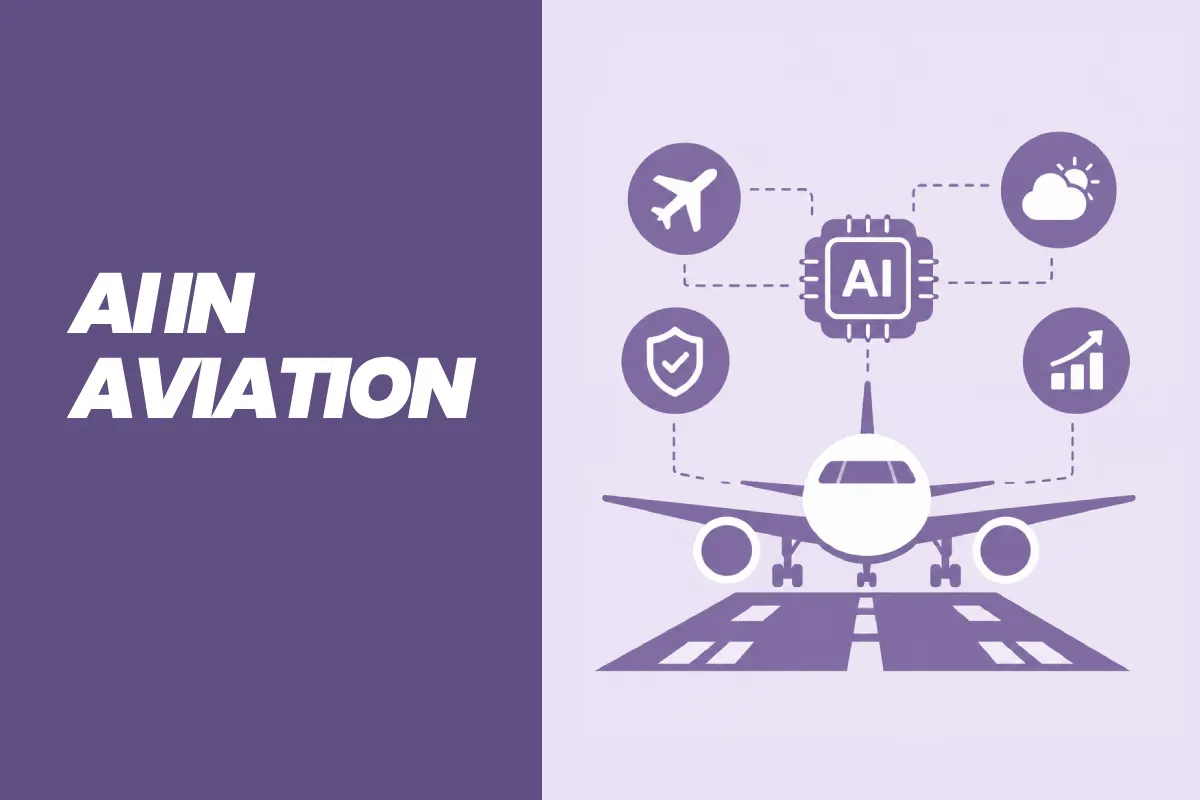
The Role of AI in the Aviation Industry
Aviation produces large volumes of structured data and operates under tight margins, strict safety requirements, and constant time pressure. These conditions make it a strong fit for AI, which can identify patterns across complex datasets, forecast changing conditions, and support decisions that must be made quickly.
Why Aviation Is Well Suited to AI
Every flight generates information from the aircraft, airport, crew, and passenger journey. AI can combine these sources to identify relationships that individual systems may not reveal. For example, connecting aircraft health records with flight schedules and spare-parts availability can help maintenance teams anticipate disruptions and plan repairs more effectively.
| Data source | Examples of data | AI applications |
|---|---|---|
| Aircraft and engine monitoring | Temperature, vibration, pressure, fault codes | Predictive maintenance and anomaly detection |
| Flight and weather systems | Altitude, speed, winds, forecasts, airspace restrictions | Route optimization and operational risk prediction |
| Maintenance records | Defects, repairs, inspection findings | Fault diagnosis and technical document search |
| Reservation and loyalty systems | Bookings, fares, travel history | Demand forecasting and personalized offers |
| Airport sensors and cameras | Passenger queues, baggage movement, gate activity | Passenger-flow prediction and operational monitoring |
Who Is Adopting AI
AI adoption spans the aviation ecosystem, with each organization focusing on different operational priorities.
- Airlines use AI for flight planning, revenue management, crew scheduling, predictive maintenance, and customer service.
- Airports apply it to passenger-flow management, baggage handling, resource allocation, security screening, and terminal energy use.
- Maintenance, repair, and overhaul providers use AI to identify defects, diagnose faults, plan inspections, and manage spare-parts inventory.
- Aircraft manufacturers apply it to design optimization, production quality checks, digital twins, and supply chain planning.
- Air navigation service providers explore AI-supported traffic prediction, sequencing, and conflict detection.
- Cargo operators use forecasting and optimization tools to improve capacity allocation, load planning, and shipment processing.
How AI Capabilities Have Evolved
Aviation has used statistical models and rule-based automation for decades. Machine learning expanded these capabilities by identifying patterns in historical and real-time data. Computer vision now supports the interpretation of inspection images and airport camera feeds, while natural language processing helps teams search technical documentation and analyze reports.
Generative AI adds capabilities such as summarizing operational information, drafting reports, and answering questions using approved internal sources. Agentic AI aims to coordinate multiple steps across software systems, such as identifying a disruption, comparing recovery options, and preparing a proposed response. These newer capabilities require careful limits on what a system can execute without approval, particularly when actions affect flight safety or aircraft availability.
Advance Your Aviation Operations with AI
Explore how our AI development services can help your organization improve operational efficiency, optimize maintenance planning, strengthen decision-making, and deliver better passenger experiences through practical AI solutions.
Key Areas of AI Application
Flight Operations and Air Traffic Management
Flight operations involve decisions about routes, fuel, weather, aircraft availability, crew schedules, and airspace restrictions. AI can process these variables together and help dispatchers and flight operations teams compare alternatives.
Key applications include:
- Flight and route optimization: Recommending routes and altitudes based on weather, winds, airspace constraints, and fuel requirements.
- Fuel planning: Estimating fuel consumption and identifying opportunities to reduce unnecessary burn.
- Weather and turbulence prediction: Highlighting potentially hazardous conditions and supporting decisions about route changes.
- Dispatch support: Comparing aircraft swaps, alternate airports, and schedule adjustments when disruptions occur.
- Crew scheduling: Forecasting staffing requirements and helping planners maintain duty-time and rest requirements.
- Air traffic flow management: Predicting congestion and supporting arrival sequencing and traffic-flow decisions.
- Surface movement optimization: Forecasting taxi times and identifying gate or runway conflicts.
- Cockpit decision support: Providing pilots with relevant information and checklist assistance, subject to approved operational procedures.
AI can improve the speed and consistency of planning, but recommendations must account for changing conditions and operational constraints. Flight crews, dispatchers, and air traffic controllers retain responsibilities defined by applicable procedures and regulations.
Maintenance, Repair, and Overhaul
Unplanned maintenance can ground aircraft, disrupt schedules, and increase operating costs. Traditional maintenance programs rely heavily on scheduled inspections and defined service intervals. AI can complement these methods by identifying deterioration patterns in aircraft and engine data.
Predictive maintenance models analyze sensor readings, fault histories, operating conditions, and previous repairs to estimate the likelihood of component failure. Teams can use these predictions to prioritize inspections and coordinate maintenance with aircraft availability. Remaining-useful-life estimates can also help planners determine when a component may require attention, although such estimates must be validated against engineering requirements and approved maintenance limits.
Computer vision supports inspections by identifying possible cracks, corrosion, dents, and other defects in images. It can assist with borescope inspections and non-destructive testing, helping inspectors direct attention to areas that warrant closer examination. AI-powered search tools can also retrieve relevant information from technical manuals, maintenance records, and fault-code databases.
Other applications include maintenance scheduling, spare-parts forecasting, repair recommendations, and workforce planning. The objective is not to replace qualified technicians but to reduce the time spent finding information, prioritize work more effectively, and improve aircraft availability.
Airport Operations
Airports coordinate passenger processing, baggage systems, aircraft stands, security, ground handling, and staffing. A disruption in one area can affect several others, making coordinated forecasting particularly valuable.
AI can predict passenger congestion at check-in, security, immigration, and boarding areas. Airport managers can use these forecasts to adjust staffing and direct passengers toward less congested facilities. Computer vision can support baggage tracking, monitor turnaround milestones, and identify unsafe movements of ground vehicles and equipment.
Other applications include automated security-image analysis, biometric identity verification, gate allocation, runway debris detection, and terminal energy management. These systems can improve throughput, but their effectiveness depends on reliable data, appropriate infrastructure, and procedures for handling system errors. Biometric and camera-based applications also require attention to privacy, access controls, and applicable data-protection rules.
Airline Commercial Operations and Customer Service
Airlines use AI to improve revenue management and respond to changing passenger demand. Forecasting models estimate bookings by route, season, customer segment, and external event. Revenue management systems can use these predictions to inform pricing and seat availability decisions.
Personalization tools recommend seats, baggage options, upgrades, and other services based on relevant booking information and customer preferences. Virtual agents can answer routine questions about bookings, baggage allowances, flight status, and travel policies. More advanced systems may assist with rebooking during disruptions by comparing available itineraries and presenting suitable alternatives.
AI also supports loyalty analysis, payment-fraud detection, customer feedback analysis, and marketing optimization. However, customer-facing systems need access to current and accurate information. When an issue involves complex travel requirements, exceptional circumstances, or a dissatisfied passenger, the system should offer a clear route to a human representative.
Safety, Security, and Cybersecurity
AI can help safety teams identify patterns across flight data, incident reports, maintenance records, and ground-operation events. Rather than relying exclusively on manually reviewed reports, teams can use classification and anomaly-detection tools to identify recurring issues for further investigation.
Computer vision can help detect foreign object debris, wildlife, unauthorized drones, and unsafe movements around aircraft. Cybersecurity systems can analyze network activity and flag unusual access patterns or potential threats.
These applications support earlier detection, but an alert is not proof that an incident has occurred. False positives, missed detections, and incomplete data must be considered. Safety and security teams need defined escalation procedures and must retain responsibility for assessing alerts and deciding what action is appropriate.
Manufacturing, Supply Chain, and Cargo
Aircraft manufacturers use AI to support production inspection, identify manufacturing defects, and analyze quality data. Generative design tools can explore alternative component geometries against specified engineering constraints, while digital twins can help engineers study system behavior under different operating conditions.
Supply chain forecasting can identify potential shortages and delays affecting aircraft production or maintenance. Cargo operators use optimization tools to improve load planning, forecast shipment volumes, and allocate capacity. AI-assisted document processing can extract information from shipping and customs documents, reducing repetitive data entry and helping teams identify missing or inconsistent information.
Training and Workforce Management
AI can support adaptive simulator training by adjusting scenarios to a trainee’s performance and helping instructors identify areas requiring further practice. Maintenance organizations can use assistants grounded in approved technical documents to help technicians locate procedures and understand unfamiliar tasks.
Workforce planning tools forecast staffing needs across roles, shifts, and locations. These applications can improve resource allocation, but training assessments and employment decisions require appropriate validation, transparency, and human review.
Maturity of Major Use Cases
AI adoption varies by application, organization, and regulatory environment. The following categories indicate broad maturity rather than guaranteeing that every implementation is equally established.
| Maturity | Examples |
|---|---|
| Established | Revenue management, demand forecasting, crew scheduling, flight planning, selected predictive maintenance applications |
| Growing | Passenger-flow forecasting, computer vision inspections, disruption recovery, virtual agents, safety-report analytics |
| Early or developing | Agentic operations systems, generative AI copilots, expanded cockpit assistants, advanced drone traffic coordination |
Also Read: AI in Marketing
Improving Safety and Operational Reliability with AI
Detecting Safety Risks Earlier
AI can review large volumes of operational data and highlight patterns that deserve investigation. In flight operations, models may identify recurring unstable approaches or unusual operating trends. In maintenance, they may flag changes in component performance before a fault becomes more serious. At airports, image-analysis systems can identify potential hazards on runways and aprons.
The value lies in directing attention toward relevant evidence. Safety specialists must still assess whether an alert reflects a genuine hazard, determine its significance, and decide whether corrective action is necessary. Organizations should document how alerts are investigated and use the findings to improve procedures and training.
Reducing Delays and Disruptions
Delays often arise from connected operational problems rather than a single cause. A technical fault can affect aircraft availability, crew assignments, connecting passengers, and gate schedules. AI can help teams forecast the likely impact and compare recovery options before the disruption spreads.
Weather forecasts, aircraft health predictions, crew availability, and airport congestion can inform a common operational picture. For example, a system may identify that an aircraft swap could protect a later departure, while also showing the effect on maintenance requirements and crew legality. Decision-makers can compare these trade-offs rather than relying on isolated recommendations.
Human Oversight and Safety Controls
AI systems used in aviation need oversight proportionate to the consequences of an error. Document classification or report summarization may be suitable for relatively high levels of automation after validation. Decisions involving aircraft airworthiness, flight operations, or safety-critical procedures demand stricter controls and qualified human involvement.
Organizations should define who approves decisions, what actions a system may execute, when it must escalate an issue, and how a recommendation can be overridden. Audit trails should record important inputs, outputs, approvals, and subsequent actions. These controls make it easier to investigate failures, demonstrate accountability, and improve system performance.
Enhancing the Passenger Experience
Passengers judge airlines and airports by how easy, fast, and predictable the journey feels. AI can support more relevant information and reduce friction at different stages of travel.
During booking, recommendation systems can help passengers compare suitable options. Before departure, automated assistants can answer questions about check-in, baggage, and travel requirements. At airports, queue forecasts and wayfinding tools can help passengers navigate busy terminals. During disruption, AI-supported rebooking can identify alternatives and help communicate changes more quickly.
Connecting Customer Systems
The strongest improvements often come from connecting existing systems rather than adding isolated tools. A virtual agent that cannot access current flight status, baggage information, or rebooking options may provide incomplete answers and increase passenger frustration. A connected system can retrieve relevant information, perform permitted tasks, and transfer complex requests to staff with the necessary context.
Airlines should also evaluate whether automated service works for passengers with different accessibility needs, language preferences, and levels of digital confidence. Clear escalation routes remain important, especially when a passenger faces a missed connection, urgent travel requirement, or complex refund request.
Efficiency, Cost Control, and Sustainability
Fuel, maintenance, labor, inventory, and delays account for significant operating expenses across aviation. AI can help organizations manage these costs by improving forecasts, reducing avoidable work, and supporting better use of aircraft and airport resources.
Reducing Operating Costs
Flight optimization can reduce unnecessary fuel consumption, while predictive maintenance may help avoid unplanned removals and schedule disruption. Better spare-parts forecasts can reduce excess inventory without increasing the risk of stockouts. Airport staffing models can align resources with expected passenger volumes, and automated customer-service tools can handle routine inquiries.
These benefits are not automatic. An organization must consider software licensing, integration, data preparation, infrastructure, employee training, and ongoing model monitoring. It should also account for the operational cost of inaccurate predictions, unnecessary alerts, and systems that require frequent manual intervention.
Supporting Sustainability Goals
AI can contribute to environmental objectives by identifying opportunities to reduce fuel use, unnecessary ground movement, and energy consumption. Route and flight-profile optimization can support more efficient operations when weather, airspace, safety, and other constraints permit.
At airports, occupancy-based energy controls can adjust heating, cooling, and lighting to changing demand. AI can also support contrail prediction, sustainable aviation fuel planning, and emissions-data management. These applications should be assessed using credible measurements and operational constraints; a modeled reduction does not automatically translate into a verified environmental benefit.
Also Read: AI Development Cost
Measuring Business Results
Organizations should establish performance baselines before deployment and assess whether improvements can reasonably be attributed to the AI initiative. Relevant metrics vary by use case.
| Metric | What it measures |
|---|---|
| Fuel burn per flight or seat | Efficiency of flight planning and operations |
| On-time performance and delay minutes | Schedule reliability |
| Unscheduled maintenance events | Impact of predictive maintenance |
| Aircraft turnaround time | Ground-operation performance |
| Cost per passenger or flight hour | Overall operating-cost changes |
| Customer satisfaction and contact rate | Passenger-service outcomes |
| Revenue per available seat | Commercial performance |
Metrics should be reviewed alongside operational context. For example, a reduction in maintenance events may coincide with changes in fleet age or flight hours. Similarly, lower contact-center volume may reflect improved self-service—or passengers giving up when they cannot reach an agent. Balanced measurement helps organizations distinguish genuine improvements from misleading indicators.
Advance Your Aviation Operations with AI
Explore how our AI development services can help your organization improve operational efficiency, optimize maintenance planning, strengthen decision-making, and deliver better passenger experiences through practical AI solutions.
The Future of AI in Aviation
The next phase of aviation AI is likely to involve more connected systems that move beyond analysis and recommendations to coordinate tasks under defined limits. Generative AI copilots may help teams summarize operational information, retrieve technical guidance, and prepare reports. Agentic systems may coordinate actions across booking, scheduling, maintenance, and resource-management tools.
Digital twins can support simulations of aircraft systems, airports, and operational networks. Improvements in computer vision may expand automated inspection, while AI-supported traffic management may help accommodate growing numbers of drones and advanced air mobility vehicles. The pace of adoption will depend on validation, certification requirements, interoperability, and evidence that systems perform reliably under real operating conditions.
Preparing for Wider Adoption
Organizations should focus on several practical priorities:
- Data management: Establish clear ownership, consistent identifiers, and reliable access to operational, maintenance, and customer information.
- Governance: Define approval requirements, audit trails, escalation procedures, and limits on automated actions.
- Workforce skills: Train operational, maintenance, and commercial teams to interpret AI outputs and recognize limitations.
- Vendor selection: Assess integration requirements, data rights, security practices, model monitoring, and support arrangements.
- Cybersecurity: Protect operational networks and sensitive information, particularly when systems connect to external AI services.
- Performance measurement: Set baseline metrics and review business outcomes throughout deployment.
Integrating AI into Existing Aviation Workflows
AI delivers value when its outputs inform operational decisions rather than remain isolated predictions. A predictive maintenance model may identify a component at risk of failure, for example, but the benefit depends on whether planners can arrange inspections, source replacement parts, and schedule work without causing avoidable flight disruptions. Similarly, a model that forecasts passenger congestion must connect with staffing and terminal-management processes so teams can respond before queues become excessive.
Integration often requires connecting systems that were developed independently. Airlines may need to link aircraft health monitoring with maintenance planning, flight schedules, inventory, and crew management. Airports face similar requirements across baggage handling, gate management, security screening, and passenger information platforms. Reliable interfaces and consistent data definitions help ensure recommendations reflect current operating conditions.
Organizations should also distinguish between decisions that AI can execute and those that require human approval. Routine document classification may be suitable for automation after validation, while decisions affecting airworthiness or safety-critical operations require stricter controls. Teams need to understand why recommendations are generated, review the supporting information, and override outputs when circumstances demand it.
Monitoring must continue after deployment because model performance can change as fleets, operating conditions, passenger behavior, and maintenance practices evolve. Organizations should track prediction accuracy alongside operational outcomes, investigate incorrect recommendations, and establish thresholds for retraining or suspending a system. A phased rollout—from historical testing to controlled trials and monitored live deployment—helps demonstrate value before wider implementation.
Challenges and Risks of Implementing AI in Aviation
Despite its potential, implementing AI in aviation presents technical, operational, and regulatory challenges. One major obstacle is data quality. Airlines, airports, and maintenance providers often rely on legacy systems that store information in different formats. Incomplete records, inconsistent data, and limited interoperability can reduce model accuracy and make it difficult to apply insights across departments.
Model reliability and validation are equally important. AI systems may perform well under familiar operating conditions but produce unreliable predictions when they encounter unusual weather, unfamiliar equipment behavior, or unexpected operational disruptions. Organizations must test models against diverse scenarios and monitor their performance after deployment. In safety-critical applications, AI recommendations must remain subject to appropriate human review and established operational procedures.
Regulatory compliance and accountability add another layer of complexity. Aviation organizations must determine how AI-supported decisions fit within existing safety-management processes and applicable regulatory requirements. They also need clear records of model outputs, approvals, and actions to support audits and incident investigations.
Cybersecurity presents additional risks as AI tools connect with operational networks and external data sources. Unauthorized access, manipulated inputs, or data breaches could undermine system reliability. Organizations must also address employee training and resistance to changing established workflows. Successful adoption therefore requires not only technical investment but also strong governance, security controls, workforce preparation, and ongoing performance evaluation.
Endnote
AI is becoming an increasingly important part of aviation, from flight planning and predictive maintenance to airport operations and passenger service. Its success depends on more than selecting a capable model: organizations need reliable data, integration with existing workflows, appropriate human oversight, and clear measures of operational and financial performance. By starting with well-defined problems and validating results before expanding deployment, airlines, airports, manufacturers, and maintenance providers can adopt AI responsibly while preparing for more advanced generative and agentic applications.
Transform aviation operations with our AI development services. We build tailored solutions that help airlines, airports, and maintenance teams improve efficiency, make informed decisions, and unlock new opportunities for innovation.
Frequently Asked Questions
What is AI in aviation?
AI in aviation is the use of artificial intelligence across airlines, airports, maintenance providers, manufacturers, and air navigation services to analyze operational data, forecast conditions, and support faster decisions. It powers applications such as route optimization, predictive maintenance, passenger-flow forecasting, revenue management, and safety analytics, while qualified people retain responsibility for safety-critical decisions.
How is AI used in the aviation industry?
AI is used in aviation for flight and route optimization, fuel planning, crew scheduling, predictive maintenance, computer vision inspections, passenger-flow management, baggage tracking, demand forecasting, dynamic pricing, virtual customer service agents, and safety-report analysis. Manufacturers also use it for production quality checks, digital twins, and supply chain forecasting, while cargo operators use it for load planning.
How does AI improve aircraft maintenance?
AI improves aircraft maintenance by analyzing sensor readings, fault histories, and repair records to predict component failures before they ground an aircraft. Computer vision helps inspectors spot cracks, corrosion, and dents in inspection images, and AI search tools retrieve information from technical manuals. Predictions must still be validated against engineering requirements and approved maintenance limits.
How does AI improve aviation safety?
AI improves aviation safety by reviewing large volumes of flight data, incident reports, and maintenance records to flag patterns worth investigating, such as recurring unstable approaches or changes in component performance. Computer vision can detect runway debris, wildlife, and unauthorized drones. An AI alert is not proof of a hazard, so safety specialists must assess each one.
What is the future of AI in aviation?
The future of AI in aviation points toward connected systems that coordinate tasks under defined limits, including generative AI copilots for operational summaries and technical guidance, agentic systems spanning scheduling and maintenance tools, digital twins of aircraft and airports, expanded automated inspection, and AI-supported traffic management for drones. Adoption pace will depend on validation and certification.

Make your ideas turn into reality
With our AI & mobile app solutions