Oct 30, 2026 Artificial Intelligence
Fashion has always depended on interpreting change. Designers read cultural signals, merchants anticipate demand, manufacturers coordinate complex production networks, and retailers connect customers with products they want to wear. Artificial intelligence (AI) is introducing new ways to perform these tasks by analyzing large datasets, recognizing visual patterns, generating content, and supporting decisions across the industry. Its role is expanding beyond isolated experiments into marketing, product discovery, design support, planning, and customer service. Adoption is growing, although the depth of implementation varies. The State of Fashion 2026 report from McKinsey and The Business of Fashion states that more than 35% of surveyed fashion and luxury executives already use generative AI in areas such as customer service, image creation, copywriting, consumer search, and product discovery.
AI in fashion is not a single technology or category of software. It includes predictive models that estimate demand, computer vision systems that interpret images, recommendation engines that personalize shopping, and generative models that produce text, images, and design concepts. These technologies can support creative and operational work, but their value depends on relevant data, clear objectives, and people who can judge the quality of the results. As fashion companies explore broader adoption, the focus is shifting toward integrating AI into established processes and determining how it can contribute to business performance.
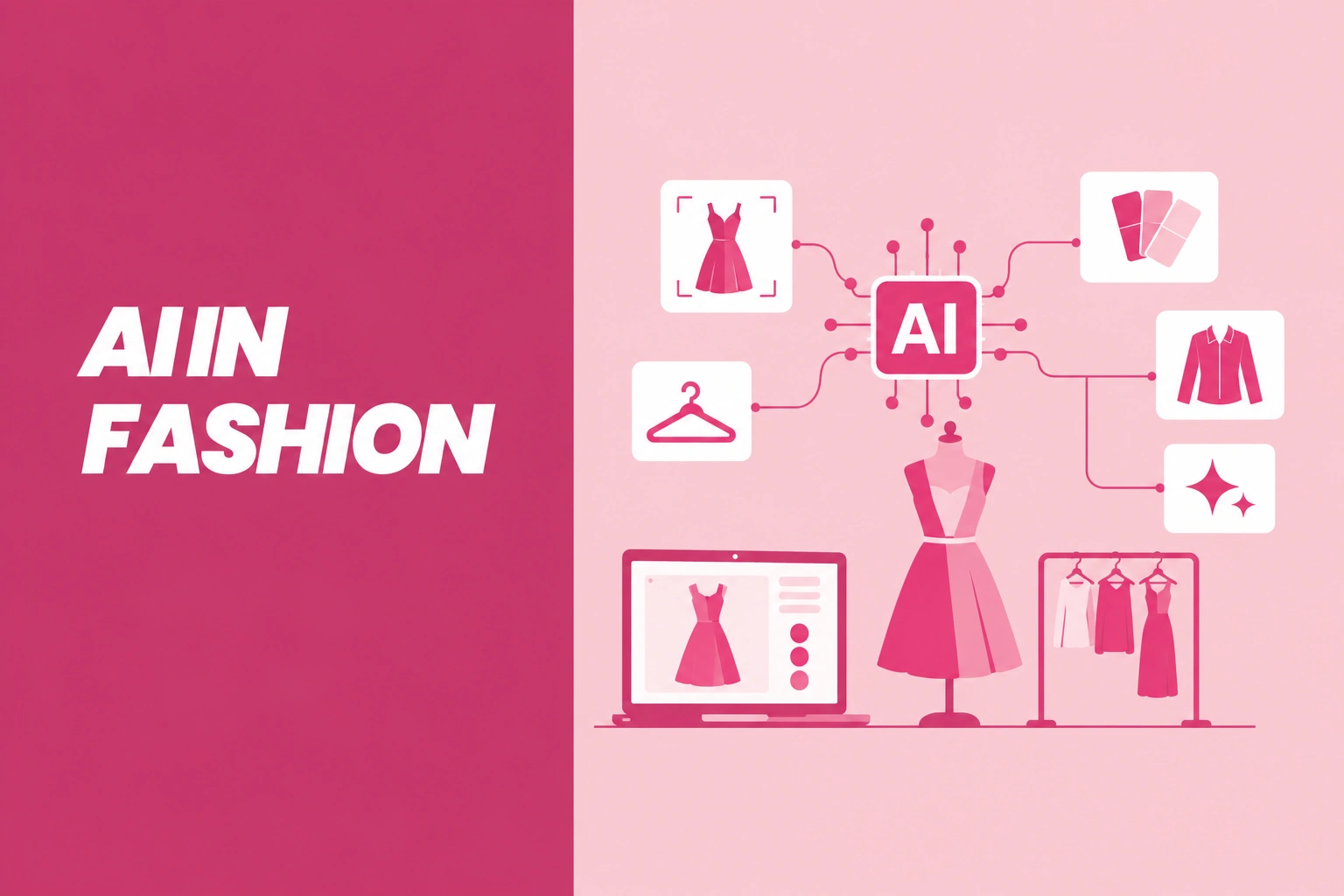
The Role of AI in the Fashion Industry
Fashion companies face changing consumer preferences, short product cycles, seasonal demand, and complex supply chains. Decisions about design, production, pricing, and inventory can significantly affect costs and sales, while brands must respond to emerging trends without losing their identity.
AI helps teams analyze sales data, search behavior, customer reviews, product images, and market trends to support forecasting and decision-making. Its applications vary by business: luxury brands may focus on design exploration and clienteling, retailers on demand forecasting and assortment planning, and manufacturers on quality inspection and production scheduling.
However, AI cannot replace fashion expertise. Models can identify patterns and estimate demand, but designers, buyers, and business teams must interpret these insights in the context of brand identity, customer preferences, and commercial priorities. AI is most valuable when it strengthens human judgment rather than replacing it.
Key Applications of AI in Fashion
Trend Analysis and Demand Forecasting
Fashion teams monitor runway collections, social media, search activity, sales data, customer reviews, and competitor assortments to understand emerging preferences. AI can process these sources together, detect changes in interest, and distinguish short-lived attention from patterns that may influence purchasing. Image-analysis tools can group recurring colors, prints, shapes, and garment features, while language models can summarize conversations about products and styles.
Demand forecasting applies similar methods to estimate likely sales by product, size, location, channel, and time period. Models can incorporate historical sales, promotional activity, weather, lead times, and current demand signals. These forecasts help teams make more informed decisions about buying quantities and replenishment. Accuracy remains difficult when products are new, trends change abruptly, or sales history is limited, so forecasts should be reviewed alongside buyer knowledge and current market conditions.
Generative Design and Product Development
Generative AI can help designers explore visual directions, produce mood-board variations, develop print concepts, and create early-stage garment imagery. A team might provide a visual reference, a color palette, a target audience, and constraints such as silhouette or fabric category, then generate several concepts for review. These outputs can accelerate exploration, but they are not automatically production-ready designs.
Product development requires attention to pattern construction, fit, fabric behavior, stitching, durability, cost, and manufacturing limitations. A generated image may depict a garment that cannot be assembled as shown or may ignore the properties of the intended material. Designers and technical teams must translate suitable concepts into specifications, patterns, samples, and fit assessments. AI is therefore best understood as an aid to exploration and iteration rather than a substitute for technical design judgment.
Personalized Shopping and Product Discovery
Online fashion catalogs can contain thousands of items, making it difficult for shoppers to identify suitable products. Recommendation systems rank products using signals such as browsing behavior, purchases, saved items, size preferences, and product attributes. More advanced search tools let customers describe what they want in natural language, such as a formal outfit for warm weather or a jacket similar to an uploaded image.
Generative AI can explain product differences, assemble outfit suggestions, and help shoppers refine searches through conversation. Visual search allows customers to submit an image and find items with similar colors, cuts, or patterns. These experiences depend on accurate product metadata and recommendations that reflect availability, sizing, and relevant preferences. Poor recommendations can narrow discovery, repeatedly show similar items, or infer sensitive characteristics in inappropriate ways, so personalization needs controls and regular evaluation.
Virtual Try-On and Product Visualization
Computer vision and generative imaging can create visual representations of garments on digital models or, in some implementations, on a shopper’s image. Virtual try-on tools can help customers imagine how a product might look, while three-dimensional product visualization allows them to inspect shape, color, and details from different angles. These tools can be particularly useful when shoppers cannot examine a garment in person.
Visual realism does not guarantee an accurate fit. Fabric drape, stretch, body measurements, lighting, and garment construction all affect how clothing appears when worn. Brands should communicate what a visualization represents and avoid presenting an approximate simulation as a reliable fit prediction. Better size guidance may require separate measurement data, fit models, and return analysis.
Inventory, Pricing, and Merchandising
AI models can help merchants estimate which products will sell, where demand is likely to occur, and when replenishment may be necessary. They can combine sales, stock levels, product attributes, promotions, and supply constraints to support allocation decisions across stores and distribution centers. Pricing models can estimate how demand may respond to price changes or markdowns, giving teams additional information when managing seasonal inventory.
These systems should operate within commercial rules. A recommendation to discount a product may conflict with brand positioning, supplier agreements, or a planned promotion. Merchants need visibility into the factors behind recommendations and authority to apply business judgment. The objective is not simply to maximize short-term sales, but to balance availability, margin, customer expectations, and inventory risk.
Manufacturing and Quality Inspection
Computer vision can inspect fabric, identify visible defects, compare finished garments with reference images, and support consistency checks. In manufacturing, AI can analyze production data to detect recurring quality problems, estimate bottlenecks, and help supervisors prioritize interventions. Forecasting tools can also support workforce and machine scheduling when order volumes or product mixes change.
Results depend on image quality, lighting, camera placement, and the range of defects represented in training data. A system trained on one fabric type may not perform equally well on another. Human inspectors remain important for ambiguous defects and decisions requiring contextual judgment. AI-supported inspection is most effective when its findings are integrated into a quality process that records decisions and feeds recurring problems back to production teams.
Marketing, Content, and Customer Service
Fashion marketing requires a high volume of product descriptions, campaign assets, email content, social posts, and localized material. Generative AI can create first drafts, adapt copy for different channels, and help teams produce variations for testing. Image tools can support concept development and asset adaptation, while analytics models can estimate which messages or products may resonate with particular audiences.
Customer-service assistants can answer questions about delivery, returns, product details, and store policies by retrieving information from approved sources. They can summarize customer conversations and route complex cases to staff. Human review remains essential for brand-sensitive campaigns, claims about materials or sustainability, and generated imagery that could misrepresent the actual product. Businesses should establish clear rules for image rights, brand consistency, and disclosure where appropriate.
Advance Fashion Innovation with AI
Discover how AI can improve fashion design, demand forecasting, and customer experiences. Our AI development services help businesses identify valuable use cases and build solutions aligned with their operational goals.
AI Technologies Used in Fashion
Machine Learning and Predictive Analytics
Machine learning systems identify patterns in historical and current data to classify information, estimate outcomes, or recommend actions. In fashion, they support demand forecasting, product ranking, stock allocation, pricing analysis, and customer segmentation. Predictive models learn from examples rather than relying only on manually written rules, but their performance depends on the quality and relevance of the data used to train and evaluate them.
Forecasts should include uncertainty rather than being treated as guaranteed outcomes. Demand patterns may shift because of weather, cultural events, promotions, competitor activity, or changes in consumer budgets. Models need to be monitored for drift, and teams should compare predictions with actual outcomes to identify where retraining or revised assumptions are necessary.
Computer Vision
Computer vision enables systems to analyze images and video. Fashion applications include garment classification, visual search, product tagging, virtual try-on, defect detection, and visual merchandising analysis. A model may identify a garment’s color, sleeve type, neckline, pattern, or category, helping standardize product catalogs and improve search.
Image-based systems can struggle with occlusion, unusual styling, low-quality images, similar patterns, and differences in lighting. Their output should be checked when errors could affect product information, quality decisions, or customer expectations. Strong image datasets need broad representation of garment types, body shapes, colors, materials, and capture conditions.
Natural Language Processing and Large Language Models
Natural language processing allows software to interpret and generate human language. Large language models extend these capabilities to tasks such as summarization, drafting, question answering, and conversational search. Fashion teams can use them to search product information, summarize customer feedback, create initial descriptions, and help employees locate internal guidance.
Language models can generate plausible but incorrect details, including unsupported fabric claims, care instructions, or product features. Connecting them to verified catalog data and approved documents can reduce this risk, but outputs still require appropriate checks. For customer-facing use, the system should know when to provide a grounded answer, ask for clarification, or transfer the request to a person.
Generative AI and Recommendation Systems
Generative AI creates new text, images, and other content based on patterns learned during training. It can support creative exploration and content production, while recommendation systems estimate which products or information may be relevant to a particular shopper. Although both can personalize experiences, they perform different functions: generative models create outputs, while recommendation systems rank or select options.
These technologies can be combined. A conversational shopping assistant might interpret a request, retrieve suitable products from a catalog, rank them using customer preferences, and explain the results in natural language. The quality of the experience depends on accurate product data, clear ranking objectives, and controls that prevent the assistant from inventing products or promising unavailable features.
Three-Dimensional Modeling and Digital Twins
Three-dimensional modeling represents garments, materials, bodies, and production processes digitally. AI can support aspects of this work by generating variations, estimating properties, or helping analyze simulation results. Digital representations can reduce the need for some physical iterations and allow teams to evaluate design changes earlier, although physical samples may still be necessary to verify fit, drape, color, and construction.
A digital twin goes beyond a static model by connecting a digital representation with information from a real product, process, or asset. In manufacturing, this may help teams examine production performance and test process changes. The value depends on whether the digital model reflects real conditions accurately enough to support the decisions being made.
Also Read: AI in Marketing
AI Across the Fashion Value Chain
AI creates different kinds of value at different stages of the fashion value chain. Its broader potential emerges when information from one stage informs decisions in another. For example, customer search behavior can help product teams understand what shoppers are seeking; product-development data can inform manufacturing plans; and sales and returns can improve future demand estimates.
Research, Design, and Sourcing
At the early stage, AI can organize trend signals, analyze customer feedback, and help teams compare possible design directions. Once a concept moves forward, digital tools can support technical documentation, material selection, and preliminary costing. Sourcing teams may use predictive analytics to assess supplier lead times, material availability, and potential delays.
These activities should be connected to practical constraints. A design that appears attractive in a concept image may depend on a material with long lead times or require manufacturing capabilities unavailable to a supplier. Bringing cost, sourcing, and production information into early decisions can reduce avoidable redesign and help teams evaluate concepts more realistically.
Product Development and Manufacturing
During development, product specifications, patterns, samples, fit notes, and quality requirements move between design teams, technical specialists, suppliers, and manufacturers. AI-supported tools can help organize these records, identify missing information, and compare revisions. In production, quality data and machine information can reveal recurring defects or capacity constraints.
The handoff between design and production is especially important. If product specifications are incomplete or inconsistent, AI may simply accelerate the spread of errors. Shared product records, controlled revisions, and clear approval steps are necessary to make automated analysis dependable. Manufacturers should also ensure that model outputs can be traced to the relevant product version and production conditions.
Distribution, Retail, and Post-Purchase Activity
After production, AI can support allocation, shipment planning, replenishment, and store-level inventory decisions. Retail teams can combine product availability with sales patterns to decide where stock is most likely to meet demand. Online and physical retail systems can use common product information to improve search, recommendations, and service consistency.
Post-purchase information is also valuable. Return reasons, fit feedback, customer questions, and product reviews may reveal recurring problems with sizing, descriptions, quality, or expectations. When these signals are structured and shared with product teams, they can influence later designs and product information. Privacy and access controls are important, particularly when customer-level data is used across functions.
The value-chain perspective shifts attention from isolated tools to connected decisions. A forecasting model may be accurate, for example, but its recommendations will have limited impact if buying teams cannot act on them or suppliers cannot adjust production in time. AI initiatives should therefore be assessed in the context of the workflow they support and the other teams whose decisions depend on the result.
Also Read: AI in Real Estate
The Business Impact of AI on Fashion Companies
AI can improve productivity, inventory management, customer experience, and decision-making. Luxury brands may prioritize design exploration and client service, retailers may focus on stock availability and markdowns, while manufacturers may target quality and material utilization.
Productivity and Decision Quality
AI can automate product descriptions, image tagging, document searches, and routine summaries, allowing specialists to focus on creative and strategic work. However, editing and fact-checking can offset time savings. Companies should measure overall workflow efficiency rather than output volume alone.
AI also helps teams analyze forecasts, trends, and quality patterns. Better insights, however, require clear objectives, reliable data, and informed human judgment.
Revenue, Margin, and Inventory
AI-powered recommendations and product search can improve product discovery, while demand forecasting can reduce stockouts and excess inventory. Pricing and markdown tools may help protect margins while accounting for brand positioning and customer expectations.
Companies should measure results against established baselines and consider other influences, such as promotions and seasonality, before attributing improvements to AI.
Customer Experience and Brand Consistency
AI can support visual search, personalized recommendations, and faster customer service. Accurate product information is essential, as misleading descriptions or unrealistic imagery can undermine customer trust.
Brands should establish clear review standards, defining which content can be generated automatically and which requires human approval to maintain brand identity and service quality.
Investment and Operating Costs
AI costs extend beyond software subscriptions to include data preparation, system integration, employee training, legal reviews, and ongoing monitoring. Custom forecasting and computer vision systems may require additional data and technical maintenance.
A sound business case should define the problem, establish performance baselines, estimate implementation and operating costs, and measure results. Starting with a focused use case can help validate value before expanding investment. Companies should also assess whether existing software meets their needs before developing custom solutions.
Also Read: AI in Aviation
The Changing Role of Fashion Professionals
AI is changing the tasks performed by fashion professionals, but its effects are not uniform. Some activities become faster or more automated, while others require stronger judgment, coordination, and technical understanding. Designers may spend less time producing initial variations and more time selecting, refining, and validating concepts. Merchandising teams may receive richer forecasts but still need to interpret them in light of brand strategy and market context. Customer-service teams may handle fewer routine queries while focusing more on complex or emotionally sensitive situations.
Designers and Creative Teams
Designers can use AI to explore visual alternatives, organize references, and communicate concepts. This can expand the range of ideas considered early in a project, but creative direction remains a human responsibility. Designers must assess originality, cultural relevance, feasibility, and alignment with the brand. They also need to understand the limits of generated images and ensure that final designs can be manufactured as intended.
The use of AI raises questions about authorship, training data, and ownership of generated material. Fashion companies should establish clear policies for using third-party images, confidential designs, and AI-generated assets. Creative teams need enough knowledge to use tools critically rather than accepting outputs simply because they look polished.
Merchants, Buyers, and Planners
Buyers and planners increasingly need to interpret model outputs alongside their own knowledge of customers, suppliers, and product categories. AI can identify patterns across large datasets, but it may not recognize a cultural shift, an emerging subculture, or a strategic decision to introduce an unfamiliar product. Professionals need to question assumptions, assess uncertainty, and understand the consequences of forecast errors.
Data literacy is therefore becoming part of commercial expertise. Employees do not all need to build models, but they should understand what a prediction means, which data informs it, and when a recommendation may be unreliable. Collaboration between business teams and technical specialists is essential to turn analysis into decisions that can be executed.
Technical, Operational, and Leadership Roles
Technical teams are responsible for data pipelines, model selection, integration, monitoring, and access controls. Operations teams must adapt workflows so that AI outputs reach the people who can act on them. Leaders need to define accountability, prioritize investments, and make sure expected gains are realistic. Legal, sourcing, design, and brand teams may also need to participate when AI affects intellectual property, supplier relationships, or customer information.
Training should be role-specific. A designer needs guidance on image generation, rights, and production feasibility; a planner needs to interpret forecasts and uncertainty; and a service employee needs to recognize when a generated answer should be checked or escalated. Effective adoption depends less on giving everyone the same tool than on making each person confident about where it fits in their work.
Endnote
AI is becoming part of how fashion companies understand demand, develop products, communicate with customers, manage production, and coordinate decisions across the value chain. Machine learning, computer vision, generative AI, and recommendation systems offer different capabilities, and their contribution depends on how well they fit real business processes. Companies that connect reliable data with domain expertise can use AI to improve analysis and reduce repetitive work without treating automation as a replacement for creative judgment. The most effective approach is to start with clearly defined needs, establish suitable controls, involve the professionals who understand the work, and evaluate outcomes across the full process rather than focusing on the technology alone.
Transform fashion operations with AI development services tailored to your business needs. We help companies build AI solutions that support smarter decisions, improve efficiency, and deliver measurable business value.
Frequently Asked Questions
What is AI in fashion?
AI in fashion is the use of machine learning, computer vision, generative AI, and recommendation systems to support design, demand forecasting, personalization, manufacturing, and customer service. It helps fashion companies analyze sales data, images, and customer behavior so teams can make faster, better-informed decisions across the value chain.
How is AI used in the fashion industry?
Fashion companies use AI for trend analysis, demand forecasting, generative design concepts, personalized product recommendations, visual search, virtual try-on, inventory and markdown planning, fabric defect detection, product descriptions, and customer service assistants. Use cases differ by business: luxury brands focus on design and clienteling, while retailers prioritize stock and pricing decisions.
How does AI help with fashion trend forecasting and demand planning?
AI combines signals from runway collections, social media, search activity, sales history, and reviews to spot rising interest in colors, prints, and silhouettes. Demand models then estimate sales by product, size, location, and channel. Forecasts are less reliable for new products or sudden trend shifts, so buyers should review them.
Can generative AI design clothes?
Generative AI can create mood boards, print ideas, and early garment concepts, but it does not produce manufacturing-ready designs. Generated images may ignore fabric behavior, pattern construction, fit, or cost. Designers and technical teams still need to turn suitable concepts into specifications, patterns, samples, and fit assessments.
How accurate is AI virtual try-on?
Virtual try-on is useful for visualizing how a garment might look, but it is not a reliable fit prediction. Fabric drape, stretch, body measurements, and lighting all affect real appearance. Accurate size guidance usually needs separate measurement data, fit models, and return analysis alongside the visualization tool.
Will AI replace fashion designers?
No. AI changes how designers work rather than replacing them. It can speed up early exploration and variation, but creative direction, originality, cultural relevance, brand fit, and production feasibility still require human judgment. Designers increasingly spend more time selecting, refining, and validating ideas instead of producing every initial variation.

Make your ideas turn into reality
With our AI & mobile app solutions