Oct 30, 2026 Artificial Intelligence
Retailers are increasingly using artificial intelligence to help customers discover products, make purchasing decisions, and resolve service requests without navigating multiple pages or waiting for an employee. Conversational AI extends these capabilities by allowing shoppers to interact with retail systems through natural language, whether they are asking about product specifications, comparing alternatives, checking availability, or seeking help with an order. According to Salesforce’s Connected Shoppers research, retailers are operating in an increasingly AI-driven commerce environment, where changing customer expectations are pushing businesses to reconsider how shopping and service interactions are delivered. The opportunity is not simply to add a chatbot to an online store; it is to make product information, purchasing assistance, and customer support accessible through a more direct conversational interface.
Conversational AI in retail encompasses technologies that understand customer requests, retrieve relevant information, maintain context across exchanges, and, when connected to appropriate business systems, perform specific actions. Its applications range from virtual shopping assistants and conversational product search to order support, store assistance, and sales enablement. However, useful retail conversations depend on more than fluent responses. Systems need accurate product data, current inventory information, clear transaction permissions, and reliable ways to transfer complex requests to human employees. Retailers must therefore consider how conversational AI fits into their commerce channels, merchandising processes, customer data practices, and sales operations. Its commercial value ultimately depends on whether it helps shoppers make better decisions while enabling the business to serve them accurately and efficiently.
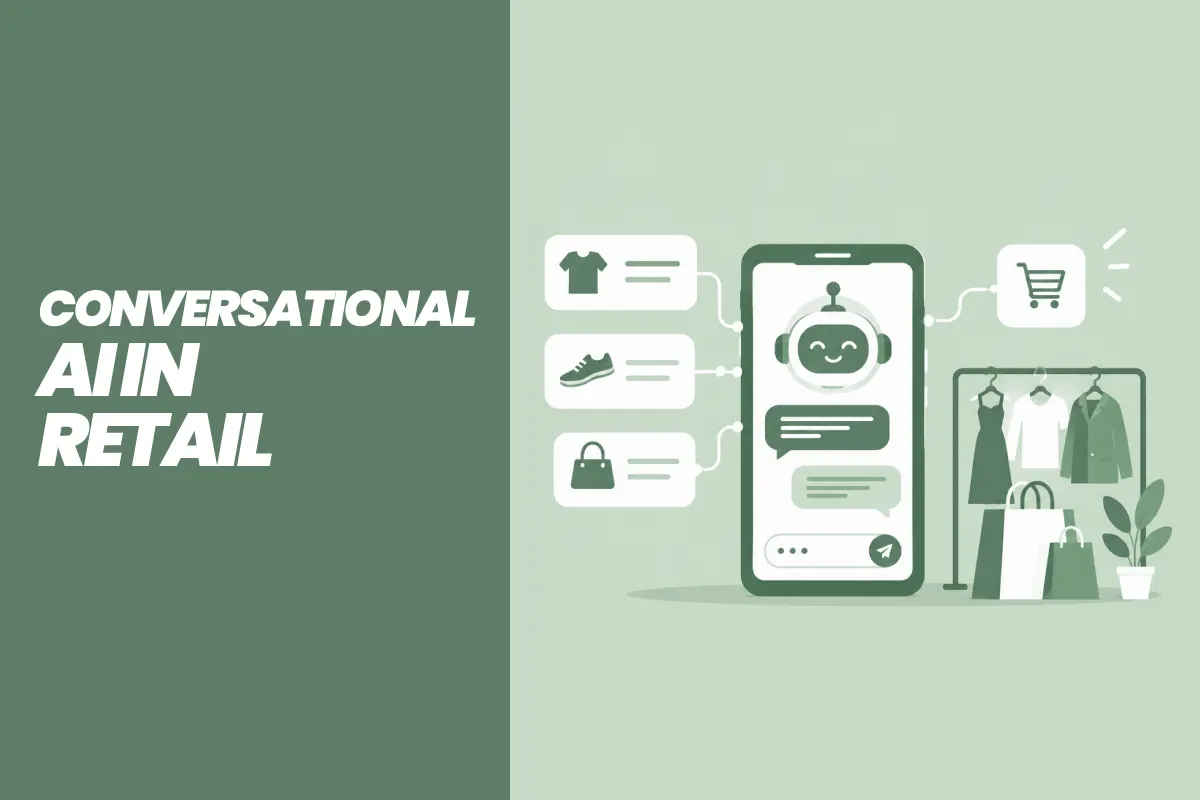
Role of Conversational AI in Retail
Conversational AI plays an important role in retail by helping customers find products, compare options, check availability, and resolve service queries through natural-language interactions. Unlike traditional chatbots that rely on predefined scripts, AI-powered assistants can interpret varied requests, handle follow-up questions, and retrieve relevant information from product catalogs and retail systems. When connected to order management and inventory platforms, they can also support tasks such as tracking deliveries, checking return eligibility, and initiating authorized service requests.
For retailers, conversational AI can support both customer-facing activities and internal operations. Shopping assistants can guide purchasing decisions, while service assistants can handle routine enquiries and help employees retrieve product information or store procedures. These capabilities depend on accurate data, reliable system integrations, and appropriate access controls. By connecting customer conversations with relevant retail information and workflows, conversational AI can reduce manual effort, improve access to product information, and help retailers manage interactions across digital and physical channels.
Build Smarter Retail Experiences with AI
Improve customer interactions and retail operations with conversational AI solutions. Our AI development services help retailers automate support, simplify product discovery, and connect customer conversations with business systems.
Key Applications of Conversational AI Across Retail Business Functions
Conversational AI can support multiple retail functions, but the underlying requirements differ considerably. A system answering a product question needs reliable catalog information, while one processing a return must also validate the order, check eligibility, and initiate an approved workflow.
Product discovery and recommendations: Shoppers can describe needs in natural language rather than constructing searches from exact product names or filters. A furniture retailer, for example, could help someone find a compact dining table for a small apartment, then refine the results by seating capacity, material, budget, and available space. Recommendations should reflect these constraints instead of simply promoting popular products.
Customer service: AI can handle recurring enquiries about delivery estimates, payment status, warranty coverage, return policies, and product availability. When an answer depends on an individual transaction, the assistant must retrieve information associated with the customer’s verified order rather than provide a generic response.
Order and return assistance: With suitable system access, conversational AI can retrieve orders, explain return eligibility, generate return requests, and communicate status updates. More consequential actions, such as cancelling an expensive order or changing a delivery address, may require additional verification or explicit confirmation.
Store and shopping assistance: Retailers can use conversational interfaces to answer questions about store locations, opening hours, product availability, and collection options. Store associates can also consult internal assistants to locate products, check stock across branches, or retrieve product specifications while helping customers.
Sales and post-purchase engagement: AI can explain complementary products, help customers understand product care, and answer questions about compatible accessories. Such recommendations should be relevant to the original purchase rather than indiscriminately encouraging additional spending.
Internal retail operations: Employees may use conversational interfaces to retrieve merchandising guidelines, supplier information, operating procedures, and product documentation. Access must be restricted according to role, particularly when the system can retrieve commercial terms, employee information, or confidential business records.
The strongest use cases generally combine frequent requests, accessible information, clear rules, and measurable outcomes. Retailers should not assume that every interaction benefits from automation. A sensitive complaint, disputed payment, or complex product-fit decision may require human judgment even when AI can assist with initial information gathering.
Also Read: AI in Project Management
Conversational Commerce and the Changing E-commerce Sales Model
Traditional e-commerce usually requires shoppers to navigate categories, apply filters, open product pages, and compare specifications. Conversational commerce introduces another route: customers describe what they want, and the system helps narrow the available options through an interactive exchange.
This changes how product discovery is organized. Consider a shopper searching for running shoes. A conventional search may return thousands of results based on keywords. A conversational assistant can ask whether the shoes are intended for road running or trails, whether the shopper has a preferred price range, and which features matter most. The answers progressively narrow the product set.
Retailers need to connect this experience to structured product attributes. If the catalog records only a product title and description, the assistant may struggle to distinguish waterproof footwear from water-resistant models or identify a garment’s actual dimensions. Attributes such as size, material, compatibility, fit, warranty, and intended use allow the system to filter products more reliably.
Conversational commerce can also support assisted transactions. A shopper might select a product, choose a variant, check availability, and request a checkout link within the conversation. Where supported integrations permit transactions directly, the assistant may initiate a purchase workflow. However, inventory validation, pricing, payment authorization, and order creation should remain controlled by the relevant commerce systems.
A practical architecture separates conversational guidance from transaction processing. The language model interprets the request and determines the next appropriate action; the commerce platform validates the operation and returns the result. This prevents the assistant from treating its own generated text as evidence that a purchase or cancellation has actually occurred.
Retailers must also decide where the conversation ends and the transaction begins. Keeping checkout on the retailer’s website or app can preserve established payment controls, loyalty benefits, customer relationships, and access to first-party purchase data. Direct in-chat checkout may reduce friction in supported environments, but it introduces additional questions about payment security, order visibility, returns, and customer ownership.
The commercial objective is not to eliminate every step in shopping. It is to remove unnecessary effort while preserving the information and control customers need to make a purchase confidently.
Conversational AI in Omnichannel Retail
Retailers frequently operate websites, mobile applications, physical stores, marketplaces, messaging channels, and customer service centers. Each channel may maintain separate records of customer interactions, product availability, and service requests. Conversational AI becomes more useful when it can retrieve consistent information across these environments.
Consider a customer who checks product availability online before visiting a store. If the assistant can access store-level inventory, it can identify suitable branches and explain collection options. A store associate may then use an internal interface to retrieve the relevant product details. Following the purchase, the customer could use the retailer’s messaging channel to ask about delivery or request assistance.
Achieving this continuity requires more than deploying the same chatbot everywhere. Retailers need consistent product identifiers, customer and order records, channel-specific authentication, and clearly defined rules for sharing conversation context. A customer should not have to repeat every detail unnecessarily, but information from one channel should not automatically become accessible in another without appropriate authorization.
Channel behavior also matters. A website assistant can display product comparisons, images, and detailed specifications. A messaging assistant may need shorter responses and direct links to product pages. An in-store employee interface may prioritize stock locations, product codes, and concise instructions. The underlying information can be shared while the interface is adapted to the task.
Retailers should define which systems are authoritative for each type of information. The inventory system should determine stock availability; the order management system should determine fulfilment status; and the commerce platform should determine current prices and promotions. Conversational AI can bring these sources together, but it should not create competing records.
A unified approach also needs clear fallback behavior. If one channel cannot retrieve live inventory, the assistant should communicate that limitation rather than reuse potentially outdated information. If a customer begins a return in one channel and continues in another, the system should retrieve the existing return record instead of creating a duplicate request.
The objective is consistent service across channels, supported by shared business data and controlled access—not necessarily a single interface for every retail interaction.
AI-Powered Virtual Shopping Assistants and Digital Sales Associates
Virtual shopping assistants differ from conventional support bots because their purpose extends beyond answering questions. They help customers identify suitable products, understand trade-offs, and progress toward a purchasing decision.
Their effectiveness depends on combining conversational understanding with product knowledge. An assistant for a beauty retailer, for example, may need to consider skin type, product ingredients, customer preferences, price, and availability. A home electronics assistant may need to compare connectivity, dimensions, energy consumption, and compatibility with existing equipment.
These requirements make product matching an important technical component. The language model can interpret a request such as “a lightweight vacuum for a small apartment with a long-haired pet,” but the recommendation process should evaluate structured product attributes against the stated requirements. Semantic search can retrieve relevant descriptions, while conventional filters can enforce hard constraints such as budget, dimensions, or compatibility.
The assistant should also explain why a product was recommended. Instead of presenting a generic claim that an item is the best choice, it can identify the features that match the shopper’s stated requirements and disclose relevant limitations. This helps customers compare alternatives and correct misunderstandings before purchasing.
Virtual assistants can also support guided selling for products that require more explanation, including appliances, furniture, electronics, and specialist equipment. However, recommendations must respect the limits of available information. If the catalog does not contain a product’s exact dimensions or compatibility details, the assistant should not infer them from a similar item.
Retailers can evaluate these assistants through recommendation relevance, product-page visits, add-to-cart rates, conversion, and returns associated with incorrect expectations. Conversion alone is insufficient: a system that encourages unsuitable purchases may initially increase sales while creating higher return rates and customer service costs.
Human sales associates remain valuable for complex needs, high-value purchases, and situations requiring nuanced judgment. AI can prepare product comparisons or retrieve specifications, leaving employees to handle the parts of the interaction where experience and interpersonal understanding matter most.
Conversational AI for Retail Merchandising and Product Information Management
Conversational AI relies on accurate product information to answer questions, compare products, and recommend suitable items. Product information management (PIM) systems centralize catalog data, including descriptions, attributes, images, variants, and specifications. Incomplete or inconsistent records can lead to incorrect responses, even when the AI model performs well.
AI can help identify missing attributes, standardize supplier terminology, and draft product descriptions from approved data. Retailers must validate these outputs before publication, particularly when errors could affect product compatibility or safety. Analyzing recurring customer queries can also reveal gaps in product information or assortment planning. Improving catalog quality benefits not only conversational AI but also product search, recommendations, and customer support.
Managing Customer Conversations Across Retail Markets
Retailers serving multiple regions face differences in language, product terminology, payment preferences, delivery practices, and customer expectations. Conversational AI must account for these variations without compromising the consistency of product information and business rules.
Multilingual capability involves more than translating responses. Shoppers may use regional expressions, abbreviations, transliterated words, or a mixture of languages in a single sentence. Product names and technical terms may also remain in English even when the surrounding conversation uses another language. Retailers should test systems against the actual language patterns of their target markets.
Regional context affects recommendations as well. A product’s suitability may depend on climate, electrical standards, available sizes, local regulations, or delivery coverage. The assistant should use relevant market-specific catalog data and policies rather than apply a single global response to every customer.
Pricing and promotions require particular care. A retailer may offer different currencies, discounts, return conditions, and fulfilment options across markets. These details should be retrieved from the appropriate regional systems. The language model should not calculate or invent an offer when an authoritative price or promotion service is available.
Large-scale deployments also need operational controls for quality. Retailers can evaluate conversations by language, market, product category, and request type to identify where the system produces weaker results. A high overall accuracy score may conceal poor performance in a particular language or on a small but commercially important product category.
Conversation analytics can help identify recurring unresolved requests, frequent escalation topics, and missing knowledge. Retailers should minimize the personal data retained for these analyses and apply suitable access restrictions. Aggregated patterns are often sufficient for identifying service problems without retaining unnecessary details about individual customers.
A scalable model combines shared standards for product facts, security, and transaction handling with local rules for language, availability, pricing, and service policies. This allows retailers to expand conversational AI across markets without assuming that one configuration will perform equally well everywhere.
Also Read: AI in Marketing
Evaluating Conversational AI Solutions for Retail Businesses
Selecting a conversational AI solution requires retailers to assess its capabilities against real business workflows rather than relying on demonstrations of fluent dialogue. A system that performs well on general questions may still fail when asked to compare variants, retrieve live stock, or process a return under specific eligibility rules.
Evaluation should begin with representative customer requests. These should include straightforward enquiries, ambiguous questions, multi-step conversations, requests involving unavailable information, and scenarios requiring human assistance. Retailers should also test product-specific edge cases, such as similar model names, discontinued items, conflicting specifications, and regional variations.
Model and retrieval quality: Retailers should examine whether the system retrieves relevant product records and generates answers supported by those records. Tests should include exact attribute queries, semantic searches, comparisons, and follow-up questions that depend on earlier context.
Integration capabilities: The solution should connect with the retailer’s commerce platform, product catalog, order management, inventory, and customer service systems as required. Integration options, API limits, authentication mechanisms, and error handling can determine whether a promising prototype is viable in production.
Transaction controls: Retailers should verify how the system handles identity checks, permissions, confirmations, and failed operations. It should distinguish between suggesting an action and confirming that the action has actually succeeded.
Monitoring and administration: Teams need visibility into response quality, latency, escalation, tool failures, and changes in performance after updates. They should also be able to modify approved knowledge, restrict functionality, and investigate incidents.
Commercial and contractual considerations: Evaluation should cover usage-based pricing, integration charges, data handling, service availability, vendor dependencies, and the ability to export relevant records. Retailers should understand how their data is processed and whether contractual terms permit the intended use.
A controlled pilot can compare the solution with an existing process. For instance, a retailer could begin with a limited product category or a defined group of support enquiries, measure performance, and review failure cases before expanding. This approach provides evidence about actual operating conditions instead of assuming that results from a vendor demonstration will generalize to the full business.
Also Read: AI in Real Estate
AI Implementation and Operating Costs
The cost of implementing conversational AI in retail depends on conversation volume, model selection, integration requirements, and the complexity of automated workflows. A basic assistant that answers questions using an approved knowledge base requires fewer resources than an AI agent connected to inventory, customer records, payment systems, and order management platforms. Retailers must account for both initial development expenses and ongoing operating costs.
Key cost components include:
| Cost component | What it covers |
|---|---|
| AI model usage | Charges based on tokens, requests, subscriptions, or usage tiers |
| Data preparation | Cleaning product catalogs, standardizing attributes, and organizing knowledge sources |
| System integration | Connecting the assistant with e-commerce platforms, inventory systems, CRM, and order management |
| Infrastructure | Hosting, storage, monitoring tools, and supporting services |
| Testing and maintenance | Evaluating response accuracy, updating knowledge sources, and resolving technical issues |
| Human oversight | Reviewing sensitive responses, handling escalations, and supervising automated workflows |
Retailers can manage expenditure by selecting models according to task complexity, caching frequently requested information, limiting unnecessary context, and reducing repeated model calls. Smaller models may handle routine enquiries, while more capable models can be reserved for complex product comparisons or multi-step requests. However, excessive cost optimization can reduce response quality and increase escalations, making the overall system more expensive to operate.
Integration complexity also influences the budget. Connecting an assistant to an existing, well-documented retail platform may be relatively straightforward, whereas older systems may require custom APIs, additional data processing, and stronger access controls. Transactional assistants need further safeguards to verify customer identity, validate requests, and recover from failed operations.
Retailers should evaluate the total cost per successfully resolved interaction, rather than focusing only on the cost of generating an AI response. This measure should include model usage, infrastructure, maintenance, integration expenses, and human intervention. Businesses can then compare these costs with savings in customer support, improved conversion, or other measurable commercial outcomes.
Demand fluctuations also matter. Sales events, festive shopping periods, and product launches can increase conversation volumes and infrastructure requirements. Estimating peak demand, setting usage limits, and monitoring performance help retailers manage costs without compromising response quality or customer service.
Also Read: AI in Fashion
Measuring the Commercial Performance of Conversational AI
Conversational AI should be evaluated through a combination of operational, customer, and financial measures. The right metrics depend on the use case: a shopping assistant is expected to help customers find suitable products, while a service assistant may primarily aim to resolve enquiries accurately.
Resolution rate measures the proportion of eligible enquiries resolved without further assistance. It should be paired with accuracy and customer confirmation because an assistant can appear to resolve a request while providing incomplete or incorrect information.
Conversion and average order value help assess shopping-related applications. Retailers should track whether assisted sessions produce purchases and whether recommendations contribute incremental revenue rather than simply redirect customers who would have purchased anyway.
Service efficiency can be measured through average handling time, cost per resolved enquiry, escalation rate, and repeat-contact rate. A reduction in initial response time is not a meaningful improvement if customers need to contact support repeatedly to correct an answer.
Product recommendation quality can be assessed through relevance ratings, product engagement, add-to-cart behavior, return rates, and feedback on unsuitable recommendations. Results should be segmented by category and customer task to identify specific weaknesses.
Reliability and risk measures include unsupported-answer rates, failed tool calls, incorrect stock information, unauthorized action attempts, and policy violations. These indicators are particularly important when the assistant can access customer records or execute transactions.
Where feasible, retailers should use controlled experiments or comparable groups to estimate incremental impact. Results should account for seasonality, promotions, product availability, channel differences, and customer mix. A pilot may generate promising results without proving that the same improvement will occur across every category or market.
Measurement should continue after launch. Changes in product catalogs, policies, model behavior, and customer language can affect performance over time. Regular reviews help retailers identify emerging errors, improve knowledge sources, adjust permissions, and decide whether additional automation is justified.
Endnote
Conversational AI can become a practical retail capability when it connects natural-language interactions with accurate product information and reliable business workflows. Its value extends from shopping assistance and customer support to merchandising, omnichannel operations, and internal employee tools. Retailers that establish clear use cases, authoritative data sources, transaction controls, and meaningful performance measures are better positioned to determine where conversational AI delivers measurable value and where human expertise remains essential.
Enhance retail customer experiences with our AI development services. We build conversational AI solutions that streamline customer support, simplify product discovery, and improve operational efficiency.

Make your ideas turn into reality
With our AI & mobile app solutions