Aug 5, 2026 Artificial Intelligence
Key Takeaways
- Through 2026, organizations are expected to abandon 60% of AI projects that aren’t backed by AI-ready data — the real bottleneck is rarely model architecture.
- A model that scores well in validation often fails in production due to overfitting, data drift, edge-case blindness, or ungrounded hallucination risk.
- Compliance isn’t a final checkbox: GDPR, HIPAA, and the EU AI Act’s risk tiers need to shape architecture decisions from the first design meeting.
- Infrastructure and inference costs routinely scale faster than budgets anticipate, making cost modeling before architecture selection a critical early step.
- Bias in AI outputs is usually inherited from historical data, not intentional, and needs ongoing fairness audits rather than a one-time pre-launch check.
Every enterprise roadmap has an AI line item now. Budgets have followed. Enterprise AI spending keeps climbing, and most organizations aren’t pulling back even where early pilots have stalled. But spending and success aren’t the same thing. According to Gartner, through 2026, organizations will abandon 60% of AI projects unsupported by AI-ready data.
That gap is the reason this piece exists. We’re not here to convince you that AI is worth building; you already know that, or you wouldn’t be reading a piece titled AI model development challenges. We’re here to walk through where these projects actually break, because in our experience, it’s rarely the model architecture. It’s the decisions made before a single line of training code gets written, and the ones made after the model technically works.
According to McKinsey, approximately 88% of organizations use AI in at least one business function regularly. This shows that in 2026, more businesses have started using artificial intelligence to streamline their operations and digitally transform.
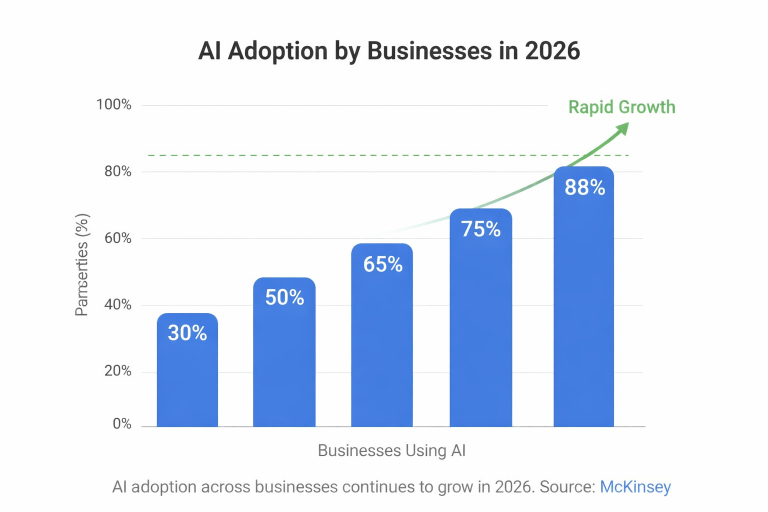
We’ll cover the challenges in AI development that show up at each stage data, infrastructure, compliance, cost, and deployment and what separates teams that ship from teams stuck in pilot purgatory.
Key AI Model Development Challenges For Enterprises
Below, we break down the primary technical and operational roadblocks enterprise engineering teams face and explain how we systematically solve them.
1. Data Readiness Is Still the First Wall Teams Hit
Ask any engineering lead what killed their last AI timeline, and data comes up before anything else does.
The problem isn’t a lack of data. It’s usable data. Enterprise data typically lives across disconnected systems, such as CRMs, legacy databases, spreadsheets nobody’s cleaned in years, PDFs, scanned forms. Before a model ever sees this information, someone has to:
- Standardize formats across every source system
- Resolve duplicate and conflicting records
- Label data accurately enough for supervised learning
- Fill or account for structural gaps without introducing bias
Why this keeps derailing projects: Teams frequently scope a build assuming the data is mostly ready. It rarely is. As enterprises put more models into production, messy, siloed data has become a compounding problem rather than a one-time cleanup task.
What actually works: Treat data audits as a separate project phase with its own budget and timeline, not a two-week sprint bolted onto the front of model development. We run this as a distinct discovery phase for every engagement, because the cost of skipping it always shows up later, and always costs more.
2. Talent Scarcity Is a Bottleneck; Money Alone Doesn’t Fix
There’s no shortage of people who’ve taken an AI course. There’s a real shortage of engineers who’ve shipped a model into a live, regulated, revenue-generating environment and kept it stable there.
That distinction matters because talent-related AI development challenges are fundamentally about depth of experience, not hiring volume. A model that performs well in a notebook and a model that holds up under production load, adversarial inputs, and drift over six months are built by very different skill sets: MLOps, data engineering, prompt and retrieval architecture, and domain-specific validation.
Three ways teams typically respond, in order of what we actually see work:
- Build in-house from scratch, which is slowest, most expensive, but retains full institutional knowledge
- Partner with an established AI development firm for the build phase, then transition to internal ownership
- Hybrid staffing, augmenting internal product knowledge with external ML engineering depth
For most mid-market and enterprise teams without a mature ML org already in place, option two or three gets a working system into production faster and with fewer expensive false starts.
3. Model Accuracy and Reliability Don’t Hold Up Outside the Lab
A model that scores well on a validation set is not the same thing as a model that’s reliable in production. This is one of the more underestimated AI model development challenges, because the failure mode is invisible until it isn’t.
Common failure patterns we see:
- Overfitting to training data that doesn’t represent real-world input variety
- Data drift, where the live environment shifts away from what the model was trained on
Edge-case blindness, where the model performs well on average but fails predictably on the inputs that matter most - Hallucination risk in generative AI and LLM-based systems, particularly when retrieval isn’t properly grounded
The fix isn’t more training data alone. It’s building continuous evaluation into the architecture from day one, such as automated monitoring, feedback loops, scheduled retraining triggers, and human-in-the-loop review for high-stakes decisions.
Also Read: AI Development Cost Guide 2026
4. Regulatory and Compliance Complexity Keeps Shifting Under Teams’ Feet
If your AI system touches customer data, financial decisions, healthcare information, or hiring processes, compliance isn’t a checkbox at the end. It’s an architectural constraint from the first design meeting.
What’s actually in scope, depending on sector and geography:
- Data privacy frameworks (GDPR, CCPA, and region-specific equivalents)
- Sector-specific regulation (HIPAA for healthcare, financial services regulation for fintech)
- Emerging AI-specific regulation, including the EU AI Act’s risk-tiered obligations
- Explainability requirements, particularly for AI used in credit, hiring, or healthcare decisions
Why is this one of the harder challenges in AI development to solve? The rules keep changing while the system is being built. A model designed against today’s compliance requirements can be out of alignment by the time it ships if legal and engineering aren’t in the same room from day one.
Our approach: Compliance review isn’t a final gate before launch. It’s embedded into the architecture decisions, such as how data is stored, how decisions are logged, how model outputs are made explainable, from the first sprint. This is standard practice for any credible enterprise AI development services partner, and it’s non-negotiable for regulated industries.
5. Infrastructure and Cost Scale Faster Than Teams Expect
Training and running models, especially large or generative ones, is computationally expensive, and the costs don’t scale the way most budget forecasts assume.
Where budgets typically break:
- Cloud compute costs for training, which scale with model size and iteration count
- Inference costs at scale, which compound with every additional user or query
- Storage and data pipeline infrastructure, often underestimated at the proposal stage
- The build-versus-buy decision on infrastructure, which has long-term cost implications either direction
What we recommend: Model the full cost curve training, inference, storage, monitoring before committing to an architecture, not after. Right-sizing a model to the actual use case, rather than defaulting to the largest available option, is often the single highest-leverage cost decision in the entire project.
6. Integration With Legacy Systems Is Where Timelines Actually Slip
A model can be technically excellent and still fail to deliver value if it can’t talk to the systems the business actually runs on.
Most enterprises aren’t building on a clean slate. They’re integrating AI into ERP systems, CRMs, and internal tools that were never designed with AI workflows in mind, some of them a decade or more old, with limited or nonexistent API support.
This shows up as:
- API limitations that block real-time data exchange
- Legacy databases that can’t support the data throughput modern models need
- Organizational resistance from teams who’ve watched integration projects fail before
- Change management gaps, where the technology is ready but the workflow around it isn’t
An experienced AI app development company scopes integration risk before finalizing model architecture; discovering a connectivity gap after the model is built is a far more expensive place to find it.
7. Ethical Risk and Bias Management Require Ongoing Governance, Not a One-Time Audit
Bias in AI models isn’t usually intentional. It’s usually inherited from historical data that reflects historical inequities. Left unaddressed, it becomes a legal, reputational, and operational liability, and it’s one of the AI development challenges that compounds the longer it goes unaddressed.
A defensible approach requires:
- Bias testing across demographic and use-case segments, not just aggregate accuracy
- Diverse training data curated specifically to reduce representational gaps
- Explainability tooling, so outputs can be audited and defended if challenged
- Scheduled fairness audits post-launch, not just at model sign-off
Boards and regulators are increasingly asking for it directly, and the organizations best positioned to answer are the ones that built governance into the model lifecycle rather than retrofitting it after a public failure.
Also Read: Top 10 AI Development Companies
AI Development Challenges & How Xicom Technologies Solves Them
Knowing where AI projects break down is only half the picture. What matters more is having a partner who’s already solved for it. Here’s how we approach the challenges in AI development we’ve outlined above, mapped directly to the way we work with our clients.
| Challenge Businesses Face | How Xicom Technologies Solves It |
|---|---|
| Messy, siloed, or unusable data | We run a dedicated data audit and readiness phase before model development starts. Standardizing formats, resolving duplicates, and closing structural gaps so the model isn’t trained on flawed inputs. |
| Shortage of experienced ML/MLOps talent | We bring senior engineers who’ve already shipped models into live, regulated environments, not just trained them in a notebook. You get production-grade depth without a lengthy internal hiring cycle. |
| Models that work in testing but fail in production | We build continuous evaluation into the architecture from day one, such as automated monitoring, drift detection, and retraining triggers. The performance holds up under real-world conditions, not just validation data. |
| Shifting compliance and regulatory requirements | We embed compliance into architectural decisions from the first sprint, not as a final review, covering data handling, explainability, and audit logging aligned with sector-specific regulations. |
| Infrastructure and inference costs scaling out of control | We model the full cost curve training, inference, storage, monitoring before committing to an architecture, and right-size the model to the actual use case instead of defaulting to the largest option. |
| AI systems that can’t integrate with legacy infrastructure | We scope integration risk before model architecture is finalized, working around API limitations and legacy system constraints so the model connects to your actual systems of record. |
| Bias and ethical risk in model outputs | We build bias testing, explainability tooling, and scheduled fairness audits into the model lifecycle, not as a one-time check but as ongoing governance post-launch. |
Final Takeaway
The technical part of building an AI model is, honestly, the part most teams get right. Where the majority of projects actually stall is everywhere around it, such as the data pipeline that was never fully cleaned, the compliance requirement that surfaced two sprints too late, the infrastructure bill nobody modeled past the pilot phase.
We’ve built enough of these systems to know that the gap between a working prototype and a production-grade AI model is where most budgets, timelines, and internal confidence quietly erode. Closing that gap takes senior engineering judgment as much as it takes model expertise, knowing which corners genuinely can’t be cut, and which assumptions need to be tested before they become expensive mistakes.
If your team is navigating any of the challenges outlined here data that isn’t build-ready, compliance requirements that keep shifting, infrastructure costs that don’t match your original projections that’s exactly the stage where the right partner changes the outcome. Explore Xicom’s enterprise AI development services to see how we help teams move from a stalled pilot to a model that holds up in production, at scale, under real-world conditions.
Frequently Asked Questions
What are the biggest technical challenges in AI model development?
The core challenges cluster around six areas: data quality, model interpretability, scalability, privacy compliance, model drift, and bias in training data. None of these show up as a single blocker. They compound. A model can pass every validation test and still fail in production because the data pipeline feeding it changes shape over time, or because the infrastructure it was tested on doesn’t match the load it sees live. Before any of this becomes a technical problem, it’s usually a budgeting one — most teams underestimate what it actually costs to build and maintain an AI system past the demo stage.
Why does data quality cause so many AI projects to stall?
Most models never get a clean, representative dataset to learn from. Real-world data arrives with gaps, inconsistent labeling, duplicate records, and formatting that varies by source system. A model trained on that foundation will replicate the noise, not correct for it. Teams that invest in data cleaning and governance upfront tend to spend far less time firefighting later.
Why do AI models perform well in testing but fail in production?
Testing happens against a fixed, historical dataset. Production doesn’t hold still. User behavior shifts, upstream systems change their outputs, and traffic patterns look nothing like the test environment. Add real constraints like latency limits and legacy system integration, and you get failure modes that never surfaced during development.
What is data drift, and how is it different from model drift?
Data drift is specifically when the input data a model sees in production shifts away from what it was trained on. It shows up in two forms: covariate drift, where the distribution of inputs changes, and concept drift, where the relationship between inputs and outputs itself changes. Model drift is the broader consequence as data drifts; model accuracy quietly erodes even though the model’s code hasn’t changed. The fix in both cases is the same: define drift thresholds up front and set a retraining cadence rather than waiting for a performance complaint to trigger action.
How can companies reduce bias in AI models?
Bias usually enters through the training data, not the algorithm. Addressing it means auditing datasets for skewed representation before training starts, testing model outputs across different demographic and use-case segments, and keeping a human review step in place for high-stakes decisions rather than assuming the model self-corrects.
Why do AI projects fail even when the underlying model works?
More often than not, the model isn’t the weak link. The environment around it is: unclear ownership post-launch, no defined monitoring thresholds, integration gaps with legacy infrastructure, and a mismatch between what the pilot proved and what production actually demands. This is why AI governance frameworks matter as much as model architecture; they’re what turn “who’s supposed to catch this” into an actual answer instead of a shrug.
How should teams monitor AI models once they’re live?
Uptime alone doesn’t tell you much. Effective monitoring tracks prediction outputs, feature distributions, and performance against real outcomes, with thresholds defined in advance so there’s a clear signal when something needs attention. Teams building multi-step or agent-based systems face this even more acutely, since a failure can propagate across several AI agent frameworks before anyone notices.
How long does an AI implementation typically take?
A working pilot can often be stood up in a matter of weeks. A production-grade deployment, integrated with existing systems and hardened for real traffic, is a longer build, typically several months depending on scope, data readiness, and how much legacy infrastructure it needs to connect with. Larger transformations that touch multiple legacy systems can extend well beyond that.
What should companies get right before deploying an AI model into production?
Governance and accountability need to be defined before launch, not patched in afterward: who owns the model post-deployment, what the escalation path looks like when it misbehaves, what the audit trail covers, and how data privacy and industry-specific compliance requirements are handled. In regulated industries, this gets stricter fast; healthcare teams, for instance, often assume HIPAA compliance covers them, only to find FDA requirements kick in separately the moment a model’s output touches a clinical decision. The same discipline applies to data privacy more broadly, where GDPR compliance requirements shape how a model can even be trained on EU user data in the first place.
Which industries tend to struggle most with AI adoption?
Heavily regulated industries with complex workflows feel these challenges hardest — healthcare, financial services, government, and manufacturing, where compliance requirements and legacy systems compound the usual deployment risks. Manufacturing deals with this because production schedules, quality records, and machine maintenance data all have to line up before a model can be trusted with a real decision, and insurance faces a similar bind between regulatory scrutiny and the pressure to automate claims and underwriting. The business upside remains substantial in each case; the difference between success and stalled adoption usually comes down to execution discipline rather than the technology itself.

Make your ideas turn into reality
With our AI & mobile app solutions
Explore related services
Based on this article's topic