Aug 18, 2026 Artificial Intelligence
Key Takeaways
- Autonomous agents create risks static ML governance never had to handle, like runaway API loops, over-privileged access, and non-deterministic execution paths.
- A working framework rests on five pillars: machine identity and access control, runtime guardrails, continuous telemetry, human-in-the-loop triggers, and regulatory alignment.
- Governance has to be built into the agent’s architecture from day one, not layered on after deployment as a policy document.
- Rolling it out works best in stages: inventory every agent, tier them by risk, secure the highest-risk ones first, then build monitoring and compliance mapping around them.
- Cost scales with risk tier, from around $30K for basic logging and rate-limiting up to $500K+ for enterprise-grade multi-agent governance with compliance automation.
The transition from passive generative language models to goal-driven autonomous agents marks a fundamental shift in software engineering. Enterprise teams are no longer simply questioning a model for text summaries. We are now deploying autonomous systems that make independent decisions, interact with production microservices, move financial resources, and modify sensitive records.
While static machine learning governance focused primarily on training data bias and model drift, autonomous systems introduce a dynamic attack surface. When an AI agent framework generates its own planning paths, selects tools, and executes multi-step API calls across core business systems, traditional security boundaries fail.
To bridge the gap between initial proof-of-concept testing and enterprise production, engineering teams must deploy a dedicated agentic AI governance framework. At Xicom, we partner with mid-market enterprises and global brands through our specialized AI development services to build secure execution environments that balance rapid workflow automation with ironclad compliance and operational safety.
What Is an Agentic AI Governance Framework and Why Is It Mandatory?
An agentic AI governance framework is the technical safety harness you place around autonomous software. It combines programmatic safeguards, system-level validation, real-time tracking, and clear operational rules to oversee how AI agents run in your production environment.
The fundamental difference comes down to autonomy. Passive machine learning models just spit out text or predictions when prompted. Traditional automation pipelines follow rigid, pre-written steps. Autonomous agents, on the other hand, operate with a high degree of independence. You give them an end goal, and they figure out the path to get there; breaking big tasks into smaller steps, generating code on the fly, hitting external APIs, and writing data directly to your core database without a human checking every move.
This structural shift introduces systemic vulnerabilities that traditional IT controls cannot manage:
- Endless recursion and spiraling costs: If an agent gets stuck in a logic loop, it won’t just stop. It can easily fire off tens of thousands of API requests in a few minutes, crashing your internal microservices and burning through your cloud computing budget before anyone notices.
- Over-privileged access: When an agent runs on broad, ambient permissions rather than tightly scoped access, it opens up a massive attack surface. A clever prompt injection attack could trick the agent into pulling and exposing restricted enterprise records.
- Unpredictable execution paths: Because agents adapt their behavior based on real-time outputs, feeding them the exact same prompt twice might lead to two completely different execution sequences. That non-deterministic nature makes traditional compliance logging and auditing an absolute nightmare.
Enterprise Risk Exposure Created by Agentic AI Systems
Agentic AI systems change the enterprise risk profile because autonomous agents can take action inside critical business systems, not just generate recommendations.
Adoption is moving fast. 79% of organizations report deploying AI agents, and 88% plan to increase AI budgets over the next year. As more enterprises push autonomous systems into production, AI governance and risk management become a core operational requirement, not an afterthought.
Traditional AI deployments produced reports, forecasts, or alerts. A human reviewed the output and decided on the next step. Agentic systems remove that checkpoint. They access systems directly, execute tasks, and make decisions across live operational environments without waiting for approval.
This shifts how enterprise leaders need to think about AI. Agentic systems touch infrastructure, financial workflows, and regulated data. Every autonomous action an agent takes carries real operational and regulatory consequences, which makes risk management a design requirement, not a compliance checkbox added later.
Design Secure AI Agent Governance
Build trusted AI agents with strong identity controls, runtime guardrails, continuous monitoring, and compliance-ready governance.
Core Pillars of Enterprise AI Agent Governance Frameworks
To safely transition multi-agent platforms into live operating environments, we break down the governance architecture into five core operational pillars.
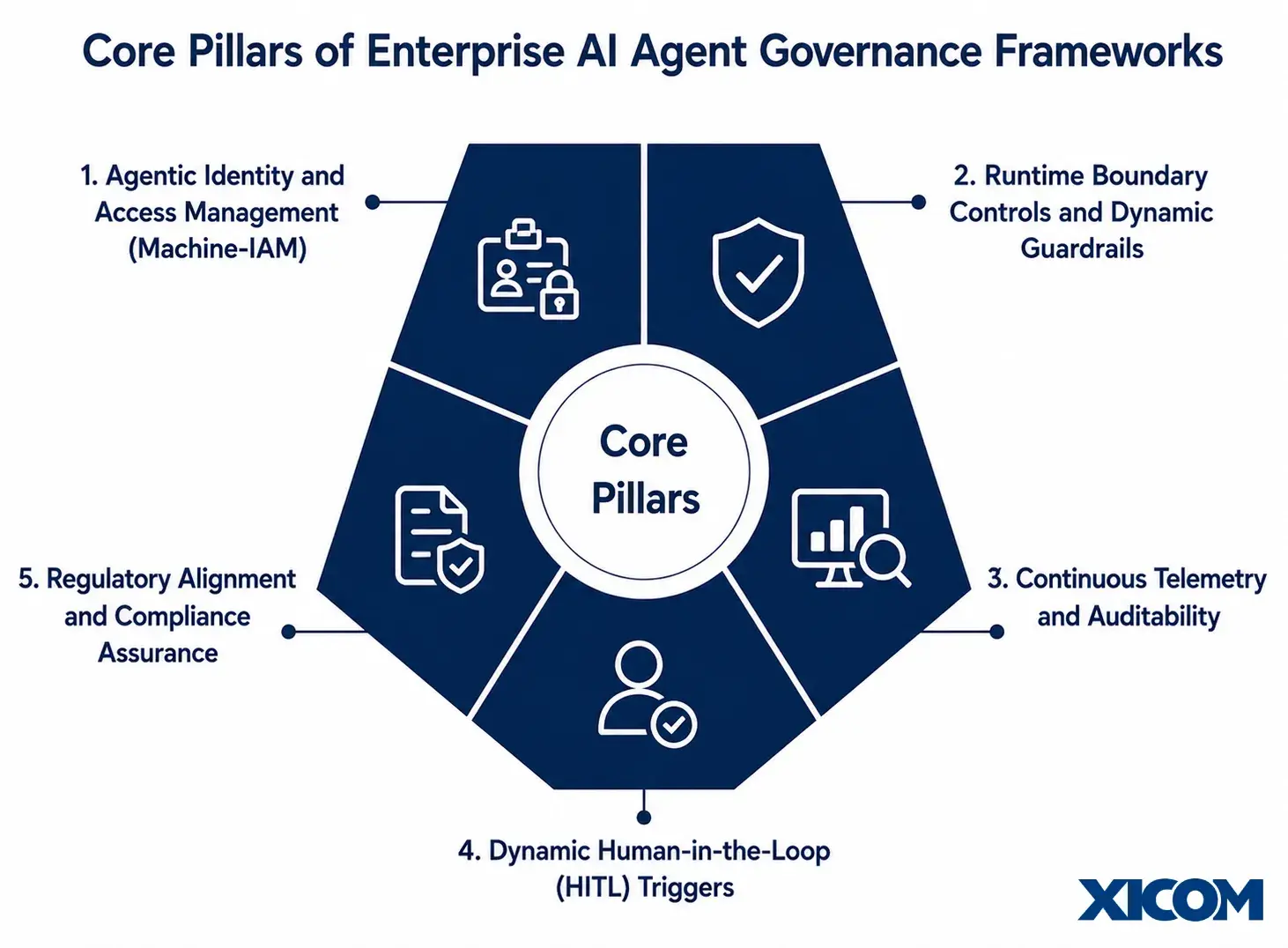
1. Agentic Identity and Access Management (Machine-IAM)
Autonomous agents must never operate under ambient system admin rights. Every agent requires a unique, temporary cryptographic identity with scoped OAuth tokens, strict rate limits, and short-lived credentials restricted to its precise task scope.
2. Runtime Boundary Controls and Dynamic Guardrails
Generative system prompts alone cannot guarantee safety. Hard programmatic guardrails must wrap the model execution layer. These programmatic wrappers validate intermediate responses against defined schemas, sanitize prompt injections, and block prohibited API parameters before execution.
3. Continuous Telemetry and Auditability
Autonomous operations demand complete visibility. AI governance frameworks require deterministic logging of an agent’s internal chain-of-thought, tool calls, raw inputs, system outputs, and environment variables to create unalterable audit trails for security analyses.
4. Dynamic Human-in-the-Loop (HITL) Triggers
Not every action requires immediate human approval, but high-risk transactions do. A robust framework establishes clear confidence score thresholds and monetary limits. If an action crosses a high-value boundary, the agent enters a paused state until an authorized admin approves the execution.
5. Regulatory Alignment and Compliance Assurance
Autonomous workflows must comply with regional and industry regulations, such as HIPAA for healthcare data, SOC 2 for operational security, and the EU AI Act. Automated compliance layers enforce strict data-handling policies, prevent unauthorized data retention, and mask personal identity information before sending requests to external LLM providers.
What Makes Agentic AI Governance Different from Traditional AI Governance?
Traditional AI governance was built for prediction and generation: a model outputs a score, a recommendation, a paragraph, and a human decides what happens next. Agentic systems collapse that gap. The agent decides, acts, and often chains that action into the next one, without a human in the loop at each step.
A useful way to frame it for your leadership team:
- Autonomy level – Is the agent suggesting or executing? Executing with review, or executing independently?
- Scope of access – What systems, data stores, and APIs can it actually reach?
- Reversibility – If the agent gets it wrong, can the action be undone, or is it final (a payment sent, a record deleted, a message delivered)?
- Chaining risk – Does one agent’s output become another agent’s input, and does an error compound as it moves down that chain?
None of these questions are answerable by a static model card or a one-time bias audit. They require an operating framework that governs behavior continuously, which is precisely what an agentic AI governance framework is designed to do.
Step-by-Step: How to Build an Agentic AI Governance Framework
Engineering a custom AI agent governance framework requires moving away from static policy documents toward enforceable software guardrails. Here is how we design and deploy these controls at Xicom.
- Step 1: Inventory every agent currently in production or pilot. Most organizations are surprised by how many agents already exist across departments, often deployed by individual teams without central visibility. You can’t govern what you haven’t counted.
- Step 2: Classify each agent by autonomy and access, using the tiering model above. This becomes your baseline risk register.
- Step 3: Assign identity, scoped access, and logging to every agent, starting with the highest-risk tier. Don’t try to retrofit the whole fleet at once. Fix the agents that can do the most damage first.
- Step 4: Build the monitoring and circuit-breaker layer. This is usually the technical heavy lift, and it’s where working with an experienced AI agent development company shortens the timeline considerably, since the monitoring hooks need to be built into the agent’s architecture, not layered on top after the fact.
- Step 5: Map compliance obligations against each tier and document escalation ownership. Legal, security, and engineering need to co-own this, not just legal.
- Step 6: Pilot the framework on a single high-value, medium-risk use case before scaling it org-wide. Median time-to-value on agent deployments currently sits around a few months, so give the pilot enough runway to actually prove the model before you scale it.
- Step 7: Review and recalibrate on a fixed schedule. Quarterly is a reasonable starting cadence for high-tier agents; every six months for lower tiers.
How Xicom Helps Enterprises Build Agentic AI Governance Frameworks
Building governance for autonomous AI requires more than defining policies. Enterprises need governance controls embedded directly into the agent architecture, from identity and access management to runtime monitoring, compliance, and human oversight.
At Xicom, we help enterprises design and implement agentic AI governance frameworks tailored to their AI workflows, technology stack, risk profile, and regulatory requirements.
Agent Risk Assessment & Governance Strategy
We assess existing and planned AI agents based on their autonomy level, data access, connected tools, business impact, and potential failure scenarios. This helps enterprises establish risk tiers and define appropriate governance controls for each agent.
Secure Agent Identity & Access
Xicom implements machine-level identity and least-privilege access controls so agents can access only the systems, APIs, and data required for their assigned tasks. Short-lived credentials, scoped permissions, and policy enforcement help reduce unauthorized access and limit the impact of compromised agents.
Runtime Guardrails & Execution Controls
We integrate programmatic guardrails directly into agent workflows to validate inputs, outputs, tool calls, and API requests before execution. Circuit breakers, rate limits, schema validation, and policy checks help prevent unsafe actions and uncontrolled agent behavior.
Agent Observability & Audit Trails
Our governance architectures provide continuous visibility into agent activity, including tool usage, execution paths, API interactions, errors, and policy violations. These audit capabilities help security and compliance teams investigate incidents and demonstrate operational accountability.
Human-in-the-Loop Controls
For high-impact operations, we design approval workflows that automatically pause agent execution when predefined risk, confidence, or transaction thresholds are exceeded. This allows enterprises to maintain human oversight without slowing down lower-risk automated workflows.
Compliance & Policy Enforcement
We help map agent behavior and data handling to applicable enterprise policies and regulatory requirements such as SOC 2, HIPAA, GDPR, and the EU AI Act. Governance controls can be integrated into the execution layer to enforce policies continuously rather than relying solely on manual reviews.
Continuous Governance & Optimization
Agentic AI governance is not a one-time implementation. As agents gain new tools, access additional systems, or become more autonomous, their risk profile can change. Xicom helps enterprises continuously monitor, evaluate, and refine governance controls as their agent ecosystem evolves.
The result is an enterprise-ready governance architecture that enables organizations to scale autonomous AI while maintaining control over access, execution, compliance, and operational risk.
Design Secure AI Agent Governance
Build trusted AI agents with strong identity controls, runtime guardrails, continuous monitoring, and compliance-ready governance.
How Much Does It Cost to Build an Agentic AI Governance Framework?
This is usually the first question a business leader asks once the technical team agrees on scope, and it’s a fair one, because the range is wide. What you pay depends less on your industry and more on how many agents you’re governing, how many of them sit in the high-risk tier, and whether you’re building on top of existing infrastructure or starting cold.
Here’s roughly how it breaks down, based on enterprise AI development services to build an agentic AI governance framework:
| Scope & Complexity | Development Investment (USD) | Primary Features & Governance Capabilities |
|---|---|---|
| Tier 1: Baseline / Small Deployment | $30,000 – $60,000 | Basic proxy validation layers, static rate-limiting, simple JSON schema checks, and foundational logging for a single autonomous agent use case. |
| Tier 2: Mid-Market Operational Framework | $70,000 – $180,000 | Dynamic prompt-injection filters, non-human machine identity scoping, automated circuit breakers, human-in-the-loop workflows, and basic observability dashboards. |
| Tier 3: Enterprise-Grade Governance Architecture | $200,000 – $500,000+ | Multi-agent coordination safeguards, real-time trajectory auditing, SOC 2 / HIPAA automated compliance wrappers, custom validation proxies, and dedicated red-teaming infrastructure. |
Common Mistakes Enterprises Make When Building These Frameworks
A framework that only runs a check before deployment misses everything that happens after. Therefore, treating governance as a launch gate instead of an ongoing layer is a common mistake that most businesses make, and they fail to opt for secure AI governance consulting services from companies offering agentic AI governance framework solutions.
- Using one risk tier for every agent. This is the exact failure mode Gartner called out, and it’s the single most common mistake we see.
- No owner for high-risk agents. If three teams share responsibility, none of them actually own it.
- Governance built by legal or security alone, without engineering input. The framework has to be technically enforceable, not just written down.
- Ignoring agent-to-agent chains. Reviewing individual agents in isolation misses the compounded risk when one agent’s output feeds another’s decision.
Essential Technical Frameworks and Tooling Stack for 2026
To implement a robust AI governance framework for agentic AI, engineering teams combine open-source developer tooling, custom proxy layers, and cloud infrastructure security.
Orchestration & Workflow Control
Tooling frameworks such as LangGraph, CrewAI, and LlamaIndex Workflows allow developers to program stateful execution graphs with built-in checkpointing and deterministic branching.
Runtime Guardrails & Security Proxies
Solutions like NeMo Guardrails, Guardrails AI, and custom Envoy-based proxy layers filter malicious inputs, enforce schema constraints, and intercept improper function calls.
Observability & Trajectory Auditing
Enterprise monitoring tools like Arize Phoenix, LangSmith, and Datadog LLM Observability log real-time token spend, trace step-by-step agent decisions, and alert teams to execution failures.
Identity & Policy Governance
Modern enterprise access environments use identity solutions such as Okta, Auth0 Fine-Grained Authorization, HashiCorp Vault, and Open Policy Agent (OPA) to enforce strict machine-level permissions across all services.
Conclusion
Deploying goal-driven autonomous systems into production enterprise environments requires a fundamental rethink of standard software architecture. When software agents write their own execution paths, invoke live APIs, and handle corporate data without human intervention at every step, basic prompt engineering and static governance policies are no longer enough.
This is where Xicom helps enterprise leaders bridge the execution gap. For organizations looking to deploy secure, compliant, and highly performant agentic systems, we provide the deep architectural experience and engineering talent needed to build resilient operational controls from day one. Rather than relying on unconstrained AI pilots that fail in production, our goal is to deliver custom, enterprise-ready software architectures that streamline operations while protecting your core business assets.
Transform your enterprise software operations with secure, scalable intelligence. Explore how Xicom’s enterprise AI development services can help you architect, deploy, and govern high-performing autonomous agent systems tailored to your technical requirements.
Frequently Asked Questions
What is an AI governance framework?
An AI governance framework is a structured set of policies, controls, and oversight processes that define how autonomous AI systems access data, make decisions, and act within an organization. It establishes accountability, audit trails, and permission boundaries so AI agents operate within approved limits instead of acting unchecked.
For agentic AI specifically, governance covers three areas: what data an agent can access, what actions it is authorized to take without human approval, and how its decisions are logged and reviewed after the fact.
How do enterprises govern autonomous AI systems in production?
Enterprises govern autonomous AI systems through layered controls: identity and access management for each agent, policy engines that enforce business rules before an action executes, and continuous monitoring that flags anomalous behavior in real time.
In practice, this means every AI agent is treated like a system identity, not a black box. It gets scoped permissions, its actions are logged, and its outputs pass through approval workflows before triggering high-risk operations like payments, data deletion, or customer communication.
What risks do agentic AI systems introduce?
Agentic AI systems introduce operational, security, and compliance risks because they can take multi-step actions with limited human visibility into intermediate decisions. Common risks include agents pursuing a goal in unintended ways, escalating access beyond what a task requires, and taking actions faster than a human can review them.
Other risk areas include data leakage across tool integrations, inconsistent decision logic between similar tasks, and reduced audit visibility once agents chain multiple actions together without checkpoints.
How can organizations build responsible AI governance?
Organizations build responsible AI governance by defining clear decision boundaries for each agent, requiring human approval for high-impact actions, and maintaining detailed audit logs of every decision an agent makes. Governance should be designed before deployment, not added after an incident.
This typically includes: role-based access scoped per agent, mandatory human-in-the-loop checkpoints for irreversible actions, real-time monitoring dashboards, and periodic review cycles to catch model drift or policy gaps as usage scales.
What frameworks and standards guide enterprise AI governance?
Enterprises commonly align AI governance programs with the NIST AI Risk Management Framework and ISO 42001, the international standard for AI management systems. These frameworks provide a baseline for risk classification, documentation, and audit readiness.
Xicom builds governance implementations around these standards, combined with ISO 9001 quality management practices, to ensure AI systems meet both technical and compliance requirements across regulated industries like BFSI and healthcare.
What are the core components of an agentic AI governance framework?
The core components are: identity and access management for each agent, policy enforcement engines that validate actions before execution, decision logging for auditability, and human oversight checkpoints for high-risk actions. Together, these ensure agents act within defined boundaries, and every decision can be traced.
A complete framework also includes model monitoring for drift and performance degradation, incident response protocols specific to AI failures, and documented escalation paths so flagged decisions reach the right reviewer quickly.
How does Xicom help enterprises implement AI governance frameworks?
Xicom helps enterprises design and implement AI governance frameworks that combine policy design, access controls, and monitoring infrastructure tailored to each organization’s compliance requirements. This includes governance model design, identity and access setup for AI agents, audit trail architecture, and integration with existing enterprise risk and compliance systems.
With 20+ years of enterprise software delivery and ISO 9001, NASSCOM, and STPI certifications, Xicom’s AI governance engagements are built to align with regulatory requirements from day one rather than retrofitted after deployment.

Make your ideas turn into reality
With our AI & mobile app solutions
Explore related services
Based on this article's topic