Oct 5, 2026 Artificial Intelligence
Agentic AI in manufacturing refers to AI agents that can understand a goal, plan the steps to reach it and take action across systems like ERP, MES, quality and supply chain tools, with people approving the decisions that matter. Unlike traditional automation that follows fixed scripts, these agents read context, handle exceptions and adapt as conditions change. They deliver the most value today in supply chain coordination, procurement, maintenance planning, quality documentation and customer order handling, where work is high-volume but full of variation.
This guide explains what agentic AI means for a manufacturer, where it fits next to RPA and generative AI, the use cases worth starting with, real examples from named companies, the benefits and challenges, how to estimate cost and how to choose your first agent.
Key Takeaways
- Agentic AI goes beyond scripted automation. An AI agent works toward a goal, chooses its next step and acts across business systems, while people approve high-impact decisions.
- The strongest manufacturing use cases sit where work is frequent but messy: supplier disruptions, maintenance planning, order exceptions, quality records and procurement.
- Agents don’t replace RPA, ERP or MES. They sit on top, using bots and APIs to execute and existing systems as the source of truth.
- Named manufacturers are already running agents in production for supply chain, finance and engineering work, with human oversight built in.
- Success depends on clean data, clear guardrails, measurable goals and starting small, which is why a focused pilot beats an enterprise-wide rollout.
What Is Agentic AI in Manufacturing?
An AI agent is software built around a large language model or other AI model that can do four things: understand a goal, plan the steps to reach it, use tools to act, and check the result before moving on. The tools might be an ERP transaction, an MES query, an email to a supplier, an RPA bot or an API call. Agentic AI is the broader approach of building operations around these agents.
In a factory setting, that changes what automation can take on. A traditional bot can create a purchase order when stock drops below a threshold. An agent can notice that a supplier’s shipment is delayed, check which production orders depend on that part, look for alternate suppliers or substitute materials, draft a revised schedule and send the options to a planner for approval.
Most agentic systems in manufacturing share a few building blocks:
- A reasoning model that interprets requests, documents and data, then decides the next step.
- Tools and integrations such as ERP, MES, WMS, QMS, CMMS, PLM and supplier portals, reached through APIs or RPA bots.
- Grounded knowledge from SOPs, specifications, contracts and past records, often through retrieval-augmented generation, so answers are based on your own data.
- Guardrails and approvals that limit what an agent can do on its own and route higher-risk actions to people.
- Monitoring and logs that record what each agent did and why, so teams can audit and improve it.
Some deployments use a single agent for one job. Others use several specialized agents that hand work to each other, such as one agent that reads a quality complaint, another that searches production records and a third that drafts the corrective action report.
Also Read: Agentic AI for Businesses
Why Manufacturers Are Investing in Agentic AI Now
Agentic AI has moved from conference keynotes into manufacturing strategy. Deloitte’s 2026 Manufacturing Industry Outlook names it as a driver across smart manufacturing, supply chain and aftermarket services, and expects adoption to move from pilots toward scale. The same outlook cites a Deloitte survey of 600 manufacturing executives in which 80% plan to put 20% or more of their improvement budgets into smart manufacturing.
The pressure behind that spending is real. In the outlook, 78% of manufacturers in the National Association of Manufacturers’ third-quarter 2025 survey named trade uncertainty as their top concern, and they expect input costs to rise by an average of 5.4% over the next year. When suppliers, tariffs and costs shift this often, teams need tools that can spot a problem, assess its impact and propose options quickly. That is exactly the kind of work agents are built for.
Analysts expect agents to spread across business software too. Gartner predicts that at least 15% of day-to-day work decisions will be made autonomously through agentic AI by 2028, up from 0% in 2024, and that 33% of enterprise software applications will include agentic AI by 2028, up from less than 1% in 2024.
Three other forces make agentic AI for manufacturing timely:
- Knowledge walking out the door. Deloitte points to agents that capture tacit knowledge from experienced workers and turn it into standard operating procedures, which speeds up onboarding.
- People stay central. The same outlook expects more than 81% of manufacturing task hours to remain human-driven, so the goal is to give skilled workers better support, not to take them out of the loop.
- Systems are finally connectable. Modern ERPs, MES platforms and integration layers expose APIs, and RPA can bridge the older systems that don’t, giving agents something reliable to act through.
Top Agentic AI Use Cases in Manufacturing
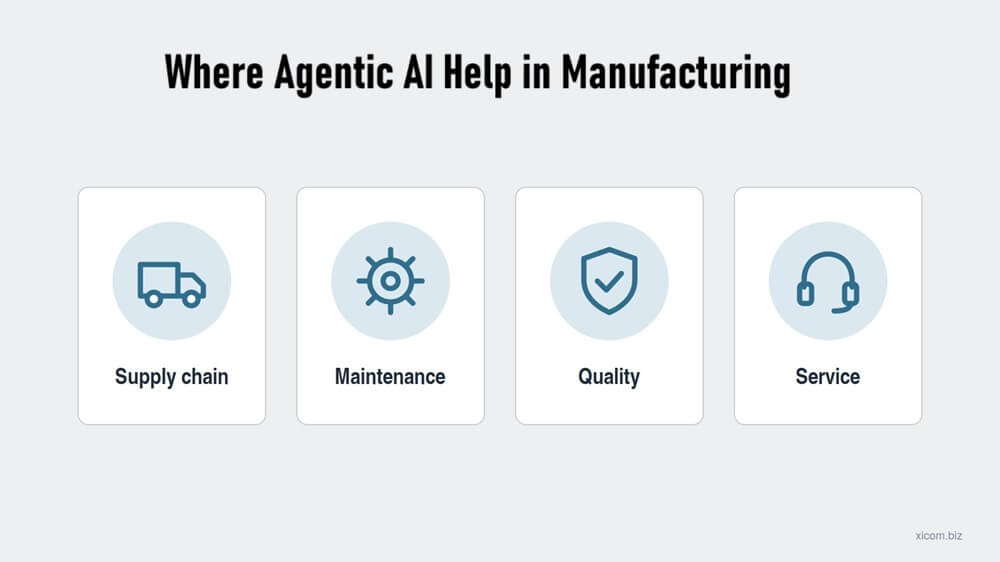
The best agentic AI use cases in manufacturing have three things in common: they happen often, they involve judgment across several systems, and the cost of delay is high. Here are ten worth evaluating, from the back office to the plant floor.
1. Supply Chain Disruption Response
A supply chain agent monitors supplier updates, shipping data, news and trade alerts for signs of disruption. When it spots a risk, it checks which parts and production orders are exposed in the ERP, estimates the impact on delivery dates and suggests alternate suppliers or substitute materials. A planner or buyer reviews the options and approves any order changes or supplier outreach.
2. Procurement and Supplier Onboarding
Agents can draft RFQs from a specification, compare incoming quotes against price history and contract terms, and chase missing supplier documents such as certificates and tax forms. They connect to the ERP, supplier portals and email. Final supplier selection, contract changes and anything outside negotiated terms go to the procurement lead.
3. Maintenance Planning and Work Orders
When condition-monitoring or predictive models flag an anomaly, a maintenance agent pulls the asset’s history from the CMMS, checks spare part stock, looks up the relevant procedure and drafts a work order with a proposed time slot that avoids critical production runs. The maintenance planner confirms the schedule, and technicians make the call on the actual repair.
4. Production Scheduling Support
Scheduling agents watch for changes such as rush orders, machine downtime or late materials, then propose revised sequences using data from the MES, ERP and capacity plans. They explain the trade-offs, for example which orders slip and by how much. Production planners keep the final say, especially when customer commitments are affected.
5. Quality Investigations and Documentation
When a nonconformance or customer complaint comes in, an agent can gather batch records, inspection results and supplier data from the QMS and MES, look for similar past cases and draft the investigation summary or CAPA report. Quality engineers review the root cause, decide the disposition and sign off, since product release decisions stay with qualified people.
6. Order Management and Exception Handling
Order agents read purchase orders that arrive by email, EDI or portal, check pricing, availability and credit, and create sales orders in the ERP. When something doesn’t fit, such as an obsolete part number or a requested date the plant can’t meet, the agent proposes alternatives and routes the case to customer service with the context already assembled.
7. Aftermarket Service and Spare Parts
Service agents can use equipment usage and telemetry data to anticipate part wear, check dealer and warehouse stock, and propose a service visit with the right parts ready. They also help validate warranty claims by comparing claim details with usage records. Service managers approve higher-value claims, and customers confirm appointments.
8. Shift Handover and Frontline Knowledge
A knowledge agent grounded in SOPs, work instructions and past maintenance logs can answer operator questions in plain language and draft shift handover reports from MES events and operator notes. It cites the source document for each answer. Supervisors review handover reports, and safety-critical procedures always defer to the approved document.
9. Engineering Change Coordination
When engineering releases a change in the PLM system, an agent can identify affected BOMs, routings, open orders and inventory, then draft the update tasks for each team. It connects PLM, ERP and MES records. Engineering and production owners approve each change before it takes effect.
10. Compliance and Regulatory Reporting
Compliance agents track deadlines, gather data from ERP, EHS and quality systems, check it for gaps and prepare report drafts in the required format. They can also flag regulatory updates relevant to your products or sites. A named compliance owner reviews and submits every report.
Real Examples of Agentic AI in Manufacturing
Agentic AI is new, so verified results are still emerging. The four examples below come from company or technology partner publications that name the manufacturer. Where a company reported an expected outcome rather than a final result, the table says so.
| Company | What the agents do | Published outcome | Source |
|---|---|---|---|
| Dow (materials science, United States) | An autonomous agent built in Copilot Studio reads PDF freight invoices from email and flags billing errors; a second “Freight Agent” lets employees investigate the flagged invoices in plain language | Handles more than 100,000 PDF shipping invoices a year; Dow expects to save millions of dollars in shipping costs in the first year | Microsoft WorkLab and Microsoft customer story |
| Toyota (automotive, Japan) | “O-Beya,” a multi-agent system with nine specialist agents, such as vibration and fuel consumption agents, grounded in past design reports, regulations and veteran engineers’ handwritten notes | About 800 powertrain engineers have had access since January 2024; human experts review AI responses to keep improving them | Microsoft Source Asia |
| thyssenkrupp Automation Engineering (industrial automation, Germany) | Uses the Siemens Industrial Copilot to help engineers build automation projects for battery and hydrogen assembly lines | Planned global rollout from 2025; more than 100 companies, including Schaeffler, were using the copilot at the time of the announcement | Siemens press release |
| Tetra Pak (food processing and packaging, global) | AI agents summarize requests, route tasks and coordinate actions in warehousing and service supply; “healing agents” detect and fix automation issues caused by system changes | Supply chain and customer onboarding turnaround cut from days to hours, with human-in-the-loop validation | UiPath case study |
These examples share a common thread. None of them hands full control to software. Dow’s agents surface errors for employees to act on, Toyota’s experts review answers, and Tetra Pak keeps people in the loop for onboarding. That balance of agent speed and human judgment is what makes agentic AI workable in a regulated, safety-conscious industry. It is also why good agentic AI development starts with guardrails, approval steps and audit logs, not just model choice.
Benefits of Agentic AI for Manufacturing
The benefits of agentic AI in manufacturing come from one shift: work that used to wait for a person to notice, gather data and start acting now begins on its own. People still decide, but they decide faster and with better information.
- Faster response to disruptions. Agents watch suppliers, shipments and machines continuously, so problems are flagged and assessed in minutes rather than discovered at the next meeting.
- Fewer exceptions falling through the cracks. Agents handle the messy cases that rules-based bots escalate, such as unusual invoices or incomplete orders, and pass only the truly hard ones to people.
- Better decisions with full context. When a planner or engineer receives a case, the agent has already gathered the relevant orders, history, documents and options.
- Recovered cost leakage. Agents can check every freight invoice, supplier bill or claim instead of a sample, catching errors that manual checks miss, as Dow’s freight invoice work shows.
- Preserved expert knowledge. Agents grounded in SOPs, design reports and past cases make veteran know-how available to newer staff, which matters as experienced workers retire.
- More productive skilled teams. Engineers, planners and quality staff spend less time searching and compiling, and more time solving problems.
- More resilient automation. Agents can adapt when inputs change and, as Tetra Pak’s “healing agents” show, even detect and fix automation issues caused by system updates.
- Proactive aftermarket service. Agents can anticipate part needs and schedule service before failures, opening the door to new service revenue.
- Consistent, auditable work. Every step an agent takes can be logged, which supports traceability, internal audits and regulatory reviews.
- Scalable operations. Agents absorb volume spikes in orders, invoices or inquiries without a matching increase in headcount.
Challenges of Agentic AI in Manufacturing and How to Solve Them
Agentic AI is powerful, but it is not easy to get right. Gartner predicts that over 40% of agentic AI projects will be canceled by the end of 2027 because of escalating costs, unclear business value or inadequate risk controls. Gartner also warns of “agent washing,” where vendors rebrand chatbots, assistants or RPA as agents, and estimates that only about 130 of thousands of agentic AI vendors are real. The good news is that each common failure point has a practical fix.
| Challenge | What it looks like | How to solve it |
|---|---|---|
| Unclear business value | A pilot impresses in a demo but nobody can say what it saves or improves | Start with a process that has a measurable baseline, such as hours, error rates or recovered costs, and agree on success metrics before building |
| Poor or scattered data | Agents give inconsistent answers because master data, documents and system records disagree | Clean the data the first use case depends on, ground agents in approved sources and show citations for every answer |
| Too much autonomy too soon | An agent takes an action nobody expected, such as changing an order or emailing a supplier | Set clear permission levels, start with recommend-and-approve, and expand autonomy only after a track record builds |
| Inaccurate or made-up outputs | The model fills gaps with plausible but wrong information | Use retrieval from trusted documents, validation rules, confidence thresholds and human review for high-impact outputs |
| Integration complexity | Agents can’t reliably reach legacy ERP, MES or plant systems | Use APIs where they exist, RPA where they don’t, and an integration layer that logs every call |
| Security and access risk | Agents get broader system access than any single employee needs | Give each agent its own identity with least-privilege access, protect credentials and monitor activity |
| Cost creep | Model usage, integrations and monitoring grow faster than expected | Track cost per completed task from day one and choose model sizes that match the job |
| Workforce trust | Teams ignore or work around agent recommendations | Involve users in design, explain how the agent reaches its suggestions and make it easy to give feedback |
Agentic AI vs. RPA vs. Generative AI
These three technologies are often lumped together, but they do different jobs. In a well-designed manufacturing stack, they work as layers rather than rivals.
| Aspect | RPA | Generative AI Assistant | Agentic AI |
|---|---|---|---|
| What it does | Follows a fixed script to move data and click through applications | Answers questions and drafts content when a person asks | Works toward a goal, plans steps and takes actions across systems |
| Who starts the work | A schedule or trigger | A person typing a prompt | An event, a goal or a person, then the agent continues on its own |
| Handles variation | Poorly; stops when inputs change | Well for language, but doesn’t act | Well; adapts its plan to the situation within set limits |
| Uses other tools | Yes, through user interfaces | Rarely, or only when a person asks | Yes, including APIs, RPA bots, databases and documents |
| Best manufacturing fit | Stable, high-volume data entry and reconciliations | Searching SOPs, drafting reports, summarizing documents | Disruption response, exception handling, multi-step coordination |
| Human role | Handles exceptions the bot can’t | Reviews and uses every output | Sets goals and guardrails, approves high-impact actions |
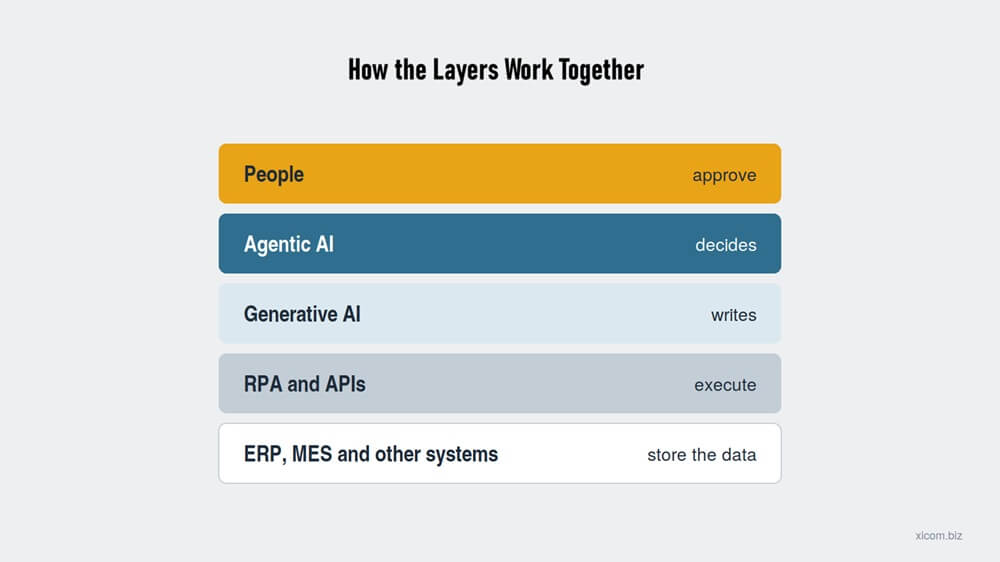
Here’s how they combine in practice. A supplier delay alert arrives. An agent assesses which orders are affected, a generative model drafts the customer notice and the supplier email, RPA bots update dates in an older ERP screen that has no API, and a planner approves the plan. If you already run bots, our guide to RPA in manufacturing explains where that layer fits best, and natural language capabilities from NLP development help agents read the documents and messages that drive these workflows.
Also Read: AI Agents vs Agentic AI
How Much Does Agentic AI Cost in Manufacturing?
Agentic AI costs depend on how complex the workflow is, how many systems the agent touches, how much knowledge it needs and how much it is used. The ranges below are planning estimates to help frame an early budget discussion. They are not industry benchmarks, and a discovery phase on your actual process will narrow them.
| Cost item | Planning range (USD) | What drives it |
|---|---|---|
| Discovery and use case design | $5,000 to $20,000 one-time | Number of candidate processes, stakeholder interviews, clarity of the success metrics |
| Agent design and development | $25,000 to $150,000 per agent | Number of steps and decisions, exception paths, multi-agent coordination, testing depth |
| System integrations | $10,000 to $80,000 one-time | Number of systems (ERP, MES, QMS, portals), API availability, need for RPA bridges |
| Knowledge grounding and data preparation | $5,000 to $40,000 one-time | Volume and quality of SOPs, specifications and records; cleanup needed |
| Model usage | $2,000 to $50,000 per year | Task volume, document length, model size, how many steps each task takes |
| Hosting, monitoring and guardrails | $3,000 to $30,000 per year | Cloud vs. on-premises, logging and evaluation tools, security requirements |
| Support and improvement | 15% to 25% of build cost per year | Frequency of process and system changes, retraining, new features |
| Training and change management | $3,000 to $15,000 one-time | Number of users and teams, depth of training needed |
Worked example: one order exception agent
The figures below are illustrative assumptions, not results from a real project. Replace them with your own volumes and rates.
Assumptions
- Volume: 1,200 order exceptions per month, such as pricing mismatches, invalid part numbers or unrealistic delivery dates
- Manual handling today: 20 minutes per exception
- Share the agent resolves end to end within approved rules: 50%
- Remaining 50% still need a person, but take 8 minutes instead of 20 because the agent assembles the context and proposes a fix
- Fully loaded staff cost: $30 per hour
- One-time build cost: $60,000 (design, integrations and knowledge grounding)
- Annual running cost: $30,000 (model usage $12,000 + hosting and monitoring $6,000 + support $12,000, which is 20% of build cost)
The math
- Manual time today: 1,200 × 20 minutes = 24,000 minutes, or 400 hours per month.
- Exceptions still handled by people: 50% × 1,200 = 600 × 8 minutes = 4,800 minutes, or 80 hours per month.
- Hours saved: 400 − 80 = 320 hours per month, an 80% reduction (320 ÷ 400), or 3,840 hours per year.
- Annual labor value freed: 3,840 × $30 = $115,200.
- Net annual benefit after running costs: $115,200 − $30,000 = $85,200, or $7,100 per month.
- Payback on the build: $60,000 ÷ $7,100 ≈ 8.5 months.
- First-year net: $115,200 − $60,000 − $30,000 = $25,200.
Two cautions apply. The end-to-end resolution rate depends heavily on data quality and how clearly your rules are defined, so measure it in a pilot before committing to scale. And freed hours only create value if people move to higher-value work, such as resolving the harder exceptions faster or improving supplier performance.
How to Identify the Right Processes for AI Agents
Gartner’s advice is to pursue agentic AI only where it delivers clear value or ROI, and to rethink workflows rather than bolt agents onto old ones. These steps help you find the right first candidate.
- Map where people spend time on judgment-heavy coordination. Look for work that involves gathering information from several systems, deciding what to do and following up, such as supplier delays, order exceptions or quality investigations.
- Check whether the process really needs an agent. If the steps never change and the inputs are structured, RPA or a simple workflow tool is cheaper and more predictable. Save agents for work with variation and decisions.
- Measure the baseline. Capture volume, handling time, error rates, delays and any money lost, so you can prove the impact later.
- Assess data and system access. Confirm the agent can reach the data it needs through APIs or bots, and that the underlying records are reliable enough to act on.
- Define the agent’s boundaries. Write down what it may do on its own, what it may only recommend and what always requires approval. Start conservative.
- Score value against risk. Prefer use cases with high value and low safety or customer risk for the first pilot. Leave safety-critical or product-release decisions for later, with stronger controls.
- Design the human handoff. Decide who reviews the agent’s work, how cases are presented to them and how their feedback improves the agent.
- Run a time-boxed pilot. Limit it to one site, line or team, with agreed metrics and a fixed review date, and compare results against the baseline.
- Scale along connected workflows. Once the pilot proves out, extend to neighboring steps, such as moving from order exceptions to customer delivery updates, rather than launching unrelated agents everywhere.
Also Read: How to Build an Agentic AI Governance Framework
How Xicom Helps Manufacturers Build AI Agents
Xicom has been engineering enterprise software since 2002, and today we work as an AI-first custom AI development company. For manufacturers, that means building agents that fit the systems you already run and keep your people in control of the decisions that matter.
Here’s what working with us looks like:
- Use case discovery. We map your workflows, measure baselines and help you choose a first agent with clear value and manageable risk.
- Agents grounded in your knowledge. we connect agents to your SOPs, specifications, contracts and past records so answers are based on your data, with sources shown.
- Reliable execution across systems. We integrate agents with ERP, MES, QMS and supplier portals through APIs, and use our RPA development services to reach older systems without modern interfaces.
- Natural interfaces for your teams. With conversational AI consulting, we design how planners, engineers and frontline staff talk to agents and review their work.
- Guardrails from day one. Permission levels, approval steps, audit logs and monitoring are built in, not added later.
If you’re exploring agentic AI in manufacturing, start with one workflow that costs your team the most time or money. We’ll help you size it honestly, build a focused pilot and scale what works.
Conclusion
Agentic AI in manufacturing moves automation from following scripts to pursuing goals, with agents that sense problems, gather context and act across your systems. The strongest early uses are supply chain disruptions, procurement, maintenance planning, order exceptions and quality documentation. Companies such as Dow, Toyota, thyssenkrupp Automation Engineering and Tetra Pak show that agents can deliver real value when people stay in control of key decisions. At the same time, analysts warn that many projects will fail without clear value, clean data and strong guardrails. The practical path is to pick one measurable workflow, start with recommend-and-approve, and expand autonomy as trust grows. Manufacturers that build this foundation now will be ready to scale agents across their operations with confidence.
FAQs
1. What is agentic AI in manufacturing?
Agentic AI in manufacturing uses AI agents that understand a goal, plan the steps and take actions across systems like ERP, MES and supplier portals. Unlike fixed automation, agents adapt to changing inputs and exceptions, while people approve high-impact decisions.
2. How is agentic AI different from RPA?
RPA follows a fixed script and stops when inputs change. Agentic AI reasons about the situation, chooses its next step and can use RPA bots, APIs and documents as tools. Many manufacturers use both, with agents deciding and bots executing.
3. What are the best agentic AI use cases in manufacturing?
Strong starting points include supply chain disruption response, procurement and supplier onboarding, maintenance work orders, order exception handling, quality investigations, aftermarket service and engineering change coordination. These are frequent, involve several systems and benefit from faster decisions.
4. Are there real examples of AI agents in manufacturing?
Yes. Dow uses agents to review freight invoices and flag billing errors, Toyota gives powertrain engineers a multi-agent system grounded in its design knowledge, and Tetra Pak uses agents in supply chain and onboarding workflows. Each keeps people involved in reviewing or approving outcomes.
5. Is agentic AI safe to use on the factory floor?
It can be used safely when its permissions are limited, high-impact actions require approval and every action is logged. Most manufacturers start with back-office and decision-support uses, and keep safety-critical control and product release decisions with qualified people.
6. How much does it cost to build an AI agent for manufacturing?
Costs vary with workflow complexity, integrations and usage volume. As a planning estimate, a single agent’s build often falls in the tens of thousands of dollars, plus annual model, hosting and support costs. A discovery phase on your process gives a reliable figure.
7. Why do agentic AI projects fail?
Gartner points to escalating costs, unclear business value and inadequate risk controls. Avoid these by choosing a measurable use case, cleaning the data it depends on, setting clear guardrails and running a time-boxed pilot before scaling.
8. Will AI agents replace manufacturing workers?
The evidence points to augmentation rather than replacement. Deloitte expects more than 81% of manufacturing task hours to remain human-driven, with agents taking on information gathering and coordination so people can focus on judgment, problem solving and hands-on work.

Make your ideas turn into reality
With our AI & mobile app solutions