Mobile App Development Cost in India (2026): Real Numbers, Worked Examples
Oct 13, 2026 App Development
Oct 13, 2026 App Development
Oct 13, 2026 App Development
Quick Answer
Most mobile app projects reviewed on Clutch cost $10,000 to $49,999, about ₹9.5 lakh to ₹47.5 lakh. A focused MVP usually sits inside that band. Apps with heavy integrations or AI run above it. Published figures disagree because most come from agencies with no stated method, and because seniority, QA depth and scope move the hour count more than location does.
This guide prices mobile app development cost in India from the ground up: independent benchmarks with named sources, a quote formula you can check, three apps costed end to end, and the bills that arrive after launch. All conversions use ₹95 = $1 as a working rate. Check the latest FBIL reference rate on the day you set your budget. On 12 October 2026 the market rate was about ₹96 to the dollar, so rupee figures here may read about 1% low. Figures exclude 18% GST unless stated.
Every row uses the same model as the rest of this guide: estimated hours × ₹1,900 to ₹2,375 per hour ($20 to $25). The last column applies the same hours at Clutch’s US band of $25 to $49 per hour (Clutch, updated 21 September 2026). Screen counts and hours are planning assumptions, not quotes. Figures exclude GST and running costs.
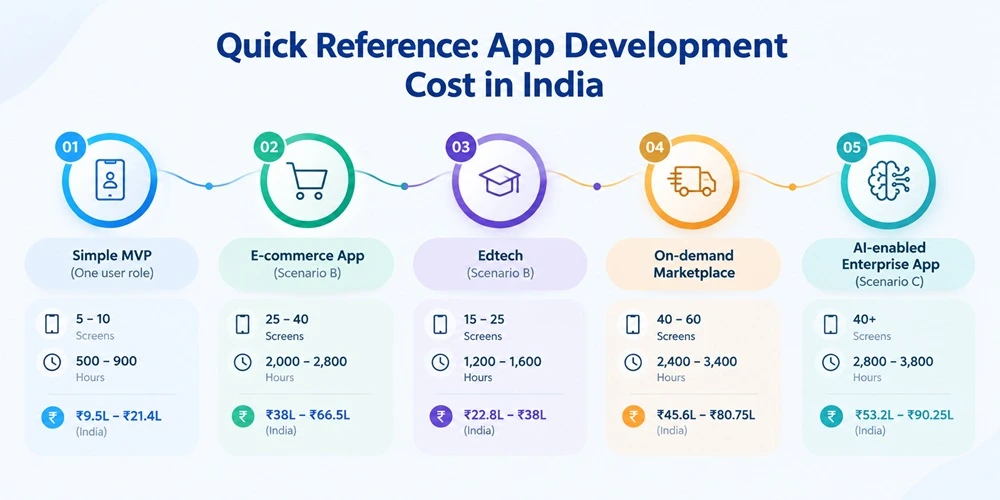
| App type | Screens | Hours | Timeline | India cost | Same hours at US rates |
|---|---|---|---|---|---|
| Simple MVP, one user role | 5 to 10 | 500 to 900 | 2 to 3 months | ₹9.5 lakh to ₹21.4 lakh ($10,000 to $22,500) | ₹11.9 lakh to ₹41.9 lakh ($12,500 to $44,100) |
| Booking or business app (Scenario A) | 15 to 25 | 1,200 to 1,600 | About 4 months | ₹22.8 lakh to ₹38 lakh ($24,000 to $40,000) | ₹28.5 lakh to ₹74.5 lakh ($30,000 to $78,400) |
| E-commerce app (Scenario B) | 25 to 40 | 2,000 to 2,800 | 5 to 6 months | ₹38 lakh to ₹66.5 lakh ($40,000 to $70,000) | ₹47.5 lakh to ₹1.30 crore ($50,000 to $137,200) |
| On-demand marketplace | 40 to 60 | 2,400 to 3,400 | 6 to 8 months | ₹45.6 lakh to ₹80.75 lakh ($48,000 to $85,000) | ₹57 lakh to ₹1.58 crore ($60,000 to $166,600) |
| AI-enabled enterprise app (Scenario C) | 40+ | 2,800 to 3,800 | 6 to 7 months | ₹53.2 lakh to ₹90.25 lakh ($56,000 to $95,000) | ₹66.5 lakh to ₹1.77 crore ($70,000 to $186,200) |
Most pages ranking for this topic are written by agencies. They quote package prices without saying how many hours, which roles or what level of testing sits behind the number. Two quotes for “a food delivery app” can differ by 5x and both be honest, because they describe different products.
Independent data narrows the picture. Clutch’s Mobile App Pricing Guide (updated 21 September 2026) reports that India-based firms average under $25 per hour, while US firms sit at $25 to $49. That is one rate band lower, not five times cheaper. The same guide puts the average project at $90,780 (about ₹86 lakh) over roughly 11 months, with average monthly spend of $8,188. One caveat: Clutch figures are self-reported by reviewed clients and skew toward export projects, so domestic budgets often run lower.
A labour signal helps too. The Stack Overflow Developer Survey 2025 shows a median total annual compensation of $10,462 for mobile developers in India, from a salary chart based on 1,093 India respondents. That is one signal, not a market rate. The gap between salary and agency rate pays for project management, QA, non-billable time, tooling and margin.
So the real spread in any estimate comes from three things: the seniority of the team, how much testing you pay for, and how tightly the scope is defined.
Also Read: How to Build an App with AI
Any credible price estimation to create an app in India follows one formula:
Estimated hours × blended hourly rate + fixed costs
Fixed costs are store fees, cloud hosting, third-party APIs (SMS, maps, payments, AI models) and compliance work. They do not shrink when you negotiate the rate.
What drives the hour count:
Xicom runs projects in five phases: strategic planning, design, development, quality assurance, and release and support. Hours per phase are set during discovery rather than by a fixed percentage.
The rate used in this article. Xicom publishes its dedicated developer rates on its Hire Mobile App Developers page: $25 per hour for junior developers (1 to 3 years), $35 for mid-level (3 to 5 years) and $45 for senior (5+ years), which is ₹2,375, ₹3,325 and ₹4,275 at the working rate. A project team blends these levels with design, QA and project management time. For the worked examples below, we use an illustrative blended rate of ₹1,900 to ₹2,375 per hour ($20 to $25), which sits at or under Clutch’s India average.
Each card shows hours × rate with the assumptions written out. “Build plus first 12 months live” includes the one-time store setup of ₹11,780 ($124): Apple’s $99 annual fee plus Google Play’s $25 one-time fee.
How the AI cost is calculated. Assume 200 technicians asking 20 questions a day for 22 working days: 88,000 requests a month. Each request uses about 3,000 input tokens (instructions plus a manual excerpt) and 400 output tokens, so 264 million input and 35.2 million output tokens a month. At Anthropic’s list prices, checked on its Claude API pricing page on 12 October 2026:
Model choice moves the AI line by 20x. Token counts vary by tokenizer, so measure with your real prompts. Prompt caching, which bills repeated context at a fraction of the input price, lowers this further.
Industry does not set the price. It changes the hour count through compliance, integrations and security testing. Each range below uses the same hours × rate model, and the hours are planning assumptions.
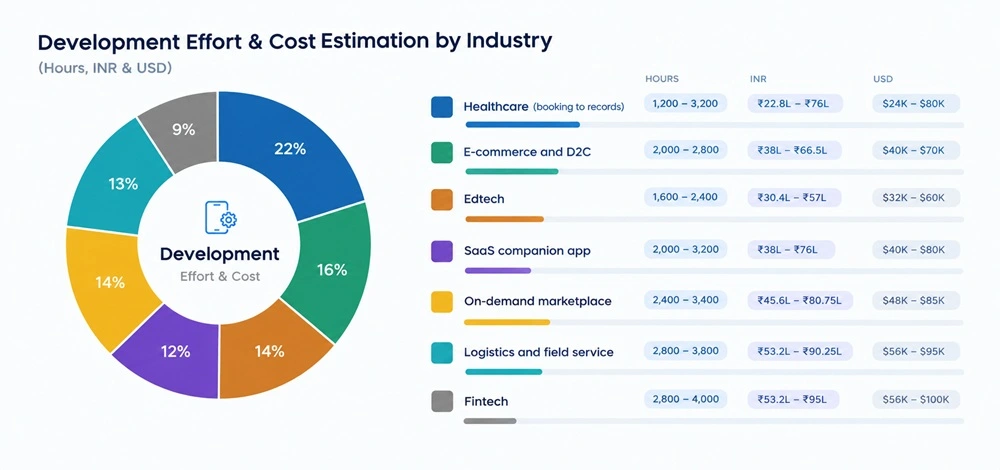
| Industry | Hours | INR | USD | What adds hours |
|---|---|---|---|---|
| Healthcare (booking to records) | 1,200 to 3,200 | ₹22.8 lakh to ₹76 lakh | $24,000 to $80,000 | ABDM integration, DPDP consent, health records workflows |
| E-commerce and D2C | 2,000 to 2,800 | ₹38 lakh to ₹66.5 lakh | $40,000 to $70,000 | Catalogue, payments, logistics and CRM integration, admin panel |
| Edtech | 1,600 to 2,400 | ₹30.4 lakh to ₹57 lakh | $32,000 to $60,000 | Course content, video delivery, assessments, student and teacher roles |
| SaaS companion app | 2,000 to 3,200 | ₹38 lakh to ₹76 lakh | $40,000 to $80,000 | Multi-tenancy, role management, API integrations |
| On-demand marketplace | 2,400 to 3,400 | ₹45.6 lakh to ₹80.75 lakh | $48,000 to $85,000 | Two-sided apps, live tracking, partner payouts |
| Logistics and field service | 2,800 to 3,800 | ₹53.2 lakh to ₹90.25 lakh | $56,000 to $95,000 | Offline sync, maps, fleet and route data, role-based access |
| Fintech | 2,800 to 4,000 | ₹53.2 lakh to ₹95 lakh | $56,000 to $100,000 | KYC, RBI directions that fit your product (such as digital lending or payment aggregator rules), PCI DSS if the app stores, processes or transmits card data, security testing |
Also Read: AI App Development Cost
| Costs you cannot control | Costs you can control |
|---|---|
| Apple Developer Program: $99 per year (about ₹9,405); Google Play: $25 one-time (about ₹2,375) | Scope: every screen, role and integration adds hours |
| Google Play service fee in India: 15% on the first $1M of annual earnings, 30% above, 15% on auto-renewing subscriptions, 4 points lower with alternative billing. Apple Small Business Program: 15% for developers with $1M or less in prior-year proceeds | Platform choice: one cross-platform codebase or two native apps |
| GST: 18% on IT services in India; export of software services is zero-rated | Design depth: custom UI and motion vs a design system |
| Mandatory platform updates: Google Play apps must target Android 16 (API level 36) from 31 August 2026, extensions to 1 November 2026; Apple requires Xcode 26 and the iOS 26 SDK since 28 April 2026 | Team seniority: senior-heavy teams cost more per hour and often fewer hours |
| DPDP Rules 2025: consent, notices, data principal rights, breach handling and retention duties from May 2027 | Engagement model: fixed price, time and materials, or dedicated team |
| Third-party price changes for SMS, maps and AI models | Build vs buy: use existing services for payments, chat and maps instead of custom builds |
Most quotes cover the build only. These lines are real costs, priced with the same sources and rate used in the rest of this guide.
| Hidden cost | India cost (2026) | Frequency | Notes |
|---|---|---|---|
| Apple Developer Program | $99 (about ₹9,405) | Yearly | Charged in local currency; in India, enrolment runs through the Apple Developer app, which shows the rupee price |
| Google Play registration | $25 (about ₹2,375) | Once | Required to publish on Google Play |
| Cloud hosting | From ₹3,800 ($40) a month | Monthly | AWS’s own multi-tier Lightsail example; scales with users |
| SMS and OTP | ₹0.16 to ₹0.25 per SMS | Per message | MSG91 India rates by volume, plus 18% GST |
| Payment gateway | 2% + GST per transaction | Per payment | Razorpay standard plan, including UPI |
| Maps API | 70,000 free events a month per SKU, then $1.50 to $2.10 per 1,000 | Monthly | Google Maps Platform India price list |
| AI model tokens | ₹4,180 to ₹83,600 ($44 to $880) a month | Monthly | For 88,000 requests, as in Scenario C |
| Maintenance | 20 to 80 hours a month (₹38,000 to ₹1,90,000) | Monthly | Range across Scenarios A to C |
| OS and SDK deadline work | ₹76,000 to ₹1,90,000 | Yearly | 40 to 80 hours for Android target API and Apple SDK rules |
| DPDP engineering | ₹1,52,000 to ₹3,80,000 | Once | 80 to 160 hours; most duties apply from May 2027 |
| Store commission | 15% or 30% of digital revenue | Ongoing | Lower with alternative billing on Google Play; see the table above |
| GST | 18% on IT services | Per invoice | Export of software services is zero-rated |
Many buyers budget only for the build. Here is the clinic booking MVP from scenario A across three years, using the same rate assumption. Two extra lines are assumptions: 40 to 80 hours a year for mandatory OS and SDK updates, and 80 to 160 hours once for DPDP engineering.
| Line item | Year 0 (build) | Year 1 | Year 2 |
|---|---|---|---|
| Build | ₹22,80,000 to ₹38,00,000 | Nil | Nil |
| Store accounts | ₹11,780 | ₹9,405 | ₹9,405 |
| Cloud and maintenance | Nil | ₹5,01,600 to ₹9,00,600 | ₹5,01,600 to ₹9,00,600 |
| Platform deadline work | Nil | ₹76,000 to ₹1,90,000 | ₹76,000 to ₹1,90,000 |
| DPDP engineering | Nil | ₹1,52,000 to ₹3,80,000 | Nil |
| Total | ₹22,91,780 to ₹38,11,780 | ₹7,39,005 to ₹14,80,005 | ₹5,87,005 to ₹11,00,005 |
Three-year total: ₹36.2 lakh to ₹63.9 lakh ($38,100 to $67,300). The build is only about 60% of it. Year 0 plus Year 1 cloud and maintenance equals the ₹27.9 lakh to ₹47.1 lakh shown in the scenario card. The other lines are the ones most budgets miss.
Two notes on timing. If your app launches in early 2027, the DPDP duties land in Year 1. And if you sell digital content or subscriptions, add store commission from the month revenue starts.
Clutch reports that hourly rates are the same across Android, iOS and cross-platform work, at $25 to $49 overall. The difference is volume: building two separate native apps roughly doubles project cost. That is why Flutter app development cost in India is usually lower for a first release. You pay for one codebase, one test suite and one release process.
The table below prices the clinic booking scope from Scenario A on each platform option. Single-platform native hours are an assumption. The two-native row applies Clutch’s point that two native apps roughly double cost.
| Platform | Hours | INR | USD | When to choose |
|---|---|---|---|---|
| Android only (Kotlin) | 1,000 to 1,400 | ₹19 lakh to ₹33.25 lakh | $20,000 to $35,000 | Users clearly on Android, such as field staff on company devices |
| iOS only (Swift) | 1,000 to 1,400 | ₹19 lakh to ₹33.25 lakh | $20,000 to $35,000 | An audience you know is mostly on iPhone |
| Native, both platforms | 2,000 to 2,800 | ₹38 lakh to ₹66.5 lakh | $40,000 to $70,000 | Heavy device hardware, demanding graphics, platform-specific polish |
| Flutter (cross-platform) | 1,200 to 1,600 | ₹22.8 lakh to ₹38 lakh | $24,000 to $40,000 | Most MVPs and growth-stage apps on both platforms |
| React Native (cross-platform) | 1,200 to 1,600 | ₹22.8 lakh to ₹38 lakh | $24,000 to $40,000 | Same case as Flutter, or a team with strong JavaScript skills |
Android and iOS cost the same to build because Clutch finds hourly rates do not change by OS. The difference is in store fees: $99 a year for Apple, $25 once for Google.
Native still earns its cost in specific cases:
For most booking, commerce and field-service apps, cross-platform is the sensible default.
Also Read: Top Mobile App Development Companies in India
At ₹1,900 to ₹2,375 per hour, the bottom of Clutch’s band (₹9.5 lakh) buys about 400 to 500 hours. The top (₹47.5 lakh) buys about 2,000 to 2,500 hours.
Near the lower end:
Around the middle:
What to cut first: custom animations, social login variants, in-app chat built from scratch, multi-language support at launch and complex reporting.
We price scope before we price hours. Every estimate separates labour from fixed lines such as store fees, cloud and APIs, and includes first-year running costs so the number you approve is the number you spend.
Xicom has delivered 1,800+ projects for 750+ clients in 50+ countries over 20+ years, with 350+ IT professionals and a 4.8 rating on Clutch. We hold ISO 9001, NASSCOM and STPI credentials.
Timelines follow scope. Xicom’s published bands are 3 to 6 months for a basic single-platform app, 6 to 9 months once payments, real-time features and integrations are added, 9 to 12 months for advanced security, offline mode, Artificial Intelligence features and admin dashboards, and 12+ months for multi-country, compliance-heavy builds. Post-launch support is scoped and quoted with the build.
Mobile app development cost in India comes down to hours multiplied by a rate, plus fixed costs no vendor can negotiate away, such as store fees, GST and annual platform updates. Clutch’s typical band of ₹9.5 lakh to ₹47.5 lakh is a fair starting point. Where you land depends mostly on scope, platform choice and team seniority.
Budget for three years, not one, since the build is often only about 60% of the total. Choose a mobile app development company that shows the hours behind its number, lists fixed costs separately and includes first-year running costs.
Most mobile app projects reviewed on Clutch cost $10,000 to $49,999, about ₹9.5 lakh to ₹47.5 lakh (Clutch, updated 21 September 2026). In our worked examples, a cross-platform booking MVP of 1,200 to 1,600 hours costs ₹22.8 lakh to ₹38 lakh to build, before 18% GST and running costs.
Clutch’s Mobile App Pricing Guide (updated 21 September 2026) reports that India-based firms average under $25 per hour, against $25 to $49 for US firms. Rates do not change by operating system. Clutch data is self-reported by reviewed clients and leans toward export projects, so treat it as a benchmark, not a quote.
Usually, for the first release. Clutch notes that hourly rates are the same across Android, iOS and cross-platform work, but building two separate native apps roughly doubles project cost. A single Flutter codebase avoids that duplication. Native still makes sense for heavy device features, demanding graphics or platform-specific experiences.
Budget for it in hours. In our clinic booking example, 20 to 30 maintenance hours a month plus a $40 cloud setup costs ₹41,800 to ₹75,050 monthly. Add annual OS and SDK deadline work and, from May 2027, DPDP engineering. Over three years, the build is only about 60% of total cost.
Yes. GST on IT services in India is 18%, charged on top of the development quote for Indian clients. Export of software services is zero-rated, which matters for buyers in the US, UK and UAE contracting an Indian firm. Confirm the invoicing structure and tax treatment with your accountant before signing.
Google Play’s service fee in India is 15% on the first $1M of annual earnings, 30% above that, and 15% on auto-renewing subscriptions, four points lower with alternative billing. Apple’s Small Business Program charges 15% for developers with $1M or less in prior-year proceeds. Apple’s developer fee is $99 a year; Google’s is $25 once.
It depends mainly on model choice and volume. For 88,000 requests a month, our field-service example costs about $44 (₹4,180) on Claude Haiku 5.5 or $880 (₹83,600) on Claude Sonnet 5.5, using Anthropic’s list prices checked 12 October 2026. Prompt caching and shorter prompts reduce this further.
Yes, as engineering work. The DPDP Rules 2025 were notified in November 2025, and most operational duties, including consent, notices, data principal rights, breach handling and retention, apply from May 2027. Consent capture and data deletion need screens, APIs and logs. Our three-year example budgets 80 to 160 hours for this.

Based on this article's topic