Aug 27, 2026 Artificial Intelligence
Key Takeaways
- Due diligence agents don’t just search documents, they plan, cross-reference, execute code, and reason through conflicting data like a digital analyst.
- The due diligence investigation market is projected to hit $11.83B by 2030, growing at 7.6% CAGR.
- Legacy manual review breaks down under document volume, cross-referencing errors, and expanding regulatory scope AML, KYC, ESG, data protection.
- A production-ready agent needs six architecture layers: ingestion, hybrid retrieval, multi-agent orchestration, deterministic tool execution, security/governance, and attribution.
- Multi-agent setups split work across specialized roles, a lead coordinator, financial specialist, legal auditor, and deal memo compiler.
- Deterministic tool execution (Python sandboxes) prevents hallucinated numbers by running actual code instead of model “mental math.”
- Every flagged fact links back to its exact source page and line, giving human reviewers instant, one-click verification.
- Core use cases span financial/tax review, legal/contract scrutiny, AML and compliance checks, and technical codebase audits.
- Human in the loop stays central: agents surface findings and evidence, but senior deal partners retain final sign-off.
- Recommended rollout: start with high-volume friction points, build custom rather than buy off the shelf, then expand to portfolio level tools.
Due diligence has historically been defined by an uncomfortable trade-off, i.e., speed vs. depth. Investors, private equity firms, and corporate mergers and acquisitions (M&A) teams often spend weeks sifting through thousands of unstructured documents. These include financial statements, employment contracts, environmental impact reports, and proprietary source code bases. As deal velocity increases and regulatory frameworks evolve rapidly, manual review methods hit clear scaling limits.
Data volumes inside modern virtual data rooms (VDRs) are growing exponentially. Recent studies from Research and Markets indicate that the due diligence investigation market size will grow to $11.83 billion in 2030 at a CAGR of 7.6%.
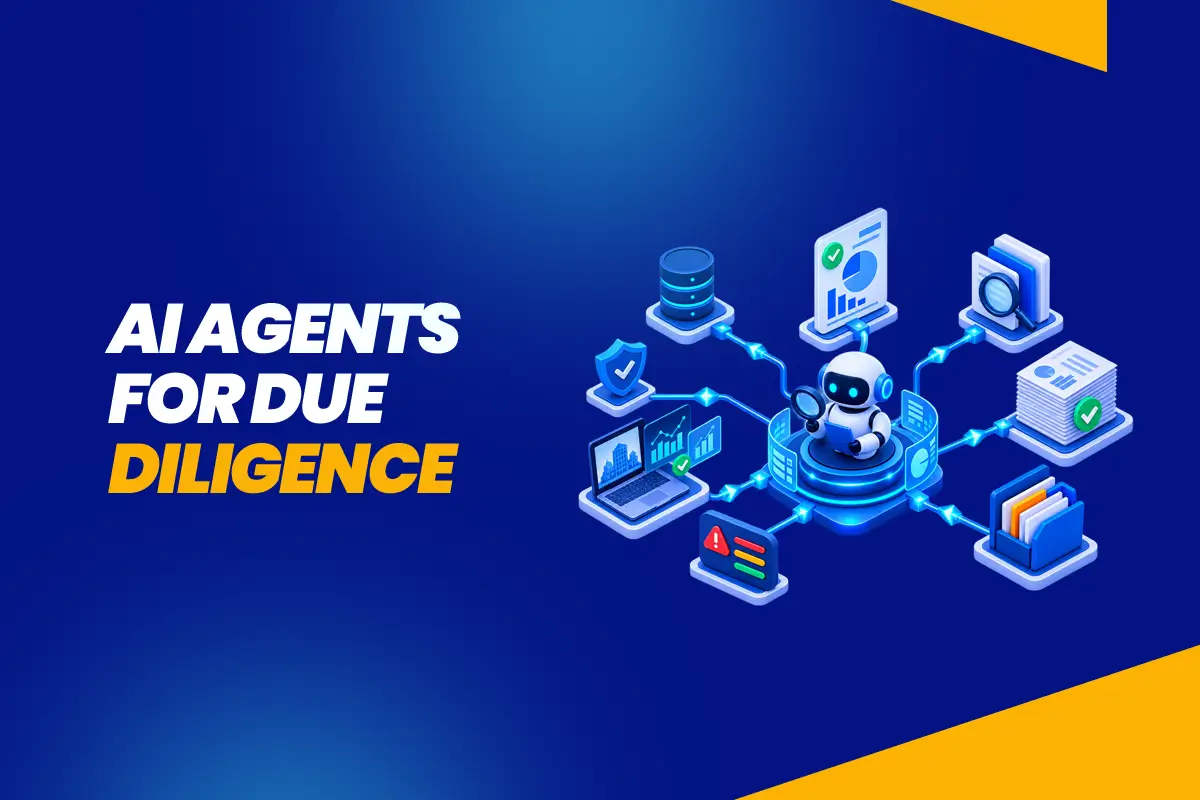
This is precisely where AI agents change the game. Unlike passive retrieval systems or basic chatbots, AI agents break down complex workflows, plan analytical steps, cross-reference external regulatory databases, execute code verification, and reason through conflicting metrics.
We design and deploy AI agents for due diligence that function as continuous digital analysts. These agentic workflows streamline M&A audits, financial risk modeling, legal contract scrutiny, and anti-money laundering (AML) protocols.
What Is Due Diligence?
Due diligence is the investigation you run before you commit to something big, such as an acquisition, a new vendor, a customer relationship in a regulated industry, or an investment. Instead of just taking pitch decks or seller statements at face value, deal teams dig through contracts, audit trails, and data rooms to verify claims, unearth hidden risks, and ensure the asset is actually worth the asking price.
What is an AI Agent for Due Diligence?
While a basic chatbot answers simple questions and standard document search tools pull up relevant passages, an autonomous due diligence agent acts like a tireless digital analyst. You don’t just ask it to find a file; you assign it a goal. For example, you can tell the system: “Audit all customer contracts in the data room, identify any change-of-control clauses triggered by 49% equity acquisition, and flag any capped liability terms below $1.5 million.“
The agent breaks that complex request into step-by-step actions. It locates the files, reads through the legal jargon, checks numbers using actual code, cross-references external databases, and flags real operational risks.
How It Differs from Other AI Approaches
| System Type | How It Handles Data | Where It Falls Short in Deal Reviews | The Agentic AI Difference |
|---|---|---|---|
| Standard Chatbot | Responds to single text prompts by summarizing uploaded text. | Passive and reactive; cannot run multi-step checks or cross-reference separate files. | Proactive Workflow Execution: Breaks complex deal goals into sub-tasks and executes them end-to-end. |
| Basic RAG Search | Scans vector databases to fetch text passages matching your search terms. | Struggles with complex logic; misses context when numbers span across multiple files or footnotes. | Context-Aware Reasoning: Combines semantic search with exact keyword retrieval and evaluates full document context. |
| Traditional Automation | Follow hardcoded rules (if word X appears, extract value Y). | Extremely fragile; breaks completely if a scanned PDF is messy or a contract strays from standard templates. | Adaptive Layout Parsing: Understands intent and visual document structure, handling messy real-world files easily. |
Why Does the Legacy Due Diligence Actually Fall Apart?
A handful of pressure points keep showing up across every industry we work with. Here are a few reasons that are relevant today, which show why the legacy due diligence is falling apart and companies today are relying on AI agents in due diligence:
- Document volume has outgrown the team: A mid-size acquisition can throw tens of thousands of pages at a review team on a two-week clock. Nobody’s reading all of it with the same attention on page one and page nine thousand.
- Cross-referencing is exhausting and error-prone: Catching a mismatch between a supplier contract and a financial disclosure means holding two documents in your head at once. That’s precisely the kind of task people get careless about.
- Regulatory scope keeps expanding: AML checks, KYC, sanctions screening, ESG disclosures, data protection law. Each new requirement adds another checklist item that has to be verified, not assumed.
Also Read: AI Agent for Fraud Detection
AI Agent Architecture for Due Diligence
Building a production-ready diligence platform requires moving away from single-prompt models toward a multi-layered, modular software architecture. At Xicom, we deploy enterprise-grade diligence frameworks using six interconnected architectural layers designed for precision, security, and strict auditability:
| Architecture Layer | Core Functionality & Technical Capability | Operational Value |
|---|---|---|
| 1. Multi-Modal Ingestion | Uses layout-aware OCR and spatial parsers to extract unstructured scans, spreadsheets, and PDFs while tracking pixel coordinates. | Preserves financial table structures, footnotes, and visual context without flattening data into raw text. |
| 2. Hybrid Data & Memory | Combines dense vector embeddings with sparse keyword search (BM25) alongside short- and long-term context stores. | Prevents missed numerical figures or dropped negative accounting signs during document retrieval. |
| 3. Multi-Agent Orchestration | Deploys a central supervisor agent to route sub-tasks across specialized legal, financial, and compliance agents. | Eliminates context overload by dividing massive review workloads into parallel digital workflows. |
| 4. Deterministic Tool Execution | Equips agents with isolated, air-gapped Python sandboxes and external API connectors (SEC EDGAR, IP registries). | Runs precise financial math, recalculates cash flows, and verifies external claims without model hallucinations. |
| 5. Security & Governance | Applies Role-Based Access Controls (RBAC), automated PII scrubbing, and enterprise zero-data-retention API terms. | Protects non-public material information (MNPI) and ensures strict compliance with SOC 2, GDPR, and HIPAA. |
| 6. Attribution & Synthesis | Compiles verified agent findings into structured deal memos with interactive visual citations linked to source pages. | Enables human reviewers to instantly verify any flagged liability or metric back to the exact paragraph and line item. |
How to Build a Due Diligence AI Agent?
Building an enterprise-ready diligence system is far more complex than just wrapping a public API in a simple user interface. Here’s a solid 7-step engineering roadmap that guides you on how to build one that is not only reliable but also gives you high-quality investment insights:
Step 1: Set Up Layout-Aware Data Ingestion
A typical Virtual Data Room (VDR) is a chaotic mix of unstructured scans, dynamic spreadsheets, legacy legal PDFs, and SQL database exports. Standard text extractors completely mangle complex layouts.
- Preserve Document Structure: We implement layout-aware parsers that keep tables, headers, columns, and footnotes tied together in their original visual context.
- Map Spatial Coordinates: Scanned files get converted into clean text while tracking their exact pixel and page coordinates, ensuring that every piece of data pulled can be traced back visually to the original page.
Step 2: Build a Specialized Retrieval Pipeline (RAG)
Standard vector search falls short when reading dense financial statements. Off-the-shelf embedding models average out text, often blending critical numbers or dropping negative signs altogether.
- Combine Dense and Sparse Search: We implement a hybrid retrieval setup that pairs semantic vector matching with sparse keyword search (like BM25). This ensures the agent catches both high-level legal concepts and exact line-item figures.
- Use Hierarchical Chunking: We index small, focused blocks of text for fast searching, but feed the broader parent section back to the model so it never evaluates a single clause out of context.
- Apply Granular Metadata Filters: Data is tagged by deal phase, subsidiary, file type, effective date, and governing jurisdiction so the engine can filter out irrelevant noise in milliseconds.
Step 3: Architect a Dedicated Multi-Agent Task Pipeline
Asking one prompt to read a 400-page contract, run complex financial math, check corporate filings, and draft a deal memo is a recipe for failure. Instead, we use orchestration frameworks like LangGraph or AutoGen to break the work across specialized digital roles:
- The Lead Coordinator: Takes the high-level question from the deal team, maps out an execution strategy, and breaks the task into focused assignments for sub-agents.
- The Financial Specialist: Audits balance sheet line items, runs ratio calculations, and flags accounting anomalies or unusual working capital swings.
- The Legal & Regulatory Auditor: Scans contracts for liability caps, change-of-control triggers, non-compete limits, and regulatory exposure risks.
- The Deal Memo Compiler: Takes verified insights from all active agents and formats them into a standardized Investment Committee memorandum complete with direct source citations.
Step 4: Choose the Right Models and Fine-Tune Performance
Not every sub-task requires a massive, power-hungry model. Mixing model sizes keeps performance high while controlling latency and computing costs.
- Heavyweight Reasoning Models: We deploy high-parameter frontier models for multi-step logic, complex legal interpretation, and numerical cross-checks.
- Targeted Open-Source Models: We fine-tune compact open-source models (such as Llama or Mistral variants) on proprietary domain data to handle fast classification, PII scrubbing, and metadata extraction.
- Strict Format Rules: We enforce JSON schema outputs on all agent responses to ensure downstream databases and UI components ingest findings cleanly.
Step 5: Connect Natively into Dealmaker Workflows
A diligence tool is only useful if it lives where your deal team actually works.
- Direct Data Room Connectors: We build enterprise API integrations directly into leading VDR platforms like Datasite, Intralinks, and Ansarada for real-time document sync.
- Enterprise System Links: We link agents straight into internal ERPs, CRMs, and business intelligence dashboards so team members don’t have to copy-paste data between isolated browser tabs.
Step 6: Deploy Governance, Privacy, and Audit Trails
Handling confidential M&A data demands zero compromises on data isolation and compliance.
- Strict Access Control (RBAC): We tie agent permissions directly to existing user roles, ensuring an analyst only sees outputs derived from files they are explicitly authorized to view.
- Zero Data Retention Guarantees: Enterprise API endpoints run with strict zero-data-retention agreements, ensuring your target company’s sensitive assets never train external models.
- Visual Citation Requirements: Every fact, ratio, or legal risk flagged by the agent links directly back to the exact page, line, and paragraph of the source document for instantaneous human verification.
Step 7: Run Continuous Quality Benchmarks & Maintain Human Control
Before rolling an agent out across active deal channels, its analysis needs rigorous verification.
- Automated Quality Testing: We set up continuous testing frameworks (using tools like RAGAS) to score the pipeline on accuracy, relevance, and factual faithfulness.
- Human-in-the-Loop Safeguards: Senior deal partners retain final sign-off. The agent presents structured findings, highlights risks, and provides evidence, leaving final strategic decisions to the deal team.
Also Read: Multi-Agent System
Key Applications of Agentic AI for Due Diligence Across Enterprise Sectors
When you deploy due diligence agent systems across the real-world, the biggest impact happens in the day-to-day grind of heavy document review. Instead of sending endless spreadsheets and PDF folders back and forth between legal, tax, and engineering teams, multi-agent setups take on the heavy lifting for each major evaluation track.
Here is how we set up these workflows to handle specific diligence areas:
1. Financial & Tax Review
Validating financial performance usually means digging through general ledgers, tax returns, quality of earnings reports, and complex revenue schedules. Multi-agent pipelines streamline these numbers to make sure nothing gets missed:
- Checking Revenue Health: Agents audit customer retention rates, revenue recognition policies, and concentration risks across thousands of transactional line items to show where earnings actually come from.
- Catching Working Capital Shifts: The system highlights unexpected swings in accounts receivable or inventory pricing methods. The kind of sudden accounting adjustments that can alter purchase price calculations right before closing.
- Uncovering Tax Liabilities: Specialized sub-agents compare state, federal, and international tax filings against updated tax laws to flag potential unpaid back-taxes or unrecorded audit exposures.
2. Legal & Contract Scrutiny
Legal review easily eats up hundreds of billable hours as associate attorneys manually pore over customer contracts, lease agreements, and employment records. An autonomous setup speeds up contract abstraction significantly:
- Flagging Change-of-Control Risks: Agents pull out assignment provisions triggered by equity transfers, giving deal teams immediate visibility into vendor contracts or client accounts that might churn during an acquisition.
- Spotting Liability Caps: Algorithms scan massive contract archives to highlight capped damages, unlimited liability clauses, and non-standard warranty terms that introduce operational risk.
- Verifying Patent & IP Ownership: The system matches internal patent, trademark, and copyright records against global IP databases to verify that the target business truly holds clean, unencumbered ownership.
3. Compliance, AML & Background Checks
In heavily regulated industries like banking, fintech, and healthcare, relying on routine spot checks leaves major blind spots. Continuous digital workflows allow risk teams to maintain active oversight throughout the deal cycle:
- Screening Ownership & Sanctions Lists: Agents track Ultimate Beneficial Ownership structures against dynamic global watchlists, uncovering multi-tiered shell corporate setups.
- Running Background & Media Audits: Language models parse international news sources and court filings to surface past litigation, regulatory fines, or political exposure linked to key company executives.
- Auditing Healthcare & Safety Records: For clinical or health-tech transactions, specialized agents review clinical trial documentation, patient data privacy controls, and past regulatory inspection logs.
4. Technical & Codebase Audits
When evaluating tech companies or proprietary software assets, engineering leaders have to verify code quality, security standards, and open-source licensing before taking on the codebase:
- Catching Open-Source License Violations: Agents audit source code repositories to spot copyleft open-source licenses (like GPL or AGPL) that could legally force a company to publish its proprietary software.
- Measuring Security Exposure: The system cross-references application dependencies against public security vulnerability databases, giving deal teams a realistic estimate of post-acquisition patch costs.
- Evaluating Technical Debt: Automated code reviewers measure structural modularity, test coverage, and historical bug fix velocity so buyers know exactly how much engineering effort will be required post-closing.
Benefits of AI Agents for Due Diligence
When investment teams evaluate high-stakes acquisitions, the biggest bottleneck is almost always the sheer volume of material they have to digest under tight deadlines. Pulling autonomous digital agents into your deal pipeline changes the entire dynamic. Rather than replacing human judgment, these systems take over the mechanical heavy lifting, allowing analysts to focus on deal strategy and valuation.
Here is how deploying dedicated diligence agents changes day-to-day transaction operations:
Drastically Faster Document Review
Instead of spending days or weeks manually reading through thousands of VDR files, agents parse and organize massive document caches in hours. Files are indexed, tagged, and ready for deep analysis almost as soon as the data room opens.
Smart Cross-Document Correlation
A human analyst reading a vendor agreement might easily miss how a specific covenant conflicts with a loan facility document. Multi-agent setups analyze the entire data room simultaneously, immediately connecting the dots across separate legal, tax, and operational filings to catch conflicting terms.
Elimination of Audit Fatigue & Human Oversight Errors
Exhaustion leads to missed details, especially when teams are reviewing dense contract appendices. Digital workflows evaluate page 10,000 with the exact same precision and focus as page 1, maintaining consistent analytical standards across the entire transaction.
Seamless Deal Scalability
Expanding your investment pipeline usually requires hiring more associate reviewers or spending heavily on external consultants. With an autonomous agent framework in place, your team can evaluate three to four times as many potential targets at once without increasing operational overhead.
Immediate Risk & Anomaly Spotting
Early detection of deal-breakers changes negotiation power. Whether it’s an unrecorded tax liability, a pending regulatory fine, or a restrictive change-of-control clause, agents flag high-priority liabilities right at the start of the evaluation phase so you don’t waste time on non-viable deals.
Built-in Audit Trails & Traceability
Every insight, financial summary, or flag generated by an enterprise-grade agent links directly to the exact page, line, and paragraph of the original file. This lets your legal and financial leads instantly verify facts with a single click.
Significant Reduction in Repetitive Manual Work
Deal leads shouldn’t spend billable hours copying financial line items into spreadsheets or manually summarizing standard lease contracts. Automating routine data extraction gives a time back to conduct real strategic evaluation and engage in higher-value deals.
Also Read: AI Agent for Healthcare
Overcoming Core Technical & Security Challenges in AI Diligence
Deploying autonomous systems into high-stakes M&A or regulatory environments presents distinct challenges. Enterprise software engineering leaders must solve three primary technical hurdles.
Hallucination Prevention & Strict Source Attribution
In financial diligence, a hallucinated revenue figure or misquoted debt clause can break a transaction.
- Solution: We enforce strict Groundedness Guardrails inside our multi-agent pipelines. If an agent asserts a fact without a corresponding reference inside the ingested VDR document, the synthesis engine discards the claim automatically.
Handling Complex Tabular Data & Financial Models
Standard language models frequently misinterpret financial tables, mistaking column headers or dropping negative signs across dynamic balance sheets.
- Solution: Integrate specialized layout-aware table transformers alongside custom Python execution sandboxes. Instead of asking the model to perform mental arithmetic on balance sheet text, the agent writes and executes Python code against extracted numerical arrays to make numerical calculations deterministic and auditable.
Enterprise-Grade Data Security & Regulatory Compliance
Target acquisition files often contain non-public personal information (NPI), protected health information (PHI), and material non-public information (MNPI).
- Solution: Build air-gapped processing pipelines within dedicated virtual private clouds (VPCs). Use automated PII/PHI redaction agents to scrub sensitive identities before data reaches model reasoning steps. Ensure complete compliance with SOC 2 Type II, GDPR, and HIPAA standards.
Strategic Roadmap: Implementing AI Diligence Agents in Your Enterprise
For technology leaders, private equity firms, and enterprise decision-makers looking to deploy autonomous diligence capabilities, we recommend taking a structured, phased approach.
Phase 1: Focus on High-Volume Friction Points
Do not attempt to automate your entire investment committee process overnight. Start with high-volume, repetitive pain points such as contract abstraction, change-of-control auditing, or preliminary financial data room indexing.
Phase 2: Build Custom Rather Than Buying Off-the-Shelf
While generic SaaS AI tools provide quick demos, they lack the data privacy controls, enterprise custom system integrations, and deterministic precision needed for complex transactions. Building tailor-made agentic AI architectures ensures your business retains full ownership of its intellectual property and security framework.
Phase 3: Integrate Custom AI Chatbots for Portfolio Scrutiny
In addition to transactional due diligence, internal tools like custom AI chatbot development solutions are deployed so portfolio management teams can query historical diligence documents in real time using conversational interfaces long after the deal has closed.
How Does Xicom Engineer Enterprise AI Agents for Due Diligence?
At Xicom, we turn complex M&A due diligence into an automated, battle-tested engineering reality. Leveraging over two decades of custom software expertise, we don’t rely on generic AI. Instead, our senior software developers map your exact review workflows and build custom multi-agent architectures that process dense financial statements, legal contracts, and technical assets in parallel without losing structural context or security.
From architecting layout-aware RAG pipelines and enterprise VDR integrations to enforcing air-gapped security guardrails and zero-data-retention policies, we cover the full deployment lifecycle. Every solution includes visual citation tracking, rigorous benchmark testing, and continuous post-launch optimization, giving your firm an enterprise-grade intelligence platform that drastically cuts deal evaluation time while eliminating manual oversight errors.
Final Takeaway
Building enterprise software for high-stakes dealmaking isn’t like launching a basic enterprise SaaS app. When we introduce autonomous decision-making into live financial, legal, or M&A evaluation pipelines, we need an engineering architecture that handles complex edge cases, protects sensitive corporate data, and integrates smoothly with legacy data rooms and ERP systems.
For organizations seeking to deploy custom AI agents for due diligence that accelerate deal velocity, maintain strict regulatory compliance, and eliminate tedious manual documentation review, we provide the talent and strategic architecture required to build safely.
Transform your transactional operations with enterprise-grade autonomous intelligence. Explore how Xicom’s specialized AI agent development services can optimize your due diligence workflows, lower operational overhead, and give your firm a decisive competitive edge. Our engineering team stands ready to architect custom software solutions tailored directly to your strategic business goals.
FAQs
1. How is an AI agent different from a chatbot or basic document search?
A chatbot answers single prompts reactively. A due diligence agent is goal-driven, you assign it a task, and it breaks that into steps, executes them, and cross-references multiple sources on its own.
2. Does an AI agent replace the deal team?
No. It handles the mechanical heavy lifting, document review, cross-referencing, flagging anomalies, while senior deal partners retain final strategic sign-off on every decision.
3. How do these agents prevent hallucinated financial figures?
Through groundedness guardrails: if an agent asserts a fact without a traceable reference in the source document, the system discards the claim. Numerical calculations also run through actual Python execution rather than model-generated math.
4. What kind of documents can an AI agent process?
Unstructured scans, spreadsheets, legacy legal PDFs, and SQL exports, using layout-aware OCR that preserves tables, footnotes, and visual context instead of flattening everything into raw text.
5. Is this safe for confidential M&A data?
Yes, enterprise deployments use role-based access controls, air-gapped processing in VPCs, automated PII/PHI redaction, and zero-data-retention agreements, aligned with SOC 2, GDPR, and HIPAA.
6. What’s the first step to adopting this in our firm?
Start narrow, automate a high-volume friction point like contract abstraction or data room indexing-rather than trying to replace the entire investment committee process at once.

Make your ideas turn into reality
With our AI & mobile app solutions
Explore related services
Based on this article's topic