Oct 8, 2026 Artificial Intelligence
Gartner predicts that 80% of enterprise software and applications will be multimodal by 2030, up from less than 10% in 2024. Enterprise data has always arrived as scanned forms, product photos, call recordings and sensor feeds; software is now catching up.
For CTOs and product leaders, the question is no longer whether multimodal AI applications work. It is which workflows justify the build, which model fits, and what it takes to run the system reliably in production.
This guide covers how multimodal AI works, 12 industry use cases with named deployments, the leading models as of October 2026, a step-by-step build process, cost drivers, and the compliance issues you need to plan for.
Key Takeaways
- Multimodal AI processes two or more data types, such as text, images, audio and video, in one system, which lets it reason over information the way business processes actually produce it.
- The strongest enterprise use cases combine a visual or audio signal with structured records, for example damage photos with policy documents, or medical images with patient history.
- Frontier closed models from OpenAI, Google and Anthropic lead on general multimodal reasoning, while open-weight families such as Qwen, Gemma and Llama 4 suit teams that need self-hosting or data residency.
- Most production systems succeed or fail on data alignment, evaluation and integration, not on model choice alone.
- EU AI Act obligations for stand-alone high-risk systems now apply from 2 December 2027, so teams building multimodal AI for hiring, education, credit or healthcare should design governance in from the start.
What Is Multimodal AI?
Multimodal AI is a type of artificial intelligence that can take in, connect and reason across more than one kind of data, such as text, images, audio, video and sensor signals, within a single system. Instead of analyzing a photo or a document in isolation, it interprets them together to produce a more complete answer, decision or output.
A unimodal model handles one input type. A text-only language model reads a claim description; a separate vision model classifies a damage photo. A multimodal model can read the description, inspect the photo and flag that the reported rear impact does not match visible front-end damage.
That cross-referencing is the core value. Gartner noted in 2024 that many multimodal models were limited to two or three modalities; current frontier systems accept text, images, documents, audio and video, and some respond in speech in real time.
Also Read: Recent Developments in AI
How Multimodal AI Works?
Most multimodal systems follow the same four-stage pattern.
1. Modality Encoders
Each data type passes through its own encoder: a vision transformer for images, a speech encoder for audio, a tokenizer and embedding layer for text. Each converts raw input into numerical vectors (embeddings).
2. Alignment and Shared Embedding Space
The embeddings from different encoders are projected into a shared space where related concepts sit close together. A photo of a cracked windshield and the phrase “cracked windshield” end up near each other. OpenAI’s CLIP popularized this approach through contrastive training on image and text pairs, and it remains the foundation of many retrieval and search systems.
3. Fusion
Fusion is where the modalities are combined. There are three common strategies:
- Early fusion: raw or lightly processed inputs are merged before deep processing. This captures fine-grained interactions but needs well-synchronized data.
- Late fusion: each modality is processed separately and the outputs are combined at the decision stage. It is simpler and more robust to a missing modality, but can miss cross-modal relationships.
- Hybrid or cross-attention fusion: the model lets tokens from one modality attend to tokens from another. Most modern multimodal large language models use this approach. Qwen’s newer generations, for example, use a unified vision-language design with early fusion of multimodal tokens.
4. Reasoning and Output Generation
A language model backbone reasons over the fused representation and generates the output: text, structured JSON, a tool call, synthesized speech or, in some systems, an image.
Architecture diagram suggestion: Four inputs (Text, Image, Audio, Video) each feed an encoder, then a Shared Embedding Space, a Cross-Attention Fusion layer and an LLM Backbone, ending in three outputs (Text/JSON, Speech, Actions). A “Guardrails and Evaluation” band spans the pipeline.
Multimodal AI vs Unimodal AI vs Generative AI
These terms overlap. They describe different properties of a system, not mutually exclusive categories. A model can be generative and multimodal at the same time, and most frontier models today are both. In practice, many teams start with a text-based assistant and add image or document understanding later, which is why multimodal capability is now a standard requirement in generative AI development projects.
| Dimension | Unimodal AI | Multimodal AI | Generative AI |
|---|---|---|---|
| What defines it | Handles one data type | Handles two or more data types together | Produces new content |
| Typical input | Text only, or images only | Text, images, audio, video, sensor data | Any, depending on the model |
| Typical output | A label, score or text | Text, speech, actions or structured data | Text, images, audio, video or code |
| Example | A spam classifier | A claims system reading photos and policy PDFs | An image generator |
| Best fit | Narrow, high-volume tasks | Workflows where context lives across formats | Content creation and drafting |
When evaluating vendors, ask which modalities a system accepts and produces rather than relying on category labels.
Top 12 Multimodal AI Applications and Use Cases by Industry
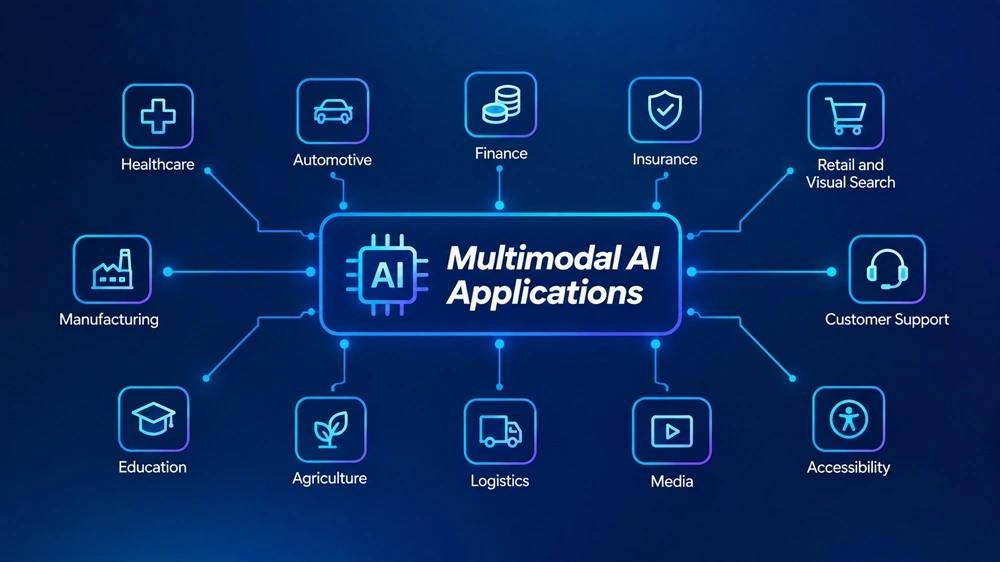
1. Healthcare: Imaging, EHR and Clinical Notes
Problem: Clinicians reconcile imaging, records and visit notes manually, which adds documentation time.
Modalities: Medical images, structured EHR data, clinical notes and speech.
How it works: Vision encoders interpret scans while a language model reads patient history, so outputs reference both.
Real example: Google’s MedGemma 27B Multimodal supports interpretation of longitudinal EHRs alongside medical images; Google states the models require validation for each intended use. Microsoft’s Dragon Copilot combines ambient listening, dictation and generative AI for clinical documentation.
Business outcome: Microsoft reported that health systems using its ambient AI saved five minutes per encounter (vendor-reported).
2. Automotive and ADAS
- Problem: Every sensor has blind spots. Cameras struggle in fog; lidar alone lacks semantic understanding.
- Modalities: Camera video, lidar, radar and map data.
- How it works: A sensor-fusion encoder combines inputs over time, while a vision-language component reasons about unusual scenes.
- Real example: Waymo states that combining cameras, lidar and radar gives the Waymo Driver a redundant world view no single sensor can replicate.
- Business outcome: Waymo reports more than 200 million fully autonomous miles driven.
3. Insurance Claims: Photos, Documents and Voice
- Problem: Claims still involve manual photo review, document checks and site visits.
- Modalities: Smartphone photos, policy documents, claim forms and recorded calls.
- How it works: Computer vision assesses damage severity, and results are matched against policy terms and repair cost data.
- Real example: Tractable’s AI reviews smartphone photos of cars and homes and recommends decisions based on damage severity.
- Business outcome: Tractable states drivers can get an appraisal up to 10 times faster (vendor-reported). Related: Conversational AI in Insurance.
4. Finance: Document Intelligence and KYC
- Problem: Onboarding teams re-key data from IDs, statements and corporate filings in inconsistent formats.
- Modalities: Scanned documents, ID images, selfie or video liveness checks, and customer records.
- How it works: Vision-capable models extract fields, classify documents and cross-check them against application data, with analysts reviewing exceptions.
- Real example: Citi’s Global Payments paper Practical AI Applications outlines generative AI for validating whether onboarding documents are complete and current.
- Business outcome: Shorter onboarding cycles with fewer manual touches per application.
5. Retail and Visual Search
- Problem: Shoppers often cannot describe what they want in words.
- Modalities: Camera images plus text refinements.
- How it works: Image embeddings are matched against catalog embeddings, and users add text modifiers such as “in blue”.
- Real example: Google Lens lets shoppers search with a photo and refine the results with text, for example snapping a chair and adding “in blue”.
- Business outcome: Product imagery becomes a discovery channel, making catalog image quality a measurable growth lever.
6. Manufacturing Quality Inspection
- Problem: Manual inspection is inconsistent at line speed, and rules-based vision fails when materials shift or stretch.
- Modalities: High-speed camera feeds, line data and inspection logs.
- How it works: Edge-deployed vision models inspect every unit and feed results into manufacturing systems.
- Real example: In September 2026, Siemens and Procter & Gamble announced they are expanding an AI-based quality inspection system across P&G’s global manufacturing operations, processed on Siemens Industrial Edge.
- Business outcome: Inspection coverage at full line speed and real-time visibility into process stability.
7. Customer Support: Voice, Screen and Text
- Problem: Customers struggle to describe technical issues by phone, and agents lose time on clarifying questions.
- Modalities: Live voice, screenshots or camera images, transcripts and CRM records.
- How it works: A speech-to-speech model holds the conversation, reads images the customer shares and calls back-office tools.
- Real example: OpenAI’s Realtime API and gpt-realtime model support image input during voice sessions, SIP phone calling and remote MCP servers.
- Business outcome: Fewer escalations for visual issues such as device setup and error screens.
8. Education and Language Assessment
- Problem: Spoken language assessment is expensive to score consistently at scale.
- Modalities: Speech audio, transcripts and rubric text.
- How it works: Audio models evaluate pronunciation and fluency; a language model scores coherence and grammar against the rubric.
- Real example: Xicom built an IELTS Speaking Evaluator that assesses recorded responses against band descriptors [IELTS Speaking Evaluator case study].
- Business outcome: Faster, more consistent learner feedback. AI used in education assessment falls within the EU AI Act’s Annex III high-risk categories.
9. Agriculture
- Problem: Broadcast spraying applies herbicide across the whole field, including weed-free areas.
- Modalities: Boom-mounted camera imagery, nozzle control data and field maps.
- How it works: Cameras and onboard processors identify weeds in real time and trigger individual nozzles.
- Real example: John Deere reports See & Spray was used across more than five million acres in 2025, with customers reducing non-residual herbicide use by an average of nearly 50%.
- Business outcome: Deere reports nearly 31 million gallons of herbicide mix saved in 2025.
10. Logistics
- Problem: Drivers lose time searching cluttered vans for each stop’s packages.
- Modalities: In-van camera vision, package labels, route data, and audio and light cues as output.
- How it works: Computer vision identifies the packages for each stop and projects a marker onto them, linked to the route plan.
- Real example: Amazon’s Vision-Assisted Package Retrieval (VAPR) was announced in October 2024 for rollout in 1,000 electric delivery vans.
- Business outcome: Amazon reported pilot drivers saved more than 30 minutes per route.
11. Media and Content Moderation
- Problem: Harmful content often depends on how an image and caption combine, which text-only filters miss.
- Modalities: Images, video frames, captions and audio.
- How it works: A multimodal classifier scores combined content against policy categories and routes uncertain cases to reviewers.
- Real example: OpenAI’s omni-moderation model classifies text and images.
- Business outcome: Wider coverage of mixed-media content and better use of reviewer time.
12. Accessibility
- Problem: Blind and low-vision users face inaccessible labels, documents and interfaces daily.
- Modalities: Camera images, live video and voice.
- How it works: A vision-language model describes scenes and answers follow-up questions.
- Real example: Be My Eyes, which offers the Be My AI assistant, announced in March 2026 that more than 1 million blind or low-vision users are connected with over 10 million volunteers.
- Business outcome: On-demand visual assistance that complements human volunteers.
Emerging Frontier: Multimodal AI Agents and Real-Time Voice + Vision
The most significant shift in 2026 is from models that describe what they see to agents that act on it.
Computer-use agents read screenshots of a desktop or browser, decide on the next click or keystroke, and execute it. OpenAI introduced GPT-6 Astra in September 2026 with improvements in coding, research, computer use and complex multi-step work. Anthropic also offers computer use for Claude models through its API.
Live voice assistants now combine speech with vision. Google launched Gemini 3.8 Live and Gemini 3.8 Live Extended Thinking as speech-to-speech audio models in September 2026, and OpenAI’s gpt-realtime accepts images mid-conversation.
Document agents read contracts, invoices and forms with mixed text, tables and stamps, then update downstream systems.
Agents change the design priorities: action permissions, audit logs, human approval for consequential steps, and defenses against prompt injection hidden in screenshots or documents. Explore AI agent development.
Leading Multimodal AI Models in 2026
The table below reflects official announcements available as of 7 October 2026. Release cadence is fast, so confirm modalities on each provider’s model card before publishing or procuring.
| Model | Provider | Modalities In | Modalities Out | Open vs Closed | Best Fit |
|---|---|---|---|---|---|
| GPT-6 Astra | OpenAI | Text, image | Text | Closed | Complex reasoning, computer use, multi-step agents |
| gpt-realtime | OpenAI | Audio, image, text | Audio, text | Closed | Production voice agents and phone support |
| Gemini 3.1 Pro | Text, image, audio, video | Text | Closed | Long video and large document analysis | |
| Gemini 4 Argon | Text, image, video | Text | Closed, phased rollout | Frontier reasoning; currently limited to select partners | |
| Claude Opus 5.5 / Sonnet 5.5 | Anthropic | Text, image, PDF | Text | Closed | Document-heavy reasoning, coding and computer-use agents |
| Llama 4 Scout / Maverick | Meta | Text, image | Text | Open weight (Llama Community License) | Self-hosted multimodal assistants |
| Qwen3.8-27B | Alibaba | Text, image, video | Text | Open weight (Apache 2.0) | Self-hosted vision-language workloads on a single GPU |
| Qwen3.5-Omni | Alibaba | Text, audio, image, video | Text, speech | Light variant open weight; Plus/Flash API only | Omni-modal assistants and live translation |
| MedGemma | Medical images, text, EHR | Text | Open (HAI-DEF terms) | Healthcare prototypes requiring local deployment | |
| CLIP | OpenAI | Image, text | Embeddings | Open | Multimodal search, retrieval and zero-shot classification |
Llama 4 (April 2025) remains Meta’s latest open-weight generation.
Also Read: What is Conversational AI?
Benefits of Multimodal AI for Businesses
Each benefit below is tied to a metric you can track during a pilot.
- Faster cycle times on document-heavy work. Measure: minutes per case for claims, onboarding or underwriting.
- Higher straight-through processing rates. Measure: percentage of cases resolved without manual handoff.
- Fewer errors from re-keying. Measure: field-level extraction accuracy against a labeled sample.
- Better first-contact resolution in support. Measure: repeat contacts within seven days for issues where customers shared images.
- Lower input or material waste. Measure: material usage per unit, as in John Deere’s reported herbicide reduction.
- Broader inspection coverage. Measure: percentage of units inspected and defect escape rate.
- New discovery and accessibility channels. Measure: conversions from visual search sessions, or task completion rates for assistive features.
How to Build a Multimodal AI Application: Step-by-Step
Step 1: Scope One High-Value Use Case
Pick a workflow where the decision depends on more than one data type. Define the user, the acceptable error rate and the fallback when the model is unsure.
Step 2: Audit Data Across Modalities
Inventory each modality’s volume, quality, labeling, consent and retention rules. Then check alignment: can each photo be linked to the right claim ID? Misaligned pairs are a common reason multimodal pilots stall.
Step 3: Decide Build vs Fine-Tune vs API
- API first when the task is general (document extraction, image Q&A) and data can leave your environment.
- Fine-tune an open-weight model when you need domain vocabulary, consistent output formats or self-hosting.
- Custom architecture when you have proprietary sensor types, strict latency budgets or edge deployment needs. This is where end-to-end Artificial Intelligent development services matter most, because the model, data pipeline and integrations are designed together rather than bolted on.
Step 4: Design the Architecture
A typical stack has four layers: preprocessing (OCR, transcription, frame sampling); multimodal RAG that indexes page images, charts and tables, not just extracted text; a vector store holding image and text embeddings in a shared space for cross-modal search; and an orchestration layer that routes requests, calls tools and enforces permissions.
Step 5: Evaluate and Add Guardrails
Build a gold-standard test set per modality combination. Track grounding, consistency between the answer and the image, and performance on blurry photos or noisy audio. Add output validation and human review for consequential decisions.
Step 6: Deploy and Monitor
Monitor drift by modality, since a new scanner or phone camera can shift input quality. Log inputs, outputs and reviewer overrides, and feed corrections back into evaluation. High-risk systems under the EU AI Act need automatic logging, so design for it early.
Not sure whether to call an API or fine-tune? A two-week architecture assessment can map your data, latency and compliance needs to the right model strategy.
What is the Cost of Multimodal AI Development?
The ranges below are Xicom planning estimates based on typical project scopes. They are not industry statistics and will vary with your requirements.
| Complexity Tier | Typical Scope | Planning Estimate (Xicom) | Typical Timeline |
|---|---|---|---|
| API-based MVP | One workflow, two modalities, frontier API, basic UI, limited integrations | $40,000 to $90,000 | 8 to 12 weeks |
| Fine-tuned solution | Open-weight model fine-tuned on domain data, multimodal RAG, 2 to 3 system integrations, evaluation suite | $100,000 to $250,000 | 3 to 6 months |
| Custom enterprise system | Multiple modalities including video or sensor data, edge or private cloud deployment, agentic workflows, compliance documentation | $300,000 and above | 6 to 12+ months |
What drives the cost:
- Number and type of modalities. Video and sensor data cost far more to store, label and process than text and images.
- Data preparation and labeling. Aligning and annotating paired data is often the largest single line item.
- Model strategy. API usage shifts cost to ongoing inference; fine-tuning and self-hosting shift it to GPUs and MLOps.
- Latency requirements. Real-time voice and vision need streaming infrastructure and sometimes edge hardware.
- Integration depth. Connecting to EHRs, core banking, MES or CRM systems adds engineering and testing time.
- Compliance scope. HIPAA, GDPR and EU AI Act documentation, logging and human oversight add design and audit work.
Challenges and How to Solve Them
Data Alignment
Modalities that are not correctly paired or timestamped teach the model the wrong associations. Enforce shared identifiers at ingestion and audit pairings by sampling.
Compute Cost and Latency
Images, audio and video consume far more tokens than text. Downsample frames, crop to regions of interest, cache embeddings, route simple requests to smaller models, and run inference at the edge where latency matters.
Hallucination Across Modalities
A model may describe objects that are not in an image or misread a scanned table. Require grounded outputs that cite page numbers or image regions, verify numeric fields, and route low-confidence results to human review.
Privacy and Compliance
Images and audio often contain faces, voices, and health or identity data. Redact before processing, keep protected health information in HIPAA-eligible environments under a business associate agreement, and map each use case to its EU AI Act risk tier. Under the AI Omnibus, high-risk obligations apply from 2 December 2027 for Annex III systems and 2 August 2028 for Annex I systems. See [AI governance consulting].
Evaluation Difficulty
Public benchmarks do not reflect your images, accents or document layouts. Build task-specific test sets per modality combination, include low-quality and adversarial inputs, and keep measuring after launch.
Also Read: AI Adoption Challenges
Future of Multimodal AI
Four trends will shape the next 24 months.
- Omni-modal by default. Models are converging on accepting text, images, audio and video in a single architecture, with speech output becoming standard.
- Agents that act. Computer-use and document agents will move from pilots into back-office operations, with stronger permission and audit controls.
- Physical AI. Vision-language-action models are extending multimodal reasoning into robotics and vehicles, as Waymo’s foundation model shows.
- Open-weight competition. Open releases such as Qwen3.8, Llama 4 and MedGemma make self-hosted multimodal AI viable for regulated industries that need data residency.
Conclusion
Multimodal AI applications deliver the most value where a decision already depends on more than one type of information: a photo and a policy, a scan and a patient history, a call and a screenshot. Capable models are widely available. The differentiators are data alignment, evaluation, integration and governance. Start with one workflow, measure it against a clear baseline, and build the compliance foundation before you scale.
Xicom has delivered enterprise software for over 20 years, with 1,800+ projects across 50+ countries. If you are evaluating where multimodal AI fits in your product or operations, our team can help you scope, prototype and scale it.
FAQs
1. What are multimodal AI applications?
Multimodal AI applications are systems that process and connect two or more data types, such as text, images, audio and video, to make a decision or produce an output. Common examples include insurance claims tools that read damage photos with policy documents, clinical assistants that combine imaging with patient records, and visual product search in retail.
2. How does multimodal AI work?
Multimodal AI works by converting each data type into embeddings with a dedicated encoder, aligning those embeddings in a shared space, and fusing them so a reasoning model can interpret them together. Most modern systems use cross-attention fusion, which lets image, audio and text tokens inform each other before the model generates text, speech or actions.
3. What is the difference between multimodal AI and generative AI?
Multimodal AI describes what data types a system can handle, while generative AI describes whether it creates new content. The categories overlap. A model can be both, such as one that reads an image and writes a report, or it can be multimodal without generating content, such as a classifier that combines camera and sensor data.
4. What are examples of multimodal AI models in 2026?
Leading multimodal AI models in 2026 include OpenAI’s GPT-6 family and gpt-realtime, Google’s Gemini 3.1 Pro and Gemini 4 Argon, and Anthropic’s Claude Opus 5.5 and Sonnet 5.5. Open-weight options include Qwen3.8, Llama 4 and, for healthcare, MedGemma. CLIP remains a widely used foundation for image and text search.
5. How much does it cost to build a multimodal AI application?
Cost depends on the number of modalities, data preparation effort, model strategy and integrations. As a Xicom planning estimate, an API-based MVP typically starts around $40,000 to $90,000, while custom enterprise systems with video, edge deployment or agentic workflows often exceed $300,000. These are not industry benchmarks.
6. What are the main challenges of multimodal AI?
The main challenges are aligning data across modalities, managing compute cost and latency, controlling hallucinations about images or documents, meeting privacy rules for faces, voices and health data, and evaluating performance on real business inputs. Each can be addressed through data governance, grounded outputs, human review and task-specific test sets.
7. Is multimodal AI regulated under the EU AI Act?
Yes, when it is used in a regulated context. The EU AI Act classifies systems by use case, so multimodal AI used for hiring, education, credit scoring or certain healthcare functions can be high-risk. Following the AI Omnibus, obligations for stand-alone high-risk systems apply from 2 December 2027.

Make your ideas turn into reality
With our AI & mobile app solutions