Aug 27, 2026 Artificial Intelligence
Key Takeaways
- Assistive AI recommends and scores, generative AI creates new content, that’s the core split, not which sounds more advanced.
- The generative AI market is ~$29.6B in 2026, growing 40%+ annually, but Gartner projects 40%+ of agentic AI projects will be scrapped by 2027 due to governance gaps, not model quality.
- Assistive AI is easier to audit: every decision traces to a person and timestamp, not a probability score.
- Generative AI pays off when output volume is too high for humans and mistakes are cheap to catch before launch.
- Assistive and generative systems need different stacks: mandatory human review vs tiered autonomy guardrails and prompt version control.
- “Autonomy creep”-letting a reviewed system quietly go fully automated, is the most common costly mistake.
- Generative models carry more IP/compliance exposure EU AI Act, HIPAA; assistive tools on internal data carry less.
- Decide human-vs-autonomy boundaries at design time, retrofitting them after launch is expensive.
An executive decision on artificial intelligence architecture dictates not just operational efficiency but long-term regulatory compliance, infrastructure cost, and system reliability.
While consumer narrative focuses on text and image generation, enterprise engineering requires a clearer choice. The division between assistive AI vs generative AI isn’t about which technology sounds more innovative. It comes down to deterministic process optimization versus non-deterministic output generation.
At Xicom, we partner with enterprise teams, mobile app founders, and engineering leaders to navigate these core trade-offs. The wrong choice introduces hallucinations, escalating compute costs, and liability exposure. The right choice creates scalable, secure digital assets that drive real business value.
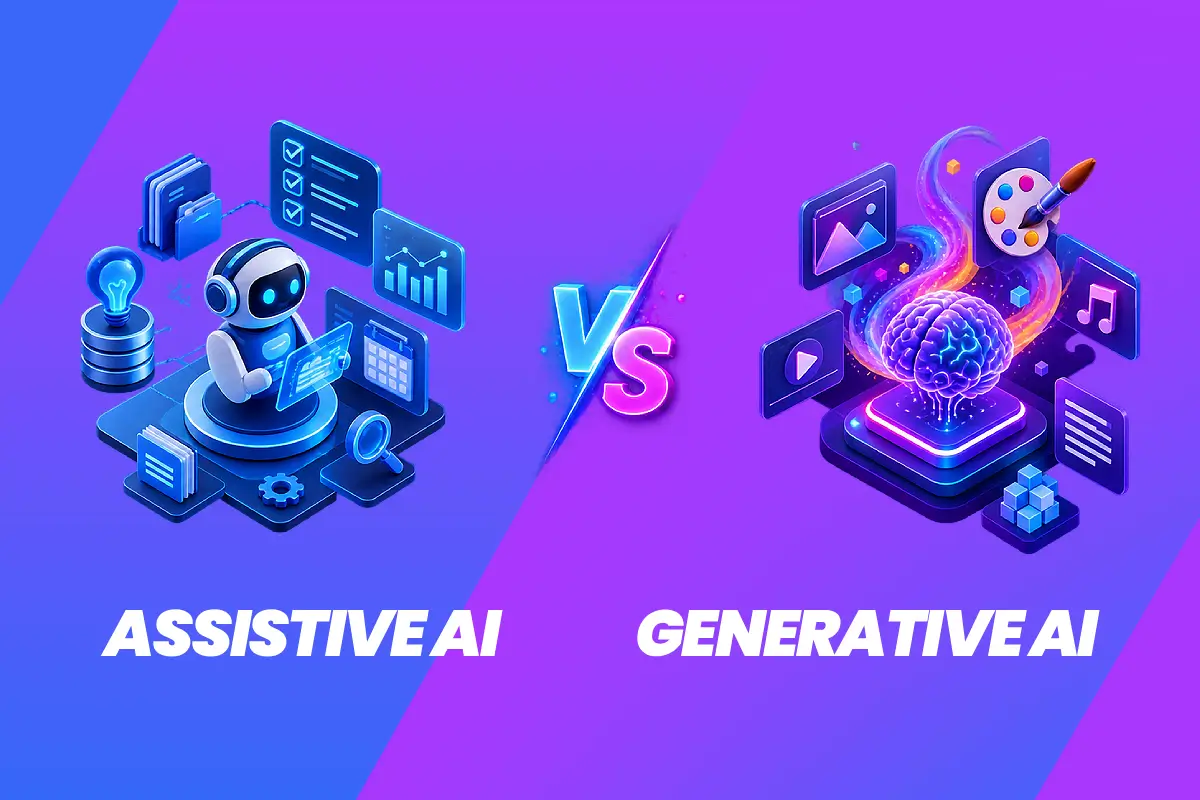
Core Architectural Mechanics: Assistive AI vs Generative AI
Understanding the functional boundary between assistive AI vs generative AI requires examining their underlying model design, probabilistic bounds, and system behavior.
What Is Assistive AI?
Assistive AI systems optimize human execution without replacing human judgment. These architectures operate within predefined operational boundaries, using machine learning, natural language processing (NLP), and predictive algorithms to analyze structured and unstructured data in real time.
- Operational Mechanism: Instead of creating content from scratch, assistive tools run pattern-recognition engines over clean, curated datasets. They surface actionable recommendations, trigger automated workflows, and identify anomalies.
- Core Characteristics: Highly deterministic, verifiable, low-latency, and heavily bounded by explicit business logic or governance frameworks.
- Primary Objective: Augment human decisions, boost throughput, and eliminate manual, error-prone tasks.
When engineered correctly, these solutions integrated via professional AI development services improve human efficiency while preserving structural guardrails.
What Is Generative AI?
Generative AI builds entirely new data artifacts based on probabilistic predictions from large training sets. Using foundation models like Transformer architectures, Generative Adversarial Networks (GANs), and Variational Autoencoders (VAEs), these systems map inputs to multi-modal latent spaces to generate text, synthetic media, voice, or custom application code.
- Operational Mechanism: The engine predicts sequence probabilities based on contextual prompt embeddings rather than retrieving static database rows.
- Core Characteristics: Highly creative, contextual, non-deterministic, and prone to stochastic variation across executions.
- Primary Objective: Synthesize new content, build synthetic datasets, and automate creative or free-form execution.
Deploying these engines requires a dedicated generative AI developers, to design precise prompting workflows, retrieval-augmented generation (RAG) layers, and guardrail protocols.
Generative AI vs Assistive AI: Why the Market Is Suddenly Obsessed With This Question?
This isn’t an academic debate anymore. It’s a budgeting one. Grand View Research says the global generative AI market is at roughly $29.6 billion in 2026, with a compound annual growth rate above 40% through the early 2030s. The spread itself tells you something. Nobody has fully agreed on where generative AI ends and the rest of enterprise software begins, which is exactly the kind of ambiguity that gets flagged in an audit.
At the same time, Gartner has been blunt about the risk side. Its analysts project that over 40% of agentic AI projects, tools built on generative foundations with autonomous decision-making layered on top, will be scrapped by the end of 2027. The reasons cited aren’t model quality. There are governance gaps, unclear ROI, and risk controls that were bolted on after launch rather than designed in from day one.
Read those two numbers side by side, and the picture is clear. Capital is flowing into generative AI at record pace, and a large share of that capital is being spent on projects that were architected without a clear answer to the who decides, and who’s accountable question. That question is exactly what separates assistive from generative deployments, and it’s the one founders keep skipping past.
Also Read: Generative AI in Healthcare
Strategic Comparison Matrix
To help your team evaluate generative vs assistive AI, here is a direct operational comparison:
| Metric / Dimension | Assistive AI Architectures | Generative AI Architectures |
|---|---|---|
| Primary Output | Recommendations, risk scores, extracted data, automated triggers | Text, image assets, synthetic media, software code |
| Execution Risk | Low to moderate (bounded by static rule sets and human review) | Moderate to high (risk of model drift, hallucination, and bias) |
| Data Requirements | Clean, domain-specific transactional and operational data | Massive multi-modal pre-training sets + fine-tuned vectors |
| Human Supervision | Continuous co-pilot interaction (Human-in-the-Loop) | Varies (ranging from prompt review to fully automated background agents) |
| Compute Profile | Lower inference latency, lightweight edge/cloud footprints | High-compute requirements, token-based pricing, high GPU cost |
| Primary Advantage | Predictable execution, low compliance overhead, clear ROI | High versatility, creative scale, rapid unstructured text processing |
What Assistive AI Solves For: A Founder’s and Administrator’s Lens
Assistive AI earns its budget when the cost of a wrong autonomous decision is high, and the cost of a slower, human-reviewed decision is tolerable. That covers more of the enterprise stack than most teams assume.
Where it fits well:
- Clinical and diagnostic support: Flagging abnormalities for a physician to confirm, not diagnosing independently.
- Fraud and risk scoring: Ranking transactions or claims by risk so a human analyst prioritizes correctly, instead of the system blocking accounts on its own.
- Underwriting support: Surfacing relevant data points for a loan or insurance officer, while the officer retains final authority.
- Operational triage: Routing support tickets, prioritizing maintenance requests, or flagging supply chain anomalies for a manager to act on.
For administrators specifically, assistive AI has a quieter advantage: it’s easier to audit. Because a human approves every consequential action, you get a clean decision trail. When a regulator or an internal auditor asks why this happens, the answer is a person’s name attached to a timestamp, not a model’s probability score.
What Generative AI Solves For: Where the Speed Actually Pays Off
Generative AI earns its place when the volume of output required is too high for a human to produce alone, and the cost of an imperfect first draft is low because a human, or a lighter-weight review layer, catches it before it reaches a customer.
Where it fits well:
- Content and documentation at scale: Drafting product descriptions, support macros, internal documentation, or marketing copy that a human edits before publishing.
- Code generation and review support: Producing boilerplate, test cases, or first-pass implementations that a developer reviews and merges.
- Synthetic data generation: Creating training data for edge cases that are rare or expensive to collect in the real world.
- Personalization at scale: Generating tailored messaging or in-app content across thousands of user segments, something no team could hand-write.
This is where our generative AI development company work concentrates: building the pipelines, prompt architecture, and evaluation layers that keep generative output consistent enough to trust at volume.
Engineering Deep-Dive: AI Generated vs AI Assisted Workflows
For mobile app businesses, software startups, and enterprise product heads, understanding the technical execution differences between AI generated vs AI assisted pipelines is essential for system stability.
Deterministic vs Probabilistic Logic
- Assistive Pipeline: Input data passes through deterministic business rules and statistical models. The system suggests optimal actions, but execution relies on explicit logic or human approval.
- Generative Pipeline: The model processes prompt tokens through weight matrices, outputting probabilistic estimates. Without a RAG layer, outputs vary based on hyperparameter configurations like temperature and top-p sampling.
Hallucination Containment
- Assistive Systems: Hallucination risks are minimal because the underlying algorithms extract or categorize validated data points rather than synthesizing new text.
- Generative Systems: Hallucination is an inherent property of probabilistic language engines. Mitigating it requires vector database integration, strict semantic search constraints, and active middleware filters.
Latency, Inference, and Cost Profiles
- Assistive Models: Designed for speed, often processing requests in under 100 milliseconds. Compute footprints are lightweight, enabling cost-effective scaling on standard cloud or edge infrastructure.
- Generative Models: Rely on heavy multi-billion-parameter models running on dedicated GPU clusters. Token-based API billing and higher latency make unconstrained generative pipelines expensive at high volumes.
Assistive AI vs Generative AI: What Changes for Developers
For engineering teams, the assistive AI vs generative AI split isn’t just a product decision; it changes the actual stack you build.
Assistive AI systems typically need:
- A scoring or ranking model rather than a free-form output model, which means your evaluation metrics can be precision, recall, and false-positive rate, all measurable against ground truth.
- A mandatory human review step built into the workflow itself, not left to the front end. If a user can bypass the review screen, you don’t actually have an assistive system, you have a generative one wearing an assistive label.
- Detailed logging of what was flagged, what the human decided, and whether they agreed or overrode the system. This log is what makes the system defensible later.
Generative AI systems typically need:
- An evaluation layer that checks output quality before it reaches a user, hallucination detection, tone checks, and factual grounding against a source document.
- Guardrails on what the model is allowed to generate autonomously versus what requires review, which is rarely all-or-nothing. Low-stakes content might be published automatically. Anything touching pricing, medical information, or legal language should be routed to a human.
- Version control on prompts and fine-tuning data, since output quality drifts as models update, and you need to be able to explain why an output looked the way it did on a given date.
Also Read: Generative AI in Manufacturing
Common Mistakes We See Teams Make
A few patterns come up often enough that they’re worth naming directly.
- Letting autonomy creep in through feature requests. A product manager asks for one-click send on a system that was designed to be reviewed first. Six months later, nobody remembers that the original architecture assumed a human would check every output.
- Treating the AI Act or local regulation as a launch-week checklist item. Risk classification needs to happen at the design stage, not the week before submission to an app store or a compliance review board.
- Assuming the human in the loop satisfies every regulator by default. Some frameworks require more than a checkbox; they require evidence that the human reviewer had enough context and enough time to meaningfully evaluate the output rather than rubber-stamp it.
- Building a generative feature because competitors have one, without asking whether the underlying problem is actually a production bottleneck or a judgment bottleneck. These are different problems, and the wrong tool for either one shows up as either wasted spend or unnecessary risk.
Regulatory, Governance, and Risk Profiles
Deploying autonomous systems into enterprise production environments introduces complex legal and operational risks. Managing these risks requires solid AI governance frameworks that define operational limits for both model types.
Intellectual Property Exposure
Generative architectures trained on broad web-scale datasets risk unintentionally reproducing copyrighted material or exposing proprietary code base snippets. Assistive tools operating purely on internal enterprise data eliminate IP contamination risks.
Data Privacy and Jurisdictional Guardrails
Under frameworks like the EU AI Act, US HIPAA regulations, and global data sovereignty mandates, deploying generative models using third-party APIs can trigger data compliance violations if sensitive user information is logged or used for downstream training. Assistive tools, by contrast, process structured enterprise records locally within secure virtual private cloud (VPC) environments.
Model Drift and System Auditability
Auditing a generative system’s probabilistic output for compliance checks presents significant technical challenges. Assistive systems maintain deterministic logs, giving compliance officers clear visibility into how every decision recommendation was derived.
Organizations balancing these regulatory requirements often work with expert AI consulting services to ensure their pipelines meet industry compliance standards before deployment.
Final Takeaway
Choosing between assistive and generative AI isn’t a technical footnote. It’s the decision that determines who your organization is accountable to when something goes wrong and how much rework you’ll be doing a year from now. We’ve watched founders build generative-first, gain early traction, and then spend the next two quarters retrofitting human checkpoints they should have designed in from day one. That path is avoidable. The teams that get this right start by mapping out where a human needs to stay in the loop and where speed genuinely matters more than autonomy, before a single feature gets built.
That’s the work we do at Xicom. Our engineering teams have spent years building both assistive systems for regulated industries and generative pipelines for teams that need to move fast without losing control of their output. We don’t hand you a generic model integration. We help you decide, architecturally, where the human belongs in your system, and then build it to hold up under real scrutiny.
FAQs
1. What’s the simplest way to tell assistive AI and generative AI apart?
Assistive AI recommends or flags based on existing data-it doesn’t create anything new. Generative AI produces new content [text, code, media] by predicting likely outputs from a prompt. If the system is retrieving or scoring, it’s assistive; if it’s authoring, it’s generative.
2. Is generative AI riskier than assistive AI?
It carries higher execution risk by default, model drift, hallucination, and bias are inherent to probabilistic generation, but that risk is manageable with RAG layers, evaluation checkpoints, and tiered guardrails on what can publish autonomously versus what needs review.
3. Can a system be both assistive and generative?
Yes, and most mature enterprise systems are hybrid, for example, a generative drafting layer feeding into a mandatory human-review step, which is functionally an assistive control wrapped around a generative engine.
4. What compliance frameworks apply to each type?
Generative deployments using third-party APIs face exposure under the EU AI Act, HIPAA, and data-sovereignty rules, especially if user data gets logged or used for downstream training. Assistive tools processing data locally in a VPC face comparatively lower exposure.
5. Why are so many agentic AI projects getting scrapped?
Per Gartner’s projection cited in the article, the leading causes are governance gaps, unclear ROI, and risk controls added after launch rather than designed in from the start, not underlying model quality.

Make your ideas turn into reality
With our AI & mobile app solutions
Explore related services
Based on this article's topic