Oct 16, 2026 Artificial Intelligence
Enterprise AI is moving from systems that read text to systems that see screens, hear voices, inspect photos and then act on what they perceive. This guide covers the top multimodal AI agents available in 2026, explains how they differ from the multimodal models underneath them, and walks through 12 use cases backed by named, sourced deployments wherever one exists.
You will learn how multimodal AI agents work step by step, which commercial agents meet a strict definition of “agent”, what it takes to build a custom one, and how to evaluate an agent before it touches production data. The article is written for CTOs, product heads and enterprise teams deciding where multimodal agents fit in their roadmap.
Key Takeaways
- A multimodal AI agent perceives at least two input types (text, image, voice, video or screen) and takes actions on its own, such as browsing, booking or running a workflow.
- GPT, Gemini, Claude and Llama are models, not agents. Agents add planning, tools and permissions on top of a model.
- The agent market changed in 2026: OpenAI replaced ChatGPT agent with ChatGPT Work, and Google shut down Project Mariner and moved its technology into Gemini Agent.
- The strongest enterprise use cases combine vision with documents or voice: claims, clinical review, quality inspection, fulfillment checks and support.
- Before production, test task success, per-modality accuracy, latency, poor-input handling, human review and audit logging.
What Are Multimodal AI Agents?
Multimodal AI agents are AI systems that take in more than one type of input, such as text, images, audio, video or a live screen, combine those inputs into a single understanding of a task, and then plan and execute actions through tools, APIs or user interfaces to complete that task with limited human direction.
The key word is “act”. A system that describes a photo is multimodal. A system that reads the photo, checks it against a policy document, files the result in a claims system and notifies an adjuster is a multimodal agent.
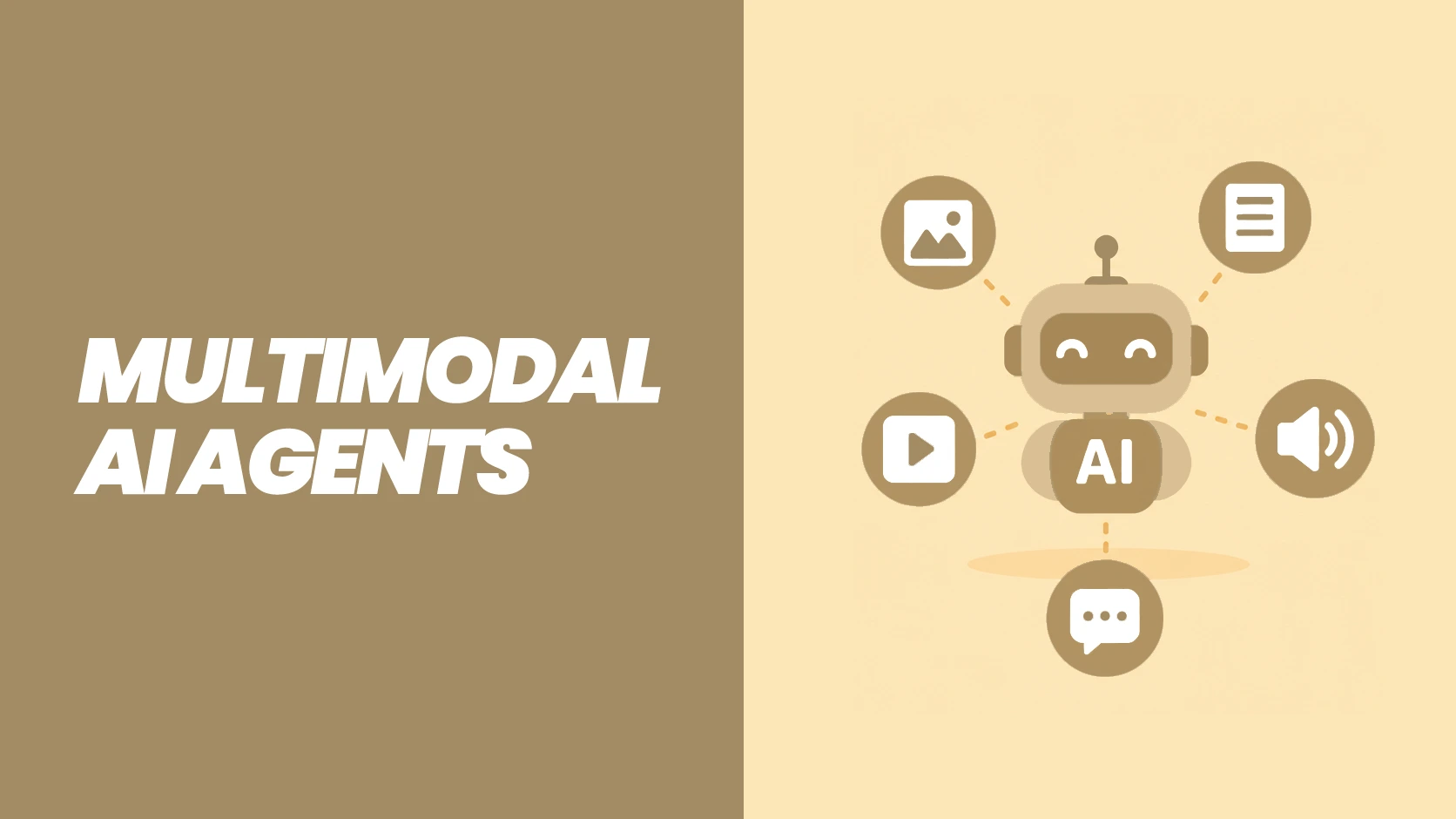
Multimodal AI Model vs Multimodal AI Agent
A multimodal AI model perceives and generates. It accepts inputs across modalities and returns an output, usually text, an image or audio. A multimodal AI agent wraps one or more models with a planner, memory, tool access and permission controls so it can pursue a goal across several steps.
| Dimension | Multimodal AI Model | Multimodal AI Agent |
|---|---|---|
| Core job | Understand and generate content | Complete a goal end to end |
| Inputs | Text, image, audio, video | Same, plus live screens, sensors, app data |
| Outputs | A response | Actions: clicks, API calls, bookings, records |
| Planning | Single turn | Multi-step, with re-planning on failure |
| Tools and memory | None by default | Tool calls, memory, connected systems |
| Examples | GPT, Gemini, Claude, Llama | ChatGPT Work, Gemini Agent, Claude in Chrome |
The model sets the ceiling on what an agent can perceive; the agent layer decides what it may do. Teams using LLM development services spend most of their effort on that agent layer.
How Multimodal AI Agents Work
Every multimodal agent runs the same loop: perceive the inputs, fuse them into one representation, reason about the next step, act, then observe the result and repeat until the goal is met or a human is needed.
Perception
Each modality is converted into numerical representations by a dedicated encoder. Images and video frames pass through a vision encoder, speech is transcribed or encoded directly as audio tokens, and documents are parsed into text and layout. Screen-based agents treat each screenshot as an image input.
Fusion
The encoded inputs are projected into a shared representation so the model can relate them. This is what lets an agent connect a dent in a photo to a line item in an estimate, or a spoken complaint to an error message on a screenshot.
Reasoning and Planning
A reasoning model breaks the goal into steps, decides which tool to call next and checks intermediate results. Planning frameworks add state, retries and branching so the agent can recover when a page fails to load or an input is unreadable.
Action
The agent executes through tool calls: REST APIs, database writes, browser clicks, keyboard input, or workflow triggers in systems such as a CRM or ERP. Well-designed agents pause for confirmation before irreversible actions such as payments or submissions.
Also Read: Multimodal AI Applications
Top 7 Multimodal AI Agents of 2026
Selection rule: this list includes only products that perceive at least two modalities (screen, camera, image, voice or text) and take actions on their own. Foundation models are excluded.
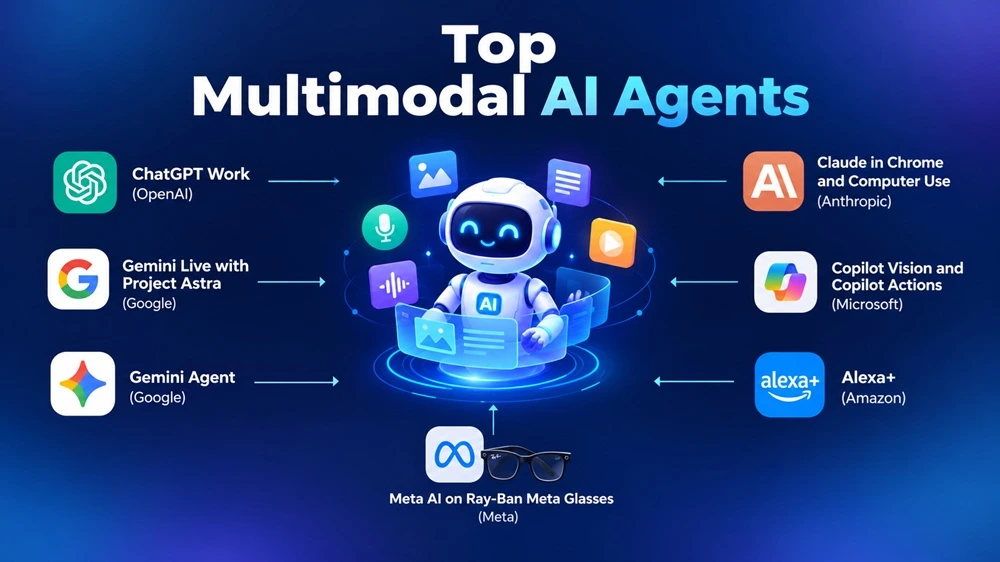
1. ChatGPT Work (OpenAI)
OpenAI launched ChatGPT Work in July 2026 as an agent that works across connected apps and files for hours at a time. It replaces ChatGPT agent, which OpenAI’s help center lists as no longer available.
- Modalities: text, uploaded documents and images, and data from connected apps.
- Actions: plans multi-step work, produces documents, spreadsheets, presentations and web apps, and runs recurring jobs through Scheduled Tasks.
- Best-fit business use: research, reporting and cross-app knowledge work.
- Availability: consumer and enterprise; rolled out first to Pro, Enterprise and Edu plans, with admin controls for Enterprise.
- Official page: ChatGPT Work
2. Gemini Live with Project Astra (Google)
Gemini Live is the real-time conversational mode in the Gemini app. Capabilities from Google DeepMind’s Project Astra research prototype added live camera input and screen sharing, so users can talk to Gemini about what their phone sees.
- Modalities: voice, live camera video, screen sharing, images and files.
- Actions: connects to Google apps to take follow-up steps, such as adding items to Calendar or Keep.
- Best-fit business use: hands-free guidance for frontline staff and visual troubleshooting.
- Availability: consumer, through the Gemini app on Android and iOS.
- Official page: Project Astra
3. Gemini Agent (Google)
Gemini Agent is an experimental feature in the Gemini app that plans and completes multi-step tasks, opening a live browser when a task needs it. Google shut down Project Mariner on May 4, 2026, and its landing page directs users to Gemini Agent for complex tasks.
- Modalities: text prompts, rendered web pages, and Gmail and Calendar data.
- Actions: browses, fills in forms, manages email and calendar entries, and asks for confirmation before sensitive steps.
- Best-fit business use: web research, scheduling and booking workflows.
- Availability: consumer, for Google AI Ultra subscribers, on web with a gradual mobile rollout.
- Official page: Gemini Agent help center
4. Claude in Chrome and Computer Use (Anthropic)
Claude in Chrome is a browser extension that reads the current tab and clicks, types and fills forms for the user. Anthropic made it generally available to paid Claude plans in August 2026. Computer use, its developer counterpart, operates a desktop from screenshots.
- Modalities: screenshots and page content, plus text instructions.
- Actions: navigates websites and desktop apps, completes forms and works across tabs.
- Best-fit business use: automating workflows in legacy or internal tools that lack APIs.
- Availability: consumer (paid Claude plans) and API, including Amazon Bedrock and Google Cloud Vertex AI.
- Official pages: Claude in Chrome and computer use documentation
5. Copilot Vision and Copilot Actions (Microsoft)
Copilot Vision lets Microsoft Copilot see a shared window, tab or phone camera feed. Copilot Actions completes tasks on the web with partners such as Expedia and OpenTable, and on Windows, where it reached Windows Insiders in November 2025.
- Modalities: screen, camera, voice and text.
- Actions: highlights where to click inside apps, completes bookings and, through Actions on Windows, works with local files.
- Best-fit business use: in-app guidance, software training and employee self-service.
- Availability: consumer, across Windows, Edge, iOS and Android, with some Windows features still in preview.
- Official page: Copilot Vision
6. Alexa+ (Amazon)
Alexa+ is Amazon’s generative AI rebuild of Alexa. It became available to everyone in the U.S. in February 2026 and has since expanded to Canada, with early access in several other countries.
- Modalities: voice, uploaded documents, photos and emails, device camera input and Ring camera footage.
- Actions: makes reservations, books hotels and home services, orders groceries, adds events to calendars and controls smart home devices.
- Best-fit business use: voice commerce and service-booking integrations for consumer brands.
- Availability: consumer, on Echo devices, the Alexa app and Alexa.com.
- Official page: Alexa+ features
7. Meta AI on Ray-Ban Meta Glasses (Meta)
Meta AI runs on Ray-Ban Meta smart glasses. Its Live AI mode lets the assistant see what the wearer sees continuously and hold a running conversation about it.
- Modalities: first-person camera video, voice and audio.
- Actions: sends messages, places calls, plays music, captures photos and video, and translates speech in real time.
- Best-fit business use: hands-free assistance for field workers, retail staff and visually impaired users.
- Availability: consumer, with features varying by country.
- Official page: Meta AI glasses
Comparison of Top Multimodal AI Agents
| Agent | Company | Modalities | Actions it can take | Best for |
|---|---|---|---|---|
| ChatGPT Work | OpenAI | Text, documents, images, app data | Multi-step projects, documents, scheduled tasks | Knowledge work across apps |
| Gemini Live with Project Astra | Voice, camera, screen, images | Follow-up actions in Google apps | Real-time visual guidance | |
| Gemini Agent | Text, web pages, Gmail and Calendar data | Browsing, forms, email and calendar tasks | Research and booking | |
| Claude in Chrome and computer use | Anthropic | Screenshots, page content, text | Clicking, typing, form filling, desktop control | Automating apps without APIs |
| Copilot Vision and Actions | Microsoft | Screen, camera, voice, text | In-app guidance, bookings, file tasks | Software help and self-service |
| Alexa+ | Amazon | Voice, documents, photos, camera | Reservations, orders, smart home control | Voice commerce |
| Meta AI on Ray-Ban Meta | Meta | Camera video, voice | Messages, calls, capture, translation | Hands-free field assistance |
12 Real Use Cases of Multimodal AI Agents
1. Insurance Claims Processing
Modalities used: image + text + voice
What the agent does: The agent reads damage photos, extracts details from the claim form and summarizes the first notice of loss call transcript. It checks the three sources for consistency, drafts an estimate and routes anything unusual to a human adjuster.
Real-world example: GEICO adopted Tractable’s AI Review to check repair estimates against submitted vehicle photos, as Repairer Driven News reported. For the voice side of claims, see our guide to conversational AI in insurance.
2. Visual Product Search and Shopping Assistants
Modalities used: live camera + text
What the agent does: The shopper points a phone camera at an object. The agent identifies it, retrieves matching products, answers questions about them and adds the chosen item to the cart without leaving the camera view.
Real-world example: Amazon’s Lens Live scans products through the phone camera in real time, shows matching items in a carousel, and pairs results with its Rufus shopping assistant, which summarizes products and answers questions, according to GeekWire.
3. Field Service and Equipment Maintenance
Modalities used: camera + voice + text
What the agent does: A technician streams the faulty equipment through a phone camera and describes the problem aloud. The agent identifies the make, model and visible fault indicators, pulls the relevant manual and service history, and speaks step-by-step repair guidance.
Real-world example: Aquant’s Vision AI combines live camera recognition of equipment with its Voice AI assistant. Guidance is spoken aloud and grounded in the customer’s own manuals and service records.
4. Medical Imaging Combined with Clinical Notes
Modalities used: medical images + pathology + text
What the agent does: Specialized agents analyze radiology images, pathology slides, genomic data and clinical notes, then an orchestrator assembles a case summary for a tumor board. Clinicians review the summary, and every claim links back to the source record.
Real-world example: Microsoft’s healthcare agent orchestrator coordinates multimodal agents for tumor board preparation and is available through Azure AI Foundry. Institutions including Stanford, Johns Hopkins and UW Health are exploring it.
5. KYC and Identity Document Verification
Modalities used: document image + selfie video + text
What the agent does: The agent reads an uploaded ID, checks security features and data fields, compares the photo with a live selfie, and cross-checks extracted details against the application form and sanctions lists. Clear passes are approved automatically; mismatches go to a compliance analyst with the evidence attached.
Real-world example: No verifiable public deployment of an agentic, multi-step KYC system was found for this article, so this describes the common pattern rather than a named company.
6. Customer Support with Screenshots and Voice Notes
Modalities used: image + voice + text
What the agent does: Customers send a photo or screenshot of the problem and describe it in their own words. The agent identifies the product state or error, matches it to known fixes and walks the customer through resolution, escalating to a human agent when needed.
Real-world example: Microsoft added Be My AI to its Disability Answer Desk so blind and low-vision customers can resolve product issues by sharing photos, and Be My Eyes reported AI sessions averaged 4 minutes versus 12 minutes with a live agent, per its Business Wire announcement.
7. Computer-Use Agents for Browser and Desktop Apps
Modalities used: screen + text
What the agent does: The agent takes screenshots, interprets buttons, fields and tables, and operates the interface with mouse and keyboard actions. This lets organizations automate data entry, testing and reconciliation in legacy systems that expose no API.
Real-world example: When Anthropic introduced computer use, it named Asana, Canva, DoorDash and Replit among early adopters, with Replit using it to evaluate apps as they were being built.
8. Manufacturing Quality Inspection
Modalities used: camera video + sensor data + text
What the agent does: Cameras along the line capture each unit, and the system compares images against specifications for the exact vehicle or part being built. Deviations are flagged to workers in real time and logged against the unit’s production record.
Real-world example: BMW Group’s AIQX platform uses networked cameras and sensors synchronized with vehicle location to automate quality checks in production, as described in this Axis Communications customer story.
9. Real-Time Voice and Screen Sales and Support Assistants
Modalities used: voice + screen
What the agent does: During a live call, the agent listens to the conversation and watches the rep’s or customer’s shared screen. It surfaces relevant product information, highlights the next step in the interface and logs the outcome in the CRM.
Real-world example: No named enterprise deployment with public documentation was found. The building blocks are available in products such as Gemini Live screen sharing and Copilot Vision, and through a custom AI voice agent development project.
10. Video and Content Moderation
Modalities used: video + audio + text
What the agent does: The agent analyzes video frames, the audio track and captions together, because a policy violation often appears in only one of them. It classifies content against policy, applies an action such as age-gating or removal for clear cases, and queues borderline items for human reviewers.
Real-world example: No platform has published a verifiable account of a fully agentic multimodal moderation pipeline, so this describes the pattern without naming a company.
11. Logistics Damage Checks and Proof of Delivery
Modalities used: image + text
What the agent does: Items are photographed as they move through a facility or at the doorstep. The agent spots damage, wrong sizes or mismatched items and isolates them before dispatch. When a customer complains, it cross-references the complaint with the captured images to find the root cause.
Real-world example: Amazon’s Project P.I. scans products in fulfillment center imaging tunnels for defects, and a multimodal LLM system cross-references customer feedback with those images, according to Amazon Science.
12. Accessibility Assistants for Visually or Hearing Impaired Users
Modalities used: camera + voice + text
What the agent does: The agent describes surroundings, reads labels and documents aloud, and answers follow-up questions. For hearing-impaired users, the same pattern converts speech into live captions or translated text.
Real-world example: Be My AI, built by Be My Eyes with OpenAI’s vision model, describes photos taken by blind and low-vision users, reads text such as labels and expiry dates, and answers follow-up questions about each image.
Also Read: Conversational AI Use Cases
How to Build a Custom Multimodal AI Agent
Off-the-shelf agents cover general tasks. Workflows that touch proprietary data, regulated decisions or internal systems usually need a custom build. The process follows six steps.
- Define the task and actions. Write down the goal, the systems the agent may touch and the actions it may take. Mark which actions require human approval.
- Choose modalities. Use only the inputs the task needs. Every added modality increases data, latency and failure modes.
- Prepare aligned data. Collect examples where inputs across modalities refer to the same event, for example a photo, a form and a transcript for one claim, along with the correct outcome.
- Pick a foundation model. Compare candidate models on your own data for each modality, then weigh cost, latency and deployment constraints such as region or on-premise hosting.
- Add orchestration and tools. Connect the model to APIs, databases and user interfaces through a planning framework. Complex workflows may split work across specialists, which is where multi-agent AI development applies.
- Add guardrails and human review. Validate inputs, restrict tool permissions, filter outputs, and route low-confidence or high-impact decisions to people.
Vision-heavy builds often reuse proven pipelines from computer vision development services for detection and inspection, with the agent layer handling reasoning and actions.
Frameworks Used to Build Custom Multimodal Agents
- LangGraph: graph-based orchestration with explicit state, branching and human-in-the-loop checkpoints.
- CrewAI: role-based multi-agent coordination for workflows split across specialist agents.
- OpenAI Agents SDK: lightweight primitives for agents, tool calls, handoffs and guardrails.
- Google Agent Development Kit (ADK): a framework for building and deploying agents, integrated with Gemini and Vertex AI.
Challenges of Multimodal AI Agents
- Aligning data across modalities. Training and evaluation need paired examples where image, text and audio describe the same event. Such data is scarce, and identifiers rarely line up across systems.
- Latency in real-time use. Encoding, reasoning and tool calls all add delay. Voice and camera agents must feel conversational, which pushes teams toward smaller models, streaming or edge processing.
- Compute cost. Images and video consume far more tokens than text, and agents call models repeatedly within one task. Costs grow with every step and every frame.
- Hallucination and conflicting signals. The agent may describe details absent from an image, or receive inputs that disagree, such as a photo of minor damage and a caller reporting a total loss. It needs rules for which source wins and when to escalate.
- Privacy and compliance. Images, voice and video often contain faces, documents and locations, bringing GDPR, HIPAA, retention and consent requirements into scope from day one.
How to Evaluate a Multimodal AI Agent Before Production
Evaluate the agent on your own data and workflows, not on public benchmarks alone. Use this checklist:
- Task success rate: share of end-to-end tasks completed correctly on a representative test set.
- Per-modality accuracy: score image, audio and document understanding separately to find which input causes failures.
- Latency budget: set a target response time per step and per task, and test it under expected load.
- Missing or low-quality inputs: test blurry photos, noisy audio, cropped screenshots and absent fields. The agent should ask for better input or escalate instead of guessing.
- Human-in-the-loop checkpoints: confirm approval steps trigger before payments, submissions, deletions and regulated decisions.
- Guardrails: test tool permission limits, prompt injection hidden in images or web pages, and output filters.
- Audit logs: record every input, tool call and action with timestamps so decisions can be reviewed.
How Xicom Builds Multimodal AI Agents
Xicom has delivered software for more than 20 years, with 1,800+ projects for 750+ clients across 50+ countries and a team of 350+ IT professionals. Our AI agent development services cover agents that combine vision, voice and text with tool access to enterprise systems.
Our work in this area spans AI agents, voice agents and computer vision solutions. Projects start with a defined task and action scope, move through aligned data preparation and model selection, and add orchestration, guardrails and human review before deployment. For organizations earlier in their AI journey, our AI development services cover strategy through production.
Xicom holds ISO 9001, ISO/IEC 27001, ISO/IEC 42001 and SOC 2 Type II certifications and has a 4.8 rating on Clutch.
Conclusion
The top multimodal AI agents share one trait: they combine perception across screens, cameras, voice and documents with the ability to act. The product market is still shifting, as the replacement of ChatGPT agent and the shutdown of Project Mariner show, so evaluate agents by capability rather than brand name. For enterprise teams, the strongest results come from narrow workflows with clearly defined actions, aligned data, human checkpoints and full audit trails. Start with one high-volume process, test it on real inputs, and expand once the agent meets its accuracy and latency targets.
FAQs
1. What are the top multimodal AI agents?
The top multimodal AI agents include OpenAI’s ChatGPT Work, Google’s Gemini Live with Project Astra and Gemini Agent, Anthropic’s Claude in Chrome and computer use, Microsoft’s Copilot Vision and Copilot Actions, Amazon’s Alexa+, and Meta AI on Ray-Ban Meta glasses. Each perceives at least two input types and takes actions on its own.
2. Which industries use multimodal AI agents?
Insurance, healthcare, retail and ecommerce, manufacturing, logistics, financial services and customer support use multimodal AI agents most actively. These industries handle a mix of photos, documents, voice and video, and they run repeatable workflows where an agent can verify information and act on it.
3. Are multimodal AI agents safe for sensitive data?
They can be, with the right controls. Images, audio and video often contain personal data, so deployments need encryption, access controls, data retention limits, consent management and compliance with laws such as GDPR or HIPAA. Human approval steps and complete audit logs reduce the risk of incorrect or unauthorized actions.
4. How much does it cost to build a multimodal AI agent?
Cost depends on the number of modalities, the volume and quality of aligned training and evaluation data, model choice and inference usage, the number of systems the agent integrates with, real-time latency requirements, security and compliance needs, and the level of human review. A scoped proof of concept clarifies costs before full development.
5. What are examples of multimodal AI agents in business?
Business examples include Tractable’s photo-based estimate review used by GEICO, Amazon’s Project P.I. for fulfillment defect checks, Microsoft’s healthcare agent orchestrator for tumor boards, BMW’s AIQX quality inspection, and Be My AI in Microsoft’s Disability Answer Desk for photo-based customer support.

Make your ideas turn into reality
With our AI & mobile app solutions
Explore related services
Based on this article's topic