Sep 25, 2026 Artificial Intelligence
RPA in banking is the use of software bots to carry out rule-based, repetitive work across banking systems, such as copying data between applications, validating documents, reconciling accounts and routing exceptions to people. It delivers the most value in high-volume back-office processes with structured inputs and clear rules: payments handling, KYC checks, loan processing, reconciliation and compliance reporting. Where inputs are messy or decisions need judgment, you pair bots with AI, which is where intelligent automation takes over.
This guide is for CTOs, product heads and finance leads deciding whether to build, buy or partner. It covers the use cases worth your attention, a scoring model for choosing processes, cost drivers, a worked ROI example and the point where rule-based bots stop being enough.
Key Takeaways
- RPA works best on stable, high-volume, rule-based processes. If a process changes every quarter or depends on unstructured documents, fix the process or add AI before you automate it.
- The strongest banking use cases sit in operations and compliance: payments exceptions, KYC, loan processing, AML alert preparation and reconciliation.
- Scoring processes with a weighted matrix before building anything prevents the most common failure, which is automating the wrong work.
- Costs vary widely with licensing model, process complexity and the number of systems a bot touches, so treat any range as a planning estimate until you run a proof of concept.
- Rule-based RPA handles structured work; intelligent document processing (IDP), machine learning and AI agents extend automation to documents, predictions and multi-step decisions.
Key Benefits of RPA in Banking
RPA in banking delivers more than cost savings. Bots speed up processing, keep compliance checks consistent and free your teams to focus on exceptions and customers. Here are the benefits banks see most often:
- Faster turnaround times. Bots work through queues around the clock, so processes like account opening, payment matching and loan file preparation move without waiting for business hours or manual handoffs.
- Fewer manual errors. Bots apply the same rules the same way every time, which reduces keying mistakes and inconsistent checks. In one AML case study, Kaufman Rossin reported a 99% reduction from the manual analysis error rate (Kaufman Rossin, PDF).
- Lower cost per transaction. Once a bot is live, handling additional volume costs far less than adding headcount, which matters most for high-volume back-office work.
- Stronger audit trails. Every bot action can be logged with timestamps and data sources, giving compliance and internal audit a clear record of what happened and when.
- More consistent compliance checks. KYC lookups, sanctions screening steps and reporting validations run the same way on every case, reducing the risk of skipped steps under deadline pressure.
- Capacity to absorb volume spikes. Month-end close, rate changes or seasonal demand can be handled by scheduling more bot runs instead of pulling staff into overtime.
- Better use of skilled staff. Analysts and operations teams spend less time copying data between systems and more time on exceptions, investigations and customer conversations. At Postbank, a bot handled 95% of received payments, leaving staff to resolve the remaining 5% (UiPath).
- Works with existing systems. Bots operate through current application interfaces, so banks can automate across legacy core systems without waiting for a full platform replacement.
- Quicker customer outcomes. Faster onboarding, dispute handling and loan processing shorten the time customers wait for answers, which supports retention.
- A foundation for intelligent automation. Once rule-based bots are running and governed, adding document processing, machine learning or AI agents becomes an extension of an existing program rather than a new start.
Robotic Process Automation (RPA) in Banking Use Cases
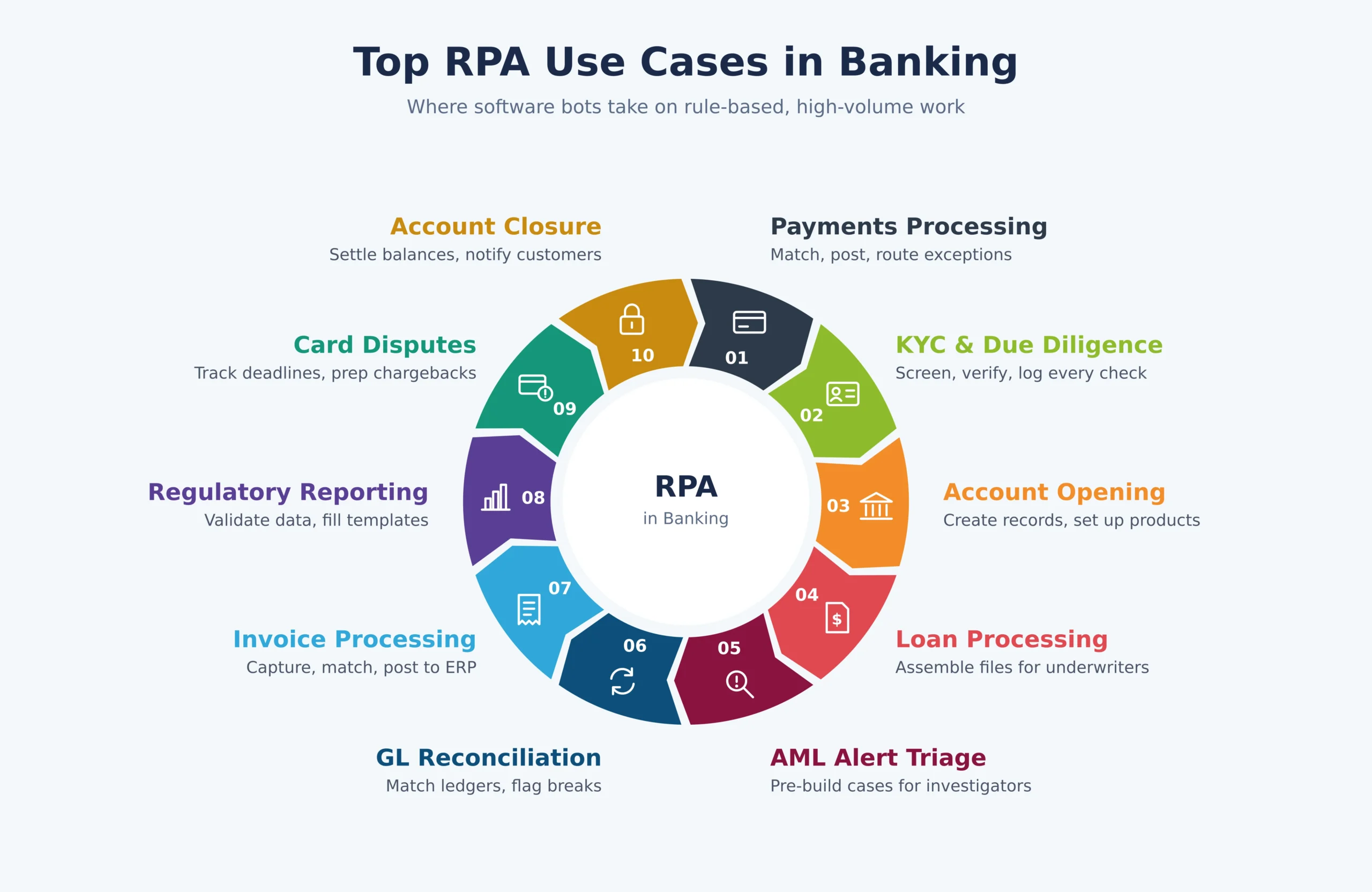
1. Payments Processing and Exception Handling
The bot reads incoming payment files, matches each payment to the right account using reference data, and posts it in the core banking system. Payments it can’t match go to a human queue with the reason attached. At Postbank, a UiPath bot distributed 95% of received payments with no errors and sent a list of the remaining 5% to human employees, who typically resolved them by contacting customers for additional information (UiPath case study).
2. KYC and Customer Due Diligence
The bot collects customer data from the onboarding form, checks it against sanctions and watchlist sources, and pulls registry records for business customers. It compiles a KYC file with every lookup logged and flags mismatches for an analyst. Analysts spend their time on the flagged cases rather than on copying data between screens.
3. Account Opening
Once a customer submits an application, the bot creates the customer record in the core system, opens the account, sets up products and triggers the welcome communication. It validates required fields before anything is created, so incomplete applications are caught early. This cuts the handoffs between front office and operations that slow onboarding down.
4. Loan Origination and Processing
The bot gathers applicant data, pulls credit bureau reports, calculates standard ratios and populates the loan origination system. It checks that required documents are present and routes the file to underwriting. Credit decisions stay with underwriters or approved models; the bot removes the data assembly work around them.
5. AML Alert Triage Support
Transaction monitoring systems generate large alert volumes. The bot gathers context for each alert, including customer profile, transaction history and prior alerts, then applies the bank’s risk rating rules and presents a pre-assembled case to the investigator. The investigator still makes the call, with far less time spent collecting data.
6. Account and General Ledger Reconciliation
This is a core use of RPA in finance and accounting. The bot extracts balances and transactions from source systems, matches them against the ledger using defined tolerance rules and produces a break report. Unmatched items go to the finance team with supporting detail, which shortens month-end close.
7. Accounts Payable and Invoice Processing
The bot captures invoice data (with IDP for PDFs and scans), performs a two-way or three-way match against purchase orders and receipts, and posts approved invoices to the ERP. Exceptions such as price mismatches go to an approver. It’s one of the most common entry points for robotic process automation in finance teams.
8. Regulatory Reporting Data Preparation
The bot pulls data from multiple systems, applies validation checks, reconciles totals and populates reporting templates. Compliance staff review and sign off. The value is consistency and a complete audit trail of every data pull, not removing human review.
9. Card Disputes and Chargebacks
When a customer raises a dispute, the bot retrieves the transaction, checks it against scheme rules and deadlines, applies provisional credit where policy allows and prepares the chargeback submission. Deadline tracking alone reduces the losses that come from missed scheme windows.
10. Account Closure and Dormant account Handling
The bot verifies closure requests, checks for pending transactions or linked products, settles balances and updates every downstream system. For dormant accounts, it identifies accounts that meet policy criteria and generates the required customer notices on schedule.
Also Read: AI in Banking
How to Implement RPA in Banking, Step by Step
Step 1: Define the Business Objective
Decide what you’re optimizing for before you pick a tool: turnaround time, cost per transaction, compliance consistency or capacity to absorb growth. The objective shapes which processes win in your scoring and what you measure in the pilot.
Step 2: Build a Process Inventory
List candidate processes with volume, average handling time, number of systems involved, exception rate and how often the rules change. Talk to the people doing the work, because documented procedures often differ from what actually happens.
Step 3: Score and Prioritize Processes
Use a weighted matrix so prioritization isn’t driven by whoever shouts loudest. Score each criterion from 1 (poor fit) to 5 (strong fit), multiply by the weight and add the results.
| Criterion | Weight | Scores 5 when… | Scores 1 when… |
|---|---|---|---|
| Transaction volume | 25% | Thousands of transactions per month | A few dozen per month |
| Rule clarity | 20% | Decisions follow documented rules | Frequent judgment calls |
| Input structure | 15% | Structured digital data | Handwritten or free-text documents |
| Process stability | 15% | Unchanged for 12+ months | Changes every few weeks |
| Error or compliance impact | 15% | Errors cause regulatory or financial exposure | Errors are minor and easily fixed |
| Handling time per case | 10% | Long manual effort per transaction | A few seconds per transaction |
Scoring thresholds (suggested):
- 4.0 and above: Automate now. Strong RPA candidate.
- 3.0 to 3.9: Candidate after work. Standardize the process first or add IDP for document inputs.
- Below 3.0: Defer. Either the process needs redesign or it’s better suited to AI, workflow software or leaving it manual.
Adjust the weights to your objective. A bank focused on compliance risk might raise the error or compliance weight to 25% and reduce volume accordingly.
Step 4: Choose the Platform and Delivery Model
Compare commercial RPA platforms against your requirements for security, audit logging, orchestration, attended versus unattended bots and integration with your core banking system. Then decide whether to build an in-house team, bring in a partner, or combine both with a plan to transfer knowledge.
Step 5: Assemble the Team
| Role | Responsibility |
|---|---|
| Executive sponsor | Owns business outcomes, secures budget, resolves priority conflicts |
| Process owner | Defines rules and exceptions, signs off on bot behavior |
| Business analyst | Documents the as-is process, writes the process design document |
| Solution architect | Designs bot architecture, integrations, credential handling and scaling |
| RPA developer | Builds, tests and maintains bots |
| QA/test engineer | Tests normal paths, exceptions and failure recovery |
| IT security and infrastructure | Approves access, manages bot credentials, environments and monitoring |
| Compliance and risk | Reviews controls, audit trails and regulatory impact |
| Bot operations/support | Monitors runs, handles failures and manages change requests |
In a small pilot, one person may cover several of these roles. The responsibilities still need an owner.
Step 6: Run a Proof of Concept
Pick one high-scoring process and run the bot in a controlled environment, then in parallel with the manual process on real volumes. Measure against a baseline you captured before the pilot:
- Straight-through processing rate: share of cases the bot completes without human intervention
- Exception rate: share of cases routed to people, and why
- Average handling time: per case, before versus after
- Accuracy: error rate compared with the manual baseline
- Bot failure rate: runs that stop because of system or data issues
- Rework volume: cases that needed correction downstream
- Audit trail completeness: whether every action is logged well enough to satisfy internal audit
Set go/no-go thresholds for these metrics before the pilot starts, not after you’ve seen the results.
Step 7: Build for Production
Harden the bot with proper error handling, retry logic, secure credential storage, logging and monitoring. Document every rule and exception. Get sign-off from compliance and security before go-live.
Step 8: Deploy and Hand Over to Operations
Roll out in phases, keep a manual fallback during the early weeks and define who responds when a bot fails. Monitor the PoC metrics in production to confirm the pilot results hold at full volume.
Step 9: Scale Through a Governed Pipeline
Set up a center of excellence or a lighter governance function that manages the automation pipeline, reusable components, standards and change control. Scaling beyond a handful of bots is where many programs stall. In Deloitte’s survey, organizations ranged from piloting with 1 to 10 automations (37 per cent) to scaling with 51 or more (13 per cent), and only 26 per cent of those piloting, and 38 per cent of those implementing and scaling, had an enterprise-wide intelligent automation strategy.
Robotic Process Automation (RPA) Implementation Cost
The figures below are planning estimates, not industry benchmarks. They’re meant to help you frame a budget conversation. Your actual numbers depend on your vendor quotes, labor rates, process complexity and whether you build in-house or with a partner.
| Cost item | Planning range (USD) | What drives it |
|---|---|---|
| Discovery and process assessment | $3,000 to $15,000 | Number of processes assessed, documentation quality, stakeholder availability |
| RPA platform licensing | Vendor quote (annual) | Vendor, attended vs unattended bots, orchestrator and add-ons, number of bots |
| Bot development (per process) | $10,000 to $50,000 | Number of systems touched, exception paths, UI vs API integration, legacy screens |
| Testing and security review | $2,000 to $10,000 | Test coverage, bank security review requirements, compliance sign-off cycles |
| Infrastructure and environments | $2,000 to $15,000 per year | Virtual machines, dev/test/prod environments, cloud vs on-premises hosting |
| Maintenance and support | 15% to 25% of build cost per year (planning assumption) | Frequency of changes in underlying applications, bot count, support hours |
| CoE setup and training | $10,000 to $50,000 | Program scale, governance maturity, internal upskilling needs |
The biggest swing factor is usually integration. A bot working through stable APIs costs far less to build and maintain than one navigating green-screen terminals and frequently changing web portals.
Worked example: one bot
Suppose you’re automating payment exception matching. All figures are assumptions for illustration.
One-time costs
- Discovery: $4,000
- Development: $18,000
- Testing and security review: $3,000
- Total one-time: $25,000
Annual running costs
- Licensing (assumed quote): $10,000
- Infrastructure: $3,000
- Maintenance: $5,000 (about 20% of development)
- Total annual: $18,000
Year-one total cost: $25,000 + $18,000 = $43,000
Also Read: AI in Accounting
How to Calculate ROI of RPA in Banking or Finance?
How to calculate it
Annual benefit = hours saved × fully loaded hourly cost + measurable error and rework savings
ROI (%) = (annual benefit − total cost for the period) ÷ total cost for the period × 100
Payback period (months) = one-time cost ÷ monthly net benefit
Example, using the bot above
Assumptions: 20,000 cases a year, 6 minutes of manual work each, the bot handles 80% end to end, and the fully loaded staff cost is $35 per hour.
- Manual hours: 20,000 × 6 ÷ 60 = 2,000 hours
- Hours saved: 2,000 × 0.8 = 1,600 hours
- Annual benefit: 1,600 × $35 = $56,000 (excluding rework savings to stay conservative)
Year-one ROI: ($56,000 − $43,000) ÷ $43,000 × 100 = about 30%
Year-two ROI: ($56,000 − $18,000) ÷ $18,000 × 100 = about 211%
Payback: monthly net benefit = ($56,000 − $18,000) ÷ 12 = $3,167, so $25,000 ÷ $3,167 = about 8 months
If your pilot shows a 60% straight-through rate instead of 80%, rerun the math. That single assumption moves the result more than anything else, which is exactly why the proof of concept matters.
Sourced real-world results
- AML transaction analysis: Kaufman Rossin built an RPA solution for a bank’s BSA/AML compliance team and reported an 80% cost reduction compared with a customized software solution, a 99% reduction from the manual analysis error rate, and 72% less time to perform the transaction analysis. The bank’s auditor also recommended an additional automation for onboarding processes (Kaufman Rossin case study, PDF).
- Payments at Postbank: As covered above, the bot handled 95% of received payments with no errors, and the remaining 5% took two employees up to two hours to resolve (UiPath).
Both are vendor-published case studies, so treat them as evidence of what’s achievable, not as a forecast for your bank.
RPA vs Intelligent Automation: When Bots Stop Being Enough
Classic RPA follows instructions. It’s fast and consistent, and it breaks when inputs don’t match what it expects. You’ll know you’ve reached its limits when:
- Inputs are unstructured. Loan applications arrive as scanned PDFs, bank statements come in dozens of layouts and customers email free-text requests. Intelligent document processing (IDP) extracts and classifies this data so a bot can act on it.
- Decisions need prediction, not rules. Deciding which AML alerts are likely false positives or which payments look anomalous is a machine learning problem. The model scores; the bot acts on the score within defined thresholds.
- Work involves language. Classifying customer complaints or drafting responses to routine queries needs natural language processing or large language models.
- Processes span many steps with judgment in between. AI agents can plan multi-step tasks, call tools and decide what to do next, with humans approving high-impact actions.
The practical approach is layered. RPA remains the execution layer for rule-based steps and legacy systems, while AI handles the parts that need interpretation. In a regulated bank, every AI component needs explainability, human oversight for consequential decisions and model risk governance, so build those in from the start rather than bolting them on.
Common Challenges and How to Solve Them
| Challenge | Root cause | How to solve it |
|---|---|---|
| Bots break frequently | Underlying applications change screens or fields without warning | Prefer API integration, add change notifications from IT, build robust selectors and monitoring |
| Pilot succeeds but program stalls | No enterprise strategy, funding or pipeline beyond the first bots | Set up governance, a prioritized pipeline and a funding model before scaling |
| Low straight-through rate | Process has too many exceptions or unstructured inputs | Standardize the process first, add IDP, or rescore with the matrix |
| Security and audit concerns | Bots use shared credentials or lack detailed logs | Use a credential vault, unique bot identities, least-privilege access and full action logging |
| Automating a broken process | Automation used to paper over bad process design | Redesign before automating; remove steps rather than speed them up |
| Staff resistance | Fear of job loss, lack of involvement | Involve process owners early, communicate how roles shift and retrain staff for exception handling |
| Rising maintenance costs | Too many one-off bots without reusable components | Build shared libraries, enforce standards and retire low-value bots |
| Unclear ROI | No baseline measured before automation | Capture handling time, volumes and error rates before the pilot starts |
How Xicom Helps You Implement RPA in Banking
Xicom has spent 20+ years delivering enterprise software, with 1,800+ projects delivered for 750+ clients across 50+ countries. Our 350+ IT professionals work to ISO 9001 quality standards, we’re recognized by NASSCOM and STPI, and clients rate us 4.8 on Clutch. As a fintech AI development company working with banking and finance teams, we follow a five-stage process designed to prove value early and scale without losing control.
- Assess. We map your candidate processes with the people who run them, capture baseline metrics and document where the real exceptions and system dependencies are.
- Prioritize. We score each process with a weighted matrix tuned to your objectives, whether that’s cost, turnaround time or compliance consistency, and give you a ranked pipeline with a clear rationale for every decision.
- Pilot. We build a proof of concept on your highest-value process, run it in parallel with the manual process and measure it against go/no-go thresholds agreed with you upfront.
- Build. We harden bots for production with secure credential handling, audit logging, error recovery and monitoring, and work with your security and compliance teams through sign-off.
- Scale. We help you set up governance, reusable components and a delivery pipeline, and we add IDP, machine learning or AI agents where rule-based bots reach their limits.
You get a partner who treats automation as an engineering discipline, not a demo. Explore our RPA development services to see how we build, deploy and support bots for regulated banking environments.
Conclusion
RPA in banking pays off when you pick the right processes, measure honestly and plan for scale from day one. Start with one high-scoring process, prove the numbers in a pilot and put governance in place early so each new bot is easier than the last. As you reach work that needs judgment or unstructured documents, bring in AI alongside your bots rather than forcing rules to do the job.
FAQs
1. What is RPA in banking?
RPA in banking is the use of software bots to perform rule-based tasks across banking systems, such as data entry, document validation, reconciliation and report preparation. Bots work through existing application interfaces, so banks can automate processes without replacing core systems. People handle the exceptions and judgment calls.
2. How is RPA used in finance and accounting?
In finance and accounting, RPA automates invoice processing, three-way matching, bank and ledger reconciliation, journal entries, expense report checks and month-end reporting. It shortens close cycles and gives finance teams a detailed audit trail of every automated step.
3. What are the most common RPA in banking use cases?
The most common use cases include payments exception handling, KYC checks, account opening, loan processing, AML alert preparation, reconciliation, accounts payable, regulatory reporting data preparation and card disputes. They share high volume, clear rules and structured data.
4. How much does RPA implementation cost for a bank?
Costs depend on licensing, the number of systems each bot touches, process complexity and security review requirements. As a planning estimate, a single bot often involves a one-time build cost plus recurring licensing, infrastructure and maintenance. Run a proof of concept to replace estimates with real figures before committing to a full program.
5. How do you calculate the ROI of RPA?
Calculate annual benefit as hours saved multiplied by fully loaded hourly cost, plus measurable error and rework savings. ROI equals annual benefit minus total cost, divided by total cost. The straight-through processing rate from your pilot is the assumption that affects the result most.
6. Is Robotic process automation (RPA) secure enough for banking?
RPA can meet banking security requirements when it’s implemented with a credential vault, unique bot identities, least-privilege access, encrypted data handling and full activity logging. Involve your security and compliance teams during design rather than at go-live.
7. What is the difference between Robotic process automation (RPA) and intelligent automation?
RPA follows fixed rules on structured data. Intelligent automation combines RPA with AI capabilities such as document processing, machine learning and language models, so it can handle unstructured inputs and decisions that need prediction or interpretation.
8. Should banks build RPA in-house or work with a partner?
Building in-house gives long-term control but takes time to hire and develop skills. A partner speeds up the first deployments and brings tested practices. Many banks start with a partner and transfer knowledge to an internal center of excellence as the program grows.

Make your ideas turn into reality
With our AI & mobile app solutions