Sep 24, 2026 Artificial Intelligence
A car moving at 100 km/h covers almost 28 metres every second. If it had to send a camera frame to a cloud server and wait 150 milliseconds for an answer, it would travel more than four metres before it knew a child had stepped off the kerb. That gap is why the intelligence in a self-driving car sits inside the car.
Edge computing in autonomous vehicles is the design choice that makes real-time driving possible. It moves perception, sensor fusion and control decisions onto computers inside the vehicle. The cloud is kept for the jobs that can wait: training models, analysing fleets and shipping software updates.
This guide explains how that split works in practice. It covers which workloads belong on the vehicle, which can live on roadside infrastructure, and which belong in the cloud. It also covers the software engineering that turns a large AI model into something a car can run on a power budget.
Key Takeaways
- Latency drives the architecture. Published research puts an autonomous vehicle’s required reaction window at roughly 10 to 50 ms, while a cloud round trip alone typically takes 100 to 200 ms. Safety-critical decisions therefore have to run on the vehicle.
- It is a three-tier system, not edge versus cloud. The vehicle handles driving, roadside and 5G multi-access edge computing (MEC) nodes add shared context, and the cloud handles training and fleet learning.
- Hardware is only half the problem. Getting a model to fit a fixed latency and power budget requires quantization, pruning, distillation and hardware-specific compilation.
- Reasoning models are changing the stack. NVIDIA’s Alpamayo family, launched at CES 2026, is positioned as a set of large teacher models that developers distill into smaller in-vehicle models, rather than models that run directly in the car.
- Market estimates vary widely. Forecasts for edge computing in automotive differ by more than 2x depending on scope, so buyers should check what each report actually measures.
What Is Edge Computing in Autonomous Vehicles?
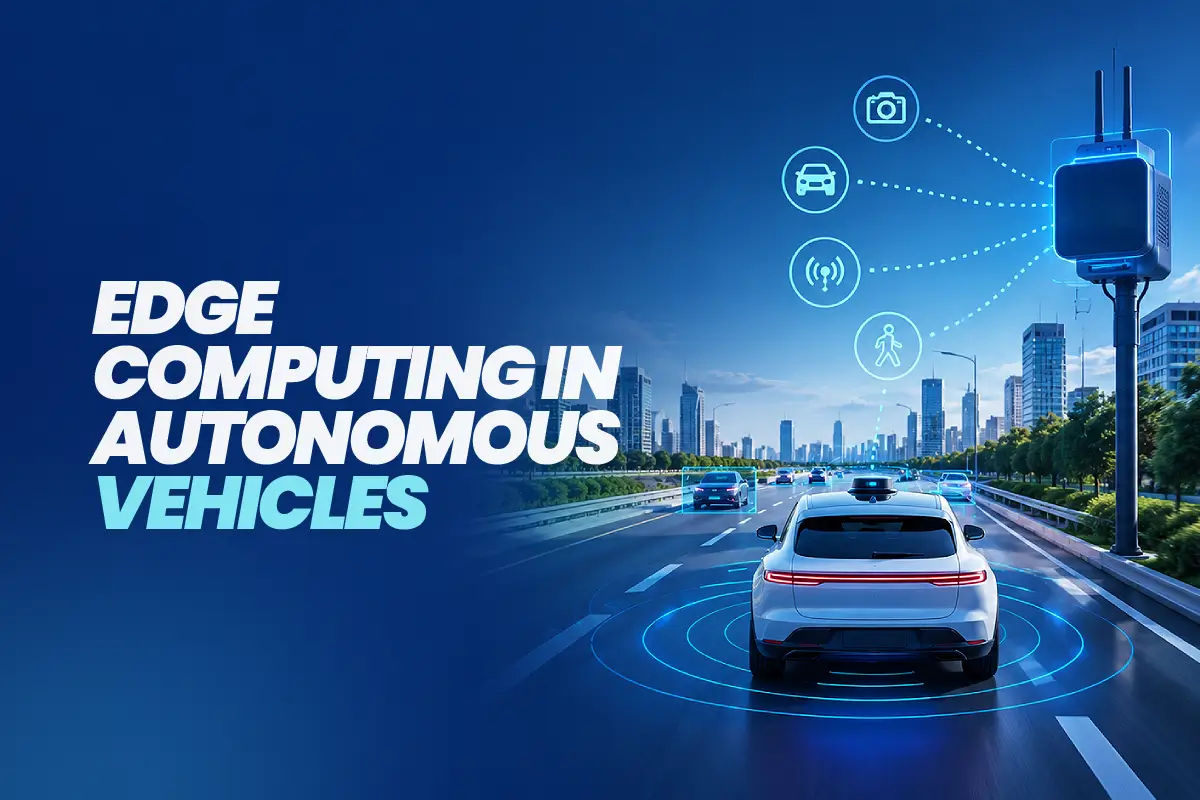
Edge computing in autonomous vehicles means processing sensor data and making driving decisions on computers inside the vehicle (or very close to it) instead of in a remote data centre. The onboard system detects objects, fuses camera, radar and LiDAR inputs, plans a path and sends braking or steering commands within milliseconds. It does this without depending on a network connection.
The term “edge” refers to the edge of the network, where data is created. In a car, that edge is the central compute unit behind the dashboard or under the floor, connected directly to the sensors. Roadside units and telecom MEC servers form a second, “near edge” layer. The cloud sits furthest away.
A related term, edge AI computing, refers specifically to running machine learning inference on that local hardware. In an autonomous vehicle the two overlap almost completely, because most of the onboard compute budget goes to neural networks for perception, prediction and planning.
Why Autonomous Vehicles Cannot Depend on the Cloud
Three separate pressures push computing into the vehicle. They are often lumped together, but each one creates a different engineering requirement.
1. Latency: Every Millisecond Is Distance
Published work on vehicular edge architectures puts the required response time for an autonomous vehicle at 10 to 50 milliseconds, and measures a cloud round trip at 100 to 200 milliseconds against 10 to 20 milliseconds for an edge deployment. The practical meaning of those numbers is clearer as distance.
Distance a vehicle travels during processing delay (our calculation)
| Speed | 10 ms (on-vehicle) | 50 ms (upper edge limit) | 150 ms (typical cloud round trip) |
|---|---|---|---|
| 50 km/h (city) | 0.14 m | 0.69 m | 2.08 m |
| 100 km/h (highway) | 0.28 m | 1.39 m | 4.17 m |
| 130 km/h (fast highway) | 0.36 m | 1.81 m | 5.42 m |
At city speeds, a cloud round trip costs about two metres, roughly the length of a pedestrian crossing stripe. At highway speed it costs more than a full car length. That delay comes before the brakes even start working, and network latency is not stable. It spikes during cell handovers and congestion. A safety case has to plan for the worst moment, not the average one.
2. Data Volume: The Uplink Cannot Keep Up
A single 8-megapixel automotive camera (3840 × 2160 pixels) at 12 bits per pixel and 30 frames per second produces about 3 gigabits per second of raw data. A vehicle with 12 such cameras generates roughly 36 Gbps before a single radar or LiDAR return is counted.
No cellular link can sustain that upload for every vehicle on the road. Streaming everything would also be expensive and wasteful. The vehicle has to interpret its own sensor data and send only what matters, such as object lists, flagged events and selected clips for training.
3. Connectivity: The Network Will Disappear
Tunnels, underground car parks, rural stretches, mountain roads and dense urban canyons all break or degrade connectivity. A vehicle that becomes unsafe when the signal drops cannot be certified. Every function on the critical driving path must work with no network at all.
Also Read: AI in Automotive Industry
How Edge Computing Works Inside a Self-Driving Car
Every autonomous driving stack follows a similar path from sensor to steering wheel. Each stage consumes part of the total latency budget, and each can be optimized or moved independently.
| Stage | What Happens | Where It Runs |
|---|---|---|
| 1. Sensing | Cameras, radar, LiDAR, ultrasonics, GNSS and IMU capture the scene | Sensors and front-end chips |
| 2. Preprocessing | Timestamps are synchronized, lens distortion is corrected, and raw frames are converted into model-ready tensors | Vehicle compute unit |
| 3. Perception | Neural networks detect and classify vehicles, pedestrians, lanes, signs and free space | Vehicle AI accelerator |
| 4. Sensor fusion and tracking | Detections from different sensors are merged into one tracked list of objects with speed and heading | Vehicle compute unit |
| 5. Prediction and planning | The system forecasts what other road users will do and selects a safe trajectory | Vehicle compute unit |
| 6. Control and actuation | The trajectory becomes steering, braking and throttle commands on the vehicle network | Vehicle safety controller |
A useful rule follows from this table. Any stage moved off the vehicle inherits the full network round trip. Moving even one small step to the cloud can turn a 30 ms loop into a loop of well over 100 ms. That is why modern stacks keep the entire chain, from perception to control, on the vehicle.
The Three-Tier Architecture: Vehicle, Roadside and Cloud
Most discussions frame this as edge versus cloud. In production systems there are three tiers, each with a different job.
| Tier | Where It Sits | Typical Latency | What It Does Best | Works Offline? |
|---|---|---|---|---|
| In-vehicle edge | Central compute unit or domain controllers in the car | Single-digit to tens of ms, deterministic | Perception, fusion, planning, control, emergency braking | Yes, it must |
| Near edge (roadside units, 5G MEC) | Intersections, base stations, telecom edge data centres | Around 10 to 20 ms | Cooperative perception, signal timing, local hazard alerts, map updates | Vehicle must stay safe without it |
| Cloud | Central data centres | 100 ms and above, variable | Model training, simulation, fleet analytics, OTA software delivery | Not required for driving |
The in-vehicle edge owns everything safety-critical. It is constrained by power, heat and cost per vehicle, and it must be predictable. Average speed matters less here than whether the system ever misses a deadline.
The near edge can see what one car cannot. A roadside unit at an intersection can spot a cyclist hidden behind a bus and warn every connected vehicle nearby. It helps when present, and the vehicle must behave safely when it is absent.
The cloud is where autonomous driving systems learn. Recorded driving data is labelled, models are retrained and tested against thousands of scenarios, and improved software is sent back to the fleet.
Edge Computing vs Cloud Computing in Autonomous Vehicles
| Factor | Edge Computing (On-Vehicle) | Cloud Computing |
|---|---|---|
| Response time | Milliseconds, predictable | Hundreds of ms, variable |
| Network dependency | None for core driving | Requires a live connection |
| Compute capacity | Limited by power, heat and unit cost | Practically unlimited |
| Data handling | Processes raw sensor data locally | Receives filtered data and event clips |
| Primary role | Real-time driving decisions (AI inference) | Model training, fleet learning, updates |
| Privacy exposure | Raw video can stay on the vehicle | Uploaded data needs strict governance |
| Cost model | Hardware cost paid on every vehicle | Ongoing compute, storage and data transfer |
| Behaviour during failure | Falls back to a minimal-risk manoeuvre | Feature becomes unavailable |
Edge and cloud are not competitors. The edge makes the car safe today. The cloud makes it better tomorrow.
Edge Computing Applications in Autonomous Vehicles
Edge computing applications in autonomous vehicles extend well beyond self-driving itself. Several of them already run in cars on the road today.
| Application | What Runs at the Edge | Why It Needs the Edge |
|---|---|---|
| Object detection and perception | Neural networks identifying vehicles, pedestrians, cyclists, signs and lanes | Must react within milliseconds |
| Sensor fusion | Combining camera, radar and LiDAR into one reliable view of the scene | Needs precisely synchronized raw data |
| ADAS features | Automatic emergency braking, lane keeping, adaptive cruise control | Safety-critical and regulated |
| Localization | Matching sensor data to maps to find the vehicle’s exact position | Must work in tunnels and dead zones |
| Driver monitoring | In-cabin cameras tracking attention and drowsiness | Privacy, since video should not leave the car |
| Predictive maintenance | Analysing vibration, temperature and battery signals for early fault detection | Filters large sensor streams into small alerts |
| EV energy management | Optimizing battery use, thermal control and regenerative braking | Continuous real-time control loop |
| V2X cooperative perception | Sharing object lists with other vehicles and roadside units | Local exchange is faster than cloud relay |
| Data triage for training | Deciding which driving moments are rare or interesting enough to upload | Reduces upload volume dramatically |
| Shadow-mode testing | Running a new model silently alongside the live one and logging disagreements | Tests new software on real roads without risk |
The last two applications get less attention but matter a great deal to engineering teams. The quality of a fleet’s AI depends on the data it collects. An edge system that recognises and uploads the right five seconds from a ten-hour drive is worth more than one that uploads everything.
Also Read: AI in Transportation
Benefits of Edge Computing for Autonomous Vehicles
When teams evaluate the benefits of edge computing for autonomous vehicles, six advantages stand out. Each one addresses a specific limitation of cloud-only designs.
Real-Time Safety Response
The biggest benefit is speed where it matters most. Because perception, planning and control all run on the vehicle, decisions like emergency braking or evasive steering complete within the vehicle’s reaction window of roughly 10 to 50 milliseconds. There is no waiting on a network round trip, so a car at highway speed does not travel several metres “blind” before it responds to a hazard.
Reliable Operation Without Connectivity
Autonomous vehicles regularly pass through tunnels, underground car parks, rural stretches and dense urban areas where mobile signals weaken or disappear. With edge computing, core driving functions keep working regardless of network conditions. The vehicle stays safe and predictable even when it is completely offline, which is also a basic requirement for regulatory approval.
Lower Bandwidth and Cloud Costs
A modern sensor suite can generate tens of gigabits of raw data every second, far more than any cellular link can carry. Edge systems process this data locally and send only what is useful to the cloud, such as object lists, flagged events and selected video clips for training. This cuts data transfer and storage costs significantly and makes large fleets economically practical.
Stronger Data Privacy
Vehicles constantly capture images of streets, pedestrians, number plates and the people inside the cabin. When this footage is analysed on the vehicle and then discarded, it never crosses a network or sits on a remote server. Processing data locally reduces privacy risk and makes it easier to comply with data protection laws in different markets.
Predictable Behaviour for Safety Certification
Functional safety standards such as ISO 26262 require systems to behave in a consistent, predictable way, especially in timing. Cloud services are designed for good average performance, but their response times vary. Onboard edge systems can be engineered for deterministic timing, which makes it possible to build a safety case that holds up under worst-case conditions.
Better Training Data and Faster Model Improvement
Edge computing also makes the AI itself better over time. Instead of uploading hours of routine driving, the vehicle can identify rare, difficult or unusual moments and send only those to the cloud. Training teams get a higher-quality dataset focused on the scenarios that actually need work, so models improve faster with less data.
Edge AI Computing Hardware: What Powers the Stack in 2026
The onboard computer is typically a system-on-chip (SoC) combining CPU cores, GPU or neural processing units, image signal processors and a safety island that keeps running if the main processor fails.
| Platform | Published Compute | Typical Use |
|---|---|---|
| NVIDIA DRIVE AGX Orin | Up to 254 TOPS | Mainstream ADAS and automated driving |
| NVIDIA DRIVE AGX Thor | Over 1,000 INT8 TOPS | Centralized compute for driving and cockpit |
| Mobileye EyeQ6 Lite | 5 deep-learning TOPS | Entry-level driver assistance |
| Mobileye EyeQ6 High | 34 deep-learning TOPS | Premium ADAS and hands-free driving |
| Qualcomm Snapdragon Ride family | Varies by configuration | ADAS through higher automation, cockpit integration |
NVIDIA DRIVE Orin delivers up to 254 TOPS, DRIVE Thor exceeds 1,000 INT8 TOPS, and Mobileye EyeQ6 High runs 34 deep-learning TOPS on a 7nm process. Naming is also shifting. NVIDIA renamed its DRIVE Hyperion reference platform to NVIDIA Hyperion in September 2026.
A word of caution about TOPS. The headline figure assumes a specific precision, batch size and utilization that real driving workloads rarely reach. Three other numbers matter more when choosing edge AI computing hardware:
- Performance per watt, which determines cooling design and, in an EV, how much driving range the computer consumes.
- Worst-case latency under full sensor load, which determines whether the safety case holds.
- Safety and security certification evidence (ISO 26262, ISO/SAE 21434), which determines whether the platform can ship at all.
Heat is a safety issue, not only a comfort issue. A perception system that slows from 30 to 20 frames per second because the board is overheating has lost a third of its situational awareness. The system must detect that and respond safely.
The Software Side: Making AI Models Fit the Edge
This is where many edge programmes stall. A model that performs well on a cloud GPU cluster often misses its deadline, or its power budget, once it reaches the vehicle. Closing that gap is an AI engineering job.
Model Optimization Techniques
| Technique | What It Does | Typical Trade-Off |
|---|---|---|
| Quantization | Converts weights from 32-bit floating point to 8-bit integers (or lower), cutting model size by up to 4x | Small accuracy loss that must be validated per scenario |
| Pruning | Removes weights or channels that contribute little to output | Needs retraining to recover accuracy |
| Knowledge distillation | Trains a small “student” model to imitate a large “teacher” model | Student may miss rare behaviours the teacher handles |
| Hardware-specific compilation | Tools such as NVIDIA TensorRT fuse layers and select optimal kernels for the target chip | Engine must be rebuilt for each hardware target |
| Architecture search | Designs networks specifically for the target accelerator’s strengths | Higher upfront engineering cost |
Distillation has become especially important in 2026. NVIDIA’s Alpamayo 1 is a 10-billion-parameter vision language action model that uses chain-of-thought reasoning, so an AV can work through unusual situations such as a traffic light outage at a busy intersection. Crucially, NVIDIA says the system is not meant to run directly in vehicles. It serves as a large teacher model that developers use to fine-tune their own autonomous driving stacks.
That pattern is likely to define edge AI in vehicles for the next several years. Large reasoning models live in the cloud and teach. Compact, optimized student models live on the vehicle and drive.
The Edge AI Lifecycle
Running AI at the edge is not a one-time deployment. It is a loop:
- Collect. Edge triage selects rare or difficult driving moments from the fleet.
- Curate and label. Data is cleaned, labelled and added to training sets in the cloud.
- Train and optimize. Models are retrained, then quantized, distilled and compiled for the target hardware.
- Validate. New models are tested against a regression library of recorded and simulated scenarios.
- Shadow deploy. The new model runs silently in vehicles, and disagreements with the live model are logged.
- Staged OTA rollout. Updates reach a small share of the fleet first, with a tested rollback path.
- Monitor. Performance drift, thermal behaviour and failure rates are tracked in production.
Teams that budget for step 3 but not steps 4 to 7 end up with models that age in the field with nobody watching them.
Where Should Each Workload Run? A Practical Placement Checklist
Before assigning a workload to a tier, answer these five questions:
- Deadline: Does a wrong or late answer within 100 ms create a safety risk?
- Offline survival: Must the function keep working when the network drops?
- Visibility: Does it need information from beyond the vehicle’s own sensors?
- Data weight: Does it consume raw sensor streams that are too heavy to upload?
- Privacy: Does it process personal data such as faces, cabin video or precise location history?
A “yes” to deadline, offline survival, data weight or privacy points to the vehicle. A “yes” to visibility alone points to the near edge. If every answer is “no”, the cloud is usually the cheaper option.
| Workload | Deadline-Critical | Must Work Offline | Recommended Tier |
|---|---|---|---|
| Pedestrian detection | Yes | Yes | In-vehicle edge |
| Emergency braking decision | Yes | Yes | In-vehicle edge |
| Driver drowsiness detection | Yes | Yes | In-vehicle edge |
| Hidden-hazard warning at an intersection | Partly | No (assistive) | Roadside / MEC |
| Traffic signal phase information | No | No (assistive) | Roadside / MEC |
| HD map updates | No | No | Cloud, delivered opportunistically |
| Model retraining | No | No | Cloud |
| Fleet-wide analytics | No | No | Cloud |
The most common mistake is not putting too much on the vehicle. It is putting too much in the cloud, simply because that is where a team’s existing data pipelines already live. The connectivity assumption slips in unnoticed and shows up later, often in a tunnel during a demo.
Also Read: AI in Manufacturing
Safety, Security and Regulation
In autonomous driving, regulation shapes the architecture from the start. The following standards directly affect what the edge system must do.
| Standard or Regulation | What It Covers | Impact on Edge Architecture |
|---|---|---|
| ISO 26262 | Functional safety of electrical and electronic systems | Redundant compute paths, safety islands, diagnostics |
| ISO 21448 (SOTIF) | Safety of the intended functionality, including hazards from limitations of perception when nothing is broken | Validation of AI models against edge cases and sensor limits |
| ISO/SAE 21434 | Cybersecurity engineering for road vehicles | Secure boot, encrypted communication, threat analysis |
| UN Regulation No. 155 | Cybersecurity management systems for type approval | Manufacturer-level security processes |
| UN Regulation No. 156 | Software update management systems | Controlled, auditable OTA updates |
| UN Regulation No. 157 | Automated Lane Keeping Systems (Level 3 on highways) | Onboard fallback and minimal-risk manoeuvres |
| SAE J3016 | Definitions of driving automation Levels 0 to 5 | Defines who is the fallback: driver (L2) or system (L3+) |
The jump from SAE Level 2 to Level 3 is the most important architectural line. At Level 2 the human driver is the backup. From Level 3 upward the system itself must keep operating safely long enough to reach a safe state. That requirement drives dual power supplies, redundant compute paths and diverse sensors. The 2022 amendment to UN Regulation No. 157 allows automated lane keeping at speeds up to 130 km/h.
Security matters just as much. A forged V2X message reporting a fake obstacle, a tampered OTA update or a spoofed sensor input are safety threats, not just IT incidents. Edge systems need hardware-rooted trust, signed software and anomaly detection.
Real-World Deployments in 2026
Autonomous driving at scale is no longer theoretical, and edge computing is at the centre of it.
- Waymo runs its fully driverless service on a lidar, radar and camera stack with heavy onboard compute. By late March 2026 it was delivering 500,000 paid rides per week across 10 US cities, with a fleet of over 3,000 robotaxis on its fifth-generation system. The company has set a target of one million paid weekly rides by the end of 2026, after quadrupling its trip volume during 2025.
- Tesla follows a camera-first approach with an in-house inference computer. Nearly all driving decisions happen on the vehicle, and fleet data flows back to central training infrastructure.
- NVIDIA’s ecosystem is expanding into reasoning-based autonomy. NVIDIA named JLR, Lucid and Uber, along with research groups like Berkeley DeepDrive, among the organizations using Alpamayo to accelerate Level 4 development.
There is also a cautionary lesson. Argo AI shut down in October 2022, and General Motors ended Cruise robotaxi development in December 2024 after investing more than 10 billion dollars. Both had capable onboard compute. Their problems were economics and operational scale. Edge hardware is necessary, but it is not a business model on its own.
Edge Computing in Automotive: Market Outlook (and Why Estimates Disagree)
Market forecasts for edge computing in automotive vary widely. We compared several published estimates:
| Source | Scope | Base Value | Forecast |
|---|---|---|---|
| Global Market Insights (2026) | Automotive edge computing | USD 14.7B (2025) | USD 85.4B by 2035 |
| Mordor Intelligence (2026) | Edge computing in automotive | USD 12.7B (2025) | USD 36.97B by 2031 |
| RedlinePulse | Automotive edge computing | USD 5.84B (2025) | USD 21.96B by 2034 |
| Global Market Insights (2025) | Edge computing gateways only | USD 4.24B (2024) | USD 26.8B by 2034 |
Sources: Global Market Insights valued automotive edge computing at USD 14.7 billion in 2025 and projects USD 85.4 billion by 2035; Mordor Intelligence estimates USD 12.7 billion in 2025 rising to USD 36.97 billion by 2031; RedlinePulse puts 2025 at USD 5.84 billion, reaching USD 21.96 billion by 2034; GMI sized the gateway segment alone at USD 4.24 billion in 2024, forecasting USD 26.8 billion by 2034. Automotive Edge Computing Market Size, Forecast 2035 +3
The base-year figures differ by almost 3x. That is mostly a scope question: whether infotainment, network infrastructure, services and gateways are included. The direction is consistent across all of them, though. Mordor reports that on-board vehicle edge held about 46% share in 2025 and expects autonomous-driving workloads to grow at roughly 25.7% CAGR through 2031. When citing any single number, always state what it measures.
Challenges That Still Slow Adoption
High Cost per Vehicle
Cost is still the biggest barrier. A redundant, safety-certified compute platform with a full sensor suite costs several times more than a standard Level 2 driver assistance system, and every vehicle carries that cost. In a data centre, hardware is shared across many users. In a car, it is paid for once per unit shipped. That is why many manufacturers still hold back higher levels of automation for premium models or commercial fleets, where the cost can be recovered over time.
Power and Thermal Limits
Continuous AI inference draws energy from the vehicle’s battery and generates heat inside a sealed enclosure that may sit in direct sunlight for hours. In an electric vehicle, every extra watt used by the onboard computer shows up as lost driving range. Engineers have to balance model accuracy against energy use and thermal limits, which is why performance per watt now matters more than raw compute.
Validating the Long Tail of Rare Scenarios
The situations most likely to cause an accident are rare, such as an unusual road layout, a fallen object or a pedestrian behaving unpredictably in bad weather. Road mileage alone cannot cover this long tail, so teams depend heavily on simulation and curated scenario libraries to test how their systems respond.
Balancing Model Updates with Safety Certification
AI models improve with every retraining cycle, but safety certification expects controlled, well-documented changes. Updating a model quickly while keeping a certifiable safety case is a process problem that many teams are still solving, and it requires tight coordination between AI, safety and software release teams.
Slow V2X Infrastructure Adoption
V2X and cooperative perception deliver real value only when enough vehicles and roadside units are equipped, but few buyers want to invest before that network exists. Until coverage improves, manufacturers treat V2X as a helpful extra rather than something the vehicle can depend on.
Shortage of Cross-Disciplinary Talent
Building edge AI for vehicles requires embedded systems engineering, AI model optimization, functional safety expertise and cloud MLOps working together. Few organizations have all of these skills under one roof. As a result, many programmes stall between a working prototype and a production-ready system.
What Comes Next for Edge Computing in Autonomous Vehicles
Centralized and zonal architectures. Dozens of separate ECUs are being consolidated into a few powerful central computers, which simplifies wiring and makes OTA updates practical.
End-to-end and reasoning models. Driving stacks are moving from separate perception and planning modules toward unified models. This changes what the edge hardware needs to be good at, with more emphasis on transformer and attention workloads.
Teacher-student deployment. Large reasoning models trained in the cloud will increasingly be distilled into compact on-vehicle models, making distillation and compression core skills.
Efficiency as the key metric. Once most platforms clear the compute threshold, performance per watt becomes the real differentiator, especially for electric vehicles.
Vehicles as long-lived software products. A car on the road for 15 years needs continuous model updates, security patches and monitoring. That turns the edge-to-cloud pipeline into a permanent engineering function.
How Xicom Helps Teams Build Edge AI Systems
Xicom works on the software half of the edge AI problem: getting models from the lab into constrained, real-time environments and keeping them reliable after deployment. Through our AI development practice, we help teams:
- Design data pipelines that collect, curate and label the right edge data
- Train, quantize, prune and distill models for target hardware and latency budgets
- Build validation, shadow-testing and staged OTA rollout workflows
- Integrate edge inference with cloud analytics and monitoring
If you are deciding which workloads should run at the edge, or your models are missing their latency or power targets, our Edge AI consulting services can help you map workloads to the right tier and build a practical deployment roadmap.
FAQs
1. What is edge computing in autonomous vehicles?
Edge computing in autonomous vehicles is the practice of processing sensor data and making driving decisions on computers inside the vehicle rather than in a remote cloud. It allows the car to detect obstacles, fuse sensor inputs and brake or steer within milliseconds, even with no network connection.
2. Why do self-driving cars need edge computing?
Self-driving cars need edge computing because cloud round trips take too long for safety decisions. A vehicle’s reaction window is roughly 10 to 50 ms, while a cloud round trip often takes 100 to 200 ms. Edge computing also reduces bandwidth use and keeps the car safe when connectivity drops.
3. What are the main edge computing applications in autonomous vehicles?
The main applications are object detection, sensor fusion, localization, path planning, emergency braking, driver monitoring, predictive maintenance, EV energy management and V2X cooperative perception. Edge systems also decide which driving data to upload for training and run new models in shadow mode for testing.
4. What are the benefits of edge computing for autonomous vehicles?
The key benefits are real-time safety responses, reliable operation without connectivity, lower bandwidth and cloud costs, stronger data privacy, predictable timing for safety certification, and higher-quality training data. Together, these make autonomous driving safer and more economical to scale.
5. What is the difference between edge computing and edge AI computing?
Edge computing is the broad practice of processing data near where it is generated. Edge AI computing is the subset that runs machine learning models on that local hardware. In autonomous vehicles the two overlap heavily, because most onboard compute powers AI models for perception and planning.
6. Do autonomous vehicles still need the cloud?
Yes, but not for real-time driving. The cloud handles model training, simulation, fleet analytics, HD map updates and over-the-air software delivery. Anything that must happen within the vehicle’s reaction window stays on the vehicle.
7. What hardware is used for edge computing in autonomous vehicles?
Autonomous vehicles use automotive-grade systems-on-chip that combine CPUs, GPUs or neural accelerators and safety processors. Common platforms include NVIDIA DRIVE Orin and Thor, Mobileye EyeQ6 and Qualcomm Snapdragon Ride. Performance per watt and safety certification matter as much as raw TOPS.
8. How does edge computing improve autonomous vehicle safety?
Edge computing improves safety by keeping the full sensor-to-brake chain on the vehicle, so decisions complete within a predictable time. It removes network delay and outages from the critical path. It also supports redundant designs required by functional safety standards such as ISO 26262.
9. What is MEC in autonomous driving?
MEC, or multi-access edge computing, places computing resources within telecom networks near the road, such as at base stations. It supports functions like cooperative perception and local hazard alerts at around 10 to 20 ms latency. Vehicles treat it as helpful extra input, never as a requirement for safe driving.
10. How are AI models optimized to run on vehicle hardware?
Models are optimized through quantization (reducing numeric precision), pruning (removing low-value weights), knowledge distillation (training a smaller model to imitate a larger one) and hardware-specific compilation. Each optimized model must then be re-validated against safety scenarios before deployment.

Make your ideas turn into reality
With our AI & mobile app solutions
Explore related services
Based on this article's topic