Nov 7, 2025 Artificial Intelligence
Artificial Intelligence in HR: Its Benefits, Challenges, and Solutions
So, why is Artificial Intelligence in HR transforming the workplaces and staffing firms? Well, let’s get in the deep…
Have you noticed how fast HR responsibilities are changing? Just a few years back, HRs were mainly responsible for handling paperwork, payroll, and hiring.
But today are expected to be data-driven decision-makers who shape the company’s future. And that is where leveraging Artificial Intelligence in HR can make a great difference.
Across the world, businesses are realizing that employees are their most valuable asset, but managing people efficiently is harder than ever.
In addition to this, the job market is saturated and changing every few months. Employees are expecting personalized growth, remote working setups, and high packages. Handling the changing market demands while balancing skills, business turnovers, and more is becoming a great challenge.
That’s why more organizations are turning to AI and machine learning in HR to make smarter, faster, and fairer decisions.
AI helps HR teams automate routine work, analyze employee data, and predict future workforce needs.
A Gartner survey also found that 61% of HR leaders are already exploring or implementing AI-based solutions to improve productivity, hiring, and retention. That’s more than triple compared to 2023 — showing how quickly this shift is happening.
So, what makes businesses adopt this change and incline towards AI technology? Because AI helps solve long-standing HR problems that affect business growth, like:
- Endless hiring cycles and poor candidate matching
- Rising employee turnover
- Limited insights from scattered HR data
- Manual and repetitive administrative work
- Lack of personalized engagement and training
By implementing AI in HR, companies can predict and perform better than ever. Using the AI-based insights, businesses can improve employee satisfaction before issues arise. It’s not just about saving time; it’s about driving new value from people they hire for the company.
As AI is becoming the core part of business transformation, it’s also creating new opportunities for innovation.
Many enterprises now collaborate with expert partners to build custom AI-driven HR tools.
These tools go beyond automation and deliver real intelligence. So if you are interested in seeing how AI innovations can help shape your business, then you can explore our guide on Top AI Trends. It highlights how organizations are rethinking their strategies with smarter, AI-powered systems.
Here in this blog guide, we will walk you through a complete guide on how Artificial Intelligence in HR is empowering staffing firms. Its benefits, challenges, and solutions make the entire process impactful.
Why is Using Artificial Intelligence in HR Gaining Popularity?
The way we work is changing fast, and the HR department is changing even faster. Traditional recruitment and talent management models are failing to keep up with the modern demands. Businesses need smarter systems that help them find the right people. That’s why more companies are turning to Artificial Intelligence in HR.
AI is no longer just about robots or automation- it’s about using intelligence to simplify how organizations are attracting, engaging, and retaining talent. In today’s competitive work environment, an increasing number of staffing companies are adopting this trend.
Here are the numbers that clearly show the increasing impact of Artificial Intelligence in HR:
According to recent studies, 87% of staffing agencies now use AI-driven tools to automate recruitment tasks. But the impact goes far beyond hiring. You don’t have to trust our words; here are the stats explaining the market overview:
- The artificial intelligence in HR market was valued at $3.25 billion in 2023 and is expected to reach $15.24 billion by 2030.
- 60% of leading tech companies are replacing the traditional process and are expected to invest in AI-powered recruitment software.
- 73% of organizations are adopting AI to automate the recruitment process.
- 44% of recruiters claim saving time is their top reason for implementing AI solutions.
So, what’s driving this massive shift toward AI in HR?
Simply put, businesses can’t afford slow, biased, or reactive processes anymore. With the benefits of AI in HR expanding every year, many enterprises are now exploring deeper innovations like AI copilots for HR.
AI is not replacing the HR department, but adding a great range of benefits to HR.
Key Use Cases of Artificial Intelligence in HR
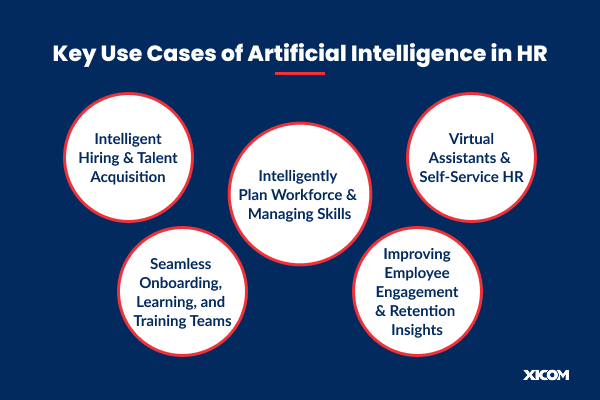
Before we dive into learning how to implement the AI capabilities into HR workflow, let’s learn what exactly is possible when you adopt Artificial Intelligence in HR.
Here we have listed use cases showing how the artificial intelligence in HR market is delivering great value.
1. Intelligent Hiring & Talent Acquisition
One of the biggest wins for HR teams lies in hiring. Using AI and machine learning in HR, can allow staffing firms to screen resumes faster and match specific candidates to the various roles. It offers a smooth candidate experience and makes the entire hiring process frictionless.
Here is how it works and simplifies the hiring process:
AI tools work with algorithms. It can analyze thousands of resumes and identify those profiles that align well with various job descriptions in seconds. According to the reports, such screening systems help HR teams find the right talent more efficiently.
- Some companies that are already using AI in recruitment are saving up to 40% time in screening resumes.
- And companies are using chatbots and virtual assistants to engage candidates and answer queries in real time is gradually reducing the drop-offs and improving the experience.
So the point is if you are taking too long to fill the position,” or “struggling to find consistent profiles”. It’s time to incorporate AI capabilities in the process.
2. Seamless Onboarding, Learning, and Training Teams
The real work actually starts once you onboard someone. But many HR teams struggle with generic training, delayed access, and weak early engagement. This is where AI can help you:
- AI-powered onboarding assistants can guide new hires, answer their initial questions without any delay. This actually helps increase employee satisfaction.
- For learning and training, AI can help personalize the training sessions. Every employee is onboarded to handle different job roles with different skillsets. Instead of everyone getting the same module, AI looks to analyze the performance and recommends what each person needs.
Implementing Artificial Intelligence in HR can help improve employee engagement and make them feel like the company is investing in them. But if you’re wondering about the budget, then consider this guide to hiring an AI developer and its cost.
3. Improving Employee Engagement & Retention Insights
In enterprises, the biggest pain point is “businesses lose people too soon, and they don’t even always know why.” Here’s where the benefits of AI in HR shine.
- AI can analyse employee data, including their attendance, survey responses, performance, and predict who might leave. That gives you a chance to intervene, but the actual question is “what is the average AI app development cost”? Though every business has special needs, it is worth getting this answer by hiring an AI development services.
- AI-driven chatbots and employee self-service tools increase satisfaction. If people get quick answers and feel supported, they’re less likely to churn.
- Some companies using AI in HR have found measurable improvements in retention and morale by catching issues earlier.
4. Intelligently Plan Workforce & Managing Skills
In a business where skills change fast and you must stay agile, you can’t just guess the future. HR needs data.
- AI in HR tools helps forecast upcoming skill gaps, plan roles and staffing levels, and optimise cost. For example, AI analyses historical data and trends to tell you: “We’ll need X roles in six months,” or “Here’s a potential skill shortage.”
- That kind of insight turns HR from reactive (we’re short-staffed) to proactive (we know we’ll be short-staffed).
5. Virtual Assistants & Self-Service HR
Another big area that eats the time is HR’s routine or daily repetitive work. HR teams spend hours on queries, forms, and follow-ups. This is where AI agents help lighten the load. Before you get straight to hiring an AI developer, many remain confused between using Chatbots Vs Conversational AI for businesses.
- Virtual assistants or chatbots powered by AI can handle leave requests, policy questions, or simple admin tasks, so your HR team can focus on higher-value work.
- This use case ties into AI and machine learning in HR because these systems get smarter with data. Using AI in HR can even improve data accuracy and response quality over time.
Major Benefits of Artificial Intelligence in HR
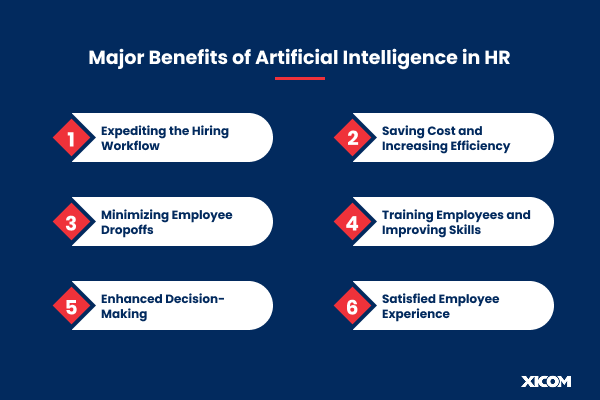
Every HR manager enjoys having a workflow that enhances their productivity and enables them to manage workflow with ease. But between managing recruitment, engaging employees, and reviewing performance, it’s easy to get lost in endless tasks. That’s where Artificial Intelligence in HR creates real impact.
With AI capabilities, HR teams can focus on tasks that matter the most. While the technology handles all the repetitive tasks like generating performance reports, monitoring employee timings, HR teams can stream pay attention to what helps maximize the ROI on investments.
If you are still thinking about how it can benefit your staffing agency or HR team, then let’s explore some key benefits of AI in HR:
1. Expediting the Hiring Workflow
Traditional hiring can take weeks. Whether it be sorting resumes, scheduling interviews, and shortlisting candidates, manually handling all these tasks is quite draining. Using AI in HR speeds that up dramatically, here’s how:
- AI tools scan thousands of resumes in seconds and enable you to gather the profiles that best match the job description.
- Predictive AI algorithms quickly assess the skills, experience, and even determine whether the candidate is a good fit for their work environment. It could be a great help for recruiters to make confident decisions.
- No need to handle initial introductions. The customized Chatbots and conversational AI tools manage initial candidate interactions. This leaves a great impact on employees and reduces the drop-offs.
This ultimately results in faster recruitments, high-quality hires, and less biased decisions.
2. Saving up to 40% Cost and Increasing Efficiency
Implementing AI and Machine Learning in HR helps organizations handle multiple tasks with perfection. Automated tools take over repetitive tasks. From data entry, payroll checks to leave approvals- manage everything from a centralized platform. The great benefits of using AI in HR workflow are that it helps reduce manual errors and frees up HR staff for strategic work.
By leveraging modern AI recruiting tools, companies can also streamline hiring processes, improve candidate matching, and reduce time-to-hire significantly.
Reports say that AI-driven HR automation can reduce administrative costs by up to 40%. It saves approximately 8 hours weekly in handling repetitive tasks and improving overall productivity. That’s a win-win for both HR and finance teams.
3. Minimizing Employee Dropoffs
Hiring great employees is quite challenging. But retaining them longer in your organization is another level of challenge.
In fact, HR teams usually struggle to predict who might stay or leave and when. But with AI in HR workflow, HR managers can get a complete overview of their employees and are able to make an informed decision.
AI enables you to get access to an AI-powered dashboard where you can analyze user behavioral data, performance metrics, and engagement patterns. By deeply evaluating everything, AI can red flag early signs of burnout.
HR managers can then take preventive steps in real time. Considering these signs, HRs can offer new strategic growth opportunities, training programs, or recognition, before it gets too late.
4. Training Employees and Improving Skills
There is no organization where one-size-fits-all training programs really exist. AI changes that. Implementing Artificial Intelligence in HR helps introduce personalized learning journeys.
Each program is customized for several employees based on their roles, skills, and career goals.
These programs not only provide the training to each employee, but also track progress and even measure learning effectiveness.
Forward-thinking businesses are positively embracing this change and are now creating internal AI copilots. These copilots make learning more interactive and adaptive.
5. Enhanced Decision-Making With Intelligent Data Insights
In every business, data is a fuel to make a decision. And this is not an exception for the HR teams. But without the right tools, it’s just a mess. Manually handling all the data can lead to major blunders. However, using Artificial Intelligence in HR helps turn that raw data into powerful insights.
With AI-powered ecosystem, HR teams can understand and make sensible decisions based on the facts. Whether it’s identifying top performers of the organization or planning future workforce strategies, these insights help HR leaders align people goals with business goals.
6. Leading to Satisfied Employee Experience
At its heart, HR is about people and AI helps make their experience smoother and more human. AI-powered self-service portals and chatbots provide instant responses to employee queries, simplifying everything from leave requests to benefits management.
When employees get quick answers and personalized support, their satisfaction naturally increases. And a happy workforce means higher productivity and stronger business growth.
Want to see how emerging tech is improving employee experiences beyond HR? Explore our blog on AI Business Ideas, it covers how companies are using AI to innovate across departments.
In a nutshell, the benefits of AI in HR go beyond automation. They drive strategic value, improving hiring quality, employee engagement, and organizational growth. Businesses that adopt AI early are already seeing major advantages. Those who delay risk falling behind in a market, where talent and data are everything.
Looking to boost business efficiency with AI technology?
Partner with Xicom to develop scalable AI apps that transform HR workflows and drive measurable ROI.
Challenges and Solutions of Using AI in HR
There is no doubt in this fact that Artificial Intelligence is turning the game in various industries. This is where using Artificial Intelligence in HR sounds exciting. However, it’s not always that easy to put this into action.
HR teams face real challenges when they start using AI tools. If you are still finding yourself stuck in between and yet not to make a final decision to hire mobile app development company, then check out the best solution to the challenges that you may be afraid of facing.
1. Data Privacy and Security
HR teams are having the most sensitive data of the organization. It could be anything – employee salary, health records to personal details. And there are always security risks aligned with AI systems. If you are AI system is not encrypted, then your data will be at risk.
Solution:
- The simple solution is to this challenge is to use strong data protection measures like encryption and access control.
- Partner with a trusted Generative AI development company that follows high security standards and pays attention to security protocols while customizing solutions.
2. Challenge In Adopting AI Modules
Most HR managers don’t understand this technology and lack the basic skills of using AI-driven modules. Lack of skills in data science and in AI makes it hard to manage or use AI tools properly.
Solution:
The best way is to look for the development partners who can customize the solution and provide proper training to the teams.
For easy adoption, you can ask experts to provide a proper manual.
3. Bias in AI Systems
AI learns from past data. If that data has hidden bias, the AI may make unfair hiring decisions. For example, it might prefer candidates of a certain gender or age.
Solution:
- Train AI with balanced and diverse data.
- Ask your AI partner to audit algorithms regularly to remove bias.
- A certified AI developer enables you to build fair and transparent systems.
4. Initial Setup Costs
Implementing or developing AI tools can seem expensive in the beginning. The initial setup cost makes many small businesses hesitate to invest in. Further, the additional cost of training and it’s maintenance also stressed them up.
Solution:
- The simple solution is to start with something small and focus on one or two key HR areas like recruitment or payroll.
- Evaluating the needs of the organization, you can scale later as you see results.
- If you’re planning your budget, then firstly pay attention on how much it cost to hire a mobile app developer.
5. Strong Resistance from Employees
Many times, employees misinterpret the logic of implementing AI into the work process. They worry that AI might replace their jobs. Others may feel uncomfortable using new tools.
Solution:
- Communicate clearly and make then understand that AI helps people, not replaces them.
- Offer training to show how AI reduces workload and improves productivity.
- You can also build AI copilots or chatbots to make transitions easier. Learn more in our guide about how to build an AI Copilot for enterprises.
6. Complexity of AI Integration in Legacy HR Systems
Did you know 45% of staffing firms are still using that old HR software, where you have different, separate tools to manage different HR activities. Connecting all systems together and making them work with AI tools is a big challenge especially when dealing with ATS integrations like Greenhouse integrations.
Solution:
- Upgrade your system or integrate it with AI using custom APIs.
- A professional software development company can make this transition smooth and error-free. To learn how top companies modernize their systems, read top software development trends.
In a nutshell, adopting Artificial Intelligence in HR comes with a challenge. But every challenge has a solution. The only key is to plan, strategise and work with the right experts to drive the best results.
Ready to future-proof your business with AI HR solutions?
Leverage Xicom’s advanced AI app development expertise to automate, analyze, and intelligently innovate your workforce management.
How Xicom Can Help You Incorporate AI in HR Department?
Implementing Artificial Intelligence in HR can feel complex. However, choosing the right tech partner can make a big difference.
This is where collaborating with Xicom can be really rewarding. Xicom, being a top AI app development company, enables businesses to unlock new business dimensions with AI capabilities.
Leveraging their AI expertise, they can turn AI implementation into a smooth and satisfying experience. From developing custom AI solutions to modernizing legacy HR systems, we make seamless transitions.
Whether you want to automate recruitment, analyze employee data, or personalize training programs, Xicom ensures your HR processes become faster, more accurate, and people-focused.
Here’s how Xicom can help you:
- Custom AI App Solutions: We design AI tools that align well with your specific HR goals. It covers everything from recruitment automation to predictive analytics.
- Frictionless System Integration: Our experts identify the scope of improvement and integrate AI into your existing HR platforms without disrupting daily operations.
- Dedicated AI Experts: Hire software developers to build or maintain your AI-powered HR tools.
- End-to-End Support: From strategy to deployment, our team manages the entire project lifecycle.
- HR Analytics & Insights: Get real-time data for smarter decisions on hiring, retention, and employee performance.
- Scalable App Development: We build mobile and web apps that are easy to scale with your business expansion.
- Future-Ready HR Systems: Continuous updates, maintenance, and innovation from a trusted software development company.
Conclusion: The Future of HR Is Powered by AI
The world of HR is changing fast. Manual processes, guesswork, and delayed decisions no longer work in today’s dynamic business world. Artificial Intelligence in HR is helping organizations move faster, make smarter choices, and focus more on people instead of paperwork.
From recruitment and onboarding to engagement and retention, AI and machine learning are transforming how HR teams work every day. Businesses that embrace this shift are already seeing better efficiency, happier employees, and improved ROI.
However, implementing AI successfully requires the right strategy, technology, and expertise. That’s where Xicom Technologies becomes your ideal partner.
With decades of experience, Xicom helps organizations build intelligent HR systems that adapt, learn, and grow with your business. Whether you want to automate hiring, improve workforce analytics, or create AI-powered employee engagement apps, our team has the skills and tools to make it happen.
So, if you’re ready to bring innovation into your HR department, don’t wait for the future. Build it now.

Make your ideas turn into reality
With our AI & mobile app solutions
Explore related services
Based on this article's topic