Mar 5, 2026 Artificial Intelligence
Artificial intelligence has been extremely rewarding for the automotive industry in the recent scenario. AI in automotive industry signifies the use of major technologies like computer vision and machine learning to change how vehicles are created. The following market size is also going to touch USD 38.45 billion by 2030.
AI-powered automotive can change algorithms and real-time data analytics from drivers and sensors to real insights. As a result, they can offer you safer and more efficient vehicles and services. The technology not only modernizes the vehicles, but also the whole manufacturing processes and supply chain management gets a new approach.
The automotive industry has been adopting agentic AI and generative AI to influence its relevance in the market. The industry is also experiencing revenue boosts due to multiple AI technologies, as per a report by IBM. As per the report’s findings, OEM executives expect the share of total revenue to increase by 9% in three years.
We will explore how AI is becoming an efficient addition in the automotive industry, along with its benefits & leading use cases.
What does AI mean in the automotive industry?
AI in the automotive industry is more about making your vehicles efficient & smarter. AI-rich autonomous cars are already uplifting the transportation sector while lessening the risks of mishaps on roads.
Predictive maintenance of AI can help you detect potential issues in the early phase while extending the lifespan of your vehicle. Talking about the manufacturing side, AI can optimize production while lessening the costs and improving quality. It encourages driving experience through advanced driver-assistance systems. You can also enjoy the relevance of personalized features and voice recognition.
Apart from AI tools in mobile development, it is also pushing the auto industry towards a future that is highly sustainable.
Based on the reports of McKinsey, it’s estimated that autonomous driving has the power to generate around USD 400 billion in revenue in the future.
How strong is the influence of AI in automotive industry?
The impact of AI in the automotive industry has been growing rapidly. It has already highlighted a significant usage in various industries, have a look below.
AI in dealership services
Machine learning tools, along with customer-centric chatbots, are capable of serving your customers anytime. These technologies can easily assess your customer data and offer them personalized support to encourage their trust in you.
AI in manufacturing efforts
The manufacturing processes have been transformed because of AI, as it enables automated robotics and real-time data gathering. This can streamline your production while enhancing the quality control. It also minimizes the operational charges and wastage.
AI in dealership marketing
You can easily enable hyper-personalized campaigns through artificial intelligence in the automotive industry. Platforms like Fullpath claim that dealerships use AI marketing automation to form leads and optimize their expenditure. This can help your results be focused on your audience while increasing conversions.
We are all well aware of the benefits of AI for startups. Government initiatives also play a crucial role in encouraging start-ups to adopt AI.
Benefits of AI in the automotive industry
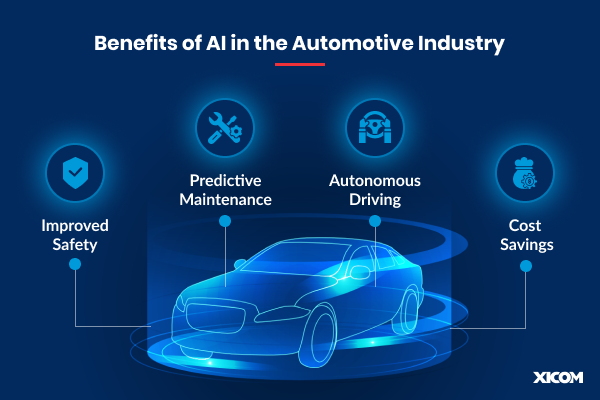
The automotive industry is continuously experimenting with a series of AI technologies to align its operations and performance. They are valuing technologies like big data and IoT to make the results more efficient. Let us further highlight the more effective benefits of artificial intelligence in the automotive industry.
Fleet-Based Advantages
Let us explore certain fleet-based benefits in this section.
Better safety
Safety on roads is another major benefit of AI. You can access safety features like adaptive cruise control or warning systems to make the effects more beneficial. You can get alerts related to potential and can accordingly consider proactive steps.
Fuel efficiency
AI systems have the capability to assess your driving habits while understanding the traffic flow. It can also read the engine parameters in real time. This can uplift fuel efficiency while minimizing pollution. It can also improve your acceleration and route planning. You can also learn many generative AI use cases to understand this technology’s impact.
Predictive maintenance
With the help of predictive maintenance, you can leverage the convenience of IoT for your vehicles. This system can track the real-time state of your cars by processing a huge amount of data. This allows your management to understand when it requires repair.
When the IoT sensor detects a potential problem, it alerts the automotive management to consider preventative measures before the condition gets worse. AI can also be helpful in reducing pollutants while encouraging the overall vehicle performance.
Monitoring
AI enables advanced monitoring of vehicle operations like route optimization, idle time, and driver habits. This is how your fleet managers can discover the inefficiencies and alter workloads as per the needs. This can also assist you in making viable decisions. To make the system work specifically for you, hire AI developers who have the knowledge to implement the features more effectively.
Driver-Related Advantages
This section will make you aware of the benefits that a driver can leverage.
Autonomous driving
Self-driving cars were impossible a few years back. This technology has been dominating the market currently. This specific technique offers a whole new experience to drivers. It has the power to minimize accident rate and increase mobility. This system is extremely viable for people with physical limitations who are unable to drive.
Better driving experience
AI-integrated entertainment systems in current automobiles leverage customized experiences for drivers and passengers as well. This can improve safety while offering you enjoyment during your travel. To make the process really personalized, you need the expertise of an AI development services.
Stress monitoring
Modern AI systems include in-cabin sensors along with face recognition to verify the attention and condition of the drivers. When the systems recognize any defect, they send out notifications and automatic replies to keep the drivers aware of the accidents. This can help you adopt safer and more responsible driving practices. AI in mobile app development can also prescribe rest periods for the drivers.
Manufacturing-Related Advantages
This section can make you aware of some manufacturing-centric benefits of AI in the automotive industry.
Uplifted quality control
You can now easily initiate instant quality inspections during the production phase due to AI-rich computer vision. These systems are capable of catching even the smallest defects. It also keeps the parts quality-oriented while lessening the chances of repairs. This approach can encourage your customers’ trust while keeping your product viable.
Optimized supply chain
AI can easily encourage your supply chain by improving its efficiency and logistics. It can assist you in predicting requirements, demand, and managing stocks. You can also plan delivery routes that allow your company to prevent delays and reduce inventory wastage.
Process automation
AI-centric robotics is capable of handling repetitive and time-heavy tasks. These smart outputs can ensure product uniformity while cutting down the chances of errors. You can enjoy seamless workflows while adopting faster assembly times. For more result-oriented approaches, consider the expert approaches of top AI development companies.
Want to Integrate AI in Your Automotive Business?
Collaborate with Xicom to implement smart manufacturing, driver assistance systems, and connected vehicle technologies powered by AI.
What are some top use cases of AI in the automotive industry?
The automotive industry is growing effectively, where the technologies have been maintaining their features. Some of the major ones are car connectivity and data sensors, along with electrification. This collective approach fuels growth in the following industry, starting from design to maintenance. Let us explore some of the most desirable use cases of AI in the automotive industry.
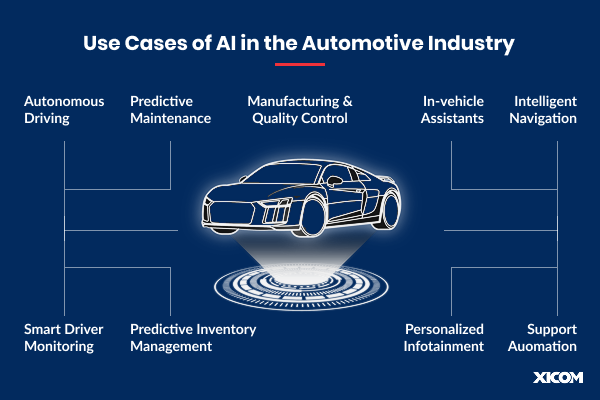
1. Driver Assistance
This is one of the best uses of AI in the automotive industry. AI-integrated systems use sensors to assist with the detection and monitoring of the blind spots. This is how you can consider preventive steps to stay protected from the beginning.
The connection between AI and cars has been growing and making the system way more intelligent.
2. Autonomous Vehicles
Next-generation cars equipped with self-learning & self-driving capabilities are among the most essential outcomes of artificial intelligence in the automotive industry. With modern technologies like big data & machine learning, your vehicles can easily navigate roads with minimal or no human instructions. This also values traffic rules while assuring you of safety.
3. Driver Monitoring
An AI algorithm is capable of assessing if the regular driver is in the car or if someone else is driving. It can accordingly adjust the mirrors while maintaining the seats and temperature if a known user is in the driving seat. The system can also track the driver’s eyes and head position to track the signs of drowsiness.
4. Improves the Comfort of the Passengers
To make your ride even smarter, manufacturers are valuing the potential of NLP and image recognition technologies. These additions are known for their safety values while upgrading the experience of the drivers. You can hire app developers to make the system understand your voice commands. This can make you enjoy a more connected journey while being confident about the safety features.
5. Effective Quality
Being assured about the vehicle’s quality is one of the top priorities. Your manual inspections might lead to missed defects and slower issue resolutions. AI manufacturers can leverage AI-centric data to detect even the smallest mistakes in the early phase. These systems can alert your teams about the potential risks before they become massive.
What are some leading trends of AI in the automotive industry?
While many discussions around AI in the automotive industry prioritize the safety features and automation, the real shift is way deeper. Instead of only valuing the AI trends, the manufacturers are willing to redesign their whole business models with continuous learning. Here, you can go through some emerging trends that highlight the transformation more effectively.
Generative AI Influencing Vehicle Design
Generative AI can reshape how you design and develop vehicles. Instead of completely following the manual engineering approaches, manufacturers are now using AI to generate optimized component designs. AI is also capable of suggesting lightweight structures while improving your fuel usage and battery range.
This approach reduces the development time while helping automakers bring new models faster.
Edge AI Accessing Real-Time Decision Making
Vehicles in the recent scenario are becoming more intelligent. So, depending upon the cloud processing alone is not practical enough. The industry is leveraging the help of Edge AI. Here, data can be processed directly inside the vehicle. This allows you to make instant decisions for critical functions like driver monitoring or object detection.
AI in Influencing Energy-Optimized Mobility
With the rapid growth of electric vehicles, AI is playing an important role in handling energy efficiency. Machine learning models can easily optimize your battery performance while predicting the charging requirements. It can plan energy-efficient routes and can extend the lifespan of your battery through load management.
Mobility Ecosystems
The automotive industry is moving beyond traditional ownership towards mobility services like subscription models & car sharing. AI can help you manage fleet utilization while forecasting the demands. Instead of prioritizing an individual vehicle, companies are using AI to operate the whole mobility network efficiently.
These are some effective trends of AI in the automotive service. You can also assess some more AI business ideas to gain a competitive edge.
Best practices for integrating AI in the automobile services
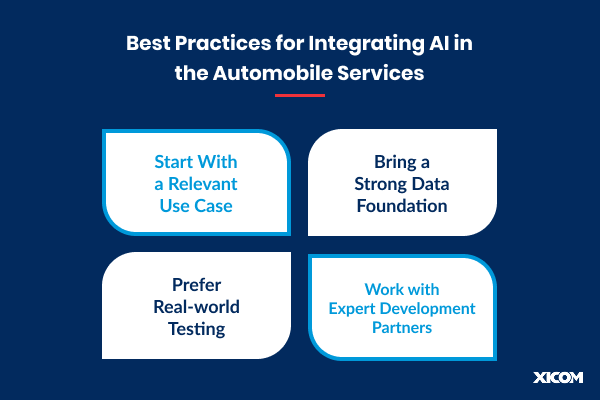
To implement AI in the automotive industry successfully, you need a structured & safety-first approach. Below are some of the best practices that you can stick to.
Start With a Relevant Use Case
Make sure to consider issues like driver monitoring and predictive maintenance. If you value a targeted approach, the results will be more customer-centric while safeguarding your brand values.
Bring a Strong Data Foundation
AI values high-quality data from sensors and vehicle systems. Prioritize better efforts for data collection and cleaning to upgrade the model’s authenticity.
Prefer Real-world Testing
Automotive AI should perform effectively in multiple weather, road, and traffic conditions. You must carry out extensive simulations and fail-safe mechanisms to ensure desirable performance.
Work With Experienced Development Partners
Many businesses prefer to hire professional AI mobile app development services to accelerate the implementation. You can easily get future-ready solutions in no time with expert guidance.
Upcoming values of AI in the automotive facilities
With the incredible rise of self-driving technology, it’s clear that autonomous vehicles are going to dominate the roads soon. As per the recent trends, around 90% of cars will be equipped with AI-enabled systems in the future. From AI in vehicle manufacturing to sales, artificial intelligence is playing an important role in making cars efficient & smarter than ever.
As per market research by Statista, the global automotive intelligence sector is going to reach USD 74.5 billion by 2030. Significant automakers are already investing in smart vehicle development. These approaches are going to evolve the transportation industry from the core.
Looking to Modernize Automotive Manufacturing with AI?
Partner with Xicom to implement AI-driven automation, quality inspection, and supply chain optimization for next-gen vehicle production.
Challenges of AI in the automotive industry
While artificial intelligence in the automotive industry offers many advantages, its implementation comes with certain challenges. One of the major concerns is data complexity and availability. Automotive AI needs massive amounts of high-quality data that can be difficult for you to gather and manage efficiently.
Safety and reliability are also critical issues. Your AI systems must perform effectively in unpredictable environments like changing weather & rare scenarios. Even minor errors can lead to serious consequences. Another major challenge is the AI app development cost. Building AI models and maintaining the computing systems requires major investment and technical expertise.
Conclusion
The inclusion of AI in the automotive industry has been a game-changer in the current scenario. It can help your company design and create new prototypes while increasing the supply chain efficiency. It is high time for the automotive industry to offer AI a chance in their business while reaching ultimate goals. You can also go through reliable generative AI trends to be aware of some result-driven options.
As a trusted AI development service provider, Xicom is here to assist you with building innovation-rich solutions. Starting from intelligent driver assistance systems to connected vehicle platforms, we hold the complete potential to future-proof your automotive journey.

Make your ideas turn into reality
With our AI & mobile app solutions
Explore related services
Based on this article's topic