How to Hire Fintech App Developers: Skills, Costs and Hiring Process
Oct 27, 2026 App Development
Oct 27, 2026 App Development
Oct 27, 2026 App Development
If you plan to hire fintech app developers, you need more than strong mobile engineers. A fintech app moves money, stores identity data and falls under rules like PCI DSS and KYC/AML. One bug in a payment retry or a balance calculation can cost real money, trigger a regulator’s attention, or both.
That is why hiring for a banking, wallet or lending app looks different from hiring for a typical consumer app. The right developers understand payment flows, ledger logic, secure mobile storage and compliance, in addition to Swift, Kotlin or Flutter. Increasingly, they also need AI skills, because fraud detection, smart KYC onboarding and in-app assistants are becoming standard features in financial apps.
The market is also growing quickly. Fortune Business Insights puts the global fintech market at USD 460.76 billion in 2026, with North America holding a 32.30% share in 2025. More products competing for the same users means less room for an app that is slow, insecure or hard to onboard.
This guide covers the skills to look for, the AI capabilities that now matter, the hiring models available, realistic cost ranges, a step-by-step hiring process with fintech-specific interview questions, and the mistakes to avoid.
Most companies hire fintech mobile app developers when the app becomes central to revenue, or when the current team lacks financial domain depth. These are the most common triggers.
If one or more of these applies, a specialized team will usually cost less than retraining a general mobile team mid-project.
The best candidates combine three layers of skill. Weakness in any one of them shows up later as security gaps, failed audits or a poor user experience.
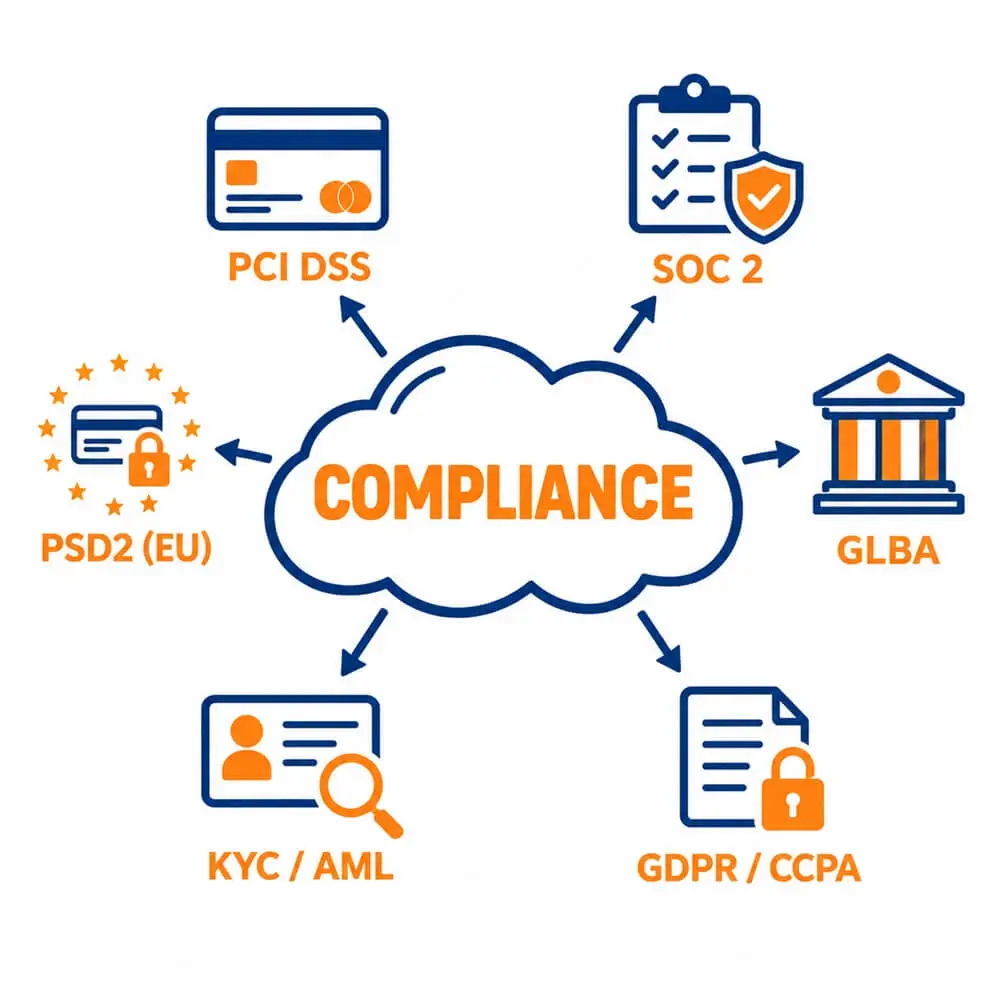
| Standard | What it means for the developer’s work |
|---|---|
| PCI DSS | Keeps card data out of scope through tokenization and hosted fields. Version 4.0.1’s future-dated requirements became mandatory on March 31, 2025 (PCI SSC). |
| SOC 2 | Requires access controls, change management and logging that auditors can verify. |
| GLBA | US financial institutions must safeguard customer financial data, which shapes encryption and access design. |
| GDPR / CCPA | Consent capture, data minimization and support for deletion and export requests. |
| KYC / AML | Identity checks at onboarding plus transaction monitoring hooks. |
| PSD2 (EU) | Strong customer authentication and regulated access to bank accounts. |
A developer does not need to be a compliance officer. They do need to know which design choices widen or narrow your audit scope.
AI is now part of most fintech app roadmaps, so the developers you hire should be able to build and ship AI features safely. Fraud detection, onboarding, credit decisions and customer support are where AI changes a financial app the most.
| AI feature | What it does in the app | Skills to look for |
|---|---|---|
| Fraud and anomaly detection | Flags unusual logins, devices and transactions in real time | Behavioral analytics, streaming data pipelines, model serving with low latency |
| AI-powered KYC | Reads ID documents, checks liveness and matches selfies | Document AI and OCR, face matching SDKs, on-device ML with Core ML or TensorFlow Lite |
| Credit scoring and underwriting | Uses alternative data to assess risk faster | ML modeling, explainability tools, bias testing |
| Personalized insights | Categorizes spending and suggests budgets or savings goals | Transaction classification, recommendation models |
| AI assistants and chatbots | Answers account questions and handles routine requests | LLM integration, retrieval-augmented generation (RAG), guardrails |
AI features in fintech must meet the same bar as the rest of the product, and often a higher one. Look for developers who:
A useful interview question: how would you stop an in-app AI assistant from exposing another customer’s data? Strong candidates will talk about access controls at the retrieval layer, not just prompt instructions. If you need AI built into your financial app from the start, a partner offering AI development services alongside mobile engineering can cover both.
The right profile depends on what you are building. A mobile banking app and a trading app share a security baseline but need very different specialists.
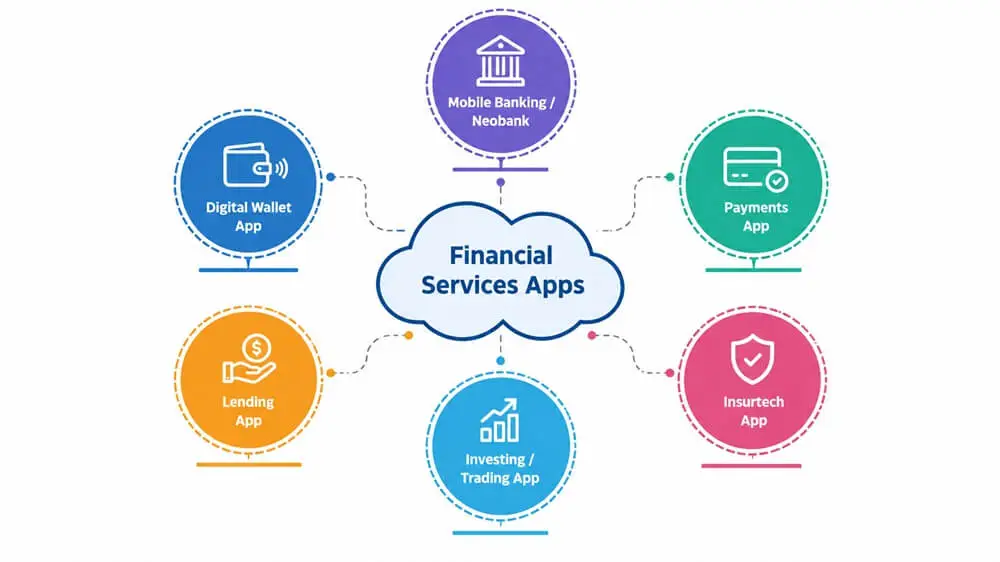
| App type | Key features | Specialist skills to prioritize |
|---|---|---|
| Mobile banking / neobank | Accounts, transfers, cards, statements | Core banking or BaaS API integration, card issuing, strong authentication |
| Digital wallet App | Stored balance, P2P transfers, QR payments | Tokenization, Apple Pay / Google Pay, ledger accuracy |
| Payments app | Checkout, merchant payouts, refunds | Gateway integration, idempotent payment APIs, webhook handling |
| Lending app | Applications, credit decisions, repayments | Credit bureau and bank data APIs, KYC flows, repayment scheduling |
| Investing / trading app | Portfolios, live prices, order placement | Real-time data streaming, brokerage APIs, low-latency UI |
| Insurtech app | Quotes, policies, claims | Document capture, claims workflows, third-party data integrations |
When you hire mobile banking app developers, for example, ask for shipped banking work specifically. Payments experience alone does not cover account opening, statements or card controls.
There are four main ways to bring fintech app developers onto a project. The right choice depends on your timeline, budget and how much control you need over code and data.
| Model | Cost | Speed to start | Control | Compliance risk | Best fit |
|---|---|---|---|---|---|
| In-house hiring | Highest (salary, benefits, recruiting) | Slow, often months | Full | Low, if you hire experienced people | Long-term core product teams |
| Freelancers | Low to medium | Fast | Limited | Higher: harder to enforce security and IP terms | Small, well-defined tasks |
| Dedicated team / staff augmentation | Medium | Fast, often days to weeks | High: developers work in your processes | Low, with NDAs, access controls and audits | Most fintech app builds and scale-ups |
| Full project outsourcing | Medium, often fixed price | Moderate | Shared with the vendor | Depends on the vendor’s certifications | Defined MVPs with a clear scope |
For a regulated product, freelancers are rarely the safe default. Access to production data, repositories and payment credentials needs contracts, background checks and controls that a single contractor often cannot provide. Dedicated fintech app developers from an established partner give you most of the control of an in-house team at lower cost and with faster ramp-up.
Start by listing the app type, target markets and core features. Then identify the regulations that apply, such as PCI DSS for card payments, GLBA for US financial data, GDPR for EU users, and KYC/AML for onboarding.
A fintech app needs more than mobile developers. A typical team includes iOS and Android (or Flutter) developers, a backend engineer, a QA engineer with security testing skills, and a DevOps engineer.
Decide between in-house hiring, freelancers, a dedicated team or full project outsourcing. Base the choice on your budget, timeline and how much control you need over code, data and IP.
Look for developers who have shipped live financial apps, not just concept designs. Ask which payment gateways, banking APIs or KYC tools they have integrated, and at what scale.
Generic coding tests miss the risks that matter. Ask how candidates prevent duplicate payments on retries, where they store auth tokens on mobile, how they keep card data out of PCI scope, and what they log for audits.
Ask candidates to walk you through a security issue they fixed. Clear explanations matter, because your product and compliance teams will depend on them to explain technical trade-offs.
Before committing long term, assign a two-to-four-week task such as a KYC onboarding flow. It shows code quality, speed and security habits on real work.
For in-house hiring in the US, a fintech software developer averages USD 147,524 a year, or about USD 70.92 an hour in salary alone, according to ZipRecruiter data from July 2026. Benefits, recruiting fees, equipment and retention costs come on top of that.
Outsourced and dedicated-team rates vary widely by region and seniority. The ranges below are indicative agency rates for mid-level to senior fintech app developers. Treat them as a starting point and confirm them with vendor quotes.
| Region | Indicative hourly rate (USD) |
|---|---|
| United States / Canada | 90 to 180 |
| Western Europe / UK | 70 to 140 |
| Eastern Europe | 40 to 80 |
| Latin America | 35 to 75 |
| India | 20 to 50 |
Xicom has delivered software for more than 20 years, with 1,800+ projects completed for 750+ clients across 50+ countries. As an AI-first engineering company certified to ISO/IEC 42001 for AI management, we also build AI features such as fraud detection, AI-powered KYC and in-app assistants. Our fintech app developers build banking, wallet, payments and lending apps as part of our fintech app development services.
You can hire dedicated mobile app developers on monthly or hourly terms, or engage Xicom for complete mobile app development services.
To hire fintech app developers who will protect your users and your business, look past general mobile skills. Prioritize shipped financial apps, payment and banking API experience, secure mobile engineering and a working knowledge of the regulations your product falls under. Run fintech-specific interviews, start with a paid pilot, and budget for QA, security and maintenance from day one.
If you want a team that can start quickly, talk to Xicom about dedicated fintech app developers for your project.
In the US, an in-house fintech software developer averages about USD 147,500 a year in salary. Offshore dedicated teams typically cost far less, with indicative rates from about USD 20 to 50 an hour in India. Final cost depends on seniority, compliance scope, integrations and platforms.
In-house hiring for experienced fintech engineers often takes several months, because the talent pool is small. Through a dedicated team or staff augmentation partner, developers can usually start within days to a few weeks. A short paid pilot adds two to four weeks but reduces hiring risk.
Freelancers suit small, well-defined tasks. For a regulated app that touches payments or personal financial data, a dedicated team is usually safer. It offers enforceable NDAs, access controls, security certifications and backup capacity, which a single contractor rarely provides.
They should understand how PCI DSS, SOC 2, GLBA, GDPR or CCPA, KYC/AML and, for EU users, PSD2 affect design choices. That includes tokenizing card data, encrypting data at rest and in transit, logging for audits and building identity checks into onboarding.
Fintech apps move money and handle sensitive financial and identity data. That requires idempotent transactions, accurate ledgers, strong authentication, regulatory compliance and stricter testing. A bug in a regular app is an inconvenience; in a fintech app it can mean financial loss or regulatory penalties.
Common choices are Swift and Kotlin for native apps, Flutter or React Native for cross-platform builds, and Node.js, Java, Kotlin or Go on the backend. Cloud skills on AWS, Azure or Google Cloud matter, along with payment, open banking and KYC SDK experience.
Options include job boards and LinkedIn for in-house roles, freelance marketplaces for short tasks, and software development companies that offer dedicated fintech teams. For regulated products, prioritize partners with proven fintech apps, security certifications and clear processes for access control and IP protection.
They should be able to build fraud and anomaly detection, AI-powered KYC with document reading and liveness checks, and LLM-based assistants using RAG and guardrails. Just as important, they should redact sensitive data, log model decisions for audits, test for bias and keep credit models explainable.

Based on this article's topic