
SGLang vs vLLM: How to Choose the Right Engine for Production LLM Serving
Compare SGLang vs vLLM on architecture, benchmarks, GPU cost and real workloads to pick the right LLM inference engine for your production AI stack.
Nov 6, 2026 Artificial Intelligence
Treasury management plays a central role in maintaining an organization’s financial stability. It involves managing cash positions, forecasting liquidity requirements, overseeing financial risks, coordinating payments, and ensuring that sufficient funds are available to support business operations. However, these responsibilities are becoming more complex as organizations expand across markets, manage multiple banking relationships, and respond to changing economic conditions. Traditional treasury processes often depend on spreadsheets, historical data, manual reconciliations, and periodic reporting. These methods can make it difficult for treasury teams to obtain a timely and consolidated view of their financial positions.
Artificial intelligence (AI) is changing how organizations approach these activities by enabling faster data analysis, more accurate forecasting, automated workflows, and improved risk monitoring. According to the 2026 AFP Treasury Benchmarking Survey, 30% of treasury practitioners identified AI and automation as one of their organization’s top five treasury priorities. At the same time, 38% cited managing AI opportunities and risks as a significant challenge. These findings indicate that treasury departments are increasingly considering AI as part of their operational and strategic priorities, while also recognizing the need for appropriate governance and oversight.
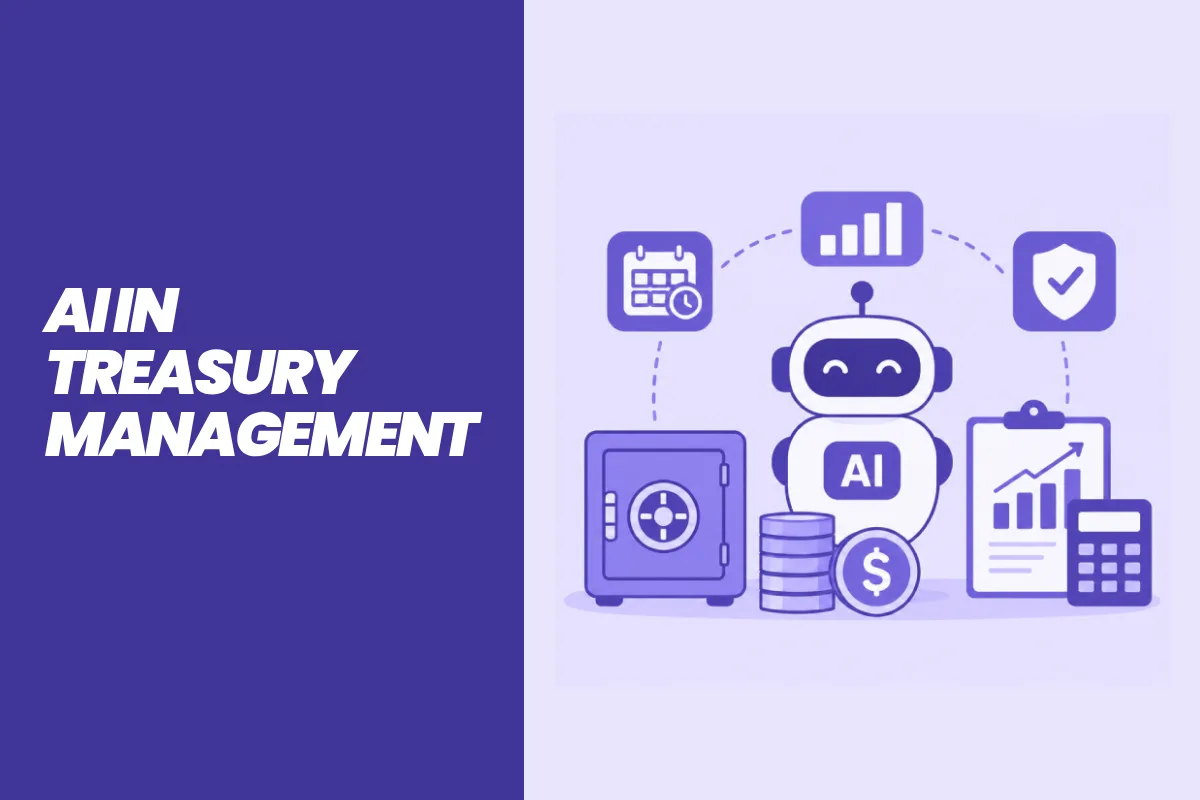
Traditional treasury operations rely on predefined rules, periodic reporting, and manual analysis. Although treasury management systems automate routine tasks, employees still need to interpret financial data, investigate discrepancies, and adjust forecasts.
AI enables treasury systems to analyze historical and real-time data, identify patterns, and generate predictions. Technologies such as machine learning, natural language processing, and generative AI support forecasting, document analysis, and workflow automation. This allows treasury teams to move beyond routine automation toward more predictive financial management.
The following table highlights the key differences between traditional and AI-enabled treasury operations:
| Area | Traditional treasury approach | AI-enabled approach |
|---|---|---|
| Cash forecasting | Forecasts based on historical averages and manual adjustments | Predictions based on historical and current financial data |
| Cash visibility | Periodic balance updates and manual consolidation | Automated analysis of account balances and transaction data |
| Risk monitoring | Rule-based alerts and scheduled reviews | Pattern recognition and continuous anomaly monitoring |
| Payments | Predefined workflows and manual exception handling | Intelligent payment classification and exception identification |
| Reporting | Manual preparation and consolidation | Automated summaries and data-driven insights |
| Decision support | Analysis performed by treasury professionals | AI-generated predictions and recommendations reviewed by professionals |
AI does not replace treasury expertise. It reduces repetitive analysis and provides professionals with additional insights to support liquidity management, risk assessment, and funding decisions.
AI can support several treasury activities, particularly those involving large transaction volumes, repetitive processes, and financial data analysis. Its applications extend across cash management, payments, risk assessment, reconciliation, and financial reporting.
Treasury teams need an accurate view of available cash across bank accounts, subsidiaries, and business units. When organizations operate across multiple regions, obtaining this information can involve collecting data from different banking portals and financial systems.
AI can process bank statements, transaction records, and account information to consolidate cash positions. It can identify unusual changes in balances, highlight accounts with excess funds, and flag accounts that may require additional liquidity. These insights help treasury professionals understand where cash is available and where it may be needed.
For example, an organization may have surplus cash in one subsidiary while another subsidiary is preparing for significant supplier payments. An AI-enabled system can identify this imbalance and recommend an appropriate intercompany transfer, subject to the organization’s cash pooling arrangements and approval procedures.
Payment operations involve validating payment instructions, checking transaction details, monitoring approval workflows, and coordinating payment execution. Manual processing can increase the time required to handle high transaction volumes and may introduce errors.
AI can classify payment transactions, identify incomplete information, detect unusual payment patterns, and prioritize transactions based on due dates and liquidity requirements. It can also help treasury teams determine suitable payment timing by considering cash availability, payment deadlines, and applicable transaction constraints.
AI-based monitoring can flag payments that differ from established patterns, such as unusual transaction amounts, unfamiliar beneficiary details, or unexpected payment frequencies. These alerts help employees investigate potentially suspicious transactions before they are processed.
Bank reconciliation involves comparing transactions recorded in an organization’s financial systems with entries reported by its banks. Differences may arise because of timing variations, bank charges, duplicate entries, incorrect references, or missing transaction records.
AI can analyze transaction descriptions, amounts, dates, reference numbers, and historical matching patterns to identify corresponding entries. Machine learning models can improve matching accuracy by learning from previously reconciled transactions. They can also categorize unmatched entries and identify recurring reasons for discrepancies.
This reduces the volume of transactions requiring manual investigation. Treasury employees can focus on unresolved exceptions rather than reviewing every transaction individually.
Treasury departments handle sensitive financial transactions and are exposed to risks such as payment fraud, account manipulation, unauthorized transfers, and business email compromise.
AI can monitor transaction activity and identify deviations from normal behavior. Models can evaluate factors such as transaction size, payment frequency, beneficiary history, transaction timing, and changes in account details. When a transaction differs significantly from established patterns, the system can generate an alert for further verification.
For example, an unusually large payment to a newly added beneficiary may require additional scrutiny. AI can identify the transaction as an exception and route it for approval under the organization’s payment control procedures.
AI-based detection does not guarantee that every fraudulent transaction will be identified. Its effectiveness depends on the quality of transaction data, the design of detection models, and the organization’s ability to investigate and respond to alerts.
Treasury professionals regularly prepare reports covering cash positions, liquidity requirements, debt obligations, investment performance, and financial risks. Collecting and organizing the information for these reports can consume considerable time.
AI can automate data consolidation, classify financial information, identify significant changes, and generate preliminary report summaries. Generative AI can also help users ask questions about treasury data in natural language and retrieve relevant information from connected systems.
For example, a treasury manager could ask why a subsidiary’s cash position changed significantly during a particular period. An AI-enabled assistant could examine transaction records, compare the current position with previous periods, and summarize the major contributing factors. The underlying figures and explanations should still be verified before being used in formal financial reporting.
Also Read: AI in Lending
Generative AI and AI agents are expanding the ways treasury professionals interact with financial information and execute routine activities. While predictive AI primarily analyzes data and generates forecasts, generative AI can interpret information, produce summaries, and respond to questions. AI agents can coordinate multiple tasks across connected applications based on defined instructions and permissions.
Treasury teams work with a large volume of financial documents, including bank statements, loan agreements, investment reports, payment policies, cash forecasts, and internal procedures. Finding relevant information across these documents can be time-consuming.
Generative AI can use retrieval-augmented generation (RAG) to retrieve information from approved internal documents and generate responses grounded in those sources. A treasury professional could ask questions about a borrowing agreement, payment approval policy, or banking arrangement without manually searching through multiple files.
Generative AI can also assist with:
These capabilities can improve access to treasury knowledge, but generated responses must be checked against original documents, particularly when they relate to contractual obligations, compliance requirements, or financial decisions.
AI agents can perform more structured, multi-step tasks by interacting with connected systems and tools. Instead of simply responding to a question, an agent may retrieve information, analyze it, prepare an output, and initiate an authorized workflow.
A treasury workflow agent could, for example:
Another agent could monitor bank reconciliation exceptions, collect supporting transaction information, and prepare cases for employees to review.
However, financial transactions require strict controls. AI agents should operate within clearly defined permissions, with human approval required for sensitive activities such as fund transfers, payment releases, investment decisions, and changes to banking instructions. Organizations should also maintain logs of agent actions and ensure that every consequential transaction can be traced to an authorized user or process.
Also Read: Conversational AI in Finance
AI-enabled treasury management depends on a combination of technologies that collect financial information, process transactions, identify patterns, and connect analytical outputs with business applications.
Machine learning enables systems to identify patterns in historical and current financial data. It is commonly used for cash flow forecasting, transaction classification, anomaly detection, and payment behavior analysis.
Supervised learning models can be trained using historical examples of known transaction categories or fraud cases. Unsupervised learning can help identify unusual transaction patterns when predefined labels are unavailable. Time-series forecasting techniques can estimate future cash movements based on historical trends and relevant variables.
Natural language processing (NLP) enables AI systems to interpret and extract information from human language. Treasury teams can use NLP to process bank transaction descriptions, supplier communications, financial reports, and contractual documents.
For example, NLP can help identify payment references, invoice details, maturity dates, and financial obligations within unstructured documents.
Large language models (LLMs) support conversational interfaces, document summarization, information retrieval, and report generation. When connected to approved treasury data through RAG, they can provide responses based on internal financial documents and policies.
These systems are particularly useful for reducing the effort involved in searching for information and preparing routine explanations. However, they should not be treated as authoritative sources for financial figures or contractual interpretations without verification.
Robotic process automation (RPA) executes repetitive, rule-based tasks such as downloading bank statements, transferring information between applications, and initiating predefined workflows. When combined with AI, RPA can handle structured execution while AI supports classification, prediction, and exception identification.
APIs allow treasury platforms to exchange information with banking systems, enterprise resource planning (ERP) applications, payment platforms, and other financial tools. They provide the connectivity required to retrieve transaction data and deliver approved outputs across systems.
Together, these technologies create the foundation for treasury processes that are more connected, analytical, and responsive.
Also Read: Explainable AI in Finance
AI cannot deliver reliable treasury insights if it operates on incomplete or disconnected financial information. Its integration with existing enterprise systems is therefore an important part of implementation.
Most organizations already use a combination of treasury management systems (TMS), ERP platforms, banking portals, payment applications, and accounting software. These systems contain information about bank balances, invoices, payment schedules, debt obligations, and financial transactions. AI solutions need controlled access to relevant information from these sources.
Integration typically involves APIs, secure file transfers, database connections, and banking connectivity services. These mechanisms allow AI models to retrieve information from different systems without requiring employees to manually consolidate every dataset.
For example, an AI forecasting solution may combine bank transaction data from a TMS, invoice information from an ERP system, and customer payment history from an accounts receivable application. This creates a broader dataset for predicting future cash movements.
Financial information may use different formats, transaction identifiers, currencies, and reporting periods across systems. Before AI models can analyze this information, organizations need to standardize relevant data fields and resolve inconsistencies.
Data validation processes should identify missing values, duplicate transactions, incorrect currency codes, and outdated records. Organizations should also establish clear ownership of financial data so that errors can be investigated and corrected at their source.
Treasury systems contain sensitive information about bank accounts, payments, financing arrangements, and financial positions. AI integration must follow the organization’s security policies and access requirements.
Role-based access controls can restrict users and AI applications to the information required for their responsibilities. Encryption, secure authentication, audit logs, and controlled API permissions help protect financial information during processing and exchange.
Integration should also preserve existing approval structures. An AI application may recommend a payment or funding action, but the final execution should remain subject to the organization’s authorization framework.
Also Read: AI in Banking
AI can improve treasury operations by reducing manual effort, providing better visibility into financial positions, and helping professionals identify potential risks earlier. Its impact extends beyond operational efficiency because more reliable financial information can also support broader business planning.
AI can consolidate information from multiple financial systems and provide a more current view of cash positions. Treasury professionals can identify available funds, upcoming obligations, and potential liquidity gaps without relying entirely on manual reporting.
Machine learning models can evaluate historical transaction patterns alongside current financial and operational data. This can improve the identification of expected inflows and outflows, helping organizations make better-informed liquidity decisions.
AI can automate activities such as transaction classification, reconciliation matching, report preparation, and exception identification. Employees can spend less time processing routine information and more time investigating discrepancies and evaluating financial decisions.
AI-based monitoring can detect unusual transaction behavior, changes in payment patterns, and potential liquidity issues. Earlier identification gives treasury teams more time to investigate exceptions and take appropriate action.
By analyzing cash balances, expected payments, and funding requirements, AI can help organizations identify surplus funds and potential shortages. This supports more informed decisions about intercompany transfers, short-term investments, and borrowing requirements.
AI-generated forecasts, summaries, and scenario analyses can make relevant information available more quickly. Treasury professionals can use these insights to assess different financial situations and provide timely recommendations to business leadership.
Although AI offers several advantages, its implementation requires careful consideration of data, technology, security, and operational controls. Treasury functions handle sensitive financial activities, so inaccurate predictions or unauthorized actions can have direct business consequences.
AI models depend on reliable data. Incomplete bank records, inconsistent transaction descriptions, duplicate entries, and fragmented financial information can reduce model accuracy. Organizations may need to improve data standardization and integration before deploying AI across treasury activities.
Some organizations operate with older treasury platforms and banking systems that do not support modern integration methods. Connecting these applications with AI solutions can require additional development, data transformation, and infrastructure changes.
A forecasting model may generate inaccurate predictions when business conditions change or historical patterns no longer apply. Similarly, an anomaly detection system may produce false alerts when legitimate transactions differ from normal behavior.
Treasury professionals need to understand the factors influencing model outputs. Organizations should monitor model performance, validate predictions against actual results, and establish procedures for investigating unusual recommendations.
AI systems may process confidential information about account balances, payment instructions, customers, suppliers, and financing arrangements. Unauthorized access or exposure of this information can create financial and regulatory risks.
Organizations must implement appropriate access controls, encryption, vendor assessments, data retention policies, and security monitoring. They should also evaluate how third-party AI providers store and process financial information.
Treasury activities are subject to internal financial controls, banking requirements, and applicable regulatory obligations. AI-generated recommendations and automated workflows must operate within these requirements.
Organizations need clear policies defining which activities AI can perform independently, which require employee approval, and how decisions and actions are recorded. AI Governance should also address model ownership, accountability, validation, and ongoing monitoring.
Treasury professionals may have extensive financial expertise but limited experience with machine learning, data analytics, or AI governance. Successful implementation requires training employees to interpret AI outputs, recognize model limitations, and use new tools within established financial processes.
Introducing AI into treasury operations requires more than selecting a technology platform. Organizations need to identify suitable use cases, prepare their data, establish governance, and evaluate whether the solution improves the performance of existing processes.
Organizations should begin by reviewing their current treasury workflows and identifying activities that involve significant manual effort, recurring delays, or complex data analysis.
Cash flow forecasting, bank reconciliation, payment monitoring, and cash position reporting are potential starting points because they involve structured financial data and recurring processes. The selected use case should address a clearly defined operational problem rather than introducing AI simply to modernize an existing system.
Before developing or deploying an AI solution, organizations should evaluate the availability, quality, and accessibility of relevant financial data. They should identify the systems that contain the required information and determine how these systems can be connected securely.
This assessment should also consider existing TMS and ERP capabilities, banking connectivity, data storage arrangements, and infrastructure requirements.
Different treasury activities require different AI capabilities. Machine learning may be suitable for cash flow forecasting, while NLP can support document processing and transaction description analysis. Generative AI may be appropriate for treasury knowledge assistants and report summaries, whereas AI agents can coordinate selected workflows across connected applications.
The technology should be selected according to the task, data requirements, risk level, and expected business outcome.
A pilot allows organizations to evaluate AI performance within a limited operational scope before expanding its use. For example, a company could introduce AI-based reconciliation for a selected group of bank accounts or test machine learning models for forecasting cash flows within one business unit.
The pilot should have measurable performance indicators, such as forecast accuracy, reconciliation matching rates, exception resolution time, and reduction in manual processing.
Organizations should define the permissions and responsibilities associated with every AI-enabled treasury process. Low-risk activities, such as report summarization, may require limited intervention, while high-impact actions such as payment execution and fund transfers should remain subject to established approval controls.
They should also document model assumptions, monitor performance, maintain audit trails, and establish procedures for handling incorrect outputs or system failures.
AI models and workflows need continuous evaluation. Organizations should compare predictions with actual financial outcomes, review false alerts, investigate model errors, and update models when transaction patterns or business conditions change.
Once a pilot demonstrates consistent results, the organization can expand the solution to additional accounts, subsidiaries, or treasury activities. This gradual approach helps ensure that AI adoption remains aligned with operational requirements and financial control policies.
AI is expanding the capabilities of treasury management by improving cash flow forecasting, automating financial workflows, strengthening transaction monitoring, and making financial information easier to analyze. Machine learning, generative AI, NLP, and AI agents can help treasury teams manage increasingly complex financial operations while reducing the effort involved in repetitive activities. However, their effectiveness depends on reliable data, secure integration, model validation, and appropriate governance. Organizations that introduce AI through clearly defined use cases and controlled implementation processes can improve treasury visibility, make more informed liquidity decisions, and strengthen the role of treasury as a strategic contributor to business finance.
Make treasury operations more intelligent and data-driven with Xicom’s AI dev services. We develop intelligent solutions for cash flow forecasting, liquidity optimization, financial process automation, and risk monitoring, enabling more informed and efficient treasury operations.
AI in treasury management is the use of machine learning, natural language processing, generative AI, and AI agents to analyze cash, payment, and banking data. It helps treasury teams forecast liquidity, consolidate cash positions, reconcile bank transactions, detect unusual payments, and prepare reports with less manual effort. Final financial decisions remain with treasury professionals.
AI improves cash flow forecasting by analyzing historical inflows and outflows alongside current data from TMS, ERP, and accounts receivable systems. Forecasts no longer have to rely on historical averages and manual adjustments. Machine learning models can identify payment patterns and seasonal trends, though they need regular validation as business conditions change.
Yes. AI can flag payments that differ from normal behavior based on transaction size, payment frequency, beneficiary history, timing, and changes to account details. For example, an unusually large payment to a newly added beneficiary can be routed for additional approval. AI does not catch every fraudulent transaction. Its accuracy depends on data quality, model design, and how quickly teams investigate alerts.
Generative AI interprets information and produces outputs: it answers questions about treasury policies, summarizes cash reports, and extracts terms from loan agreements. AI agents carry out multi-step tasks across connected systems: they retrieve balances, identify liquidity gaps, and prepare funding recommendations. In both cases, sensitive actions such as fund transfers and payment releases should require human approval.
Yes. AI solutions connect with TMS, ERP, banking portals, and payment platforms through APIs, secure file transfers, database connections, and banking connectivity services. Reliable integration also requires standardized data formats, validation for duplicates and missing values, role-based access controls, encryption, and audit logs. Existing approval workflows should stay unchanged.
No. AI reduces repetitive work such as data consolidation, transaction matching, and report preparation. Treasury professionals still interpret outputs, investigate exceptions, approve transactions, and make liquidity, funding, and investment decisions. Their role shifts toward analysis and strategic advisory work.

Compare SGLang vs vLLM on architecture, benchmarks, GPU cost and real workloads to pick the right LLM inference engine for your production AI stack.
Learn how AI in lending improves credit decisions, loan processing, fraud detection and risk management, plus key challenges like bias, compliance and ROI.

Learn how conversational AI in sales supports lead qualification, product discovery, and follow-ups, and how to measure its business impact and ROI.