How Much Does It Cost to Develop a Marketplace App Like Amazon?
Marketplace app development cost ranges from $40,000 to $300,000+. See costs by tier and feature, AI add-ons, payment fees, and how to build an app like Amazon.
Nov 6, 2026 App Development
Quick Answer
Hotel booking app development cost runs about $21,000 to $44,000 for a single-property direct booking app, $48,000 to $104,000 for a hotel chain app with loyalty and PMS integration, and $96,000 to $200,000+ for an OTA or marketplace with an offshore team. A US-based agency charges roughly 3 to 4 times more for the same hours. Store fees, payment fees, PMS or channel manager subscriptions and yearly maintenance are separate.
How much does it cost to build a hotel booking app? Online answers range from $20,000 to $500,000, often on the same page. The real number depends on how many properties the app serves, which property management system (PMS) it connects to, whether it handles payments, loyalty or mobile keys, and who builds it.
This guide is for US hotel owners, hotel groups and travel startups who want a budget they can defend. Every figure comes from one model: estimated hours × hourly rate + fixed costs. You will see cost by tier, phase and app type, three hotel apps priced end to end, running costs, and the direct booking maths against OTA commissions. All prices are in US dollars and exclude sales tax, and our methodology explains how they were built.
The cost to develop a hotel booking app depends on how many properties it covers, how deeply it connects to your PMS and distribution systems, and how many user roles it supports. The table groups typical projects into three tiers and shows hotel booking mobile app development cost at both rate bands.
| App Complexity | What It Usually Includes | Hours | Offshore Team ($30 to $40/hr) | US Agency ($100 to $150/hr) | Timeline |
|---|---|---|---|---|---|
| Simple | Single-property direct booking MVP: room listings, live availability from one PMS or booking engine, booking and card payment, confirmation emails, basic admin | 700 to 1,100 | $21,000 to $44,000 | $70,000 to $165,000 | 3 to 4 months |
| Medium | Multi-property or chain app: property search, loyalty and member rates, PMS integration, digital check-in, push notifications, staff and manager roles | 1,600 to 2,600 | $48,000 to $104,000 | $160,000 to $390,000 | 5 to 7 months |
| Complex | OTA or marketplace: many suppliers, channel manager and GDS connectivity, dynamic pricing, partner payouts, reviews, AI search or concierge | 3,200 to 5,000 | $96,000 to $200,000+ | $320,000 to $750,000+ | 8 to 12+ months |
You can sanity-check any quote with one formula: estimated hours × blended hourly rate + fixed costs. A 2,000-hour chain app costs $60,000 to $80,000 with an offshore team and $200,000 to $300,000 with a US agency. Same hours, different rate. Fixed costs such as store fees, PMS API access and payment processing don’t change when you negotiate the rate.
Here is a typical hotel booking app cost breakdown for a 2,000-hour medium app. Unlike most estimates you will find, the shares add up to 100% and the rows add up to the total.
| Phase | What It Covers | Share | Hours | Offshore Team | US Agency |
|---|---|---|---|---|---|
| Discovery and scoping | User flows, booking rules, PMS and payment plan, hour estimate | 6% | 120 | $3,600 to $4,800 | $12,000 to $18,000 |
| UI/UX design | Search and booking journey, room pages, check-in flow, design system | 11% | 220 | $6,600 to $8,800 | $22,000 to $33,000 |
| App and backend development | iOS and Android app, APIs, database, admin and front-desk panels | 46% | 920 | $27,600 to $36,800 | $92,000 to $138,000 |
| Integrations | PMS, payment provider, channel manager or booking engine, email and SMS | 14% | 280 | $8,400 to $11,200 | $28,000 to $42,000 |
| QA and security testing | Device testing, booking and refund flows, PMS sync, security checks | 16% | 320 | $9,600 to $12,800 | $32,000 to $48,000 |
| Deployment and project management | Store submission, release setup, sprint planning and reporting | 7% | 140 | $4,200 to $5,600 | $14,000 to $21,000 |
| Total | 100% | 2,000 | $60,000 to $80,000 | $200,000 to $300,000 |
QA takes a larger share than in many apps because a booking that shows a room as free when the PMS says it is sold creates a double booking at the front desk. Testing the sync is not optional.
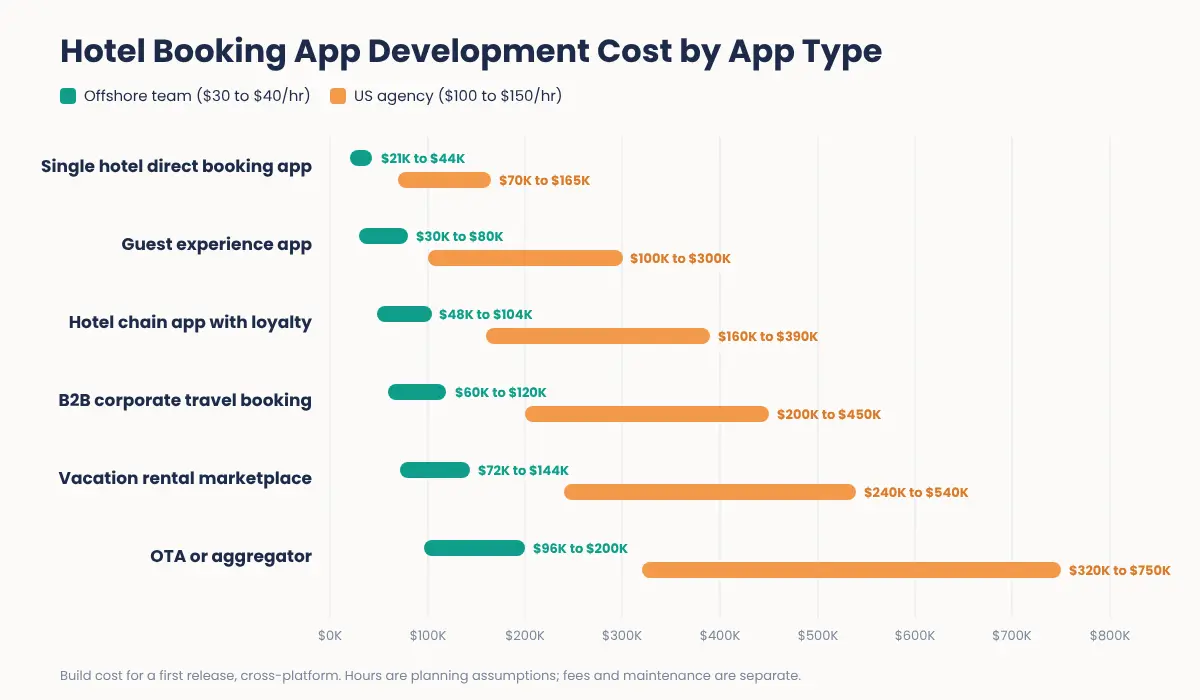
“Hotel app” covers very different products. The type you choose drives hotel booking app development cost more than any single feature, because it decides how many systems the app talks to and how many people use it.
| App Type | Features That Drive Cost | Hours | Offshore Team | US Agency |
|---|---|---|---|---|
| Single hotel direct booking app | Room listings, availability, booking, card payment, confirmations | 700 to 1,100 | $21,000 to $44,000 | $70,000 to $165,000 |
| Guest experience app | Digital check-in, mobile key, room service ordering, guest chat, optional AI concierge | 1,000 to 2,000 | $30,000 to $80,000 | $100,000 to $300,000 |
| Hotel chain app with loyalty | Multi-property search, points and member rates, PMS integration, digital check-in | 1,600 to 2,600 | $48,000 to $104,000 | $160,000 to $390,000 |
| B2B corporate travel booking | Company accounts, negotiated rates, approval flows, invoicing, travel policy rules | 2,000 to 3,000 | $60,000 to $120,000 | $200,000 to $450,000 |
| Vacation rental or boutique marketplace | Host onboarding, listings, calendars, split payments and payouts, reviews | 2,400 to 3,600 | $72,000 to $144,000 | $240,000 to $540,000 |
| OTA or aggregator | Many suppliers, channel manager and GDS connectivity, dynamic pricing, partner payouts | 3,200 to 5,000 | $96,000 to $200,000 | $320,000 to $750,000 |
Most independent hotels start with a single-property app or a guest experience app. Hotel groups usually need the chain app, and only well-funded startups should plan for a full OTA. If you need iPhone or Android only, our iOS app development cost and Android app development cost guides break down single-platform builds.
Tiers are useful, but worked examples show what really sits behind the costs of developing a hotel reservation app. “Build plus first 12 months” includes $124 in store setup: Apple’s $99 annual fee and Google Play’s $25 one-time fee. Usage fees, such as card processing, come on top.
How the AI cost is calculated? At 70% occupancy, the resort has 210 occupied rooms a night. If each asks the concierge two questions a day, that is 12,600 requests a month. Each request uses about 3,000 input tokens and 300 output tokens: 37.8 million input and 3.78 million output tokens a month. At Anthropic’s list prices (checked October 2026), Claude Haiku 5.5 ($0.10 input, $0.50 output per million tokens) costs about $6 a month and Claude Sonnet 5.5 ($2 input, $10 output) about $113 a month.
Also Read: How much does an AI development cost
A hotel app usually serves four roles: guests, front desk staff, managers and admins. Each role adds screens, permissions and test cases. Start with the guest booking journey and a lean front-desk view, then add manager reporting once the core works.
Your PMS holds the real inventory, rates and guest records, so the app must read from and write to it. Access differs by vendor. Oracle’s OPERA Cloud offers self-service REST and GraphQL APIs with a sandbox, billed per API call. Cloudbeds publishes a PMS API that outside developers can use after requesting sandbox access. Mews offers its Connector API to Mews partners. Each route has its own approval steps, so confirm access before you lock the timeline.
Rooms sell on your website, OTAs and the front desk at the same time. If your app shows stale availability, you get double bookings. Live sync, retry logic and conflict handling add backend and QA hours, but they are the features that make guests and staff trust the app.
Hotels charge deposits, pre-authorize cards, apply cancellation windows and refund partial stays. Each rule is a flow to build and test. Using your payment provider’s tokenized or hosted payment fields keeps raw card data off your servers, which reduces your PCI DSS scope and the security work that comes with it.
A clean booking flow built from standard components costs far less than custom animation. Guest experience features cost more but can lift satisfaction. ASSA ABLOY’s Vingcard mobile access can integrate with a hotel’s own app and supports Apple Wallet and Google Wallet keys, and dormakaba also offers room keys in Apple Wallet. Mobile key needs compatible door locks, so check your hardware first.
Hotel apps handle identity, payment and stay data. In the US that means PCI DSS for card handling and state privacy laws such as CCPA; guests from the EU bring GDPR obligations; and booking screens should meet accessibility expectations under the ADA. Each adds design, development and testing hours.
Rates are the biggest multiplier in hotel mobile app development cost. Here is what sits behind the two rate bands used in this guide.
| Team | Typical Hourly Rate (USD) | Basis |
|---|---|---|
| Offshore team | $30 to $40 blended | Xicom’s published dedicated app developer rates: $25 junior, $35 mid-level, $45 senior |
| US in-house developer (loaded cost) | About $93 | BLS median wage of $135,980 (May 2025), about $65.38 an hour, plus benefits at about 30% of compensation |
| US-based agency | $100 to $150 | Set just above the loaded in-house cost to cover management, QA and margin |
| Industry data from reviewed projects | $25 to $49 | Self-reported by clients and blended across locations |
Many US hotel groups keep product ownership in-house and use an offshore team for engineering, QA and maintenance. Fixed-price contracts suit a well-defined first release; a dedicated team suits a product that will keep evolving.
A single-property app usually takes 3 to 4 months, a chain app 5 to 7 months and an OTA 8 to 12 months or more. Phases overlap, and PMS access approval can add weeks if it is not started early.
| Phase | Key Activities | Simple App | Medium App |
|---|---|---|---|
| Discovery | Booking rules, PMS access request, architecture, hour estimate | 1 to 2 weeks | 2 to 3 weeks |
| UI/UX design | Wireframes, prototype, visual design | 2 to 4 weeks | 4 to 6 weeks |
| Development | App, backend, admin and front-desk panels | 6 to 10 weeks | 12 to 18 weeks |
| Integrations | PMS, payments, channel manager, sync testing | 2 to 3 weeks | 3 to 5 weeks |
| QA and launch | Testing, beta, App Store and Google Play release | 1 to 2 weeks | 2 to 4 weeks |
| Total | Phases overlap | 3 to 4 months | 5 to 7 months |
Publishing costs $99 a year for Apple’s Developer Program and $25 once for Google Play. Neither store takes a commission on room bookings: Apple’s App Review Guideline 3.1.3(e) requires payment methods other than in-app purchase for physical goods and services, and Google Play billing does not apply to them either.
Stripe charges 2.9% + 30¢ per successful US card payment. Marketplaces that pay out to hosts or partners add payout fees; with Stripe Connect, a platform that sets its own pricing pays $2 per monthly active account and 0.25% + 25¢ per payout.
Your PMS, booking engine and channel manager are usually monthly subscriptions, and some vendors charge for API access or partner certification. Oracle bills OPERA Cloud integrations per API call. Ask each vendor for its API terms during discovery, because these are recurring costs your developer cannot negotiate away.
| Cost | US Price | Can You Control It? |
|---|---|---|
| Cloud hosting | From $40 a month | Partly, through architecture |
| SMS (Twilio) | $0.0083 per segment + $0.0025 to $0.005 carrier fee | Partly |
| Maps (Google) | 10,000 free events a month per SKU, then $5 to $7 per 1,000 | Partly |
| AI model tokens | About $6 to $113 a month in Scenario C | Yes, through model choice |
| Mobile key | Quoted by your lock vendor | No |
Plan maintenance in hours: 15 to 60 hours a month depending on the app, plus 40 to 80 hours a year for platform deadlines. Google Play requires new apps and updates to target Android 16 (API level 36), and Apple requires uploads to use the iOS 27 SDK from April 2027. Every year brings a new deadline.
Here is Scenario A, the boutique hotel app, built offshore. Two lines are assumptions: 40 to 80 hours a year of SDK deadline work, and 40 to 80 hours once for a security review before scaling.
| Line Item | Year 0 (Build) | Year 1 | Year 2 |
|---|---|---|---|
| Build | $24,000 to $40,000 | None | None |
| Store accounts | $124 | $99 | $99 |
| Cloud and maintenance | None | $5,880 to $12,480 | $5,880 to $12,480 |
| SDK deadline work | None | $1,200 to $3,200 | $1,200 to $3,200 |
| Security review | None | $1,200 to $3,200 | None |
| Total | $24,124 to $40,124 | $8,379 to $18,979 | $7,179 to $15,779 |
Three-year total: $39,682 to $74,882. The build is only 53% to 60% of it. Card fees and PMS subscriptions come on top.
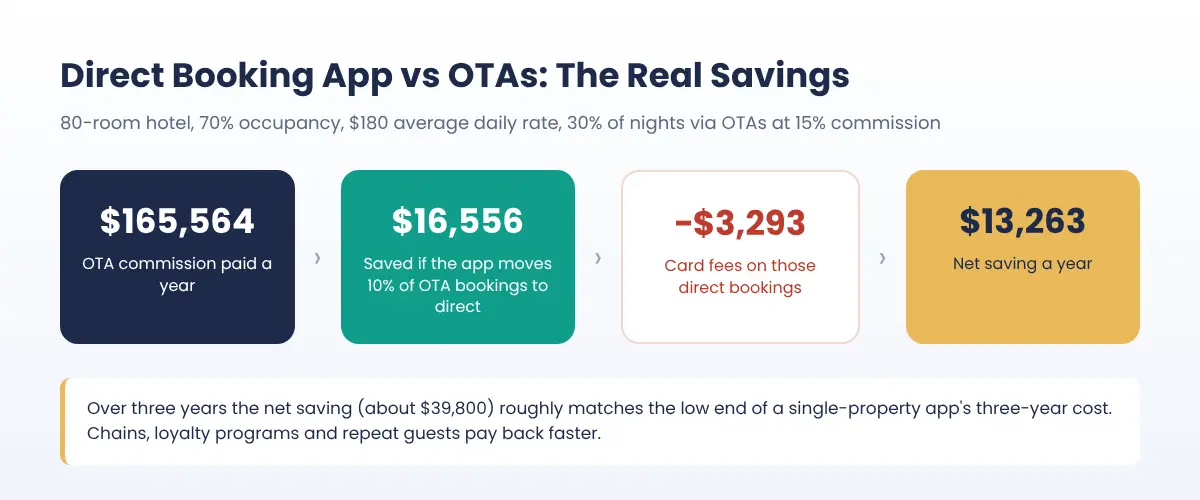
The main business case for a hotel app is cutting OTA commission. Booking.com typically charges hotels 10% to 25% per booking, depending on location and agreement. Here is the maths for the 80-room hotel in Scenario A, using 15% commission and illustrative figures you should replace with your own.
| Line | Calculation | Result |
|---|---|---|
| Room nights sold a year | 80 rooms × 70% occupancy × 365 | 20,440 |
| Room nights booked through OTAs | 30% of room nights | 6,132 |
| OTA booking value | 6,132 × $180 average daily rate | $1,103,760 |
| OTA commission paid | 15% of booking value | $165,564 |
| Commission saved if the app moves 10% of OTA bookings to direct | 15% of $110,376 | $16,556 |
| Card fees on those direct bookings | 2.9% of $110,376 + 30¢ on 307 bookings | $3,293 |
| Net yearly saving | $13,263 |
Over three years, that saving (about $39,800) roughly matches the low end of Scenario A’s three-year cost ($39,682) and falls well short of the high end ($74,882). In other words, a small single property rarely pays back an app on commission alone, and a strong booking engine on your website may be the better first step. An app pays back faster when you have repeat guests, several properties sharing one app, a loyalty program, or upsells such as room upgrades and dining that add revenue per stay.
We built every hotel reservation app development cost in this guide from scope up, not from agency price tiers. Each app was broken into roles, screens, integrations and testing, estimated in hours, then priced at two rate bands based on US wage data from the Bureau of Labor Statistics, industry data from reviewed projects and Xicom’s published developer rates. Fees and integration terms come from each vendor’s own pages (Apple, Google, AWS, Stripe, Twilio, Oracle, Cloudbeds, Mews, ASSA ABLOY and Anthropic), checked in October and November 2026. Hours are planning assumptions, not quotes, and exclude tax, marketing, legal costs and lock hardware.
We price scope before hours, and every estimate separates labor from fixed lines such as store fees, PMS access and cloud, so the number you approve is the number you spend. Xicom’s mobile app development services cover discovery, UI/UX design, iOS, Android and cross-platform development, PMS and payment integrations, store launch and ongoing maintenance.
Hotel booking app development cost comes down to hours × rate plus fixed costs. With an offshore team, plan for $21,000 to $44,000 for a single-property app, $48,000 to $104,000 for a chain app with loyalty and PMS integration, and $96,000 to $200,000+ for an OTA; a US agency costs roughly 3 to 4 times more. Budget for PMS access, payment fees and maintenance from day one, and judge the investment on repeat bookings and lower OTA commission, not on the build price alone.
Hotel booking app development cost is about $21,000 to $44,000 for a single-property app, $48,000 to $104,000 for a chain app with loyalty and PMS integration, and $96,000 to $200,000 or more for an OTA, with an offshore team at $30 to $40 per hour. A US agency at $100 to $150 per hour costs roughly 3 to 4 times more.
A single-property app usually takes 3 to 4 months, a chain app with loyalty 5 to 7 months and an OTA or marketplace 8 to 12 months or more. Requesting PMS API access during discovery avoids the most common delay.
A first version of an OTA needs many suppliers, channel manager and GDS connectivity, dynamic pricing and partner payouts. We estimate 3,200 to 5,000 hours: $96,000 to $200,000 offshore or $320,000 to $750,000 with a US agency. Reaching Booking.com scale takes years of further investment.
A guest experience app with digital check-in, mobile key, room service and chat needs about 1,000 to 2,000 hours, or $30,000 to $80,000 offshore. Mobile key also needs compatible door locks and a license from your lock vendor, which are quoted separately.
In our 2,000-hour chain app, integrations take about 14% of hours: roughly 280 hours, or $8,400 to $11,200 offshore and $28,000 to $42,000 with a US agency. Vendor fees are extra; for example, Oracle bills OPERA Cloud integrations per API call.
For the boutique hotel app in this guide, cloud and 15 to 25 maintenance hours a month cost $5,880 to $12,480 a year offshore. Add 40 to 80 hours a year for Apple and Google SDK deadlines, plus PMS and payment fees.
No. Room bookings are physical services, so Apple requires a payment method other than in-app purchase and Google Play billing does not apply. You only pay the store account fees: $99 a year for Apple and $25 once for Google Play.
Usually, for the same hours. This guide uses $30 to $40 per hour offshore against $100 to $150 for a US agency, so a $60,000 to $80,000 offshore chain app costs $200,000 to $300,000 onshore. Check PMS experience, time-zone overlap and IP ownership before comparing prices.
Yes, but slowly for small hotels. In our 80-room example, moving 10% of OTA bookings to the app saves about $13,263 a year after card fees, at 15% commission. Chains, loyalty programs and repeat guests make the payback much faster.
A complete quote covers discovery, design, app and backend development, PMS and payment integrations, QA, deployment and project management, priced as hours multiplied by a rate. Store fees, PMS subscriptions, cloud, card fees and first-year maintenance should be listed separately so you can compare quotes fairly.

Marketplace app development cost ranges from $40,000 to $300,000+. See costs by tier and feature, AI add-ons, payment fees, and how to build an app like Amazon.
Explore top mobile app development trends for 2027, from on-device AI and in-app agents to passkeys, foldables and cross-platform builds, with current data.
Explore 100+ mobile app development ideas across 32 industries, from healthcare and fintech to AI and logistics, with key features and revenue models.