AI-Powered Dynamic Pricing: Models, Applications, and Implementation
Learn how AI-powered dynamic pricing uses demand forecasting, elasticity models and optimization to set smarter prices across retail, travel and more.
Nov 27, 2026 Artificial Intelligence
Business processes often involve multiple departments, software platforms, approval stages, and manual tasks. As organizations grow, these workflows can become fragmented, creating delays, duplicated work, inconsistent decisions, and higher operating costs. Traditional automation addresses repetitive tasks but often struggles with processes that require interpreting documents, analyzing unstructured information, or responding to changing conditions.
AI is expanding the scope of business process optimization by enabling organizations to analyze operational data, predict process outcomes, automate information-intensive tasks, and support decisions. A 2025 Capgemini Research Institute study of 1,607 organizations reported an average return of 1.7 times on AI investments in business operations. Realizing comparable value, however, requires more than deploying AI tools. Businesses must identify the right processes, redesign workflows, integrate systems, and establish measurable performance targets.
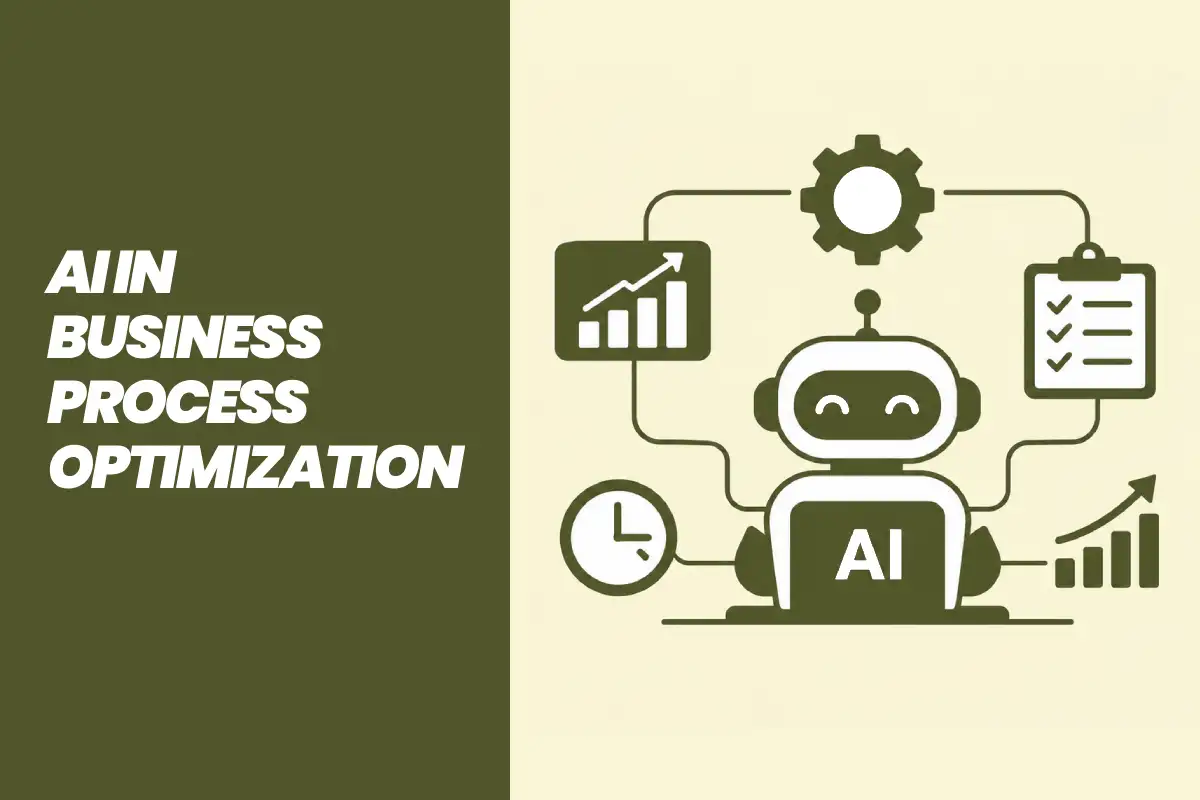
Traditional process optimization focuses on reducing unnecessary steps, standardizing activities, and automating rule-based tasks. AI extends this approach by enabling systems to interpret information, recognize patterns, make predictions, and handle decisions that previously required manual analysis.
For example, conventional workflow automation can route an invoice for approval based on predefined rules. An AI-enabled process can also extract invoice details, match them against purchase orders, identify discrepancies, classify exceptions, and recommend the next action. Employees can then focus on cases requiring judgment rather than reviewing every transaction manually.
AI can contribute to process optimization in four ways:
The greatest value often comes when these capabilities work together within redesigned business workflows.
Organizations should begin by understanding how processes actually operate rather than relying solely on documented procedures. Process mining uses event logs from enterprise resource planning (ERP), customer relationship management (CRM), finance, and other business systems to reconstruct process flows.
AI can analyze these records to identify:
For example, an organization may discover that purchase requisitions are processed quickly, but supplier onboarding and compliance checks account for most of the procurement cycle. This helps direct optimization efforts toward the actual source of delay.
Process discovery should establish baseline metrics such as cycle time, processing cost, error rate, rework frequency, and exception volume. These measurements provide a reference for evaluating improvements after AI implementation.
Predictive analytics uses historical process data and machine learning models to estimate what is likely to happen next. Rather than identifying inefficiencies after they occur, organizations can anticipate potential disruptions and intervene earlier.
Models can evaluate factors such as transaction volumes, workload distribution, historical completion times, employee availability, supplier performance, and seasonal demand. The resulting predictions can help managers identify cases likely to miss service-level agreements, anticipate backlogs, and allocate resources more effectively.
For example, a service organization can predict which customer requests are likely to exceed resolution targets based on request type, complexity, workload, and previous handling patterns. These cases can be prioritized before delays affect customer experience.
Many business workflows depend on information contained in invoices, contracts, forms, emails, reports, and other documents. Extracting and validating this information manually can increase processing time and introduce errors.
AI combines optical character recognition (OCR), natural language processing (NLP), machine learning, and large language models (LLMs) to process documents and convert unstructured information into usable business data.
A typical workflow can:
This method is useful for document-intensive processes such as invoice processing, contract review, claims administration, employee onboarding, and compliance documentation. Human review remains important when documents contain ambiguous information or decisions carry financial or legal consequences.
Workflow automation connects individual activities into coordinated business processes. AI makes these workflows more adaptable by allowing systems to interpret inputs, select actions, and respond to exceptions rather than following only fixed rules.
For example, an AI-enabled customer service workflow can classify an incoming request, retrieve relevant customer information, identify the appropriate response, and route complex cases to a specialist. Robotic process automation (RPA) can handle repetitive interactions with existing applications, while AI manages tasks involving language interpretation and decision support.
AI agents can extend this model by executing multiple connected steps across enterprise systems. However, organizations should define clear permissions, approval requirements, and escalation conditions before allowing agents to take actions such as updating records, approving transactions, or communicating commitments to customers.
Business processes change as transaction volumes, customer requirements, regulations, and operating conditions evolve. A workflow optimized at deployment may become inefficient as these conditions change.
AI systems can continuously analyze operational performance and identify deviations from expected outcomes. Organizations can use these insights to update prediction models, adjust routing rules, revise resource allocation, and improve workflow configurations.
Continuous optimization should include model performance reviews, feedback from process owners, exception analysis, and periodic validation against business KPIs. This prevents automation from becoming a fixed process that continues operating even when business requirements have changed.
AI can improve processes across departments, but the emphasis should be on the operational problem rather than the number of applications deployed.
| Business function | Process optimization opportunity | Potential business impact |
|---|---|---|
| Finance and accounting | Invoice extraction, reconciliation, anomaly detection, and exception routing | Shorter processing cycles and fewer manual errors |
| Procurement | Supplier information analysis, purchase request classification, and risk-based approvals | Faster purchasing and better supplier oversight |
| Human resources | Resume screening support, employee document processing, and onboarding workflows | Reduced administrative workload and faster processing |
| Customer operations | Request classification, case prioritization, response assistance, and escalation | Improved response times and service consistency |
| Supply chain | Demand forecasting, inventory analysis, and disruption prediction | Better inventory planning and fewer operational disruptions |
| IT operations | Incident classification, log analysis, and resolution recommendations | Faster incident handling and reduced support workload |
The extent of automation should depend on process complexity, decision risk, data quality, and the consequences of an incorrect action. Routine activities may be automated end to end, while financial approvals, compliance decisions, and sensitive customer interactions may require human authorization.
AI implementation should follow a structured approach that connects process improvements to measurable business outcomes.
Start by evaluating processes based on transaction volume, processing cost, manual effort, error frequency, cycle time, and business impact. High-volume processes with repetitive tasks and accessible data are often suitable starting points.
A prioritization framework can help compare opportunities:
| Evaluation factor | What to assess |
|---|---|
| Business value | Potential cost savings, revenue impact, and service improvement |
| Process complexity | Number of steps, systems, departments, and exceptions |
| Data readiness | Availability, quality, consistency, and accessibility of data |
| AI suitability | Whether the process requires prediction, classification, interpretation, or decision support |
| Implementation effort | Integration requirements, infrastructure, and change management |
| Risk | Financial, regulatory, operational, and customer impact of errors |
Businesses should prioritize opportunities that combine meaningful operational benefits with manageable implementation requirements.
Automating an inefficient process can make existing problems occur faster. Before implementing AI, organizations should map the complete workflow, identify redundant activities, clarify decision ownership, and remove unnecessary approval stages.
The redesigned process should define which activities AI will perform, which decisions remain with employees, and how exceptions will be handled. This is particularly important when AI is introduced into workflows involving multiple departments or enterprise applications.
Different process requirements call for different technologies. Machine learning supports prediction and classification, NLP and LLMs interpret documents and text, computer vision processes visual information, and AI agents coordinate multi-step activities.
RPA remains useful for predictable, rule-based interactions with existing systems. Combining these technologies is often more effective than attempting to solve every process requirement with a single AI model.
AI solutions need access to reliable operational data and the ability to interact with existing applications. Integration may involve ERP, CRM, human resource information systems, document management platforms, databases, and workflow management software.
APIs, event-driven integrations, and secure data pipelines allow AI components to retrieve information, initiate actions, and return results to business systems. Integration design should also account for identity management, access permissions, audit logs, and data synchronization.
Begin with a controlled deployment covering a defined process, department, or transaction category. Compare results against the baseline to evaluate processing time, accuracy, exception rates, employee workload, and operating costs.
Once the solution demonstrates consistent results, expand it to additional workflows. Scaling should include monitoring, employee training, model updates, integration maintenance, and clear process ownership.
AI investments should be evaluated through their effect on business performance rather than model accuracy or automation volume alone. A solution may process thousands of transactions but still deliver limited financial value if employees must repeatedly correct its output or manually handle most exceptions.
Organizations should assess ROI across several dimensions.
| ROI metric | How to measure it |
|---|---|
| Processing cost | Cost per transaction before and after implementation |
| Cycle time | Average time required to complete a process |
| Employee productivity | Transactions handled per employee or hours saved |
| Error and rework rate | Percentage of transactions requiring correction or repeated processing |
| Automation rate | Percentage of eligible process steps completed without manual intervention |
| Service performance | SLA compliance, response time, and resolution time |
| Business impact | Revenue improvement, reduced losses, or better resource utilization |
A basic ROI calculation is:
ROI (%) = [(Total Financial Benefits − Total Implementation and Operating Costs) / Total Implementation and Operating Costs] × 100
Financial benefits may include reduced labor costs, lower rework expenses, avoided penalties, improved resource utilization, and additional revenue. Costs should account for AI development, software licensing, infrastructure, integration, data preparation, employee training, monitoring, and ongoing maintenance.
Businesses should also distinguish between theoretical time savings and realized financial benefits. For instance, reducing the time employees spend processing invoices does not automatically produce equivalent payroll savings. The benefit becomes financially meaningful when the released capacity reduces overtime, supports higher transaction volumes, or allows employees to focus on higher-value activities.
A baseline measurement and a defined evaluation period are therefore essential for establishing whether AI has generated a measurable return.
AI-powered workflows depend on data from multiple enterprise systems. Fragmented records, inconsistent formats, missing information, and disconnected applications can undermine model accuracy and prevent automated workflows from operating reliably.
A practical infrastructure should include:
Organizations should select infrastructure based on process requirements, existing technology investments, data sensitivity, and expected workload. A large-scale platform is not always necessary for a focused optimization project.
Automating business processes introduces risks related to inaccurate outputs, unauthorized actions, data exposure, and inconsistent decisions. These risks become more significant when AI systems can update enterprise records, approve transactions, or communicate with customers and suppliers.
Organizations should establish controls before moving AI workflows into production.
AI Governance should also define accountability among process owners, IT teams, data teams, compliance functions, and business users. This ensures that responsibility for automated decisions remains clear.
The long-term value of AI lies in improving how organizations operate, not simply in replacing individual manual tasks. When businesses combine process intelligence, predictive analytics, intelligent automation, and workflow redesign, they can reduce operational friction and improve the consistency of business execution.
However, results depend on process suitability, data readiness, integration quality, employee adoption, and ongoing performance management. Organizations that connect AI initiatives to specific operational KPIs and validate financial outcomes are better positioned to move beyond isolated automation projects and build sustainable process improvements.
AI-powered business process optimization is most effective when organizations treat it as an operational improvement initiative rather than a standalone automation project. Identifying inefficient workflows, selecting appropriate AI methods, integrating enterprise systems, and establishing clear performance metrics are essential to achieving sustainable results. As AI capabilities evolve, businesses that continuously evaluate process performance and refine their workflows can improve productivity, control operating costs, and respond more effectively to changing business requirements. The focus should remain on converting AI capabilities into measurable improvements in business performance.
Businesses need AI that improves process efficiency without disrupting existing workflows. Xicom delivers AI development services that help organizations analyze operations, automate information-intensive tasks, integrate enterprise systems, and achieve measurable business improvements.
AI in business process optimization means using machine learning, NLP, predictive analytics, and AI agents to make business workflows faster, cheaper, and more accurate. Rule-based automation only follows fixed instructions. AI can also read documents, spot bottlenecks, predict delays, and recommend the next action, which lets it handle work that used to need manual review.
Take invoice approval. Traditional automation routes the invoice to an approver based on fixed rules. AI goes further: it extracts the invoice details, matches them against the purchase order, flags any mismatch, and suggests what to do next. Rules handle predictable steps; AI handles the steps that need interpretation.
Process mining rebuilds how a process actually runs, using event logs from ERP, CRM, and finance systems. It shows where work waits, loops back for rework, or departs from the documented procedure. Starting here matters because you need to fix the right bottleneck, and the biggest delay is often in a step nobody suspected.
Redesign it first. Automating a broken workflow just makes the same problems happen faster. Map the full process, remove redundant approvals, clarify who owns each decision, and define what AI handles versus what employees handle. Only then add the technology.
Use this formula:
ROI (%) = [(Total financial benefits − Total costs) ÷ Total costs] × 100
Benefits include lower labor and rework costs, avoided penalties, and new revenue. Costs include development, licensing, infrastructure, integration, data preparation, training, and ongoing maintenance. Always measure against a baseline taken before implementation.
Track cost per transaction, cycle time, error and rework rate, automation rate, transactions per employee, SLA compliance, and revenue impact. Model accuracy alone is misleading. A system that processes thousands of transactions but needs constant manual correction isn’t delivering value.

Learn how AI-powered dynamic pricing uses demand forecasting, elasticity models and optimization to set smarter prices across retail, travel and more.
Learn how AI data engineering builds reliable pipelines for ML, generative AI and RAG, covering ingestion, data quality, storage, governance and scaling.
Learn how AI in energy management forecasts demand, cuts energy costs, optimizes buildings and industrial sites, and integrates renewables and storage.