AI Data Engineering: Building Reliable Data Pipelines for Enterprise AI
Learn how AI data engineering builds reliable pipelines for ML, generative AI and RAG, covering ingestion, data quality, storage, governance and scaling.
Nov 26, 2026 Artificial Intelligence
Energy management is essential for controlling operational costs, improving energy efficiency, maintaining reliable operations, and meeting sustainability targets. However, organizations often manage energy across multiple facilities, equipment types, production processes, and distribution systems. Limited visibility into consumption patterns, fluctuating energy demand, inefficient equipment, and changing electricity prices can make it difficult to identify opportunities for optimization. Traditional energy management systems also rely heavily on historical reports and predefined operating rules, limiting their ability to respond dynamically to changing conditions.
Artificial intelligence (AI) is transforming energy management by enabling organizations to analyze energy data, forecast consumption, identify inefficiencies, and optimize energy-related decisions. Machine learning, predictive analytics, computer vision, and generative AI help businesses improve energy utilization across buildings, industrial facilities, power grids, and renewable energy systems. The International Energy Agency’s analysis of energy efficiency highlights the growing potential of digital technologies and AI to improve energy efficiency across industrial operations. These developments are encouraging organizations to adopt intelligent systems that support more efficient, responsive, and data-driven energy management.
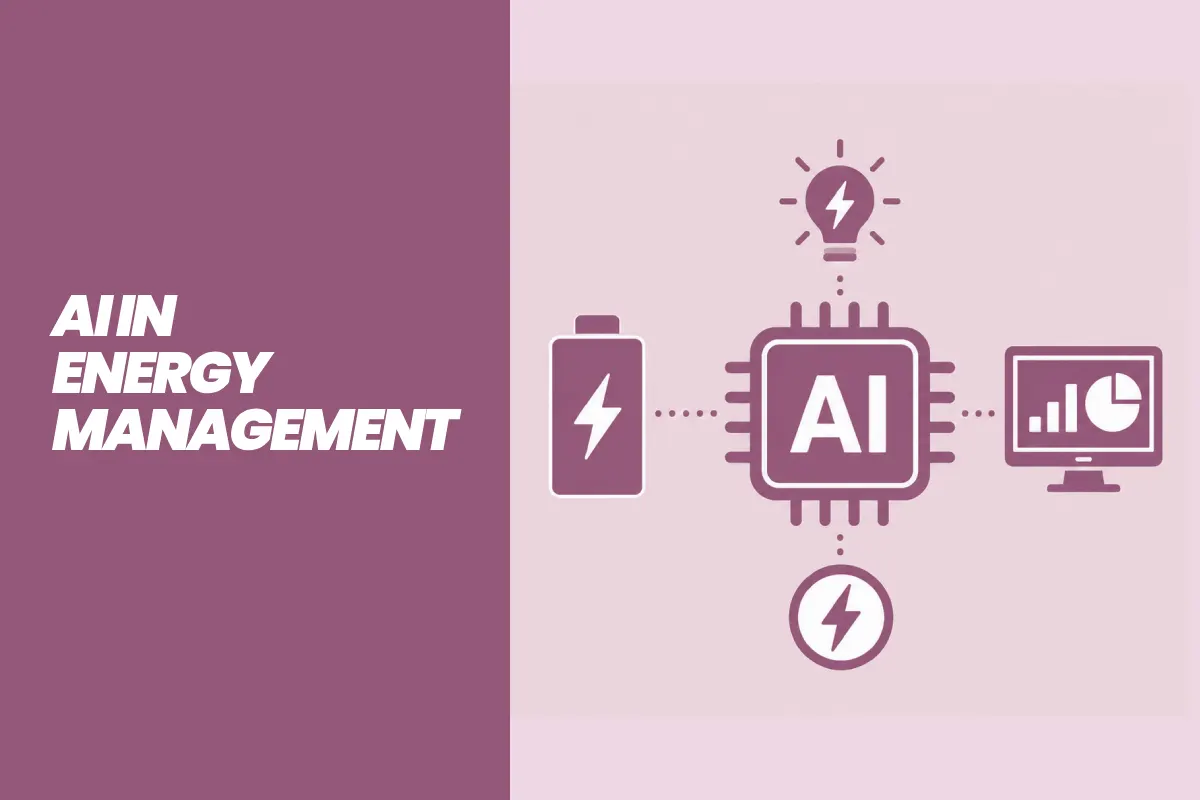
AI in energy management involves using machine learning algorithms, predictive models, and intelligent automation to analyze energy-related information and optimize how energy is generated, distributed, stored, and consumed. These systems process data from smart meters, IoT sensors, building management systems, industrial equipment, weather services, electricity markets, and utility networks.
The collected information helps AI models identify consumption patterns, detect abnormal energy usage, estimate future demand, and recommend operational adjustments. For example, a machine learning model can analyze historical electricity consumption alongside production schedules and weather conditions to predict a facility’s energy requirements for the following day. An optimization model can then recommend when to operate energy-intensive equipment, charge storage systems, or shift noncritical loads to periods with lower electricity prices.
Different AI technologies support specific energy management activities:
| AI technology | Role in energy management |
|---|---|
| Machine learning | Identifies energy consumption patterns, detects inefficiencies, and predicts equipment performance |
| Predictive analytics | Forecasts energy demand, renewable generation, and potential supply disruptions |
| Deep learning | Analyzes complex energy datasets and improves forecasting accuracy |
| Natural language processing (NLP) | Extracts information from utility bills, energy contracts, reports, and operational documents |
| Computer vision | Analyzes thermal images and equipment visuals to identify heat losses and equipment abnormalities |
| Reinforcement learning | Optimizes energy control decisions through continuous learning and adjustments |
| Generative AI | Summarizes energy reports, answers operational queries, and generates recommendations using connected energy data |
When integrated with enterprise energy management platforms, these technologies help organizations move beyond basic energy monitoring toward predictive and automated energy optimization.
Organizations often collect energy consumption data from multiple meters, buildings, production lines, and equipment. However, consolidating this information and identifying inefficient consumption patterns can be difficult when data is distributed across different systems.
AI analyzes real-time and historical energy consumption data to provide a detailed understanding of how energy is being used across facilities and operations. Machine learning models establish normal consumption patterns for individual assets, departments, and production processes. They compare actual energy usage against expected consumption and identify unusual variations.
For example, an AI system monitoring a manufacturing facility may detect that a production line consumes more electricity than usual during a particular operating cycle. By comparing equipment activity, production output, operating schedules, and historical consumption, the system can identify potential inefficiencies and alert facility managers.
AI can also help organizations:
These capabilities provide energy managers with greater visibility into consumption patterns and help them prioritize areas requiring investigation.
Energy demand varies according to production schedules, weather conditions, occupancy levels, equipment usage, and business activity. Inaccurate demand forecasts can result in unnecessary energy expenditure, inefficient resource allocation, and increased pressure on electricity infrastructure.
AI-powered forecasting models analyze historical consumption records alongside external variables such as temperature, humidity, calendar events, production volumes, and electricity prices. Machine learning algorithms identify relationships between these factors and estimate future energy requirements across different time intervals.
For example, a commercial facility may experience higher electricity demand during summer because of increased air-conditioning requirements. An AI model can analyze previous consumption patterns and weather forecasts to estimate upcoming demand. Facility managers can use these predictions to adjust cooling schedules, plan energy procurement, and manage peak electricity usage.
AI also supports load management by identifying opportunities to distribute energy consumption more efficiently. Organizations can shift noncritical operations to periods when electricity demand or prices are lower without affecting essential activities.
| Application | How AI supports energy management |
|---|---|
| Short-term demand forecasting | Predicts electricity requirements over the next few hours or days |
| Peak load prediction | Identifies periods when energy consumption may exceed established thresholds |
| Load scheduling | Recommends suitable operating times for energy-intensive equipment |
| Demand response | Adjusts noncritical energy consumption in response to grid conditions or price signals |
| Capacity planning | Helps organizations estimate future energy requirements based on operational growth |
Commercial buildings consume energy through heating, ventilation, air conditioning (HVAC), lighting, elevators, and other electrical systems. Operating these systems according to fixed schedules can lead to unnecessary consumption, particularly when occupancy and environmental conditions change throughout the day.
AI helps optimize building energy consumption by analyzing information from occupancy sensors, smart meters, temperature sensors, lighting systems, and building management platforms. These systems use predictive models to adjust equipment operation according to actual building requirements.
For instance, an AI-enabled building management system can analyze occupancy patterns, indoor temperatures, outdoor weather conditions, and electricity prices to determine when HVAC equipment should operate. It can reduce cooling in unoccupied areas, adjust ventilation according to occupancy, and optimize lighting based on available daylight.
AI can also identify inefficiencies in building equipment. If an HVAC system consumes more electricity than expected to maintain a particular temperature, an AI model can flag the deviation for further inspection.
Key applications include:
These applications are particularly relevant to commercial offices, hospitals, hotels, educational institutions, shopping centers, and large industrial campuses.
Industrial operations consume substantial amounts of energy through manufacturing equipment, furnaces, boilers, compressors, pumps, motors, and production processes. Energy requirements can vary according to production volumes, material characteristics, machine settings, and operating conditions.
AI helps manufacturers understand the relationship between production parameters and energy consumption. Machine learning models analyze equipment telemetry, production records, process temperatures, operating speeds, and energy readings to identify conditions associated with inefficient energy use.
For example, an AI system in a manufacturing plant can examine the electricity consumption of industrial motors across different production cycles. It may identify operating conditions in which motors consume more energy than necessary and recommend adjustments to speed, load, or operating schedules.
AI can also optimize energy-intensive processes by identifying suitable operating parameters. In industries such as steel, cement, chemicals, and food processing, predictive models can evaluate process conditions and recommend adjustments that reduce energy consumption while maintaining product quality and production requirements.
| Industrial application | AI-enabled optimization |
|---|---|
| Motor and pump operations | Identifies inefficient operating speeds, loads, and operating schedules |
| Boiler management | Optimizes fuel consumption and operating parameters based on process requirements |
| Furnace operations | Analyzes temperature profiles and process conditions to improve thermal efficiency |
| Compressed air systems | Detects abnormal pressure patterns, air leakage indicators, and inefficient compressor operation |
| Production scheduling | Aligns energy-intensive activities with production requirements and electricity availability |
| Process optimization | Identifies operating conditions that reduce energy consumption without compromising output |
By connecting production data with energy management systems, manufacturers can evaluate energy consumption in relation to actual production output rather than relying only on total electricity usage.
Also Read: AI in Vendor Management
Renewable energy generation depends on environmental conditions that can change throughout the day. Solar power generation varies with sunlight intensity, cloud cover, temperature, and panel conditions, while wind energy production depends on wind speed, direction, and atmospheric conditions. These variations make accurate generation forecasting important for balancing energy supply and demand.
AI models analyze historical generation data, weather forecasts, satellite imagery, and environmental sensor readings to estimate renewable energy output. Machine learning and deep learning algorithms identify patterns in weather conditions and their relationship with electricity generation.
For example, an AI model operating within a solar power plant can combine cloud movement data, solar radiation measurements, and historical generation records to predict electricity output over the next several hours. Operators can use these forecasts to plan grid supply, manage storage capacity, and anticipate fluctuations in generation.
AI supports renewable energy operations through:
These capabilities help renewable energy operators improve generation planning and manage the variability associated with weather-dependent power sources.
Energy storage systems help organizations manage fluctuations in electricity demand, store renewable energy, and reduce dependence on grid electricity during expensive or high-demand periods. However, determining when to charge or discharge batteries requires consideration of electricity prices, energy demand, renewable generation, battery capacity, and operating constraints.
AI models analyze these variables to optimize battery operations. Predictive algorithms estimate future energy requirements and renewable generation, while optimization models determine suitable charging and discharging schedules.
For example, a commercial facility with rooftop solar panels and battery storage can use AI to predict its electricity demand and expected solar generation. The system can recommend storing surplus solar electricity during periods of high generation and using the stored energy when grid electricity becomes more expensive.
AI can also support battery health monitoring. By analyzing temperature, voltage, current, charging cycles, and historical performance, machine learning models can identify abnormal battery behavior and estimate degradation patterns.
Important applications include:
These capabilities are valuable for commercial facilities, renewable energy operators, microgrids, and organizations using battery energy storage systems.
Also Read: AI Development Cost
Electricity distribution networks must continuously balance power supply with changing demand while maintaining grid stability and service reliability. The growing integration of distributed renewable energy sources, electric vehicles, and battery storage systems adds complexity to grid operations.
AI helps utilities analyze information from smart meters, grid sensors, substations, transformers, and distribution management systems. Machine learning models can identify consumption patterns, forecast localized electricity demand, and detect unusual network conditions.
For example, an AI system can analyze voltage readings, transformer loading, and historical consumption data to identify distribution areas experiencing abnormal electrical conditions. It can alert grid operators to investigate potential equipment issues before they affect a larger part of the network.
AI also supports demand response programs by predicting when electricity demand may exceed available capacity. Utilities can use these insights to coordinate demand reduction measures, manage distributed energy resources, and improve network utilization.
Applications include:
AI-enabled grid management helps utilities improve operational visibility and respond more effectively to changing electricity demand and supply conditions.
Also Read: AI Consulting Cost
Unexpected failures in energy-related equipment can interrupt operations, increase maintenance expenditure, and reduce energy efficiency. Traditional maintenance approaches often depend on fixed schedules or inspections performed after equipment problems become noticeable.
AI supports predictive maintenance by analyzing equipment performance data to identify early indicators of potential failures. Machine learning models process information such as vibration, temperature, pressure, current, operating hours, and maintenance history to detect abnormal behavior.
For example, an AI system monitoring industrial compressors may identify changes in vibration patterns and energy consumption that indicate developing mechanical problems. Maintenance teams can investigate the equipment before the issue causes an unexpected shutdown.
AI can also support maintenance planning by estimating equipment failure probabilities and identifying assets that require attention.
| Equipment | AI-enabled monitoring |
|---|---|
| Transformers | Analyzes temperature, load, and electrical operating patterns |
| Turbines | Identifies abnormal vibration, temperature, and performance variations |
| Industrial motors | Monitors current, vibration, and operating efficiency |
| Boilers | Detects abnormal pressure, temperature, and combustion-related patterns |
| Solar panels | Identifies performance deviations and potential equipment faults |
| HVAC systems | Detects inefficient operation and developing equipment issues |
By connecting predictive maintenance with energy monitoring, organizations can address equipment problems that contribute to excessive consumption and operational inefficiencies.
Energy expenditure is influenced by consumption volumes, electricity tariffs, time-of-use pricing, demand charges, contractual terms, and market conditions. Organizations operating multiple facilities may find it difficult to compare energy costs and identify the most suitable procurement strategies.
AI helps analyze utility bills, energy contracts, consumption records, tariff structures, and market information to provide a clearer understanding of energy expenditure. NLP models can extract relevant information from invoices and contracts, while machine learning models identify spending patterns and estimate future energy costs.
For example, an AI system can compare electricity consumption across different facilities and identify locations where demand charges contribute significantly to overall expenditure. It can also evaluate historical usage against available tariff structures to identify potential cost-saving opportunities.
Generative AI can further simplify energy cost analysis by allowing managers to ask questions about expenditure patterns and receive summaries based on connected enterprise data.
AI can support:
These capabilities help procurement and finance teams make more informed energy purchasing decisions and improve visibility into operational energy expenditure.
Also Read: AI-Powered Contract Analysis
AI-based energy management solutions combine multiple technologies to process energy data, generate predictions, and support operational decisions. Their implementation depends on the type of energy infrastructure, data availability, and the level of automation required.
| Technology | Application |
|---|---|
| Internet of Things (IoT) | Collects real-time information from smart meters, sensors, equipment, and connected infrastructure |
| Machine learning | Identifies consumption patterns, detects inefficiencies, and predicts energy requirements |
| Deep learning | Processes complex datasets for demand forecasting, renewable generation prediction, and equipment monitoring |
| Predictive analytics | Estimates future demand, equipment failures, and energy generation |
| Natural language processing | Extracts information from energy bills, contracts, compliance documents, and reports |
| Computer vision | Supports thermal inspections, equipment monitoring, and visual fault detection |
| Digital twins | Creates virtual representations of energy assets and facilities to simulate operating conditions |
| Generative AI | Generates energy reports, summarizes performance data, and supports natural-language queries |
| Reinforcement learning | Optimizes energy control decisions through continuous feedback and adjustments |
The integration of these technologies allows organizations to connect energy data with operational systems and develop solutions that support both analytical and automated energy management.
AI can deliver operational, financial, and environmental benefits by helping organizations understand energy consumption and make more informed decisions.
| Benefit | Business impact |
|---|---|
| Reduced energy expenditure | Identifies inefficient consumption patterns and opportunities to optimize energy usage |
| Improved operational efficiency | Helps align equipment operation and production schedules with energy requirements |
| Better demand planning | Improves forecasting and supports more effective energy procurement and resource allocation |
| Lower equipment downtime | Identifies early indicators of equipment problems through predictive maintenance |
| Renewable energy integration | Improves forecasting and coordination of renewable generation and energy storage |
| Greater operational visibility | Consolidates energy information across facilities, assets, and business units |
| Improved sustainability performance | Supports energy efficiency initiatives and more accurate emissions reporting |
| Data-driven decision-making | Provides actionable insights for facility managers, energy teams, and business leaders |
The value of AI depends on the organization’s energy infrastructure, the quality of available data, and the ability to translate model-generated insights into operational improvements. Energy savings should therefore be measured against established consumption baselines and relevant operating conditions.
AI solutions deliver greater value when connected to the systems organizations already use to manage facilities, production operations, utilities, and business expenditure. Integration enables AI models to access relevant operational information and provide recommendations within existing workflows.
Common enterprise systems include:
| Enterprise system | Role in AI-enabled energy management |
|---|---|
| Energy Management Systems (EMS) | Provides energy consumption data, monitoring capabilities, and optimization controls |
| Building Management Systems (BMS) | Connects AI models with HVAC, lighting, and building automation systems |
| Enterprise Resource Planning (ERP) | Connects energy expenditure with procurement, finance, and operational records |
| Manufacturing Execution Systems (MES) | Provides production schedules and process information for industrial energy optimization |
| Computerized Maintenance Management Systems (CMMS) | Connects equipment monitoring insights with maintenance planning |
| Supervisory Control and Data Acquisition (SCADA) | Provides operational data from industrial equipment and energy infrastructure |
| IoT platforms | Consolidates sensor readings and equipment telemetry for AI analysis |
Organizations can integrate AI models through APIs, data pipelines, cloud platforms, and edge computing infrastructure. For facilities that require low-latency responses, edge AI can process selected information closer to connected equipment rather than sending every data point to centralized cloud systems.
Integration should also account for operational safety. AI-generated recommendations may be used to support human decisions or trigger automated controls, depending on the application. Critical infrastructure and industrial control systems require appropriate validation, access restrictions, and fail-safe mechanisms before automated actions are introduced.
Successful AI adoption requires more than deploying predictive models or connecting smart meters. Organizations need a clear understanding of their energy management objectives, existing infrastructure, and the operational processes that AI solutions are expected to improve.
A structured implementation approach can help enterprises establish a foundation for scalable adoption.
Identify energy management priorities: Define the primary objectives, such as reducing electricity expenditure, improving building efficiency, forecasting demand, optimizing industrial processes, or integrating renewable energy.
Assess data availability: Evaluate the quality and accessibility of information from smart meters, IoT sensors, energy management platforms, production systems, and utility records.
Select suitable AI applications: Prioritize applications according to business value, implementation complexity, data readiness, and expected operational impact.
Develop and validate AI models: Train models using relevant historical and real-time data. Evaluate their accuracy under different operating conditions before introducing them into production environments.
Integrate with existing infrastructure: Connect AI solutions with enterprise platforms and operational systems through secure APIs, data pipelines, and appropriate integration frameworks.
Monitor performance and scale adoption: Track energy consumption, cost savings, forecast accuracy, and equipment performance. Use these measurements to refine models and expand successful applications across additional facilities.
Starting with clearly defined applications and measurable performance indicators helps organizations demonstrate value before extending AI capabilities across their energy operations.
AI is changing energy management by enabling organizations to monitor consumption, forecast demand, optimize industrial and building operations, improve renewable energy integration, and manage energy infrastructure more effectively. Machine learning, predictive analytics, IoT, and generative AI provide the capabilities needed to turn distributed energy information into actionable operational insights. As organizations focus on energy efficiency, cost control, and sustainability, AI-based energy management solutions can support more responsive and data-driven energy operations.
Xicom provides AI development services to help businesses build intelligent energy management solutions that improve consumption monitoring, demand forecasting, operational efficiency, and energy optimization through advanced analytics and automation.
AI in energy management uses machine learning, predictive analytics, and automation to monitor, forecast, and optimize how an organization generates, stores, distributes, and consumes energy. These systems analyze data from smart meters, IoT sensors, building management systems, industrial equipment, and weather services. They detect waste, predict demand, and recommend or automate operational adjustments.
AI reduces energy costs by finding inefficient consumption, predicting peak demand, and moving flexible loads to lower-priced periods. It can flag equipment that uses more power than expected, cut demand charges through load scheduling, and optimize battery charging and discharging. It can also analyze tariffs and utility bills to show cheaper procurement options across facilities.
A traditional energy management system mostly reports past consumption and follows fixed operating rules. An AI-based system learns normal patterns for each asset, predicts future demand and generation, and adapts to changing conditions in real time. That shifts energy management from reactive monitoring to predictive and partly automated optimization.
The main technologies are machine learning for pattern detection, predictive analytics and deep learning for forecasting, reinforcement learning for control optimization, and computer vision for thermal and equipment inspection. NLP extracts data from bills and contracts. Generative AI summarizes reports and answers natural-language questions. IoT and digital twins supply the data and simulation layer underneath.
Yes. AI demand forecasting models combine historical consumption with variables such as temperature, humidity, occupancy, production schedules, calendar events and electricity prices. Accuracy depends on data quality and how stable operations are. Teams should test models under different operating conditions and keep checking forecasts against actual usage to refine them.
Most AI energy management projects use interval data from smart meters and submeters, IoT sensor readings, equipment telemetry, building management or SCADA data, production records, weather data and utility bills. Clean, consistent, time-stamped data matters more than volume. A data readiness assessment is usually the first step before building any model.
Measure ROI against a clear consumption baseline adjusted for operating conditions such as weather, occupancy, and production volume. Useful KPIs include energy use per unit of output, peak demand reduction, total energy spend, forecast accuracy, equipment downtime, and emissions. Starting with one or two well-defined use cases makes the value easier to prove before scaling.

Learn how AI data engineering builds reliable pipelines for ML, generative AI and RAG, covering ingestion, data quality, storage, governance and scaling.

Learn how AI in vendor management automates onboarding, monitors supplier risk, tracks performance and contracts, and cuts vendor costs for enterprises.
AI consulting cost ranges from $15,000 for a strategy sprint to $500,000+ for production work. See rates, pricing models and budgets by company size.