Key Takeaways HR teams deal with a lot of repeat work. Screening resumes, answering the same benefits question ten times a week, and chasing employees for documentation. But none of this needs a person to think hard each time. It just needs to get done, correctly, on schedule. That’s the gap AI agent for HR are built to close. Unlike a basic chatbot that only answers questions, an AI agent can complete tasks from start to finish. It can shortlist candidates, update an employee’s leave balance and carry it through to completion. It checks systems, applies your policies, and only pulls HR when the decision needs human judgment. So, if you are planning to build this into your own HR operations, this blog will be the best guide. We will cover what AI agent in HR do, where they fit across the employee lifecycle, and the benefits of using AI agent for Human Resources operations. What are AI Agent for Human Resources (HR)? AI agent for HR are software programs that connect an LLM to your HR systems, ATS, HRIS, and payroll platform to automate daily tasks. It starts with a goal, completes the task step by step, and involves a person only when approval is required. However, it is different from older HR automation, which follows fixed if-then rules. For instance, if a leave request is over five days, route it to the manager. But agentic AI for HR does not follow fixed rules. It thoroughly understands different types
Read MoreJul 22, 2026 Artificial Intelligence 0
Jul 22, 2026 Artificial Intelligence 0
AI Agent for HR: Use Cases and Benefits
Jul 21, 2026 Artificial Intelligence 0
Jul 21, 2026 Artificial Intelligence 0
AI in Insurance: The Complete Guide to Use Cases, Benefits, and Challenges
Key Takeaways Insurance runs on risk, data, and paperwork, and AI is now touching all three. But most CEOs and CTOs in the industry aren’t short on AI vendor pitches; they’re short on a clear answer to a narrower question: where does AI actually pay off first, and where is it still not ready to replace a human decision? The market reflects the urgency. Fortune Business Insights puts the global AI-in-insurance market at $13.45 billion in 2026, up from $10.36 billion in 2025, growing at a 35.7% CAGR to reach $154.39 billion by 2034. Precedence Research puts it slightly higher, at $14.39 billion in 2026, up from $10.82 billion in 2025, with a 32.21% CAGR reaching $176.58 billion by 2035. Yet market growth alone does not tell an insurer which AI investment to make first. Here, we examine where AI is delivering measurable value today and where human judgment remains essential. We also explore how insurers can evaluate AI investments based on workflow, risk, and expected return. What Is AI in Insurance and Why Does It Matter Now? AI in insurance means applying machine learning models, NLP, computer vision, and generative AI to the core functions of the insurance business, including risk assessment, claims handling, fraud prevention, pricing, and policyholder communication. It matters now for three reasons that have converged over the past couple of years. Core AI Use Cases in Insurance The phrase “AI use cases in insurance” covers a lot of ground, but most real deployments fall into
Read MoreJul 20, 2026 Artificial Intelligence 1
Jul 20, 2026 Artificial Intelligence 1
AI Agent for Customer Service: Strategic Use Cases and Enterprise Benefits
Key Takeaways If you’ve managed a customer support desk or an engineering team over the last few years, you already know the story. Ticket queues keep growing, users expect instant fixes, and the usual band-aids simply aren’t cutting it anymore. For a long time, the go-to fix was tossing a basic decision-tree chatbot in front of your customers. We all know how that turned out. Users got trapped in endless “did this article answer your question?” loops, frustration spiked, and almost every ticket ended up right back in a human agent’s queue anyway. You paid for automation, but your team still ended up doing all the heavy lifting. That gap is why teams are shifting toward a true AI agent for customer service. The difference comes down to execution. A standard bot just reads a script or pulls a link from a FAQ page. A modern AI customer service agent, on the other hand, can actually work across your tech stack. It can look up an account, verify a purchase, run an API call to update a shipping address or clear a billing hold, and close out the ticket, all without a human rep having to click a button. For leaders looking to clean up support queues without doubling their headcount, adopting a reliable AI agent for customer support has quickly moved from a “nice-to-have experiment” to essential infrastructure. By partnering with experienced teams for AI agent development services, companies are turning chaotic helpdesks into fast, predictable systems that handle
Read MoreJul 17, 2026 Artificial Intelligence 0
Jul 17, 2026 Artificial Intelligence 0
AI Agent for Sales: Use Cases, Benefits, Compliance, and How to Build?
Key Takeaways In an era of rapid regulatory shifts, highly volatile tech valuations, and intensifying corporate demands for clear capital efficiency, the architectural integrity of a sales ecosystem directly correlates with its conversion ceiling. Relying on legacy customer relationship systems that require constant, manual data input is no longer practical or sustainable for scaling operations. Modern, hyper-competitive enterprise teams are rapidly shifting away from static software models to embrace dynamic, autonomous ecosystems driven by an integrated AI agent for sales. According to a 2026 enterprise study by Grand View Research, the global market for autonomous systems is expanding dramatically, valued at $10.9 billion this year and projected to accelerate to $182.9 billion by 2033. This seismic structural growth reflects a definitive shift in operational strategy: B2B companies are moving past standard automation scripts to integrate advanced, self-correcting workflows that actively manage customer relationships from initial contact to closed contract. Architectural Differentiation: AI Agent vs Chatbot Systems Enterprise technology leaders must maintain precise definitions when evaluating intelligent sales software. Mistaking conversational scripts for autonomous systems often leads to poor integration and wasted engineering hours. Scripted Linear Rule Trees Traditional customer service setups rely on predefined, deterministic trees. They require users to click specific buttons or type exact phrases, working within strict limits. If a prospect’s query deviates from the expected track, the system stalls, requiring a manual handoff to a human representative. These setups lack any capability for situational awareness, proactive planning, or independent decision-making. Autonomous Agentic Frameworks True agentic AI
Read MoreJul 14, 2026 Artificial Intelligence 3
Jul 14, 2026 Artificial Intelligence 3
AI Governance Frameworks: What Enterprises Need to Know
Key Takeaways Artificial intelligence is no longer a peripheral capability organizations experiment with at the edges of their operations. It sits inside credit decisioning, clinical support tools, hiring pipelines, fraud detection systems, and customer-facing products that influence outcomes at scale. The speed of that expansion has outpaced the governance structures most organizations have in place to manage it. The consequences of that gap are no longer theoretical. Regulatory enforcement is accelerating. The EU AI Act is in phased enforcement. The NIST AI Risk Management Framework has moved from advisory to procurement-relevant. ISO/IEC 42001 certification is appearing in enterprise vendor due diligence requirements. Boards are being asked questions about AI oversight that most organizations are not yet positioned to answer. An AI governance framework is the mechanism through which organizations close that gap systematically rather than reactively. This article covers what that framework consists of, which regulatory structures now govern it, how to select the right approach for a specific organizational context, and how to move from framework selection to operational implementation. What Is an AI Governance Framework? An AI governance framework is a structured system of policies, controls, accountability mechanisms, and operational processes that govern how artificial intelligence is developed, deployed, monitored, and retired within an organization. It is distinct from an AI strategy, which addresses what the organization intends to build, and from an AI architecture built on AI software frameworks, which addresses how systems are technically constructed. Governance addresses who is accountable, what boundaries AI systems must operate
Read MoreJul 13, 2026 Artificial Intelligence 1
Jul 13, 2026 Artificial Intelligence 1
AI Agent Frameworks: A Practical Guide
Key Takeaways Artificial intelligence is rapidly evolving from generating content to executing work. Unlike traditional AI applications that are mainly prompt-based, AI agents can reason, plan, interact with external tools, retrieve enterprise knowledge, and autonomously perform multi-step tasks. As organizations increasingly use agentic AI for customer support, software development, business process automation, research, and enterprise copilots, the need for strong AI agent frameworks has increased massively. This momentum is expected to accelerate further. According to Gartner, 40% of enterprise applications will incorporate task-specific AI agents by the end of 2026, up from less than 5% in 2025. With growing enterprise adoption, enterprises need frameworks that simplify the complexities of agent orchestration, system integration, governance and lifecycle management while enabling production-grade deployments. Thus, choosing the right AI agent framework is more a strategic architectural decision than simply a technology choice. In this guide, we will take a practical look at AI agent frameworks, including their key concepts, capabilities, types, platforms and how to evaluate them, to help organizations select the framework that best meets their business and technical needs. What Is an AI Agent Framework? An AI agent framework is a software platform that provides the basic infrastructure to build, coordinate, deploy and manage autonomous AI agents. It brings together a number of capabilities: reasoning, memory, workflow management, tool execution and state management, into a single development environment. This allows developers to concentrate on business logic rather than implement core infrastructure. Traditional AI frameworks mostly support either model training or inference.
Read MoreJul 7, 2026 Artificial Intelligence 0
Jul 7, 2026 Artificial Intelligence 0
How to Build an AI Agent: Complete Step-by-Step Guide (2026)
Key Takeaways AI agents are redefining how businesses automate work, make decisions, and interact with customers. According to the Capgemini Research Institute’s Generative AI in Organizations 2024 report, 82% of organizations plan to integrate AI agents within the next one to three years, highlighting the growing demand for systems that can reason, use tools, and execute tasks autonomously. As adoption accelerates, organizations are shifting their focus from experimenting with AI models to building reliable, production-ready agents. Developing an AI agent, however, involves much more than choosing an LLM. It requires thoughtful decisions around architecture, knowledge retrieval, tool integrations, security, and continuous optimization. Having designed and delivered AI solutions across diverse business use cases, we’ve learned that these engineering decisions have a far greater impact on an agent’s success than the model itself. In this guide, we walk through how to build an AI agent step by step, from selecting the right use case and architecture to integrating enterprise data, connecting external tools, testing workflows, and preparing the system for production. What Is an AI Agent? An AI agent is an intelligent software system that can reason, make decisions, and execute tasks to achieve a defined objective with minimal human intervention. Unlike traditional AI applications that primarily generate responses, AI agents combine an LLM with planning, memory, knowledge retrieval, and tool integrations to execute multi-step workflows and interact with business systems. Core Characteristics An AI agent combines several capabilities that work together to execute a task. Capability Purpose Goal-oriented reasoning Plans
Read MoreJul 3, 2026 Artificial Intelligence, Software Development 1
Jul 3, 2026 Artificial Intelligence, Software Development 1
AI Software Frameworks: A Complete Practical Guide
Key Takeaways AI software frameworks provide the foundation for developing modern AI applications. They offer the libraries, APIs, runtime environments, and development tools needed to build, train, deploy, and manage AI models without requiring developers to implement complex capabilities such as automatic differentiation, distributed computing, hardware acceleration, and model optimization from scratch. By abstracting this complexity, frameworks accelerate development while improving performance, scalability, and reliability. Their role has become increasingly important as enterprise AI adoption continues to grow. According to the McKinsey 2025 State of AI report, 78% of organizations now use AI in at least one business function, reflecting AI’s transition from experimental projects to production systems. As organizations scale their AI initiatives, the framework they choose directly impacts development speed, deployment flexibility, infrastructure costs, integration capabilities, and long-term maintainability. This guide explores the different types of AI software frameworks, their core components, selection criteria, licensing models, and their role in building scalable AI systems. What Is a Software Framework for AI? An AI software framework is a software foundation that provides the libraries, runtime components, APIs, and development abstractions required to build AI applications. Rather than implementing numerical computation, optimization routines, and execution logic for every project, an AI software development company can accelerate delivery by using standardized components maintained by these frameworks, enabling faster, scalable, and more efficient AI solution development. Underlying infrastructure remains largely abstracted from application code. Automatic differentiation engines compute gradients during training, execution runtimes distribute workloads across available hardware, and optimized libraries perform
Read MoreJul 2, 2026 Artificial Intelligence 2
Jul 2, 2026 Artificial Intelligence 2
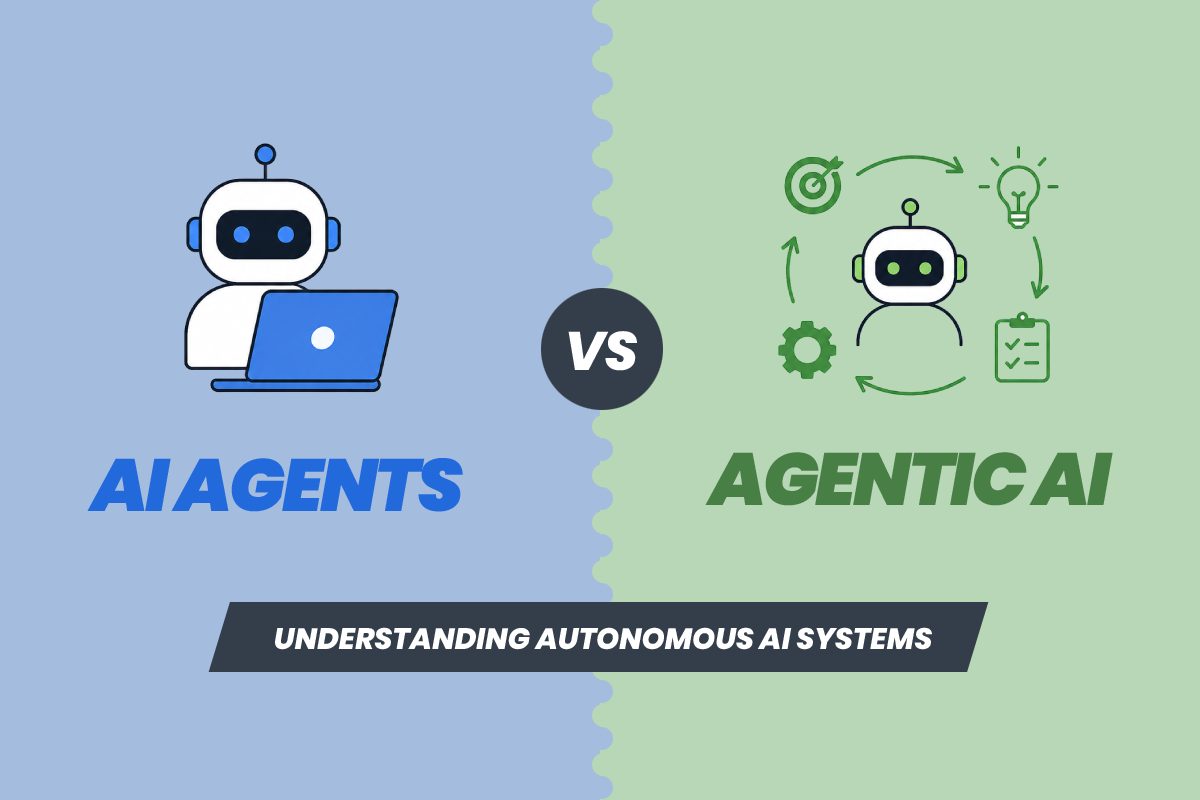
AI Agents vs Agentic AI: What’s the Real Difference?
The rapid emergence of large language model (LLM)-based systems has transformed AI from a tool for generating content into one capable of reasoning, planning, and executing increasingly complex workflows.
Read MoreJun 30, 2026 Artificial Intelligence 0
Jun 30, 2026 Artificial Intelligence 0
AI Governance Consulting Cost, ROI & Partner Selection Guide
Budgeting for AI governance consulting is far more complex than most organizations expect. Unlike conventional consulting engagements, costs vary significantly based on AI maturity, regulatory obligations, organizational scale, risk exposure, and implementation complexity.
Read MoreJun 30, 2026 Artificial Intelligence 0
Jun 30, 2026 Artificial Intelligence 0
AI in Legal: Use Cases, Benefits & Future Trends in 2026
The legal industry is going through a major change as there has been increased interest in the application of artificial intelligence within the field of legal services. AI has enabled law firms to enhance their efficiency and improve decision-making by automating various tasks. In recent years, the utilisation of AI in the legal field has grown significantly. As per the American Bar Association’s legal technology survey report for 2024, the usage of AI in legal practice has increased from 11 percent in 2023 to 30 percent in 2024, and this indicates growing trust among legal professionals in AI-based solutions. Moreover, it should be noted that Thomson Reuters has also stated that 26 percent of legal firms are utilising generative AI, while 78 percent think it will become an important part of their workflow within the next five years. Because legal business organisations have been facing the challenge of dealing with increasingly large amounts of paperwork, regulation issues, and high expectations from clients, artificial intelligence has become a very helpful technology in helping companies operate more efficiently. In this article, we will consider the role of AI in legal organisations and its possible applications in the future. Why is AI Becoming Essential in the Legal Industry? The role of AI in legal businesses has grown remarkably over time. The high workload, compliance issues, and rising expectations from clients are creating a need for more efficient and effective operational solutions in legal firms. Some of the key factors driving AI adoption in
Read MoreMay 28, 2026 Artificial Intelligence 1
May 28, 2026 Artificial Intelligence 1
Generative AI in Healthcare: Integration, Use Cases, Challenges, ROI, and Future Outlook
Generative AI is fundamentally rewriting the rules of modern healthcare and the industry is embracing it faster than anyone anticipated. From automating clinical documentation to personalizing patient care at scale, GenAI is solving problems that have plagued healthcare systems for decades, delivering measurable improvements in both operational efficiency and patient outcomes. And healthcare leaders are taking note. According to a Q1 2024 McKinsey survey of 100 US healthcare leaders spanning payers, providers, and healthcare technology groups, over 70% are actively pursuing or have already implemented GenAI solutions, driven by its potential to boost clinician productivity, reduce administrative burden, and deliver more personalized patient experiences. What makes GenAI particularly powerful in healthcare is the breadth of problems it can solve simultaneously. It helps clinicians spend less time on paperwork and more time with patients. It gives administrators real-time visibility into operational bottlenecks. It personalizes patient engagement at a scale no human team could sustain alone. At the same time, healthcare organizations must navigate real challenges, such as data privacy regulations, legacy system integration, and the need for explainable, auditable AI outputs. Getting these fundamentals right is what separates a successful GenAI deployment from a costly misstep, and it’s where having the right technology partner makes all the difference. This article takes a comprehensive look at how Generative AI is transforming healthcare, covering what it is and why it matters, the current state of adoption, practical integration approaches, real-world use cases, ROI measurement, best practices for overcoming adoption challenges, and a forward-looking
Read MoreMay 4, 2026 Software Development, Artificial Intelligence 1
May 4, 2026 Software Development, Artificial Intelligence 1
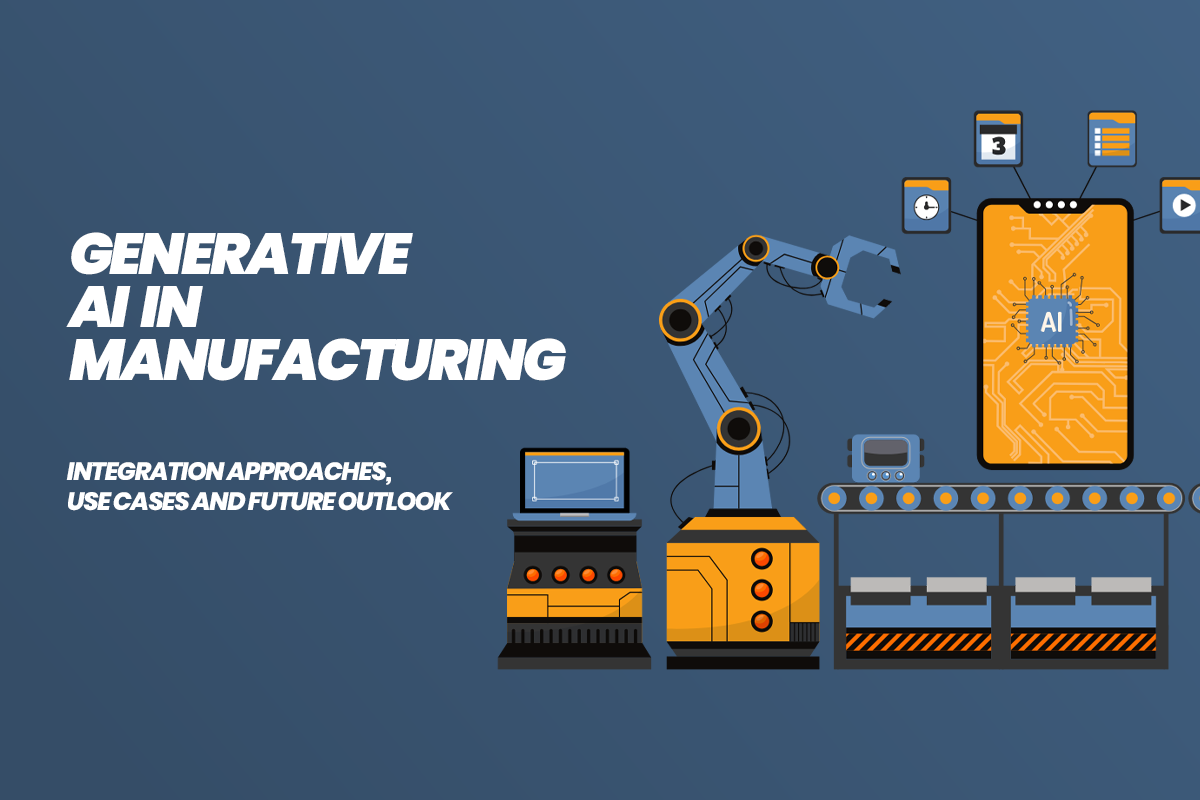
Generative AI in Manufacturing: Integration Approaches, Use Cases, and Future Outlook
Manufacturing doesn’t limit itself to machines and stressful manual processes. It has become extremely intelligent and data-driven. Generative AI in manufacturing is a technology that doesn’t just assess data but builds solutions, strategies, and designs in real time. It encourages product efficiency and optimizes supply chains by assessing a vast set of data to generate new optimized solutions. Some of its key applications include predictive maintenance, quality control, and generative design. The global generative AI in manufacturing market size is expected to reach USD 13,893.51 million by 2034. It is expanding at a CAGR of 41% over the forecast period. As per the trends of KPMG, 78% of industrial manufacturing executives now consider GenAI as their leading emerging technology. Its applications are improving production planning through real-time data analysis. Let us learn more about its influence on the manufacturing industry and how many companies have leveraged its values in recent years. How does Generative AI in manufacturing work? The operation of generative AI revolves around machine learning models. It predicts and optimizes outcomes based on input data. For example, it can give rise to prototypes that meet specific parameters of strength and cost more effectively than traditional techniques. The influential landscape of GenAI in manufacturing Generative AI can transform the manufacturing process by aligning the operations while fostering innovations. This enables you to adopt personalized production. As manufacturers recognize this technology’s great potential, its adoption has been growing efficiently. It has been driving efficiency while giving rise to many newer
Read MoreApr 9, 2026 Artificial Intelligence 0
Apr 9, 2026 Artificial Intelligence 0
Azure AI vs AWS AI: Choosing the Right Cloud AI Platform
Choosing between Azure AI and AWS AI depends on your business goals, existing ecosystem, and scalability needs. This comparison explores key differences in pricing, tools, integrations, and performance to help you select the right cloud AI platform.
Read MoreApr 7, 2026 Artificial Intelligence 0
Apr 7, 2026 Artificial Intelligence 0
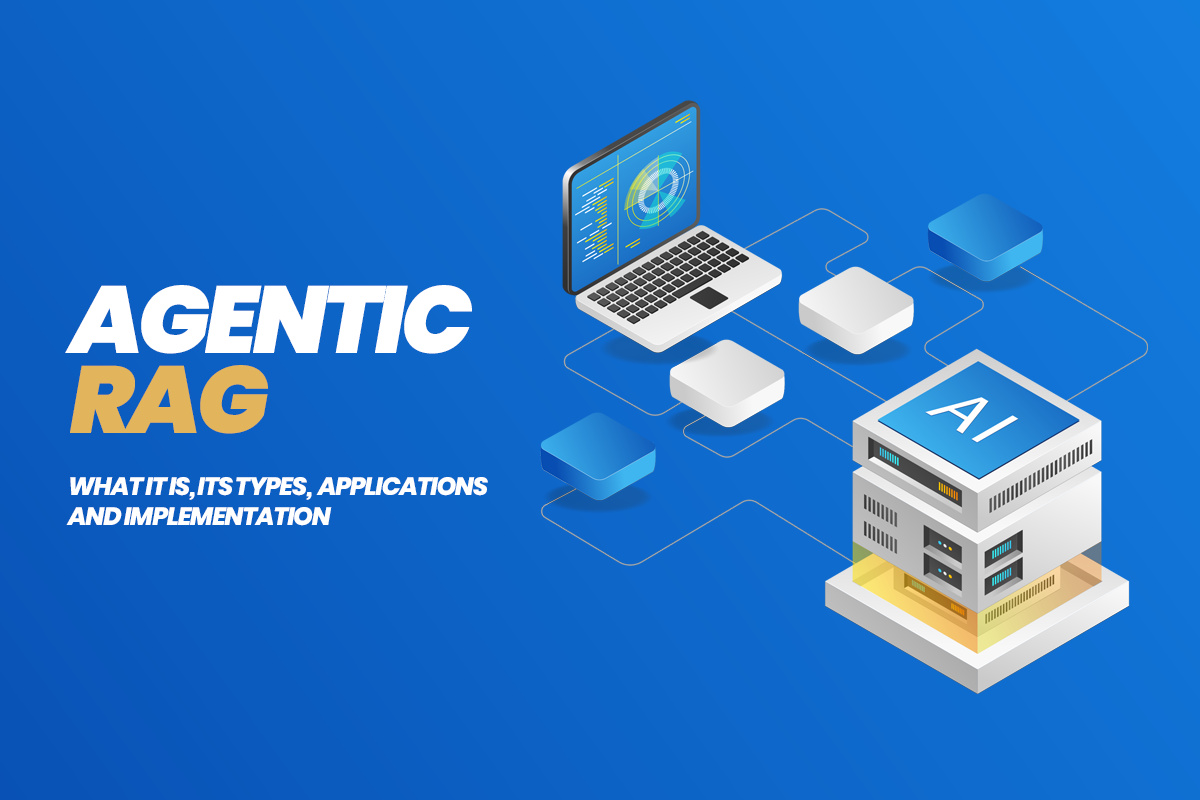
Agentic RAG: What it is, Types, Applications, and Implementation
Agentic RAG combines retrieval-augmented generation with autonomous decision-making, enabling AI systems to plan, act, and refine responses. This guide explores its types, real-world applications, and step-by-step implementation for building smarter, context-aware AI solutions.
Read MoreMar 13, 2026 Artificial Intelligence 0
Mar 13, 2026 Artificial Intelligence 0
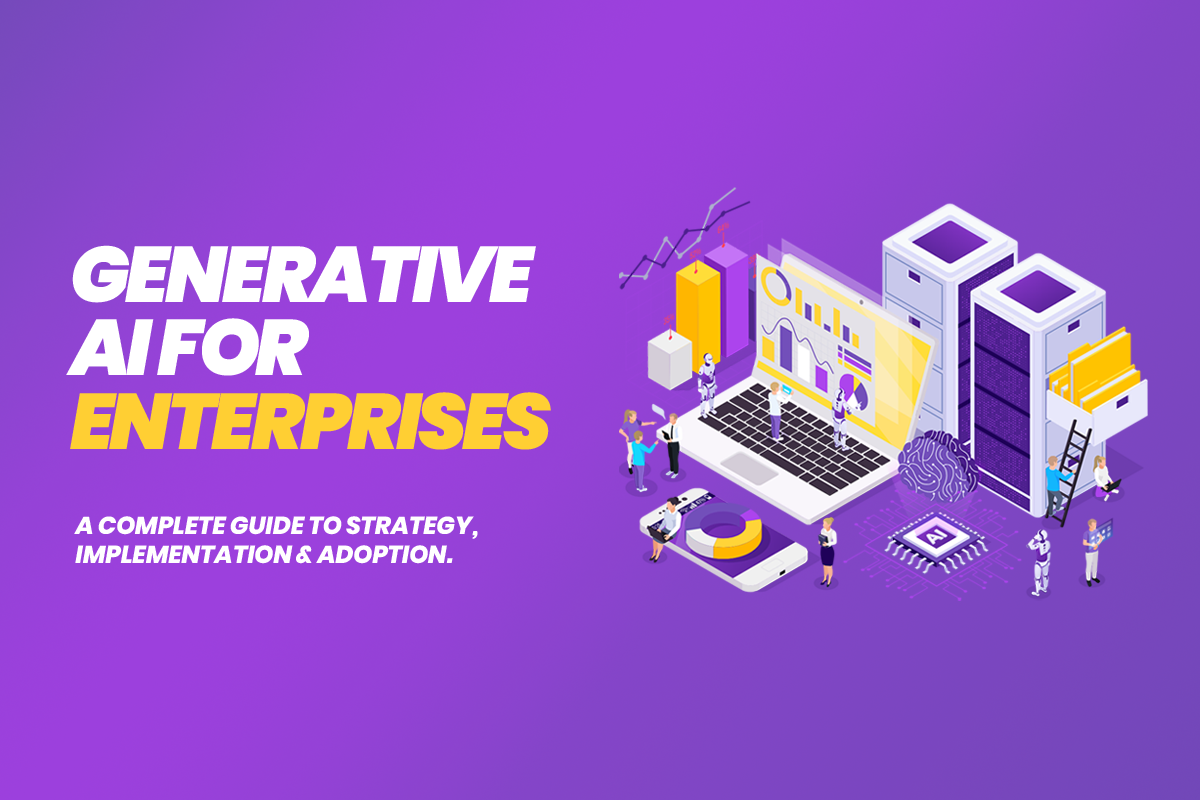
Generative AI for Enterprises: A Complete Guide to Strategy, Implementation, and Adoption
This guide explains how Generative AI for enterprises enables automation, smarter decision-making, and faster innovation. Explore key models, implementation frameworks, industry use cases, challenges, and best practices.
Read MoreMar 6, 2026 Artificial Intelligence 0
Mar 6, 2026 Artificial Intelligence 0
Xicom’s AI center of excellence for enterprises: Framework, structure, roles, and business impact
Xicom’s AI Center of Excellence (CoE) provides enterprises with a structured framework to design, deploy, and scale AI initiatives. It defines governance, roles, and processes that align AI strategy with business goals, accelerate innovation, ensure responsible AI adoption, and deliver measurable business value.
Read MoreMar 5, 2026 Artificial Intelligence 0
Mar 5, 2026 Artificial Intelligence 0
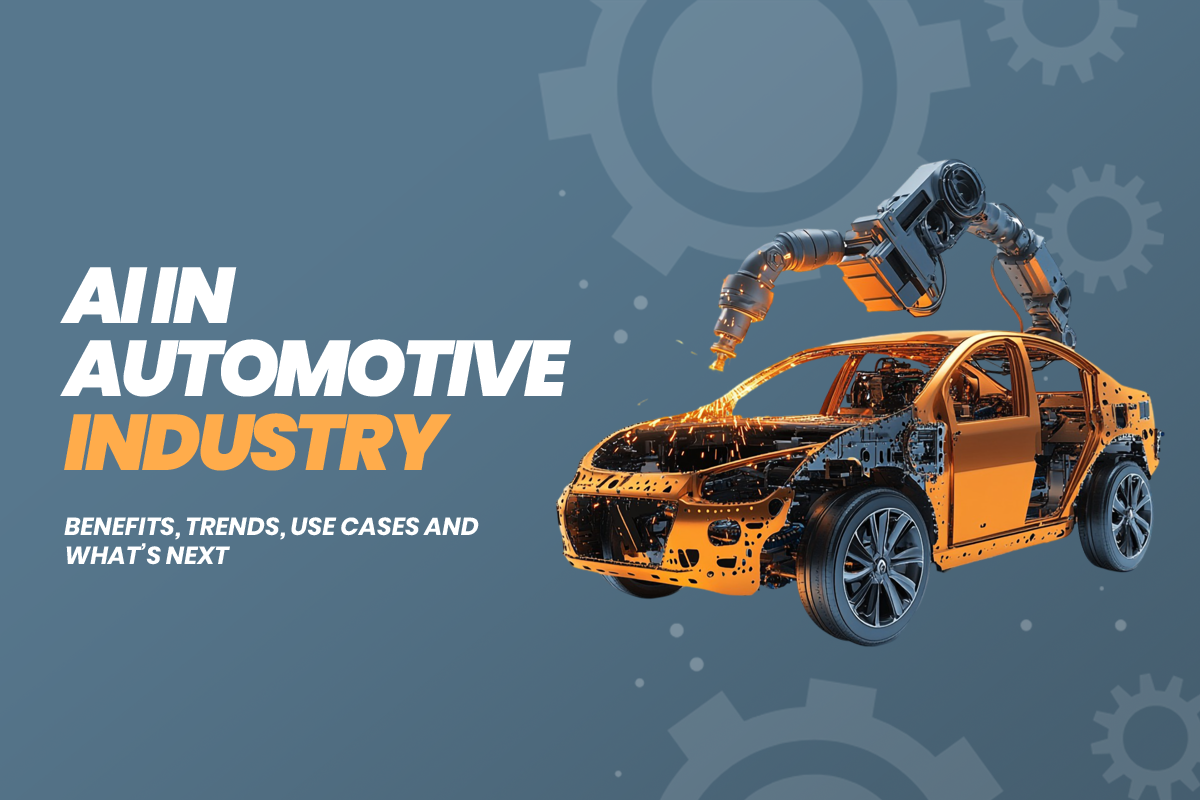
AI in Automotive Industry: Benefits, Trends, & Use Cases
AI in Automotive Industry is transforming the way vehicles are designed, manufactured, and driven. From autonomous driving and predictive maintenance to smart manufacturing and enhanced safety systems, AI is enabling faster innovation, better efficiency, and a safer, more connected driving experience.
Read MoreMar 3, 2026 Artificial Intelligence 0
Mar 3, 2026 Artificial Intelligence 0
AI in Business Operations: Use Cases and How to Integrate
AI in Business Operations explores practical AI use cases across HR, finance, marketing, operations, and customer service. Learn how organizations leverage automation, predictive analytics, and generative AI to improve efficiency, cut costs, enhance decision-making, and accelerate growth.
Read MoreFeb 24, 2026 Artificial Intelligence 0
Feb 24, 2026 Artificial Intelligence 0
Top 11 Generative AI Trends in 2026
Generative AI is rapidly transforming businesses by automating content creation, enhancing customer experiences, and accelerating innovation. From personalized marketing to intelligent product design, organizations are leveraging AI to boost efficiency, reduce costs, and unlock new revenue streams.
Read MoreFeb 12, 2026 Artificial Intelligence, App Development 0
Feb 12, 2026 Artificial Intelligence, App Development 0
Top AI Tools for Mobile App Development in 2026
Discover the top AI tools for mobile app development in 2026 that streamline coding, automate testing, enhance UI/UX design, and accelerate deployment. From intelligent code assistants to AI-powered analytics and DevOps platforms, these tools help developers build smarter, faster, and more scalable mobile apps.
Read MoreFeb 10, 2026 Artificial Intelligence 0
Feb 10, 2026 Artificial Intelligence 0
10 Benefits of AI for Startups and Growing Businesses
Artificial Intelligence is transforming how startups and growing businesses compete, innovate, and scale. From automating repetitive tasks to improving customer insights and decision-making, AI helps companies reduce costs, boost efficiency, and unlock new growth opportunities in today’s fast-moving market.
Read MoreNov 19, 2025 Artificial Intelligence 0

Nov 19, 2025 Artificial Intelligence 0
How to Build AI-Powered Marketplace App: Key Steps, Features & Cost Estimation
Discover how to build AI-powered marketplace app solutions with a clear step-by-step process, essential features, tech requirements, and detailed cost estimates. Learn how AI automation, personalization, and smart matching can elevate your marketplace platform.
Read MoreNov 7, 2025 Artificial Intelligence 0
Nov 7, 2025 Artificial Intelligence 0
AI in HR: Benefits, Challenges, and Solutions
Explore how artificial intelligence in HR is transforming the way organizations manage recruitment, employee engagement, and performance. Learn about its key benefits, major challenges, and innovative solutions driving smarter, data-driven human resource strategies.
Read MoreAug 27, 2025 Artificial Intelligence 0
Aug 27, 2025 Artificial Intelligence 0
Build an AI Copilot for Enterprises: Cost, Features, and Process
Still wondering whether you should build an AI copilot for Enterprises? Well, no matter how far we have come in terms of technology, some of the enterprises are still struggling with productivity gaps and operational inefficiencies. According to McKinsey, employees are spending nearly 1.8 hours per day (9.3 hours per week) just searching for internal information – which is a clear loss in value and efficiency. In other terms, every fifth employee is effectively off the clock, hunting for answers instead of contributing real value to the business. This is where enterprises are choosing to build an AI copilot. But what’s so different about it? The smart enterprise assistants are intentionally crafted to automate routine workflows. With these agents, enterprises can get real-time insights, and able to make faster decisions. AI copilots work smoothly with systems like CRM, ERP, and HRMS. Their primary role is to eliminate repetitive tasks. They enhance cross-team synergy. They also free employees to focus on high-impact work. Unlike generic AI assistants, enterprise AI copilots are built for specific business needs. They boost efficiency. They cut operational costs. And they adapt quickly to changing market conditions. According to the reports, enterprises shifted to copilot results into: Source: microsoft If you are also struggling with low productivity, lack of growth or decision making, then let’s understand how AI copilots help you with that. Moreover, in this blog, we are covering how to build an AI copilot for enterprises, it’s development process, features and cost. Let’s get started…
Read MoreAug 4, 2025 Artificial Intelligence 0
Aug 4, 2025 Artificial Intelligence 0
How Much Does it Cost to Hire AI Developer?
Exploring the actual cost to hire AI developers in 2026? From chatbots to personalized recommendation engines and predictive analytics to integrating advanced algorithms- AI is reshaping the world at a fast pace. Due to that the demand worldwide for AI development is increasing. But is it easy to find the right AI developers? And how much does it cost to hire an AI developer? Let’s get into it… In early 2025, a mid-sized eCommerce company set out to integrate an AI-powered recommendation engine into their existing ecommerce platform. They budgeted for it, assembled a production team, and hired an AI developer from a top-rated hiring platform. However, three months later, the project scattered. Their existing e-commerce platform started to underperform. Their sales are quickly dropping, facing cart abandonments and more. The reason being, AI integration was chaotic, and they ended up starting from scratch—with double the cost and half the momentum. Well, that becomes the story of every second enterprise that quickly falls for the fancy credentials of AI developers. They were impressed by how AI developers talked about neural technology, but practically they lacked the right execution. In a world where AI determines who gets funded, who scales faster, and who stays competitive, hiring the right AI developer is no longer optional – it’s a strategic move. Yet most businesses dive in without knowing what it actually costs to hire AI developers or how those costs vary depending on region, skill level, and project complexity. A McKinsey study recently
Read MoreJul 25, 2025 Artificial Intelligence 0
Jul 25, 2025 Artificial Intelligence 0
Agentic AI for Businesses: Definition, Benefits, and Use Cases
As the demand for intelligent, adaptive systems increases, it is important to understand the role and the ability of agentic AI for businesses. This blog explains what agentic AI is, its main advantage, and how it is used to provide average value in real world scenarios.
Read MoreJul 18, 2025 Artificial Intelligence 0
Jul 18, 2025 Artificial Intelligence 0
AI in Medical: Transforming Medical Imaging and Drug Discovery
AI in medical applications is pushing the boundaries of healthcare innovation. The convergence of AI with medical imaging and drug discovery is leading to exceptional innovations. In this blog, we will explore how AI is driving transformations in the medical domain.
Read MoreJul 1, 2025 Artificial Intelligence 0
Jul 1, 2025 Artificial Intelligence 0
Top AI Business Ideas for Startups and Enterprises in 2026
Explore 25 top AI business ideas for startups and enterprises that can drive innovation and growth. From automation and predictive analytics to smart applications, discover opportunities to build scalable, efficient, and future-ready AI-powered solutions. Stay ahead of the competition by leveraging cutting-edge technologies across industries.
Read MoreJun 5, 2025 Artificial Intelligence, App Development 0

Jun 5, 2025 Artificial Intelligence, App Development 0
AI App Development Cost 2026: The complete Breakdown and Guide
So, how much does AI app development cost in 2026? This guide breaks down pricing models, cost-influencing factors, and estimated budgets to help you plan your next business app in a strategic way. Consider this guide to make an informed decision about successful AI app development.
Read More