Sep 30, 2026 Artificial Intelligence
Super intelligence now carries two meanings, and knowing which one you’re looking at helps you make smarter decisions. In official US government language, “Super Intelligence” (SI) is the new name for the AI we already use every day. In research, super intelligence (also called artificial super intelligence, or ASI) describes a future system that would outperform the best human minds, and even large teams of experts, across nearly every cognitive task.
The first meaning updates vocabulary. The second could reshape how we work, discover, and build, which is why it matters for how you plan, govern, and invest in AI today.
Key Takeaways
- As of September 2026, US federal agencies use “Super Intelligence” and “SI” in place of “artificial intelligence” and “AI,” with the label covering the same technologies as before.
- In research, artificial super intelligence (ASI) is a future step beyond artificial general intelligence (AGI) and remains a research goal.
- Google DeepMind’s June 2026 report outlines four possible routes from AGI to ASI: scaling, new algorithms, recursive self-improvement, and multi-agent collectives.
- Expert timelines span a wide range, so the smartest plan is one that works under any timeline.
- The most valuable move for businesses today is strong AI governance: clear permissions, trusted data, and human accountability for high-stakes decisions.
Why Everyone Is Searching “Super Intelligence”
For years, superintelligence was a term mostly used by AI researchers and philosophers. In September 2026, it moved from research papers into official government vocabulary.
The US Shift From AI to SI
The change was first announced at the UN General Assembly in September 2026, with US agencies directed to call the technology “super intelligence.” It became formal policy through an executive order titled “Inaugurating The Era of Super Intelligence,” which replaced the term “Artificial Intelligence” with “Super Intelligence” across executive branch operations (Business Today).
What the New Term Covers
Here’s the detail worth knowing. The order defines “Super Intelligence” and “SI” as the same technologies and systems covered by the existing federal definition of “artificial intelligence” in section 9401(3) of title 15 of the US Code. So a chatbot, a fraud detection model, or a document-processing tool carries a new name while doing the same work.
A few other practical points:
- A 60-day window is set for proposing legislation that establishes a federal definition of “Super Intelligence.”
- Previously issued regulations, contracts, grants, and historical documents stay as they are.
- The order applies to nonstatutory documents, so existing laws and agency names that include “AI” are a separate matter.
If you work with US federal buyers, expect “SI” to appear in RFPs, policy documents, and procurement language. Outside the US, “AI” remains the standard term.
What Is Super Intelligence in the Research Sense?
When researchers talk about super intelligence, they mean something much bigger than a new label. Artificial super intelligence refers to a system whose general cognitive ability would exceed that of any person, and potentially entire organizations, across reasoning, science, strategy, and creativity at the same time.
The DeepMind team behind one of 2026’s most discussed papers frames it in organizational terms. They describe ASI as a system more capable than large, well-coordinated groups of human experts working together across virtually every domain.
Where the Idea Came From
The concept goes back further than most people expect. Computer scientist I.J. Good described an “ultraintelligent machine” in 1965 as one that could out-think humans at every intellectual task, including designing better versions of itself. That last part is the key idea. A system that can improve its own design could accelerate its own progress, a concept often called an “intelligence explosion.”
Narrow AI vs AGI vs ASI
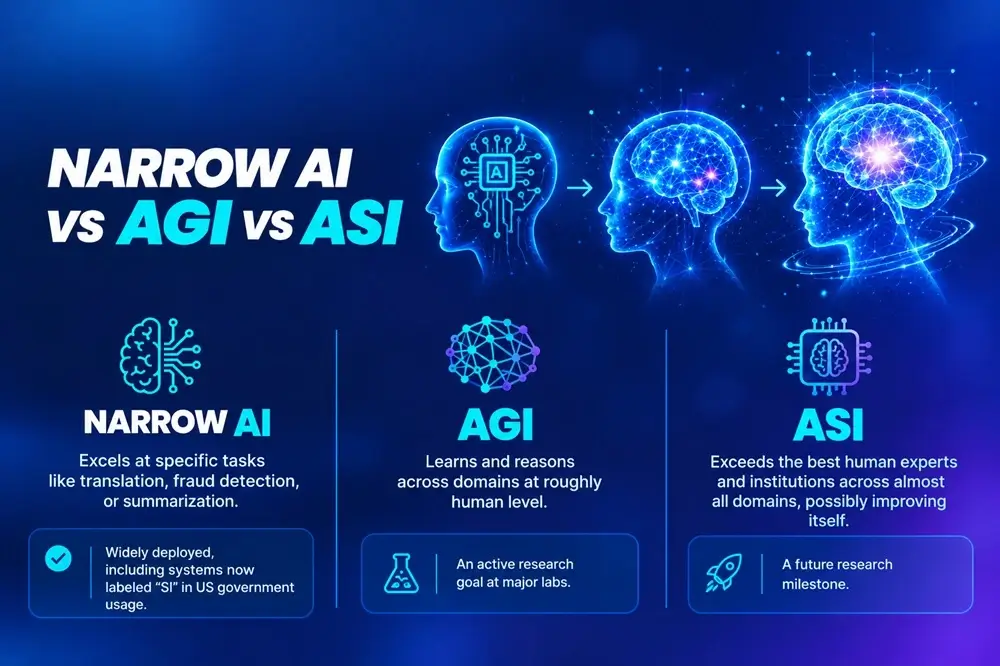
These three terms often overlap in conversation, especially now that “SI” is an official label for everyday AI. Here’s a simple way to tell them apart:
| Stage | What it can do | Where it stands today |
|---|---|---|
| Narrow AI | Excels at specific tasks like translation, fraud detection, or summarization | Widely deployed, including systems now labeled “SI” in US government usage |
| AGI (artificial general intelligence) | Learns and reasons across domains at roughly human level | An active research goal at major labs |
| ASI (artificial super intelligence) | Exceeds the best human experts and institutions across almost all domains, possibly improving itself | A future research milestone |
When a vendor describes its product as “super intelligent,” it helps to ask which of these three it means. In most cases, it’s a highly capable narrow AI system.
Also Read: AI Vs AGI
How Could We Get From Today’s AI to ASI?
The most detailed public analysis so far comes from Google DeepMind. A fourteen-person DeepMind team submitted a report titled “From AGI to ASI” to arXiv on 10 June 2026, led by Tim Genewein. It identifies four pathways that can work together, so the actual route may combine several of them.
1. Scaling
The first pathway is scaling: more compute, more data, and more algorithmic efficiency combining to produce systems that keep improving along existing trajectories. Think of it as building on what already works, at a larger scale.
2. New Algorithms and Paradigm Shifts
A new method could unlock capabilities beyond what scaling alone delivers. Many of the biggest leaps in AI history came from fresh ideas rather than more hardware.
3. Recursive Self-Improvement
This is I.J. Good’s idea in modern form. An AI system that contributes meaningfully to AI research could speed up the development of its own successors.
4. Multi-Agent Collectives
This route envisions ASI emerging from large networks of AGI-level agents working together, rather than a single system. You can already see a small-scale version in enterprise multi-agent workflows, where several specialized agents collaborate on one task.
The report also discusses practical factors such as compute costs, energy, data availability, and coordination, all of which shape how fast each pathway could progress. That’s why careful researchers describe possibilities rather than fixed dates.
How Close Are We to Artificial Super Intelligence?
The timing is still an open question, and researchers approach it with healthy humility.
The largest survey on the topic offers useful perspective. In that study, 2,778 researchers who had published in top-tier AI venues estimated that, if science continues on its current path, the chance of machines outperforming humans in every possible task was 10% by 2027 and 50% by 2047, which was 13 years earlier than a similar survey run a year before. This measures human-level performance on all tasks, which is a milestone on the way to ASI rather than ASI itself.
Researchers were also optimistic overall. 68% thought good outcomes from high-level machine intelligence were more likely, and there was broad agreement that research focused on safe AI development deserves more priority.
The takeaway for you: expert forecasts have moved earlier over time, and the smartest planning approach is one that stays flexible.
Why Super Intelligence Matters?
Even as a future milestone, super intelligence already shapes funding, policy, product roadmaps, and public conversation. Here’s why it deserves your attention.
It Is Guiding Where the Industry Invests
Leading AI organizations are building around this goal. Meta formed a division called Meta Superintelligence Labs, focused on research and development in artificial superintelligence. Safe Superintelligence Inc., founded in June 2024 by Ilya Sutskever, Daniel Gross, and Daniel Levy, is dedicated to developing superintelligence safely. As the largest labs aim for ASI, the tools that reach businesses along the way become more capable and more autonomous.
It Is Advancing Responsible AI Development
Safety is a central part of the super intelligence conversation. A public statement hosted by the Future of Life Institute calls for broad scientific consensus that superintelligence can be developed safely and controllably, along with strong public support, before development moves ahead. This focus is pushing the entire field toward better evaluation, transparency, and alignment research, which benefits the AI tools businesses use today.
It Strengthens How You Govern the AI You Already Have
This is the most practical reason super intelligence matters. The practices that would matter for advanced future systems, such as clear permissions, audit trails, human sign-off on high-impact actions, and response plans, are the same practices that make today’s AI more dependable and easier to scale. Building them now pays off under every timeline.
It Shapes Your Language, Contracts, and Content
If you work with US federal agencies, “SI” will increasingly appear in documents you receive. Clarifying in proposals and contracts whether “SI” refers to today’s AI systems (government usage) or advanced future systems (research usage) keeps everyone aligned from the start.
How AI Development Companies Are Preparing for the Super Intelligence Era?
As models grow more capable with every release, the way AI solutions are built is evolving too. Forward-looking AI development companies are designing systems that can absorb new capabilities smoothly, so each leap in model performance becomes an upgrade for their clients rather than a rebuild.
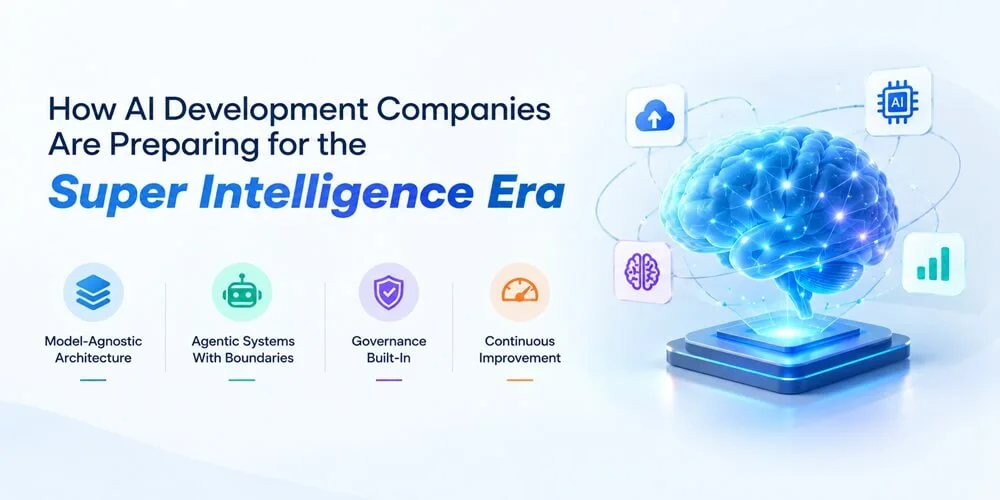
Model-Agnostic Architecture
Leading teams build applications that can switch between foundation models as better options arrive. By keeping business logic, data pipelines, and user experience separate from the model layer, you can adopt a stronger model in weeks instead of months. This approach sits at the heart of modern LLM development.
Agentic Systems With Clear Boundaries
AI agents that plan, use tools, and complete multi-step work are one of the clearest signs of progress toward more general intelligence. Development teams now design these agents with defined permissions, approval checkpoints, and full activity logs from day one. You get the productivity of autonomous workflows along with complete visibility, which is the focus of AI agent development.
Governance Built Into the Delivery Pipeline
Responsible development is becoming part of the engineering process itself. Prompts, datasets, and policies are versioned together, AI-driven changes go through review like code changes, and every release includes evaluation results. This gives your leadership and compliance teams clear evidence of how each system behaves.
Continuous Evaluation and Improvement
Capable AI teams measure performance continuously after launch, tracking accuracy, response quality, and user outcomes. When a new model becomes available, they compare it against a measured baseline, so upgrade decisions are based on real data from your own use cases.
What Businesses Can Do About Super Intelligence Now
You don’t need a view on ASI timelines to make strong moves today. Focus on what you can shape.
Map the AI You Already Run
List every model, assistant, and agent in use, including tools teams adopted on their own. Note what data each one can reach and what actions it can take.
Match Oversight to Business Impact
A model summarizing meeting notes needs lighter oversight than one approving payments or answering customer account questions. Regulated sectors lead the way here, which is why the governance practices in our guide to AI in banking apply well beyond financial services.
Ground Your Models in Trusted Data
AI performs best when it can draw on the right information. Retrieval-based architectures keep responses connected to approved sources, which is the focus of RAG development.
Keep People in Charge of High-Stakes Decisions
Let AI draft, recommend, and automate routine steps, while people approve decisions with legal, financial, or safety impact. For repetitive, rules-based work, pairing AI with robotic process automation delivers speed while keeping judgment with your team.
Also Read: Latest Developments in AI
What to Look for in an AI Development Partner
With AI capabilities advancing quickly, choosing the right development partner shapes how well your business can keep pace. Here’s what to prioritize.
Proven Delivery Across Industries
Look for a team with a track record of shipping production systems, not only prototypes. Experience across sectors such as finance, healthcare, retail, and logistics means they understand the data, workflows, and compliance needs that make AI succeed in the real world.
Strength in Both AI and Core Engineering
Great AI products depend on solid software engineering: APIs, cloud infrastructure, data engineering, and integration with your existing systems. A partner strong in both areas can take your project from idea to scaled deployment. AI integration services are a good test of this combined capability.
A Strategy-First Approach
The best partners start by identifying where AI creates measurable value for your business, then build a roadmap around those use cases. AI consulting at the start of a project helps you invest in the right priorities first.
Flexible Engagement Models
Your needs will evolve as AI evolves. Choose a partner that offers fixed-price projects for defined scopes, time-and-material engagements for agile work, and dedicated teams for ongoing product development, so you can scale up or shift direction with ease.
How Xicom Helps You Build Practical, Governed AI Today
Super intelligence may lead the headlines, but lasting results come from AI that performs reliably inside your real systems. That’s where Xicom focuses.
With 20+ years of software delivery, 1,800+ projects, and clients across 50+ countries, Xicom builds AI that delivers value now and adapts as models advance. Our teams design customer-facing assistants through conversational AI consulting, build language understanding into products with NLP development services, and connect outputs to your own data with retrieval-based architectures. Every engagement starts with scoped use cases, clear access controls, and human oversight built in, so your AI grows in capability with confidence.
Whatever name the technology carries next, you’ll have a foundation that is measurable, well governed, and ready to scale.
Conclusion
Super intelligence now has two meanings, and understanding both helps you plan with clarity. As a US government term, SI is a new name for today’s AI. As a research concept, artificial super intelligence describes future systems that would surpass the best human experts and institutions. Researchers are mapping several promising pathways toward ASI while staying thoughtful about timing. What you can act on today is strong AI governance. Build clear controls, trusted data pipelines, and human accountability now, and you’ll be ready for whatever the next generation of AI brings.
FAQs
1. What is super intelligence?
Super intelligence has two current meanings. In US federal usage since September 2026, “Super Intelligence” or “SI” is the official term for artificial intelligence. In AI research, super intelligence refers to a future system that would outperform the best human experts across nearly every cognitive domain.
2. Is SI the same as AI now?
In US government documents, yes. The executive order defines SI using the existing federal definition of AI, so it covers the same technologies. Outside US federal communications, “AI” remains the common term worldwide.
3. What is artificial super intelligence (ASI)?
ASI is the research term for AI that would exceed human intelligence across virtually all domains, including science, strategy, and creativity. Many definitions also include the ability to improve its own design. It is the next step beyond AGI.
4. What is the difference between AGI and ASI?
AGI would match human-level ability across a wide range of tasks. ASI would go further and outperform even large, coordinated teams of human experts. A simple way to think about it: AGI is peer-level, while ASI goes beyond any human institution.
5. Does super intelligence exist today?
Artificial super intelligence is still a research milestone. Today’s systems, including those now called SI in US government usage, are specialized, even when they are highly capable. Researchers view ASI as a possible future development.
6. How can an AI development company help my business prepare for super intelligence?
A skilled AI development company builds your systems on flexible, model-agnostic architecture, so you can adopt more capable models as they arrive. It also sets up governance, data pipelines, and evaluation processes that support every stage of AI progress, from today’s tools to more advanced future systems.
7. Should my business wait for more advanced AI before investing?
Today’s AI already delivers measurable value in automation, customer engagement, and decision support. Building now also creates the data foundation, integrations, and governance practices that let you benefit fastest from each new generation of models.
8. Why does super intelligence matter for businesses?
It shapes where AI labs invest, how policymakers think, and how quickly AI tools become more autonomous. The practical takeaway is to build strong governance, trusted data, and human oversight into the AI you already use.

Make your ideas turn into reality
With our AI & mobile app solutions
Explore related services
Based on this article's topic