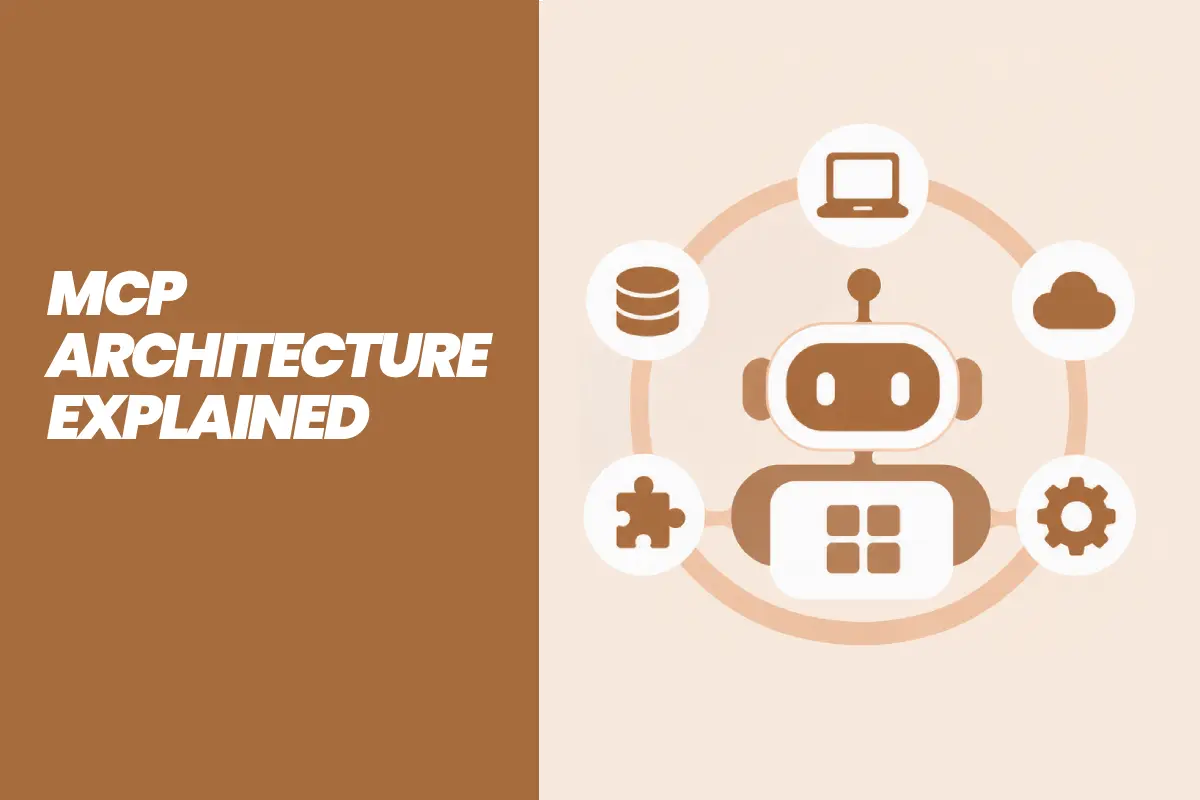
Quick AnswerMCP architecture is a client-server design with three roles. The host is the AI application, such as an IDE or chat assistant. Inside it, one MCP client connects to each MCP server. Servers expose three primitives: tools the model can call, resources that provide context, and prompts that structure interactions. Messages use JSON-RPC 2.0 over stdio for local servers or Streamable HTTP for remote ones. Every AI agent eventually hits the same wall: the data and tools it needs live in other systems. MCP architecture is the standard way across that wall. Instead of writing a separate integration between every AI application and every system, the Model Context Protocol defines one interface: a system is wrapped once as an MCP server, and any compatible AI application can use it. This guide walks through how MCP architecture is put together, follows a real request from question to answer, compares the deployment patterns teams actually use, and covers the security decisions that matter most. Why The Model Context Protocol Exists Picture a company with five AI applications (a coding assistant, a support agent, an internal chatbot and two analytics tools) and eight systems they need to reach. Without a standard, that is up to forty separate integrations, each with its own authentication, error handling and maintenance. Add a new system and every application needs another one. MCP architecture turns that grid into a hub, which is the whole point of the Model Context Protocol. Each system is exposed once as an
Read MoreNov 16, 2026 Artificial Intelligence Comments Off on MCP Architecture Explained: How The Model Context Protocol Works
Nov 16, 2026 Artificial Intelligence Comments Off on MCP Architecture Explained: How The Model Context Protocol Works
MCP Architecture Explained: How The Model Context Protocol Works
Nov 16, 2026 App Development Comments Off on SwiftUI vs UIKit in 2027: Which Should You Choose for Your iOS App?
Nov 16, 2026 App Development Comments Off on SwiftUI vs UIKit in 2027: Which Should You Choose for Your iOS App?
SwiftUI vs UIKit in 2027: Which Should You Choose for Your iOS App?
If you are planning a new iPhone app or modernizing an existing one in 2027, the SwiftUI vs UIKit question will come up early. It shapes how fast your team ships, how much the app costs to maintain, and how easily you can add the features users now expect. The stakes are higher this year. iOS 27 brings deeper Apple Intelligence features, foldable and larger-screen iPhones demand layouts that adapt to any window size, and on-device AI is becoming a standard part of good apps rather than an extra. This guide explains the real differences between SwiftUI and UIKit from a business point of view: cost, timeline, team, AI readiness and long-term upkeep. Key Takeaways The Short Answer In the SwiftUI vs UIKit choice for 2027, SwiftUI is the right default for most new iOS apps. It is faster to build with, adapts more easily to new screen sizes, and fits naturally with Apple’s newest AI frameworks. UIKit is still the better choice for large legacy apps, highly custom interfaces and apps that must support older iOS versions. Many serious apps use both. Choose SwiftUI if: Choose UIKit if: Swift, SwiftUI and UIKit Explained in Plain Terms A lot of confusion in the swift vs swiftui debate comes from comparing things that are not the same kind of tool. Here is the simple version. Swift is the programming language. Apple introduced it in 2014 to replace Objective-C, and it is now the standard language for iOS development. The Swift project
Read MoreNov 16, 2026 App Development Comments Off on Kotlin vs Java for Android App Development: Which Should You Choose in 2027?
Nov 16, 2026 App Development Comments Off on Kotlin vs Java for Android App Development: Which Should You Choose in 2027?
Kotlin vs Java for Android App Development: Which Should You Choose in 2027?
Choosing a language is one of the first decisions in any Android project, and in 2027 the Kotlin vs Java question has a clearer answer than ever. It still deserves a careful look, because the right choice depends on whether you are starting fresh or maintaining an app that already runs on Java. Three changes make the decision more important this year. Android 17 is built around Jetpack Compose, apps must now adapt to tablets, foldables and large screens, and on-device AI is becoming part of everyday app features. This guide compares Kotlin and Java from a business point of view: what each means for your budget, timeline, team and roadmap. If you are planning a new build or a modernization. Key Takeaways The Short Answer When it comes to Kotlin vs Java for Android, the answer for new apps in 2027 is Kotlin. Google has made Compose the center of Android development, and its newest tools, samples and AI features assume Kotlin. Java remains a reliable language, and it still makes sense when you already have a large, stable Java codebase or share code with Java backend systems. Choose Kotlin if: Stick with Java if: What Is the Difference Between Kotlin and Java? Java has been around since the mid-1990s and was the original language of Android. It runs on the JVM, powers a huge share of enterprise and backend software, and keeps improving through OpenJDK releases. Modern Java includes records, the var keyword and, on the server side,
Read MoreNov 3, 2026 App Development 0

Nov 3, 2026 App Development 0
How to Develop an On-Demand Roadside Assistance App?
Troubling with a flat tire all alone on the highway can be a serious situation that anyone can deal with. And this is common to happen with every fourth person. This is where planning to launch an on-demand roadside assistance app can be a great business idea for you. Here are the complete details including features, market overview, cost, monetization strategies, and more.
Read MoreNov 2, 2026 App Development 0

Nov 2, 2026 App Development 0
How Much Does it Cost to Create a Taxi Booking App?
Looking to become the next big name after Uber in the on-demand taxi booking app industry? Venturing into the taxi booking app industry is a worthy decision. Here we have a complete guide estimating the cost to create a taxi booking app, its timeline, features, tips and ways to monetize the app solution. Let's get into it!
Read MoreOct 29, 2026 App Development 0

Oct 29, 2026 App Development 0
How Much Does it Cost to Build Fitness App?
Fitness apps are redefining the way people can stay active, fit, and healthy. Not only do these smart solutions fit modern fitness training needs, but they also ensure customized training and fitness plans. If you’re also looking to venture into the fitness app development market, then refer to this guide.
Read MoreAug 10, 2026 Artificial Intelligence 1
Aug 10, 2026 Artificial Intelligence 1
AI Governance Challenges: Enterprise Security, Compliance, and Scalability
Key Takeaways Most companies didn’t plan to be here. AI moved from pilot projects to production systems faster than the policies meant to control it, and now governance teams are retrofitting oversight onto tools that are already making decisions, approving claims, flagging transactions, and scoring resumes. That sequencing problem is the root of nearly every AI governance challenge we see at Xicom, and it’s why implementing AI governance has quietly become one of the hardest engineering and organizational problems in enterprise technology right now. This piece walks through the AI governance challenges that actually slow companies down, backed by current research, and what our AI governance consulting engagements have shown works when clients move from policy documents to real operational control. Enterprise AI Governance Landscape: Why AI Governance Challenges Hit Medium and Large Enterprises Differently A ten-person startup running one internal AI tool has a coordination problem. A five-thousand-person enterprise running AI across claims processing, hiring, fraud detection, and customer service has a visibility problem; nobody in the building can list every model currently making decisions. That gap between where AI operates and where governance can actually see it is now well documented. Gartner projects spending on dedicated AI governance platforms will reach $492 million in 2026, en route to surpassing $1 billion by 2030, as fragmented AI regulation extends to roughly 75% of the world’s economies. The money is moving toward governance because the informal, spreadsheet-based approach that worked for a handful of pilot projects doesn’t survive contact with
Read MoreAug 4, 2026 Artificial Intelligence, Software Development 0
Aug 4, 2026 Artificial Intelligence, Software Development 0
AI in Healthcare Compliance: Navigating HIPAA and FDA Regulations for Leaders
Key Takeaways Most healthcare AI projects fail their first compliance review for the same reason: the team building the product assumed HIPAA compliance and FDA AI development compliance were the same conversation. They aren’t. HIPAA governs how patient data moves through your system. The FDA governs whether your software is making a medical decision, and if so, how much evidence you need before it’s allowed to. A model can be fully HIPAA-compliant; encrypted, access-controlled, logged to the letter, and still be an unregistered medical device the moment it recommends a dosage or flags a diagnosis. HIPAA and FDA AI in healthcare regulations are often treated as one conversation. They aren’t, and the gap between them is where most compliance failures start. We’ve watched this catch founders off guard more than once. The engineering team ships a triage assistant, checks the HIPAA box because PHI is encrypted at rest and in transit, and only discovers during a hospital procurement review that the FDA considers their output “clinical decision support” requiring 510(k) clearance. By then, the architecture is already built around assumptions that don’t hold up under FDA scrutiny, no audit trail for individual model versions, no change-control documentation, no way to demonstrate the training data didn’t drift. This piece is meant to close that gap. We’re walking through what HIPAA compliance in AI healthcare development actually requires at the architecture level, where FDA AI development kicks in, and where the two frameworks pull in different directions. HIPAA Compliance in AI Healthcare
Read MoreJul 29, 2026 Artificial Intelligence 0
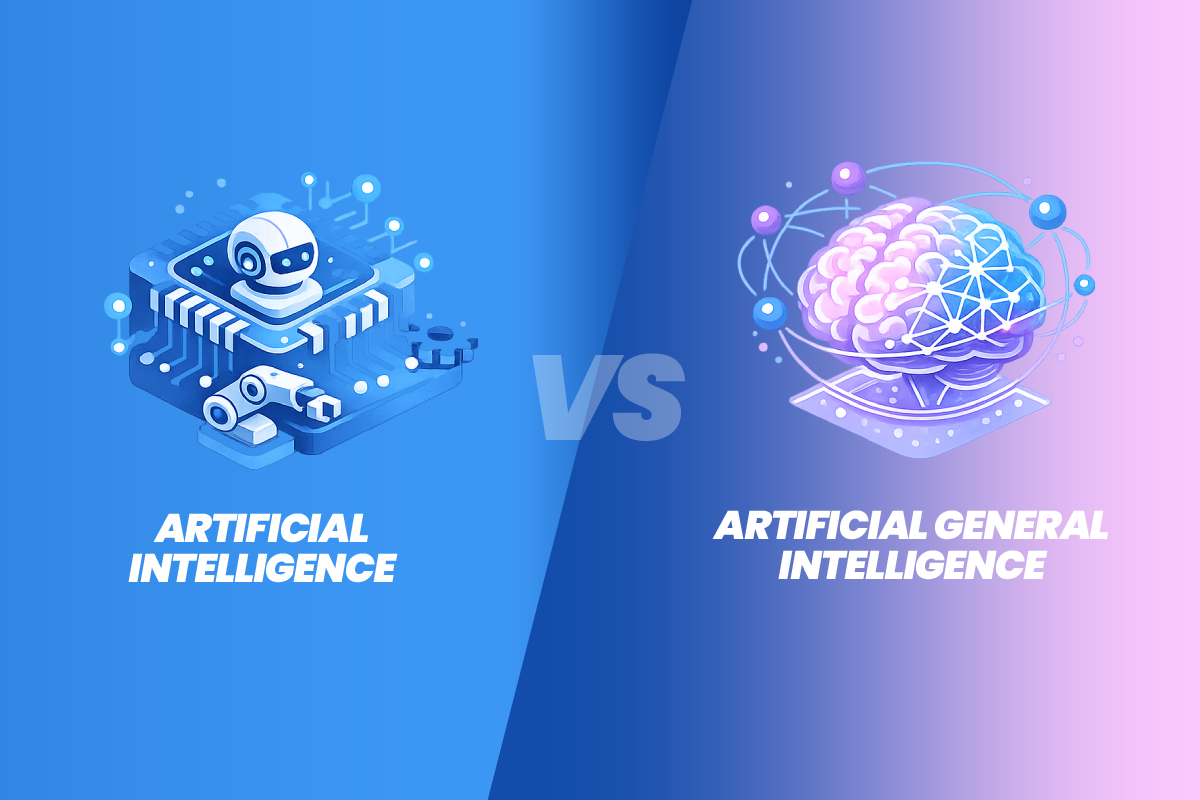
Jul 29, 2026 Artificial Intelligence 0
AI Vs AGI: What’s the Difference Between AI and AGI?
Key Takeaways The line between domain-specific machine learning and general cognitive autonomy is shifting faster than standard enterprise software cycles can adapt. While narrow AI already powers operations, misjudging the leap toward artificial general intelligence leaves legacy systems exposed to architectural obsolescence. Understanding where current models end and true system autonomy begins isn’t academic, it dictates how you allocate capital today. In boardrooms and engineering standups alike, the terms ASI, AGI or AI get tossed around interchangeably. But from an engineering standpoint, treating them as points on a single linear timeline misses the point entirely. At Xicom, we spend our days building custom enterprise software, training targeted large language models, and architecting multi-agent production frameworks. We witness firsthand how misinterpreting these concepts leads directly to poor tech stack investments, brittle integration layers, and misaligned roadmaps. Narrow artificial intelligence optimizes specific operations right now. Artificial general intelligence promises human-grade transfer learning across unstructured domains. Artificial superintelligence remains an operational hypothesis. Navigating this terrain requires looking past vendor hype. Enterprise engineering teams must understand the architectural realities, underlying mechanics, and concrete execution paths that connect specialized software models to next-generation autonomous environments. What is AI Vs AGI? The Core Distinction What is Artificial Intelligence (AI)? Artificial Intelligence (AI), as it exists commercially today, is narrow by design. It’s trained to do specific things: write copy, price a policy, flag fraudulent transactions, route a support ticket, and it does them well within that lane. Step outside the lane, and it stops working. A
Read MoreJul 28, 2026 Artificial Intelligence 1
Jul 28, 2026 Artificial Intelligence 1
AI Development Cost Guide 2026: Budgets, Ranges, and Hidden Costs
Quick AnswerAI development costs $15,000 to $45,000 for a proof of concept (4 to 6 weeks), $45,000 to $120,000 for a production MVP (8 to 14 weeks), $120,000 to $350,000 for an enterprise AI platform (14 to 24 weeks), and $350,000 to $750,000+ for custom foundation models or autonomous systems (6 to 12+ months). Data preparation typically takes 20 to 40% of the budget, and compliance such as HIPAA, GDPR or SOC 2 adds another 20 to 40%. An offshore AI/ML partner typically bills $25 to $49 per hour, compared with $150 to $300 for a US AI agency. Most AI budgets are wrong before the first line of code is written, not because the estimate was careless, but because it priced the demo, not the system. Ask five vendors what AI development costs and you will get five different numbers, none of which agree on what is included. One quote covers the model. Another covers the model plus the application around it. A third quietly leaves out data labeling, cloud compute and the months of tuning it takes to move accuracy from impressive demo to safe to ship. That is not a pricing problem; it is a scoping problem, and it is the single biggest reason AI budgets blow past their original estimate. We put this guide together to close that gap. Below, you will find current cost ranges by project tier and use case, the cost drivers that actually move your quote, team rates by region, the running
Read MoreJul 24, 2026 Artificial Intelligence 2

Jul 24, 2026 Artificial Intelligence 2
AI Agent for Fraud Detection: Architectural Blueprint for Enterprise Risk Mitigation
Key Takeaways Most fraud detection stacks today are still running on rules someone wrote three years ago. A transaction over a certain amount gets flagged. A login from a new device gets a second factor. A wire transfer to a new payee gets held for review. These rules worked when fraud was slower and more predictable. They don’t work anymore, because the people committing fraud have automated their side of the equation, and most banks, fintech’s, and marketplaces haven’t automated theirs. That gap is where AI agent for fraud detection come in. Not as a buzzword bolted onto an existing rules engine, but as a genuinely different way of handling risk decisions; one where software investigates, cross-references, and acts on its own, instead of just flagging something for a human to look at three days later. We’ve spent the last few years building agent-based systems for financial platforms and analyzing agentic AI use cases, and this piece is our attempt to lay out, plainly, what these systems actually do, where they help, and where the real work is in deploying them. What Are AI Agent in Fraud Detection? An AI agent is software that can perceive a situation, decide what to do about it, and take that action without waiting for a person to approve every step. In fraud detection, that means the agent doesn’t just score a transaction and hand it off. It pulls the customer’s transaction history, checks device fingerprints, cross-references known fraud patterns, and either clears, escalates,
Read MoreJul 17, 2026 Artificial Intelligence 0
Jul 17, 2026 Artificial Intelligence 0
AI Agent for Sales: Use Cases, Benefits, Compliance, and How to Build?
Key Takeaways In an era of rapid regulatory shifts, highly volatile tech valuations, and intensifying corporate demands for clear capital efficiency, the architectural integrity of a sales ecosystem directly correlates with its conversion ceiling. Relying on legacy customer relationship systems that require constant, manual data input is no longer practical or sustainable for scaling operations. Modern, hyper-competitive enterprise teams are rapidly shifting away from static software models to embrace dynamic, autonomous ecosystems driven by an integrated AI agent for sales. According to a 2026 enterprise study by Grand View Research, the global market for autonomous systems is expanding dramatically, valued at $10.9 billion this year and projected to accelerate to $182.9 billion by 2033. This seismic structural growth reflects a definitive shift in operational strategy: B2B companies are moving past standard automation scripts to integrate advanced, self-correcting workflows that actively manage customer relationships from initial contact to closed contract. Architectural Differentiation: AI Agent vs Chatbot Systems Enterprise technology leaders must maintain precise definitions when evaluating intelligent sales software. Mistaking conversational scripts for autonomous systems often leads to poor integration and wasted engineering hours. Scripted Linear Rule Trees Traditional customer service setups rely on predefined, deterministic trees. They require users to click specific buttons or type exact phrases, working within strict limits. If a prospect’s query deviates from the expected track, the system stalls, requiring a manual handoff to a human representative. These setups lack any capability for situational awareness, proactive planning, or independent decision-making. Autonomous Agentic Frameworks True agentic AI
Read MoreJul 10, 2026 Software Development 0

Jul 10, 2026 Software Development 0
How to Build GDPR Compliance Software: Features, Tech Stack & Cost
The implementation of General Data Protection Regulation (GDPR) significantly changed the way companies collect, process, and store personal data in Europe. Since May 2018, when it entered into force, organizations incurred penalties of over €4.5 billion. The sum tends to increase. For organizations working with the data of citizens of EU member states, compliance with GDPR is not a matter of choice; it is a legal obligation with serious fines involved. These two reasons explain why the demand for GDPR compliance solutions has increased so much over the last years. However, building such software is far from being easy. You need to have good knowledge of specific requirements, strong technical expertise, and an adequate way of developing a solution. In this article, we have prepared a comprehensive guide to building GDPR compliance software. You will have a chance to learn what such software does, how to choose the right technology stack, as well as get familiar with potential expenses and pitfalls related to the project. What Is GDPR Compliance Software? GDPR compliance software is a digital tool that helps organizations meet the requirements of the General Data Protection Regulation. They make the required tasks required of an organization easy and efficient. Primarily, this type of software lets organizations know what personal data they are collecting as well as where, who, and how they are using it. Moreover, the software can store and use consent records, manage requests and provide audits for regulatory processes. The software can be considered to be
Read MoreJul 7, 2026 Artificial Intelligence 0
Jul 7, 2026 Artificial Intelligence 0
How to Build an AI Agent: Complete Step-by-Step Guide (2026)
Key Takeaways AI agents are redefining how businesses automate work, make decisions, and interact with customers. According to the Capgemini Research Institute’s Generative AI in Organizations 2024 report, 82% of organizations plan to integrate AI agents within the next one to three years, highlighting the growing demand for systems that can reason, use tools, and execute tasks autonomously. As adoption accelerates, organizations are shifting their focus from experimenting with AI models to building reliable, production-ready agents. Developing an AI agent, however, involves much more than choosing an LLM. It requires thoughtful decisions around architecture, knowledge retrieval, tool integrations, security, and continuous optimization. Having designed and delivered AI solutions across diverse business use cases, we’ve learned that these engineering decisions have a far greater impact on an agent’s success than the model itself. In this guide, we walk through how to build an AI agent step by step, from selecting the right use case and architecture to integrating enterprise data, connecting external tools, testing workflows, and preparing the system for production. What Is an AI Agent? An AI agent is an intelligent software system that can reason, make decisions, and execute tasks to achieve a defined objective with minimal human intervention. Unlike traditional AI applications that primarily generate responses, AI agents combine an LLM with planning, memory, knowledge retrieval, and tool integrations to execute multi-step workflows and interact with business systems. Core Characteristics An AI agent combines several capabilities that work together to execute a task. Capability Purpose Goal-oriented reasoning Plans
Read MoreJul 3, 2026 Artificial Intelligence, Software Development 1
Jul 3, 2026 Artificial Intelligence, Software Development 1
AI Software Frameworks: A Complete Practical Guide
Key Takeaways AI software frameworks provide the foundation for developing modern AI applications. They offer the libraries, APIs, runtime environments, and development tools needed to build, train, deploy, and manage AI models without requiring developers to implement complex capabilities such as automatic differentiation, distributed computing, hardware acceleration, and model optimization from scratch. By abstracting this complexity, frameworks accelerate development while improving performance, scalability, and reliability. Their role has become increasingly important as enterprise AI adoption continues to grow. According to the McKinsey 2025 State of AI report, 78% of organizations now use AI in at least one business function, reflecting AI’s transition from experimental projects to production systems. As organizations scale their AI initiatives, the framework they choose directly impacts development speed, deployment flexibility, infrastructure costs, integration capabilities, and long-term maintainability. This guide explores the different types of AI software frameworks, their core components, selection criteria, licensing models, and their role in building scalable AI systems. What Is a Software Framework for AI? An AI software framework is a software foundation that provides the libraries, runtime components, APIs, and development abstractions required to build AI applications. Rather than implementing numerical computation, optimization routines, and execution logic for every project, an AI software development company can accelerate delivery by using standardized components maintained by these frameworks, enabling faster, scalable, and more efficient AI solution development. Underlying infrastructure remains largely abstracted from application code. Automatic differentiation engines compute gradients during training, execution runtimes distribute workloads across available hardware, and optimized libraries perform
Read MoreJun 30, 2026 Artificial Intelligence 0
Jun 30, 2026 Artificial Intelligence 0
AI in Legal: Use Cases, Benefits & Future Trends in 2026
The legal industry is going through a major change as there has been increased interest in the application of artificial intelligence within the field of legal services. AI has enabled law firms to enhance their efficiency and improve decision-making by automating various tasks. In recent years, the utilisation of AI in the legal field has grown significantly. As per the American Bar Association’s legal technology survey report for 2024, the usage of AI in legal practice has increased from 11 percent in 2023 to 30 percent in 2024, and this indicates growing trust among legal professionals in AI-based solutions. Moreover, it should be noted that Thomson Reuters has also stated that 26 percent of legal firms are utilising generative AI, while 78 percent think it will become an important part of their workflow within the next five years. Because legal business organisations have been facing the challenge of dealing with increasingly large amounts of paperwork, regulation issues, and high expectations from clients, artificial intelligence has become a very helpful technology in helping companies operate more efficiently. In this article, we will consider the role of AI in legal organisations and its possible applications in the future. Why is AI Becoming Essential in the Legal Industry? The role of AI in legal businesses has grown remarkably over time. The high workload, compliance issues, and rising expectations from clients are creating a need for more efficient and effective operational solutions in legal firms. Some of the key factors driving AI adoption in
Read MoreMay 4, 2026 Software Development, Artificial Intelligence 1
May 4, 2026 Software Development, Artificial Intelligence 1
Generative AI in Manufacturing: Integration Approaches, Use Cases, and Future Outlook
Manufacturing doesn’t limit itself to machines and stressful manual processes. It has become extremely intelligent and data-driven. Generative AI in manufacturing is a technology that doesn’t just assess data but builds solutions, strategies, and designs in real time. It encourages product efficiency and optimizes supply chains by assessing a vast set of data to generate new optimized solutions. Some of its key applications include predictive maintenance, quality control, and generative design. The global generative AI in manufacturing market size is expected to reach USD 13,893.51 million by 2034. It is expanding at a CAGR of 41% over the forecast period. As per the trends of KPMG, 78% of industrial manufacturing executives now consider GenAI as their leading emerging technology. Its applications are improving production planning through real-time data analysis. Let us learn more about its influence on the manufacturing industry and how many companies have leveraged its values in recent years. How does Generative AI in manufacturing work? The operation of generative AI revolves around machine learning models. It predicts and optimizes outcomes based on input data. For example, it can give rise to prototypes that meet specific parameters of strength and cost more effectively than traditional techniques. The influential landscape of GenAI in manufacturing Generative AI can transform the manufacturing process by aligning the operations while fostering innovations. This enables you to adopt personalized production. As manufacturers recognize this technology’s great potential, its adoption has been growing efficiently. It has been driving efficiency while giving rise to many newer
Read MoreApr 30, 2026 Software Development 0

Apr 30, 2026 Software Development 0
Top 10 Software Development Outsourcing Companies in India (2026)
Looking to transform your business journey and trying hard to drive better ROI? The simple way is to outsource a software development company in India that can understand your business challenges and help you evolve in the modern era. Let’s check out the list of top outsourcing software development companies in India.
Read MoreApr 15, 2026 App Development 0

Apr 15, 2026 App Development 0
Top Mobile App Development Companies in India (2026)
India is one of the strongest places in the world to build a mobile app. The top mobile app development companies in India combine proven Android, iOS, and cross-platform expertise with AI capability, verified client reviews, and rates that typically run $25 to $49 an hour, well below what comparable agencies charge in the US or Europe. The best partner for you comes down to your budget, the kind of app you are building, and how much support you need after launch, and the companies in this guide cover every one of those needs. The hard part is choosing. Thousands of firms market the same services, and the wrong pick shows up later as missed deadlines, rework, and a bigger bill. To shorten your search, we reviewed Indian app developers on portfolio depth, technical range, verified reviews, and pricing, and narrowed the field to 12 companies with strong, verified track records. Mobile App Market Overview (2026) Mobile hit record highs on every key metric in 2025, and the money is moving toward apps that keep users engaged. Figures below come from Sensor Tower’s State of Mobile 2026 report and cover the iOS App Store and Google Play. What this means for buyers: downloads have flattened, so growth now comes from retention, subscriptions, and smarter features. A development partner today needs product and AI skills, not just the ability to ship screens. How We Selected These Companies Each company on this list cleared five checks: Firms without a deep, verified review
Read MoreApr 9, 2026 Artificial Intelligence 0
Apr 9, 2026 Artificial Intelligence 0
Azure AI vs AWS AI: Choosing the Right Cloud AI Platform
Choosing between Azure AI and AWS AI depends on your business goals, existing ecosystem, and scalability needs. This comparison explores key differences in pricing, tools, integrations, and performance to help you select the right cloud AI platform.
Read MoreApr 7, 2026 Artificial Intelligence 0
Apr 7, 2026 Artificial Intelligence 0
Agentic RAG: What it is, Types, Applications, and Implementation
Agentic RAG combines retrieval-augmented generation with autonomous decision-making, enabling AI systems to plan, act, and refine responses. This guide explores its types, real-world applications, and step-by-step implementation for building smarter, context-aware AI solutions.
Read MoreNov 7, 2025 Artificial Intelligence 0
Nov 7, 2025 Artificial Intelligence 0
AI in HR: Benefits, Challenges, and Solutions
Explore how artificial intelligence in HR is transforming the way organizations manage recruitment, employee engagement, and performance. Learn about its key benefits, major challenges, and innovative solutions driving smarter, data-driven human resource strategies.
Read MoreAug 27, 2025 Artificial Intelligence 0
Aug 27, 2025 Artificial Intelligence 0
Build an AI Copilot for Enterprises: Cost, Features, and Process
Still wondering whether you should build an AI copilot for Enterprises? Well, no matter how far we have come in terms of technology, some of the enterprises are still struggling with productivity gaps and operational inefficiencies. According to McKinsey, employees are spending nearly 1.8 hours per day (9.3 hours per week) just searching for internal information – which is a clear loss in value and efficiency. In other terms, every fifth employee is effectively off the clock, hunting for answers instead of contributing real value to the business. This is where enterprises are choosing to build an AI copilot. But what’s so different about it? The smart enterprise assistants are intentionally crafted to automate routine workflows. With these agents, enterprises can get real-time insights, and able to make faster decisions. AI copilots work smoothly with systems like CRM, ERP, and HRMS. Their primary role is to eliminate repetitive tasks. They enhance cross-team synergy. They also free employees to focus on high-impact work. Unlike generic AI assistants, enterprise AI copilots are built for specific business needs. They boost efficiency. They cut operational costs. And they adapt quickly to changing market conditions. According to the reports, enterprises shifted to copilot results into: Source: microsoft If you are also struggling with low productivity, lack of growth or decision making, then let’s understand how AI copilots help you with that. Moreover, in this blog, we are covering how to build an AI copilot for enterprises, it’s development process, features and cost. Let’s get started…
Read MoreMay 8, 2025 Artificial Intelligence 0

May 8, 2025 Artificial Intelligence 0
AI in Transportation: Redefining Use Cases, Its Benefits, and Future Trends
The transforming impact of AI in the transportation industry is making systems smarter, safer, and more efficient. This blog has covered everything that how the transportation industry is working and how AI is fueling the growth and innovation. Here's a complete guide to refer to top use cases, benefits, and its future possibilities.
Read MoreApr 4, 2025 App Development 0

Apr 4, 2025 App Development 0
How to Hire Mobile App Developer in Australia in 2026?
Starting a mobile app development project? But just having a great mobile app idea is not enough to get started. This would require you to hire a mobile app developer for your project. But how to hire mobile app developers in Australia in 2026? Here's a complete guide to refer to!
Read MoreMar 26, 2025 App Development Comments Off on How to Hire an iPhone App Developers in 2026

Mar 26, 2025 App Development Comments Off on How to Hire an iPhone App Developers in 2026
How to Hire an iPhone App Developers in 2026
Your endless search for, “how to hire an iOS app developer” ends here with this blog. From parameters to the cost to hire, this guide for hiring an iOS app developer encompasses all the necessary details that you would require to find an iOS app developer to build your iOS app.
Read MoreMar 3, 2025 Software Development, App Development 0

Mar 3, 2025 Software Development, App Development 0
HIPAA-Compliant App Development: Cost, Features and Step-by-Step Process
To secure the PHI, following the HIPAA-compliant app development process for your healthcare industry is a must. Here is your assisting guide with the process, costs and steps involved in developing such applications.
Read MoreFeb 12, 2025 Software Development 0

Feb 12, 2025 Software Development 0
Construction Software Development: A Complete Guide
This blog guide explores the top benefits of construction software development solutions, explaining how they can enhance your business in multiple areas. It also helps you estimate the average cost of creating custom construction software tailored to your business needs.
Read MoreJan 28, 2025 Artificial Intelligence, ecommerce 1

Jan 28, 2025 Artificial Intelligence, ecommerce 1
AI in Ecommerce: Its Applications and Benefits
AI in eCommerce transforms sales and offering promising business opportunities by analyzing purchase behavior and automating cart recovery. Explore our detailed guide on how AI is revolutionizing the eCommerce industry, its drasticall impact on revenue generation.
Read MoreJan 3, 2025 Artificial Intelligence 0

Jan 3, 2025 Artificial Intelligence 0
How AI in Stock Trading is Redefining the Financial Market?
The use of AI in stock trading can improve the efficiency of market prediction by giving access to data analytics and order execution tools and allowing investors to concentrate on strategic decisions. If you are wondering how artificial intelligence can help transform trading services, then tap into the complete blog.
Read More