How Much Does it Cost to Build an MVP: Realistic Ranges, AI MVP Budgets and Examples
MVP development cost explained: realistic ranges by complexity, platform and product type, AI MVP budgets, three worked examples and ways to reduce cost.
Nov 9, 2026 Software Development
Quick Answer
Custom CRM development typically costs $30,000 to $300,000 or more. A basic CRM for one sales team costs $30,000 to $60,000 and takes 2 to 4 months. A mid-level CRM with automation, integrations and a mobile app costs $60,000 to $150,000 over 4 to 8 months. Enterprise CRMs with complex workflows, AI and multiple system integrations start at $150,000 and take 8 to 12 months or longer.
Most companies start looking at a custom CRM for the same reason: the off-the-shelf tool no longer fits. Sales reps keep data in spreadsheets on the side, licence bills climb every renewal, and the workflows that make your business different are forced into someone else’s template.
Building your own CRM fixes those problems, but only if the budget is realistic from day one. Quotes for the same idea can range from a few thousand dollars to several hundred thousand, and it is rarely clear what sits behind each number.
This guide breaks down custom CRM development cost the way a software team estimates it: by complexity, by feature, by data migration effort, by team location and by what you keep paying after launch. You will also find a three-year comparison with SaaS CRMs and a short list of red flags to watch for in vendor quotes.
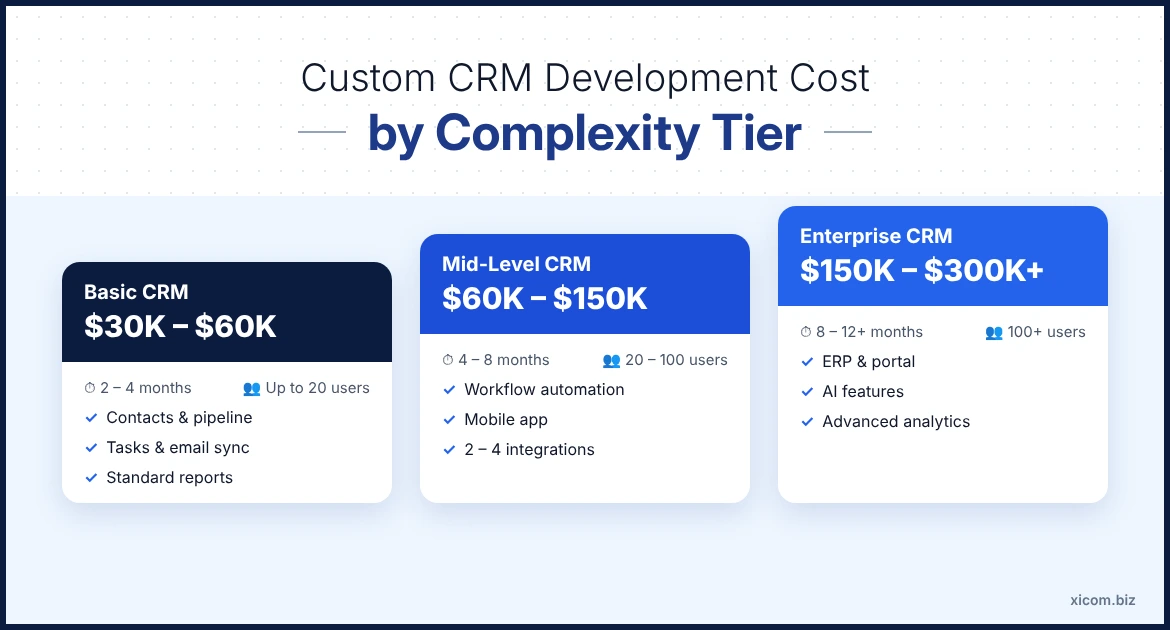
The fastest way to estimate the cost to build a CRM is to decide which of these three tiers matches your scope. The figures below are typical estimates for a production-ready CRM, covering discovery, design, development, testing and launch.
| Tier | What It Includes | Team Size It Suits | Estimated Cost | Timeline |
|---|---|---|---|---|
| Basic CRM | Contacts, one sales pipeline, tasks, email sync and standard reports | Up to 20 users | $30,000 – $60,000 | 2 – 4 months |
| Mid-Level CRM | Multiple pipelines, workflow automation, role-based access, mobile app and 2 to 4 integrations | 20 – 100 users | $60,000 – $150,000 | 4 – 8 months |
| Enterprise CRM | Complex business rules, customer portal, ERP and accounting integrations, AI features and advanced analytics | 100+ users | $150,000 – $300,000+ | 8 – 12+ months |
Most small and mid-size businesses land in the first two tiers. The enterprise tier is common when a CRM replaces several disconnected tools at once or becomes the system the whole company runs on.
If you already know which features you need, this table shows how each one adds to the cost to build a CRM. Each estimate covers design, development and testing for that feature in a typical business CRM.
| Feature | What It Covers | Typical Cost |
|---|---|---|
| Contact and account management | Contacts, companies, custom fields, search and duplicate checks | $4,000 – $8,000 |
| Sales pipeline and deal tracking | Stages, drag-and-drop boards, deal values and win/loss reasons | $5,000 – $10,000 |
| Tasks, activities and reminders | Follow-ups, call logs, notes and due-date alerts | $3,000 – $6,000 |
| Email and calendar sync | Two-way sync with Gmail or Outlook, email tracking and meeting booking | $5,000 – $12,000 |
| Reporting and dashboards | Sales reports, team performance and custom dashboards | $8,000 – $20,000 |
| Workflow automation | Lead assignment, approval flows, triggers and automated follow-ups | $10,000 – $25,000 |
| Roles, permissions and audit logs | Access by team, territory or record, plus change history | $5,000 – $12,000 |
| Mobile app (iOS and Android) | Field sales access, offline mode and push notifications | $20,000 – $50,000 |
| Customer self-service portal | Client logins, ticket or order status and document sharing | $15,000 – $35,000 |
| Accounting or ERP integration | Sync with QuickBooks, Xero, NetSuite, SAP or similar, per system | $8,000 – $25,000 |
| Quotes, invoicing and payments | Quote builder, invoices, online payments and payment status | $10,000 – $25,000 |
| Marketing automation | Segments, email campaigns, lead capture forms and attribution | $10,000 – $30,000 |
| AI features | Lead scoring, email drafting, summaries, forecasting or an assistant | $15,000 – $60,000+ |
A basic CRM, for example, combines the first five rows, which is why it typically lands between $30,000 and $60,000 once project management and testing are included.
AI is now the most requested add-on in CRM projects, and it is where budgets most often go wrong. AI features carry two costs: the one-time build and an ongoing usage cost for the language models or machine learning infrastructure behind them.
| AI Feature | What It Does | Typical Build Cost |
|---|---|---|
| Predictive lead scoring | Ranks leads by likelihood to convert using your historical deal data | $12,000 – $30,000 |
| AI email drafting | Writes follow-ups and replies using deal context and your tone | $8,000 – $20,000 |
| Call and meeting summaries | Transcribes calls, summarizes next steps and updates the record | $10,000 – $25,000 |
| Sales forecasting | Predicts pipeline revenue and flags deals at risk | $15,000 – $40,000 |
| AI assistant or chatbot | Answers questions about customers and deals in plain language | $10,000 – $35,000 |
Most teams start with one or two of these, which puts the AI layer at $15,000 to $60,000 or more. On top of that, budget for model usage. For a typical sales team, API costs for features like email drafting and summaries run from about $100 to $2,000 per month, depending on volume and the model you choose.
Two things keep AI costs under control. First, build on existing language models rather than training your own; custom models only make sense at very large scale. Second, start with the feature that saves the most time, usually meeting summaries or email drafting, and measure the result before adding more. If you are weighing AI across other products too, our guide to AI app development cost covers usage costs in more detail.
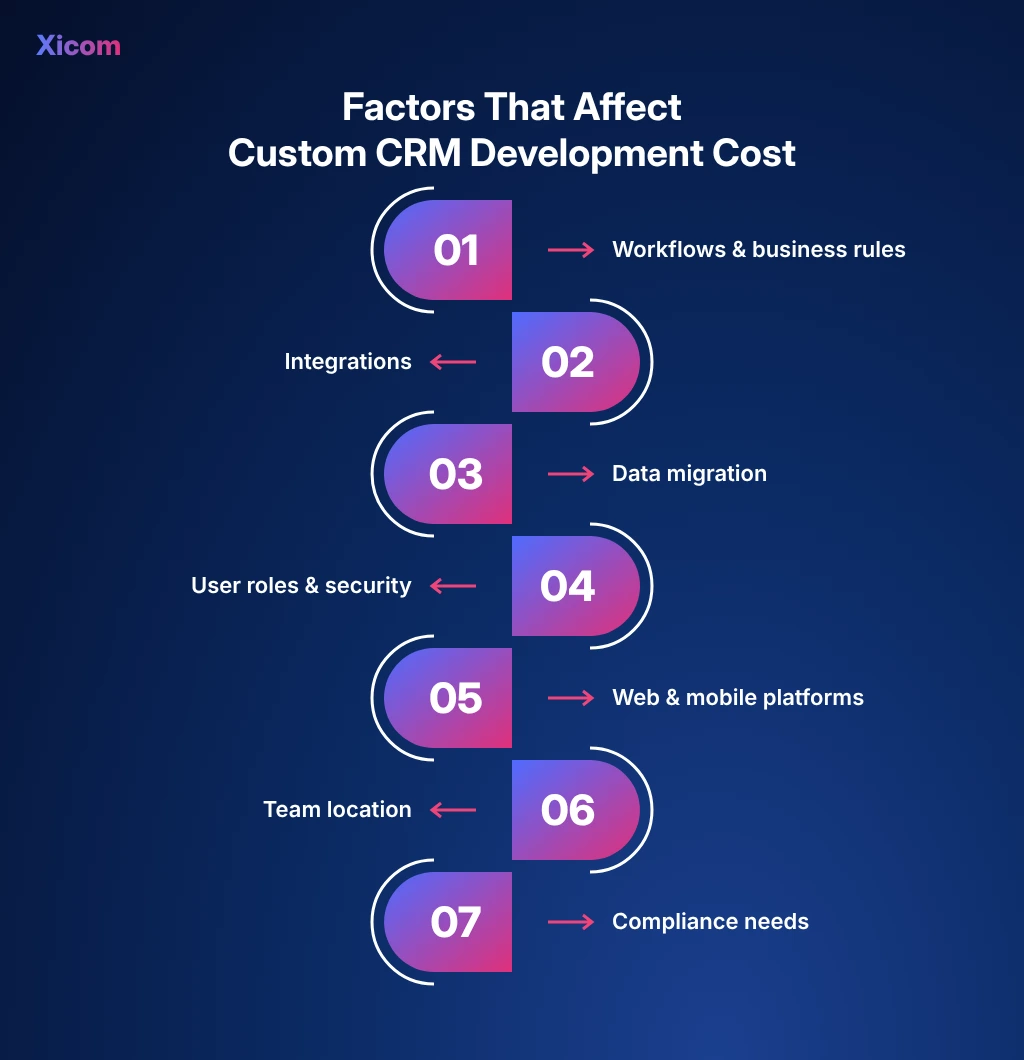
Two companies can describe the same CRM and receive very different quotes from CRM development services providers. These seven factors explain most of that difference.
This is the single biggest cost driver. A CRM with one pipeline and simple stages is quick to build. A CRM with territory-based routing, multi-step approvals, discount rules and different processes for each product line takes far longer to design and test.
Every system your CRM talks to adds work: email, telephony, accounting, ERP, marketing tools, e-commerce and support desks. Integrations with modern, well-documented APIs are straightforward. Legacy systems without APIs need custom connectors and add both time and risk.
Moving your existing customer data is often underestimated. The cost depends far more on how clean the data is than on how much of it there is.
| Current Data State | Estimated Cost | Why |
|---|---|---|
| One clean spreadsheet | $2,000 – $5,000 | Simple field mapping and a single import |
| Several spreadsheets or tools | $5,000 – $10,000 | Merging sources and removing duplicates |
| Export from a SaaS CRM | $8,000 – $20,000 | Custom objects, activity history and attachments to map |
| Legacy system with years of messy records | $20,000 – $40,000+ | Cleaning, validation and several trial migrations |
Simple admin and user roles are cheap. Record-level permissions, territory visibility, single sign-on, multi-factor authentication and detailed audit logs add cost, but they become essential once more than one team uses the CRM.
A responsive web app covers most office-based teams. Field sales and service teams usually need a native or cross-platform mobile app with offline access, which adds $20,000 to $50,000 to the CRM software development cost.
Hourly rates vary widely by region. These are typical market ranges for experienced CRM and full-stack developers:
| Region | Typical Hourly Rate |
|---|---|
| United States | $100 – $180 |
| Western Europe and UK | $70 – $140 |
| Eastern Europe | $40 – $80 |
| Latin America | $40 – $75 |
| India | $25 – $50 |
A lower rate only saves money if the team has real CRM experience. Rework from a team learning on your project can wipe out the savings. Many US companies use a blended model, with product ownership in-house and engineering from an experienced offshore partner, or they hire software developers to extend their own team.
CRMs that store health, financial or payment data need extra controls, documentation and testing. Depending on the rules involved, compliance work typically adds 15% to 30% to the build cost. We cover this by industry later in the guide.
Also Read: MVP Development Cost
Your CRM software development cost does not end at launch. These are the costs you keep paying once the system goes live:
| Cost | What It Covers | Typical Amount |
|---|---|---|
| Maintenance and improvements | Bug fixes, security patches, small enhancements and OS or browser updates | 15% – 20% of build cost per year |
| Cloud hosting | Servers, database, storage and backups | $100 – $1,000 per month |
| Third-party services | Email sending, SMS, telephony, maps and enrichment APIs | $50 – $500 per month per service |
| AI model usage | Language model API calls for AI features | $100 – $2,000 per month |
| Training and adoption | User guides, training sessions and admin handover | $2,000 – $8,000 one time |
Larger upgrades, such as a new module or a major integration, are usually budgeted as separate projects rather than out of the maintenance allowance.
SaaS CRMs look cheaper at the start because there is no build cost. The picture changes as your team grows, because licence fees scale with every user. Here is an example calculation for a 50-person team.
Assumptions: 50 users, a mid-tier SaaS plan at $100 per user per month, $20,000 for SaaS implementation and customization, $10,000 per year for paid add-ons, and no price increases. The custom CRM is a mid-level build at $100,000, with maintenance at 15% to 20% from year two and hosting at $500 per month.
| Cost Item (3 Years) | SaaS CRM | Custom CRM |
|---|---|---|
| Build or implementation | $20,000 | $100,000 |
| Licences (50 users x $100 x 36 months) | $180,000 | $0 |
| Add-ons | $30,000 | Included in build |
| Maintenance (years 2 and 3) | Included in licence | $30,000 – $40,000 |
| Hosting | Included in licence | $18,000 |
| Three-year total | $230,000 | $148,000 – $158,000 |
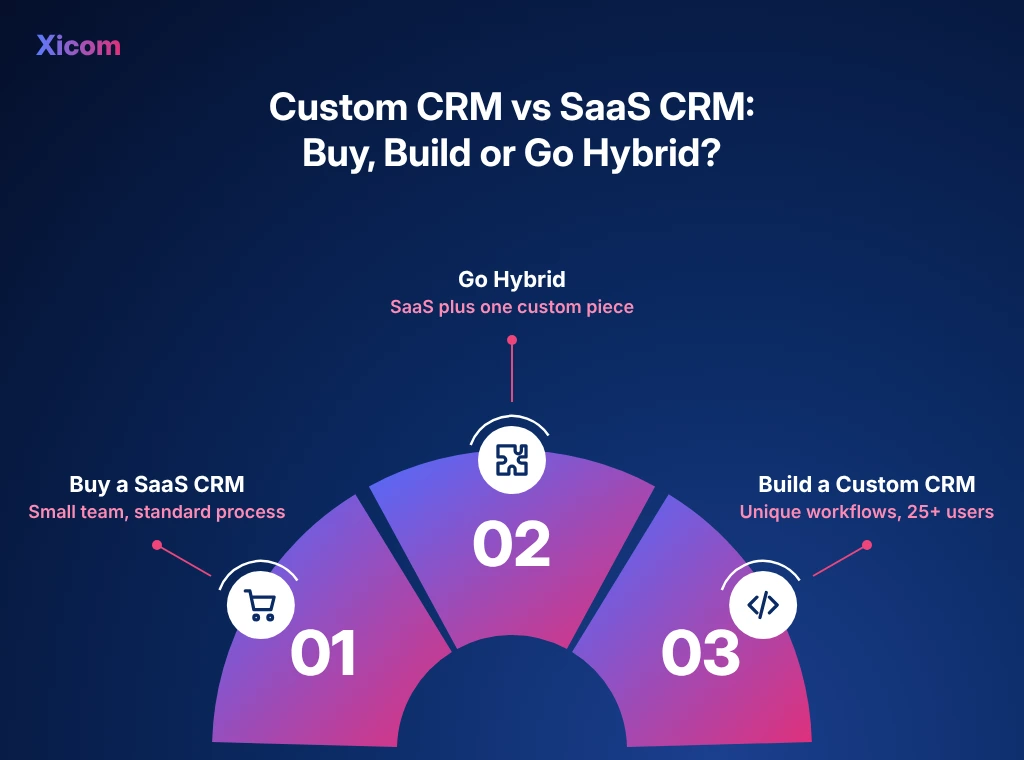
Using the same assumptions, the two options cost about the same over three years at roughly 27 users. Below that, SaaS is usually cheaper. Above it, a custom CRM pulls ahead, and the gap widens every year because you own the software and pay no per-seat fees. Check current vendor pricing for your own numbers, since plan prices and discounts vary.
Industry CRMs cost more than general sales CRMs because of specialist integrations and compliance. Expect a 15% to 30% uplift on the tier ranges above.
Launch with the features your team uses every day: contacts, pipeline, tasks and email sync. Add automation, portals and AI once real usage shows what matters.
Move one team at a time. A phased rollout spreads the budget, reduces disruption and lets you fix problems before the whole company depends on the system.
Open-source frameworks, UI libraries and low-code tools can handle standard parts such as admin screens or form builders. Reserve fully custom work for the workflows that make your business different.
Remove duplicates, archive dead records and agree on field definitions before development starts. A few weeks of internal cleanup can move you down a full row in the migration cost table.
A custom CRM development company that has built CRMs before will spot integration risks early and avoid rebuilding features later. Experienced custom software development teams also give more reliable estimates, which protects your budget from the start.
Also Read: Enterprise Software Development Cost
Custom CRM development cost ranges from about $30,000 for a focused CRM for one team to $300,000 or more for an enterprise platform with AI and deep integrations. Your workflows, integrations and data quality decide where you land far more than your headcount does. Plan for 15% to 20% a year in maintenance, run the three-year math against your current SaaS bill, and start with an MVP you can grow.
If you are ready to scope your project, Xicom can help. As a custom CRM development company with 20+ years of software delivery, our CRM development services cover discovery, design, build, data migration and support, and add AI capabilities such as lead scoring and meeting summaries where they genuinely save your team time.
Custom CRM development typically costs $30,000 to $300,000 or more. A basic CRM costs $30,000 to $60,000, a mid-level CRM with automation, integrations and a mobile app costs $60,000 to $150,000, and an enterprise CRM with complex workflows, AI and multiple integrations starts at $150,000.
A custom CRM usually takes 2 to 12 months or more to build. A basic CRM takes 2 to 4 months, a mid-level CRM 4 to 8 months, and an enterprise CRM 8 to 12 months or longer, depending on integrations and data migration.
Maintaining a custom CRM typically costs 15% to 20% of the original build cost per year. This covers bug fixes, security patches, small improvements and updates, while hosting, third-party services and AI model usage are paid separately each month.
A custom CRM for a small business usually costs $30,000 to $60,000. That covers contacts, a sales pipeline, tasks, email sync and standard reports for teams of up to about 20 users. Very small teams with standard processes are often better served by a SaaS CRM.
A custom CRM has no per-user licence fee, so the cost per user falls as your team grows. In our 50-user example, a $100,000 CRM works out to roughly $82 to $88 per user per month over three years, including maintenance and hosting, and much less after that.
A custom CRM is usually cheaper than Salesforce or HubSpot over three years once a team passes roughly 25 to 30 users. Below that, SaaS is often cheaper, especially when your sales process is standard and you need to launch quickly.
CRM developer rates typically range from $100 to $180 per hour in the United States, $70 to $140 in Western Europe and the UK, $40 to $80 in Eastern Europe, $40 to $75 in Latin America and $25 to $50 in India.
The most accurate way to get a CRM estimate is a short discovery phase. Share your current workflows, the systems the CRM must connect to, a sample of your data and your must-have versus nice-to-have features, then ask for an itemized quote with milestones.

Based on this article's topic
MVP development cost explained: realistic ranges by complexity, platform and product type, AI MVP budgets, three worked examples and ways to reduce cost.
Enterprise software development cost explained: ranges by project type, key cost drivers, hybrid delivery savings, AI costs and a formula with 3 sample budgets.
Compare the top SaaS development companies on multi-tenant expertise, AI capability, security and pricing, with cost benchmarks and checks before you sign.