How Much Does Custom Software Development Cost for Enterprise?
Enterprise software development cost explained: ranges by project type, key cost drivers, hybrid delivery savings, AI costs and a formula with 3 sample budgets.
Nov 4, 2026 Software Development
Quick Answer
MVP development cost typically ranges from $25,000 for a simple, single-platform product to $250,000 or more for a complex, regulated or AI-heavy one. Most funded SaaS, mobile and AI MVPs land between $40,000 and $150,000 and take three to six months. The three biggest cost drivers are feature scope, platform choice and integrations.
An MVP exists to answer one question before you spend serious money: will real users pay for this? Getting the budget wrong in either direction defeats that purpose. Underfund it and you test a product too weak to judge; overfund it and you have built version 2 before learning anything.
The challenge is that quotes for the same idea can range from a few thousand dollars to well over $200,000. That spread rarely comes from pricing alone. It comes from different assumptions about features, platforms, integrations, AI components and what happens after launch. Founders who understand those assumptions can compare proposals properly and protect their runway.
This guide breaks down MVP development cost with realistic ranges by complexity, platform and product type, a full section on AI MVP budgets, three worked examples with phase-level splits, and the costs that come after launch. It is written for founders, product leaders and enterprise innovation teams planning a first release.
A minimum viable product is the smallest version of a product that real users can use, and that produces evidence about whether the idea works. It is not a demo and not a finished product. Many budgets go wrong because teams ask for an MVP when they need something cheaper, or something more complete.
| Stage | Purpose | Typical cost | Typical timeline |
|---|---|---|---|
| Proof of concept (PoC) | Prove a technical approach works, often an AI model or integration | $10,000 to $40,000 | 2 to 6 weeks |
| Prototype | Test the user experience and demand with clickable screens or a no-code build | $5,000 to $25,000 | 2 to 4 weeks |
| MVP | Put a working product in front of real users and measure behavior | $25,000 to $150,000 | 3 to 6 months |
| Minimum lovable product (MLP) | Compete in a crowded market where basic functionality is not enough | $80,000 to $250,000+ | 4 to 8 months |
If technical feasibility is the open question, start with a PoC. If you are unsure users want the workflow at all, a prototype is cheaper. Build the MVP once both are answered, which is how our AI PoC and MVP development engagements are usually sequenced.
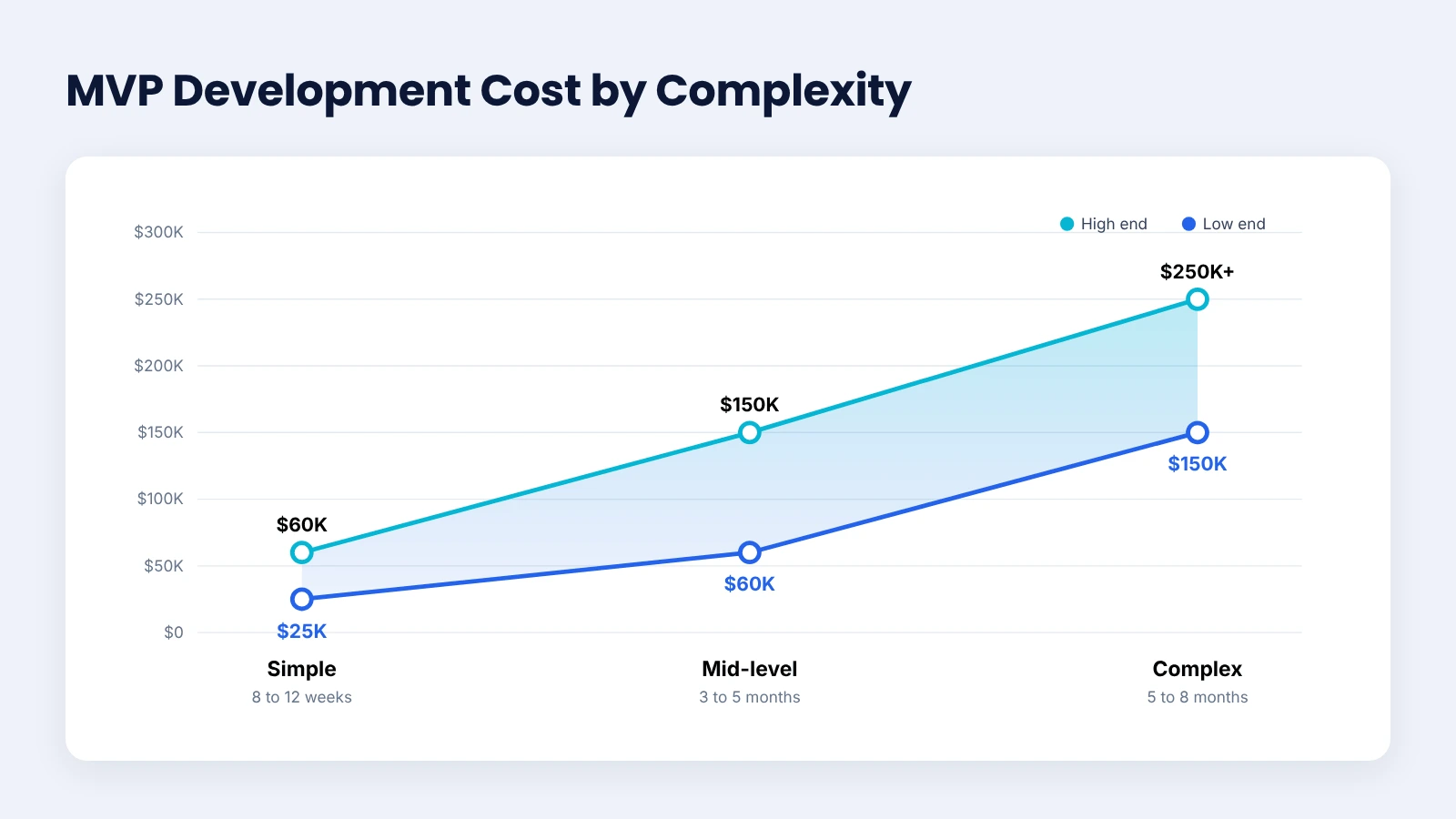
Complexity is the first filter, and it shapes the cost to develop an MVP more than any other single factor. It reflects the number of user roles, features, integrations and the amount of business logic behind each screen.
| Complexity | What it typically includes | Cost range | Timeline |
|---|---|---|---|
| Simple | One platform, one user role, 5 to 8 core features, 1 to 2 integrations | $25,000 to $60,000 | 8 to 12 weeks |
| Mid-level | Web or cross-platform mobile, 2 to 3 roles, payments, admin panel, 3 to 5 integrations | $60,000 to $150,000 | 3 to 5 months |
| Complex | Multiple platforms, real-time features, AI components, compliance scope | $150,000 to $250,000+ | 5 to 8 months |
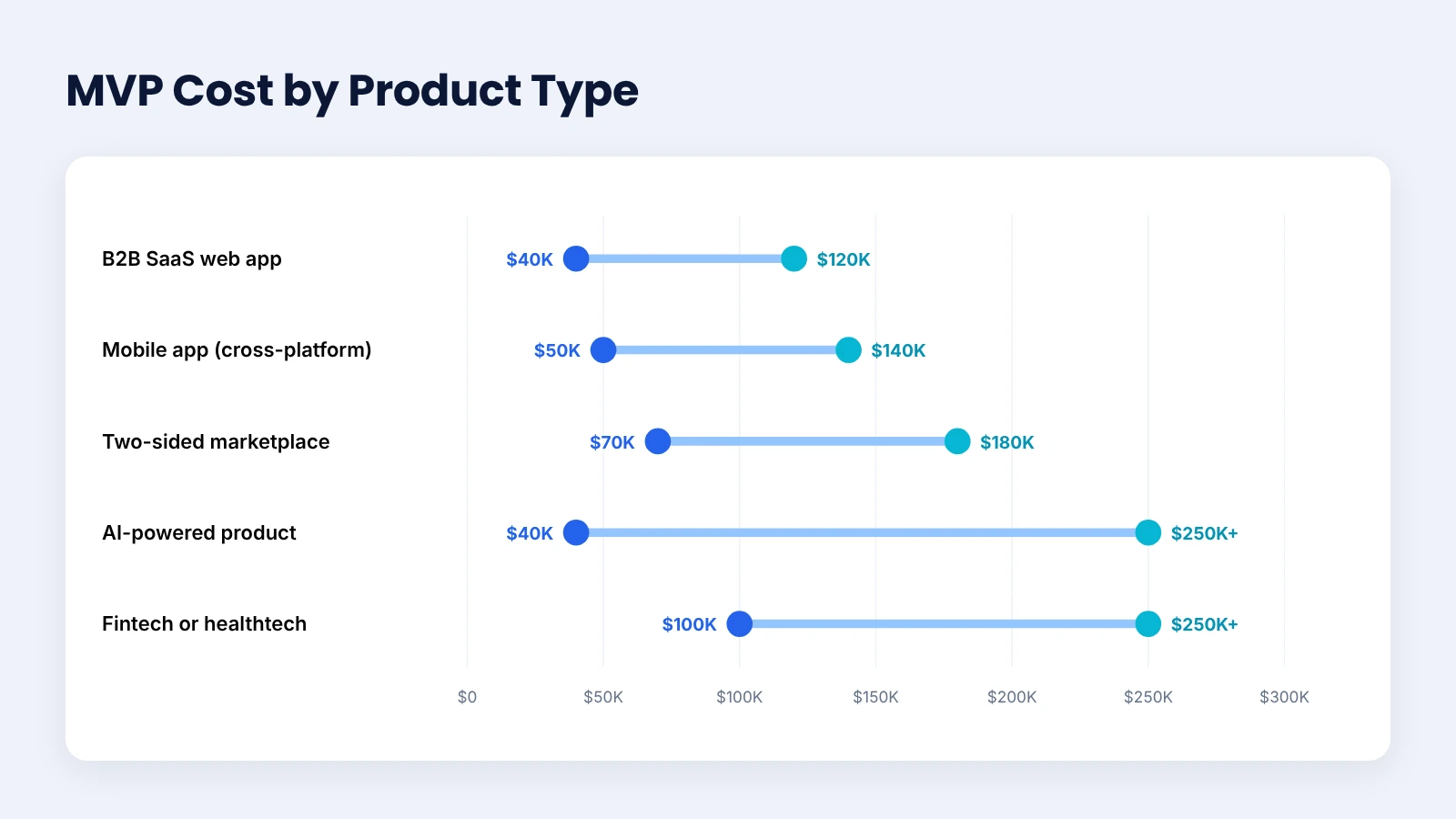
Product type shapes what has to be built before users see any value. A two-sided marketplace needs both sides working on day one; a SaaS tool can launch with one strong workflow.
| Product type | Typical cost | What drives the cost |
|---|---|---|
| B2B SaaS web app | $40,000 to $120,000 | Roles and permissions, billing, onboarding, integrations |
| Mobile app (cross-platform) | $50,000 to $140,000 | Device features, offline use, app store requirements |
| Two-sided marketplace | $70,000 to $180,000 | Two user journeys, payments and payouts, trust and reviews |
| AI-powered product | $40,000 to $250,000+ | Data preparation, model approach, evaluation, usage costs |
| Fintech or healthtech (regulated) | $100,000 to $250,000+ | Compliance controls, security testing, audit trails |
SaaS MVP development cost usually sits in the middle of the table because the hard parts are well understood: authentication, multi-tenant data, subscription billing and an admin panel. What pushes a SaaS MVP toward $120,000 is enterprise readiness, such as SSO, granular roles and audit logs, built before a single customer asks for them.
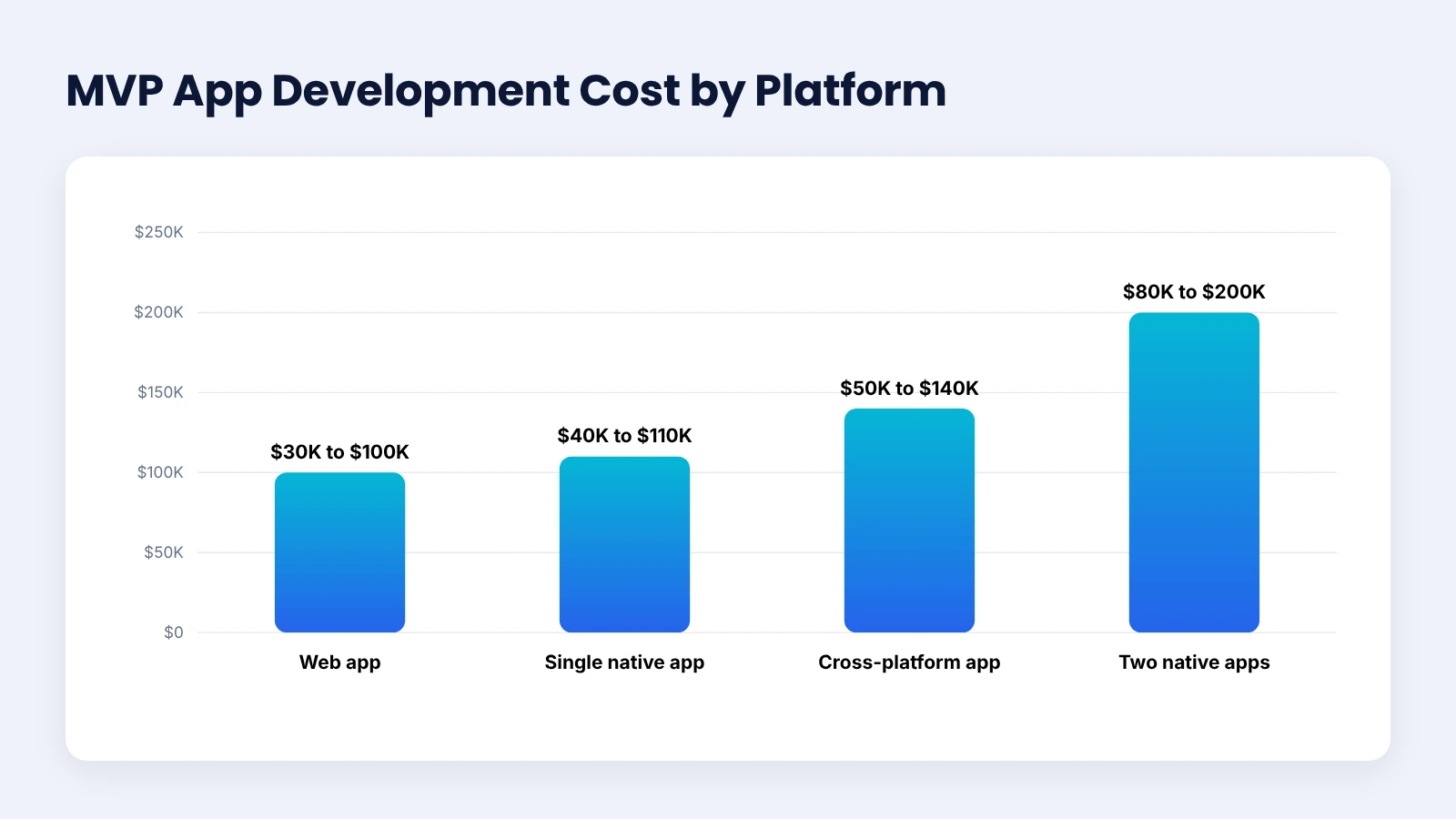
Platform choice is the single easiest lever on MVP app development cost. Launch where your first users already are, not everywhere at once.
| Platform | Typical cost | Best when |
|---|---|---|
| Web app (responsive) | $30,000 to $100,000 | B2B tools and products used mainly at a desk |
| Single native app (iOS or Android) | $40,000 to $110,000 | Your early users are concentrated on one platform |
| Cross-platform (Flutter or React Native) | $50,000 to $140,000 | You need both stores from day one |
| Two separate native apps | $80,000 to $200,000 | Heavy device-level features or performance demands |
Cross-platform frameworks share most of the code between iOS and Android, so they typically cost 30 to 40 percent less than two native apps. Native still wins for intensive camera, AR, Bluetooth or background processing work. Our mobile app development services team usually recommends cross-platform for MVPs unless one of those features is central to the product.
| Phase | Healthy share | What it covers |
|---|---|---|
| Discovery and scoping | 8 to 12% | Feature prioritization, user flows, architecture, written scope |
| UI/UX design | 10 to 15% | Wireframes, clickable prototype, visual design |
| Development | 40 to 50% | Front end, back end, integrations, admin tools |
| QA and testing | 15 to 20% | Functional, device, security and user acceptance testing |
| Deployment | 3 to 5% | Cloud setup, app store submission, launch support |
| Project management | 8 to 12% | Sprint planning, reporting, change control |
A proposal that skips discovery or folds testing into development is not cheaper. It moves those costs into rework after launch, when they are more expensive.
Team model decides both the rate and how much management falls on you. The rates below are typical blended hourly ranges for professional delivery teams.
| Option | Typical cost | Trade-off |
|---|---|---|
| In-house US team | About $14,000 to $20,000 per engineer per month, fully loaded | Full control, but months of hiring before work starts |
| Freelancers | $30 to $120 per hour | Cheap for small tasks, risky for a full product with no one owning delivery |
| US agency | $120 to $220 per hour | Full overlap and accountability at the highest rate |
| Latin America or Eastern Europe | $45 to $100 per hour | Good overlap or engineering depth at mid-range rates |
| Dedicated India-based team | $28 to $60 per hour, or $22,000 to $40,000 per month for a five-person team | Lowest total cost when product ownership and code review are strong |
The in-house figure starts from the US median wage for software developers, which the U.S. Bureau of Labor Statistics puts above $130,000 a year, plus benefits, taxes and recruiting. For an MVP that may pivot in three months, that fixed cost is hard to justify.
India-based delivery works best as a deliberate model, not a discount. A product owner on your side sets priorities in US hours, and a dedicated team builds and tests overnight, so feedback from one day is in the build the next morning. You can hire dedicated developers with onboarding in as little as 48 hours instead of waiting for a hiring cycle.
Want a scoped number for your MVP? Our team can turn your idea into a prioritized feature list, a phase-level estimate and a timeline before you commit. Request an MVP estimate.
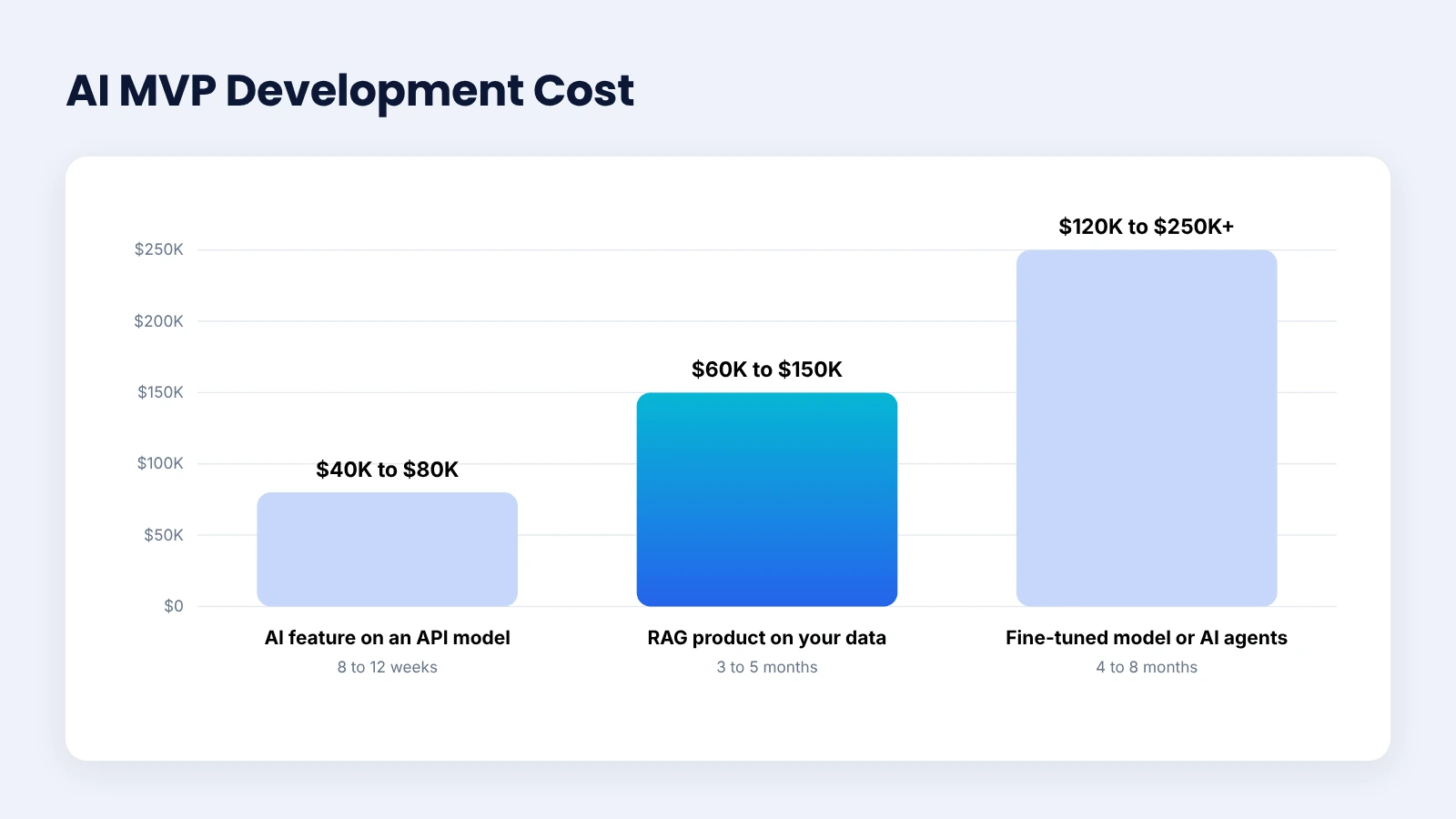
The budget for an AI MVP depends less on the screens and more on four decisions made before any code is written: which model, how it gets your knowledge, how you measure quality and what it costs to run.
| AI MVP type | Typical cost | Timeline |
|---|---|---|
| AI feature on an API model (chat, summarization, extraction) | $40,000 to $80,000 | 8 to 12 weeks |
| RAG product grounded in your own data | $60,000 to $150,000 | 3 to 5 months |
| Fine-tuned model or multi-step AI agents | $120,000 to $250,000+ | 4 to 8 months |
Hosted API models from providers such as OpenAI, Anthropic or Google are the fastest and cheapest way to start, because there is no infrastructure to run. Open-weight models hosted on your own cloud give more control over data and cost at scale, but add GPU infrastructure that can run from about $1,000 to over $10,000 a month. Most MVPs should start on an API and keep the option to switch.
Retrieval-augmented generation (RAG) lets the model answer from your documents and data without retraining it, which makes it the default for MVPs. Fine-tuning makes sense later, when you need consistent output formats, a specialist tone or lower per-request cost at high volume.
Cleaning, structuring and permissioning data often takes 15 to 30 percent of an AI MVP budget. Another 10 to 15 percent goes to evaluation sets, accuracy testing and guardrails that stop the model from giving unsafe or off-topic answers. Teams that skip this ship a demo, not an MVP.
Model usage is billed per token or per request, so it grows with adoption. At MVP stage, expect roughly $200 to $5,000 a month depending on volume and model choice. Caching, smaller models for simple tasks and good prompt design keep it in check. Our AI development services team builds these controls into the MVP rather than retrofitting them.
AI coding tools speed up scaffolding, standard CRUD screens, tests and documentation. A sensible planning assumption is a 10 to 20 percent reduction in development-phase effort. Architecture, security, integrations and edge cases still need experienced engineers, and every AI-generated change still needs human code review before it ships.
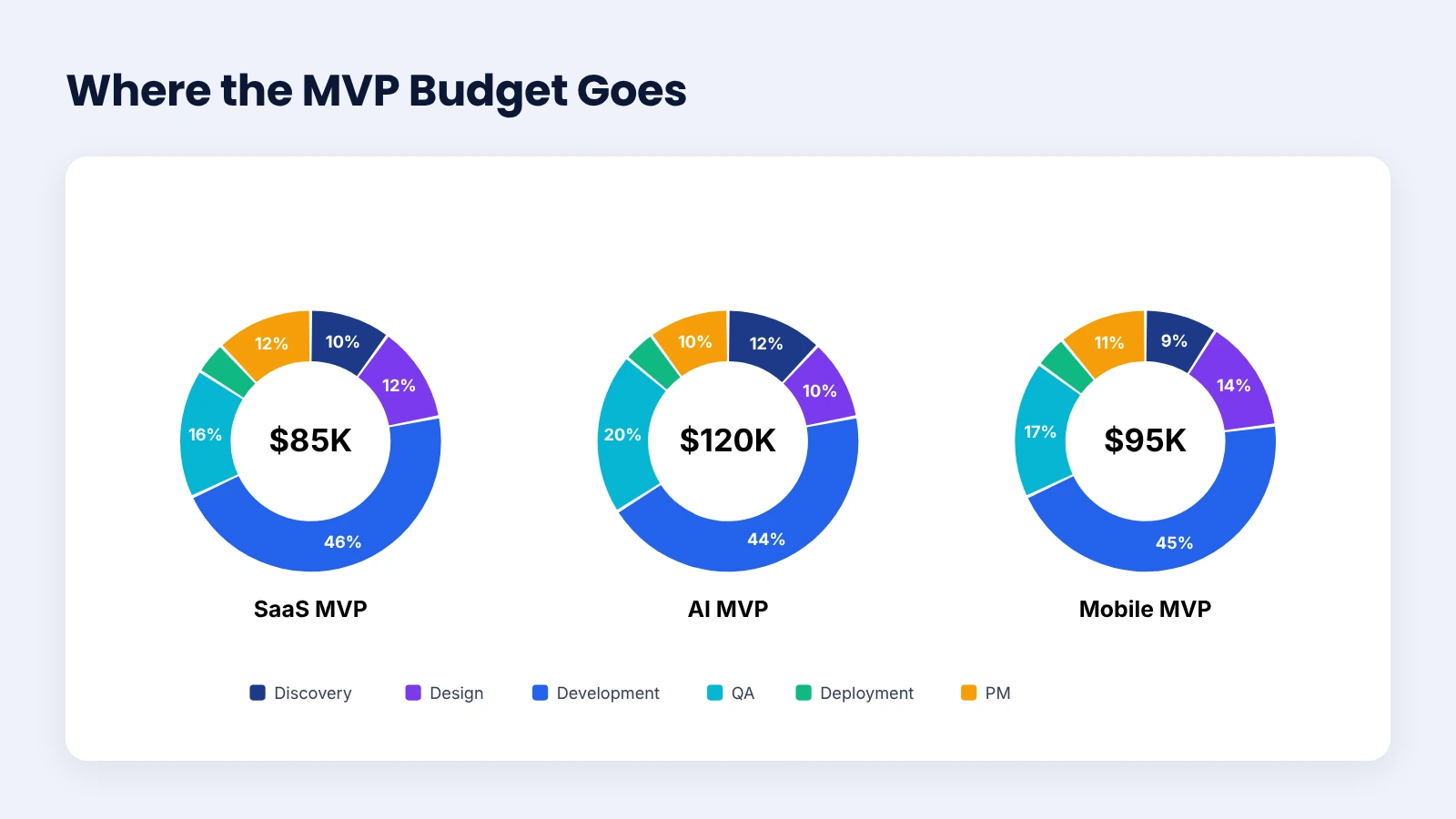
These examples show how real scopes add up. Each uses a dedicated team with a US-facing product lead.
Web app with three user roles, subscription billing through Stripe, a reporting dashboard, an admin panel and two integrations.
RAG-based assistant that answers questions from a company’s policy and contract documents, with permission-aware search, source citations, an evaluation set and a web interface. Running costs after launch: roughly $800 to $3,000 a month for model usage and hosting.
Booking app built in Flutter for iOS and Android, with user accounts, maps, in-app payments, push notifications and a web admin panel.
| Phase | A: SaaS ($85K) | B: AI assistant ($120K) | C: Mobile ($95K) |
|---|---|---|---|
| Discovery and scoping | 10% / $8,500 | 12% / $14,400 | 9% / $8,550 |
| UI/UX design | 12% / $10,200 | 10% / $12,000 | 14% / $13,300 |
| Development | 46% / $39,100 | 44% / $52,800 | 45% / $42,750 |
| QA and testing (incl. AI evaluation) | 16% / $13,600 | 20% / $24,000 | 17% / $16,150 |
| Deployment | 4% / $3,400 | 4% / $4,800 | 4% / $3,800 |
| Project management | 12% / $10,200 | 10% / $12,000 | 11% / $10,450 |
Example B spends more on discovery and testing because data mapping and AI evaluation carry most of the risk. Example C spends more on design because mobile flows have less room for error.
The build quote rarely includes everything. Budget for these from the start:
The MVP is the start of the spend, not the end. Once users validate the idea, the next 6 to 12 months typically cost 1.5 to 3 times the original MVP budget. That money goes to features users asked for, performance and security hardening, analytics and a growing team.
The biggest variable is whether the MVP can be extended or must be rebuilt. An MVP built on a clean architecture with tests can grow; one built as a throwaway often needs a partial rebuild within a year. Decide which you are building on day one, because “temporary” code has a habit of becoming permanent. For larger programs, our enterprise software development cost guide covers what scaling budgets look like.
| Ask | A strong answer |
|---|---|
| How did you arrive at this estimate? | Effort by feature and phase, with assumptions and exclusions |
| What would you cut from our scope? | Specific suggestions, not agreement with everything |
| Can we see a similar product you built? | A live product or case study with comparable scope |
| How do you review AI-generated code? | Mandatory human review and automated tests |
| Who owns the code and accounts? | You do, from day one, in writing |
| What happens after launch? | A maintenance plan and a path to version 1 |
Xicom has delivered software for more than 20 years, across 1,800+ projects for 750+ clients in over 50 countries, with 350+ professionals working from New Delhi and a presence in San Francisco. AI products we have built include Parity AI, an AI financial planning platform, and the IELTS Speaking Evaluator.
Delivery runs under ISO 9001, ISO/IEC 27001, ISO/IEC 42001 and SOC 2 Type II controls, and dedicated teams can reduce cost by up to 65 percent compared with in-house hiring. That keeps MVP development cost predictable while leaving room in the budget for version 1.
A well-planned MVP is not the cheapest version of your product. It is the smallest version that produces evidence you can trust. For most funded teams, that means a budget of $40,000 to $150,000 and three to six months of focused work, with clear limits on scope and a plan for what comes next.
The decisions that matter most are made before development starts: which problem to test, which platform to launch on, how much AI the first release really needs and who will build it. Get those right, keep part of the budget for maintenance and version 1, and the MVP becomes the foundation of the product rather than a prototype you have to replace.
Note: How we estimated these figures: cost ranges in this guide are planning estimates based on typical market rates and project scopes for professional delivery teams, including discovery, design, QA and project management. Actual costs depend on your scope, team model and region. Facts drawn from published sources are linked where they appear.
MVP development cost typically ranges from $25,000 to $250,000 or more. Simple single-platform products start around $25,000, most funded SaaS, mobile and AI MVPs cost $40,000 to $150,000, and complex or regulated products exceed $150,000. Feature scope, platform and integrations decide where your project lands.
A funded startup should expect to spend $60,000 to $150,000 on a mid-level MVP with two or three user roles, payments and an admin panel. That buys a product strong enough to test with paying users. Below this range, the MVP is often too thin to produce reliable evidence.
The same MVP scope typically costs about half as much with a dedicated India-based team. Blended rates run $28 to $60 per hour in India versus $120 to $220 for a US agency. The saving holds when a product owner sets priorities and every change goes through code review.
AI MVP development cost ranges from $40,000 for an AI feature on an API model to $250,000 or more for fine-tuned models or multi-step agents. Most RAG-based AI MVPs cost $60,000 to $150,000. Budget separately for monthly model usage, which grows with adoption.
Most MVPs take three to six months. Simple products can launch in 8 to 12 weeks, while complex, regulated or AI-heavy MVPs take five to eight months. A short discovery phase at the start usually shortens the overall timeline by preventing rework mid-build.
Yes, a no-code prototype can cost $5,000 to $25,000 and is useful for testing demand quickly. It becomes limiting once you need custom logic, integrations, performance or data control. Treat no-code as a validation step, then build the real MVP on code you own.
Plan for 15 to 20 percent of the build cost per year for maintenance, plus hosting, third-party services and AI usage. Scaling to version 1 over the following 6 to 12 months typically costs 1.5 to 3 times the original MVP budget, depending on user demand and architecture.
Most MVPs fail for market reasons rather than technical ones. In CB Insights’ analysis of 385 shut-down VC-backed startups, 43 percent cited poor product-market fit. A tightly scoped MVP tests that fit early, so the remaining runway can go into the version users actually want.

Enterprise software development cost explained: ranges by project type, key cost drivers, hybrid delivery savings, AI costs and a formula with 3 sample budgets.
Compare the top SaaS development companies on multi-tenant expertise, AI capability, security and pricing, with cost benchmarks and checks before you sign.
Latest PHP vulnerability (October 2026): PHP2Shell, CVE-2026-109618 & 109619, enables remote code execution. See affected versions and how to patch.