How Much Does it Cost to Build an MVP: Realistic Ranges, AI MVP Budgets and Examples
MVP development cost explained: realistic ranges by complexity, platform and product type, AI MVP budgets, three worked examples and ways to reduce cost.
Nov 4, 2026 Software Development
Quick Answer
Enterprise software development cost typically ranges from about $120,000 for a focused internal tool to $5 million or more for a core platform replacement, with most department and mid-sized systems landing between $300,000 and $1.5 million. The three biggest drivers are integration count, compliance scope and data migration. Budget a further 15 to 25 percent of the build cost every year for maintenance and support.
Enterprise software rarely goes over budget because a feature took longer than expected. It goes over budget because a legacy integration, a compliance review or a data migration was never priced in the first place. This guide gives technology and finance leaders the ranges, the variables and a working estimation formula to build a number that holds up after the contract is signed.
Enterprise software is not simply a larger business application. It is software that has to operate inside an existing estate of systems of record, serve many user roles with different permissions, and satisfy security and audit requirements set by people outside the product team.
Four characteristics push the cost of enterprise software development above a standard custom build:
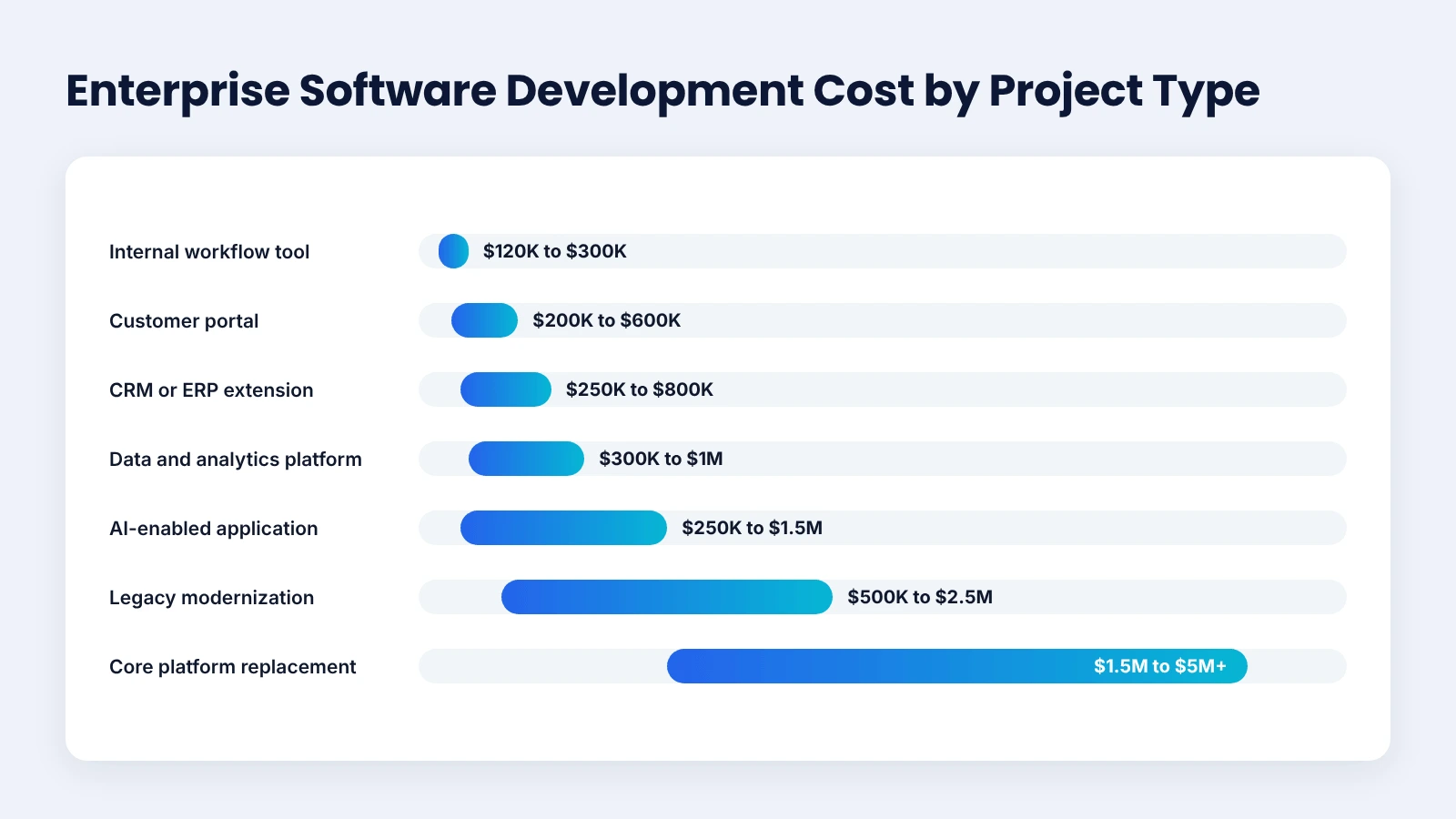
Asking how much does custom software development cost for enterprise use is really asking what kind of system you are building. System type sets the baseline before any other factor applies. The ranges below cover the full program: discovery, design, engineering, integration, testing and deployment, delivered by a senior blended team.
| Project type | Typical cost range | Typical timeline |
|---|---|---|
| Internal workflow or admin tool | $120,000 to $300,000 | 3 to 6 months |
| Customer or partner portal | $200,000 to $600,000 | 5 to 9 months |
| CRM or ERP module or extension | $250,000 to $800,000 | 6 to 12 months |
| Data and analytics platform | $300,000 to $1,000,000 | 6 to 12 months |
| AI-enabled enterprise application | $250,000 to $1,500,000 | 5 to 12 months |
| Legacy system modernization | $500,000 to $2,500,000 | 9 to 24 months |
| Core platform replacement (ERP, order management, multi-region) | $1,500,000 to $5,000,000+ | 18 to 36 months |
Two projects in the same row can still land at opposite ends of the range. A portal with two modern API integrations and no regulated data costs a fraction of one with eight integrations and HIPAA scope. Mobile clients for field staff or customers add to enterprise app development cost as well, typically as extra base effort. The variables below explain that spread.
Each integration is a separate cost item, and enterprise programs usually carry six to fifteen of them. A well-documented REST API typically costs $8,000 to $25,000 to integrate. SSO with an identity provider runs $10,000 to $25,000, an undocumented legacy system $30,000 to $90,000, and a customized ERP instance $60,000 to $180,000 or more.
Compliance changes architecture, logging, access control and testing across every sprint, so it behaves like a multiplier rather than a line item. Mapping controls to a recognized baseline such as the NIST Cybersecurity Framework early is far cheaper than retrofitting them after an audit finding. Healthcare builds must also account for the safeguards in the HIPAA Security Rule.
Migration cost tracks data quality, not volume. Consolidating years of records from several systems with inconsistent customer identifiers commonly consumes 5 to 12 percent of the budget, and it is the line most often missing from first-pass estimates.
Every additional role adds screens, rules and test cases. Row-level security and approval chains that differ by business unit can double the testing effort on a module that looks simple in a demo.
Complexity scales cost non-linearly. Real-time processing, multi-tenancy, offline support and high-availability targets above 99.9 percent each push a project toward the top of its range.
Shrinking an 18-month program to 12 months means parallel workstreams, more architects and more integration testing. Expect a 25 to 50 percent cost increase. Cutting first-release scope to protect a date is almost always cheaper than adding people to protect scope.
A smaller senior team usually costs more per hour and less per delivered feature. Removing the solution architect or business analyst to save money is one of the most expensive decisions a program can make, because rework and scope drift follow.
Also Read: AI in Software Development
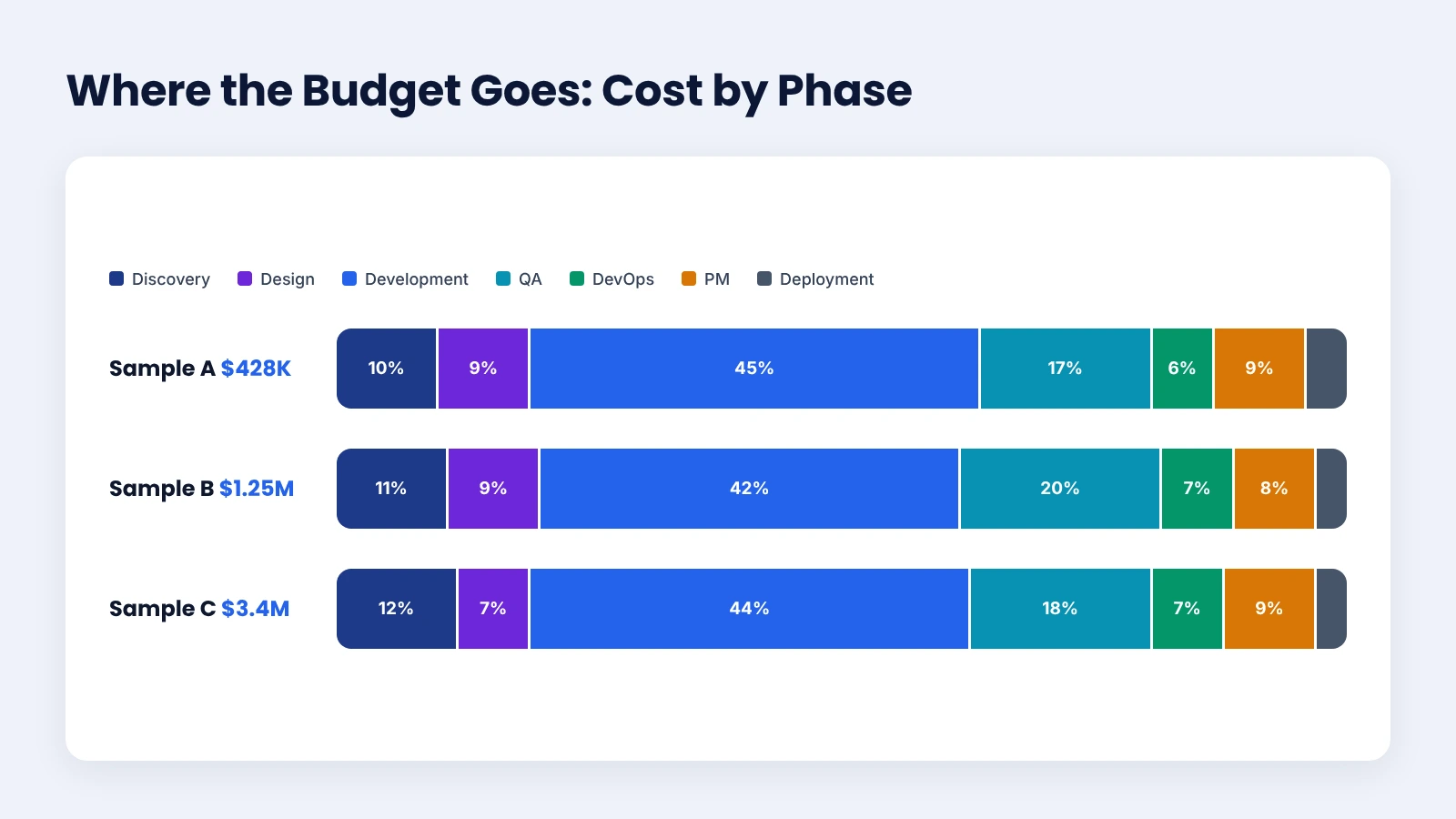
A credible estimate allocates budget by phase. The allocation itself is diagnostic: if a proposal puts 5 percent into testing on a regulated build, ask where the rest went.
| Phase | Healthy share of budget | What it covers |
|---|---|---|
| Discovery and architecture | 8 to 12% | Requirements, system boundary, integration assessment, architecture |
| UX and UI design | 6 to 12% | Role-based flows, prototypes, design system |
| Development | 40 to 50% | Front end, back end, data layer, integrations |
| QA and security testing | 15 to 20% | Functional, integration, performance, security and UAT |
| DevOps and infrastructure | 5 to 8% | CI/CD, environments, monitoring, infrastructure as code |
| Project management | 8 to 12% | Planning, reporting, risk and change control |
| Deployment and transition | 3 to 5% | Cutover, go-live support, documentation, handover |
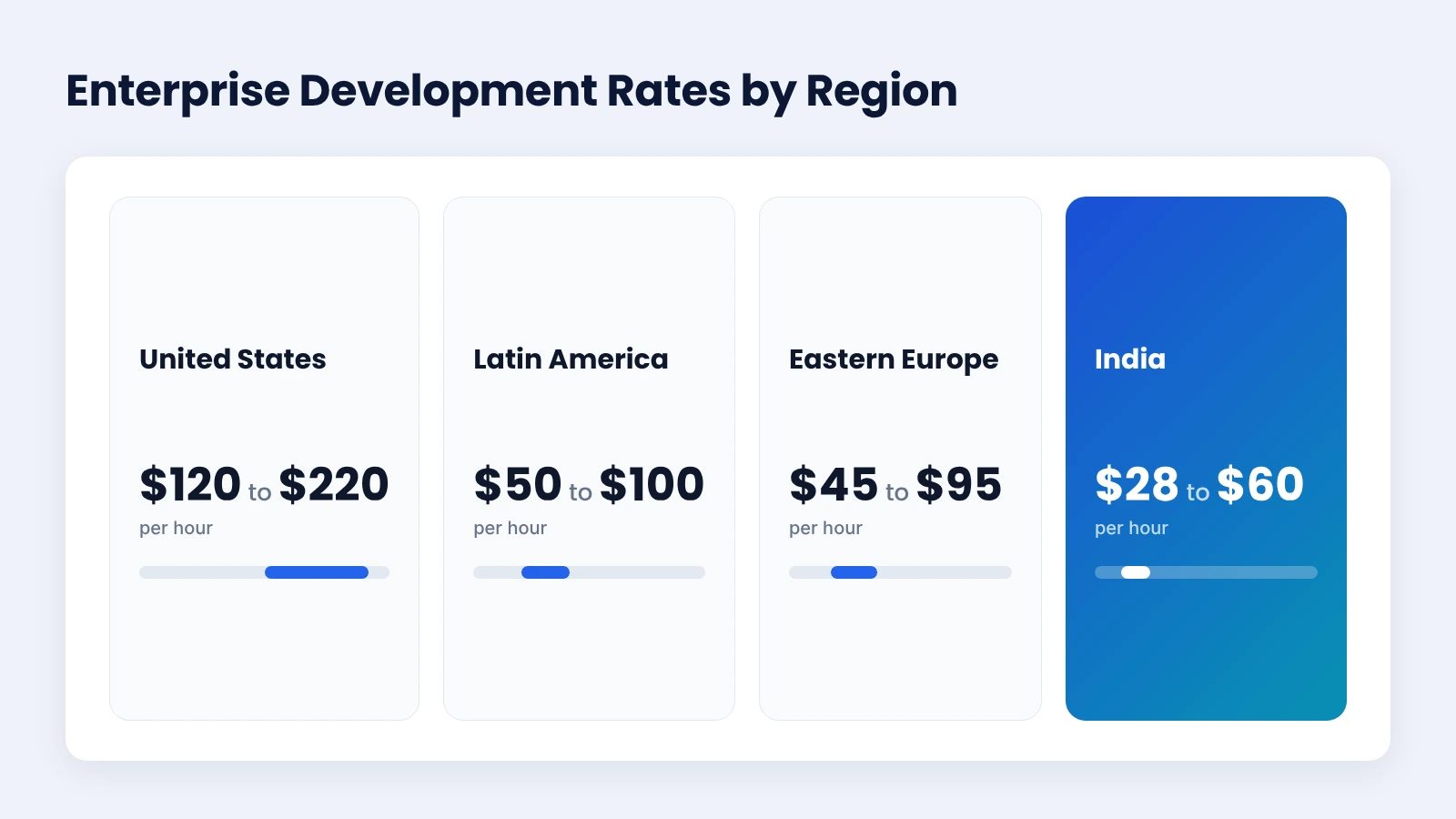
Rate cards are the most visible part of enterprise software development pricing and the most misleading. A lower hourly rate only lowers the total if the team reaches the same velocity, with the same rework rate, under the same governance.
| Delivery location | Typical blended rate (USD/hour) | Time-zone fit for US teams |
|---|---|---|
| United States (onshore) | $120 to $220 | Full overlap |
| Latin America (nearshore) | $50 to $100 | Full or near-full overlap |
| Eastern Europe | $45 to $95 | Morning overlap with US East Coast |
| India | $28 to $60 | Planned overlap windows and staggered shifts |
Offshore is often framed as the cheap option with a time-zone penalty. That framing misses how mature enterprise delivery from India actually works. The effective model is hybrid: a small product and architecture core that works US hours, paired with a larger engineering, QA and DevOps team that works a planned overlap window plus the overnight hours.
Run properly, the time difference becomes an advantage. Requirements clarified in the US afternoon are built and tested overnight, and reviewed the next morning. Defects found during US business hours are fixed before the next standup.
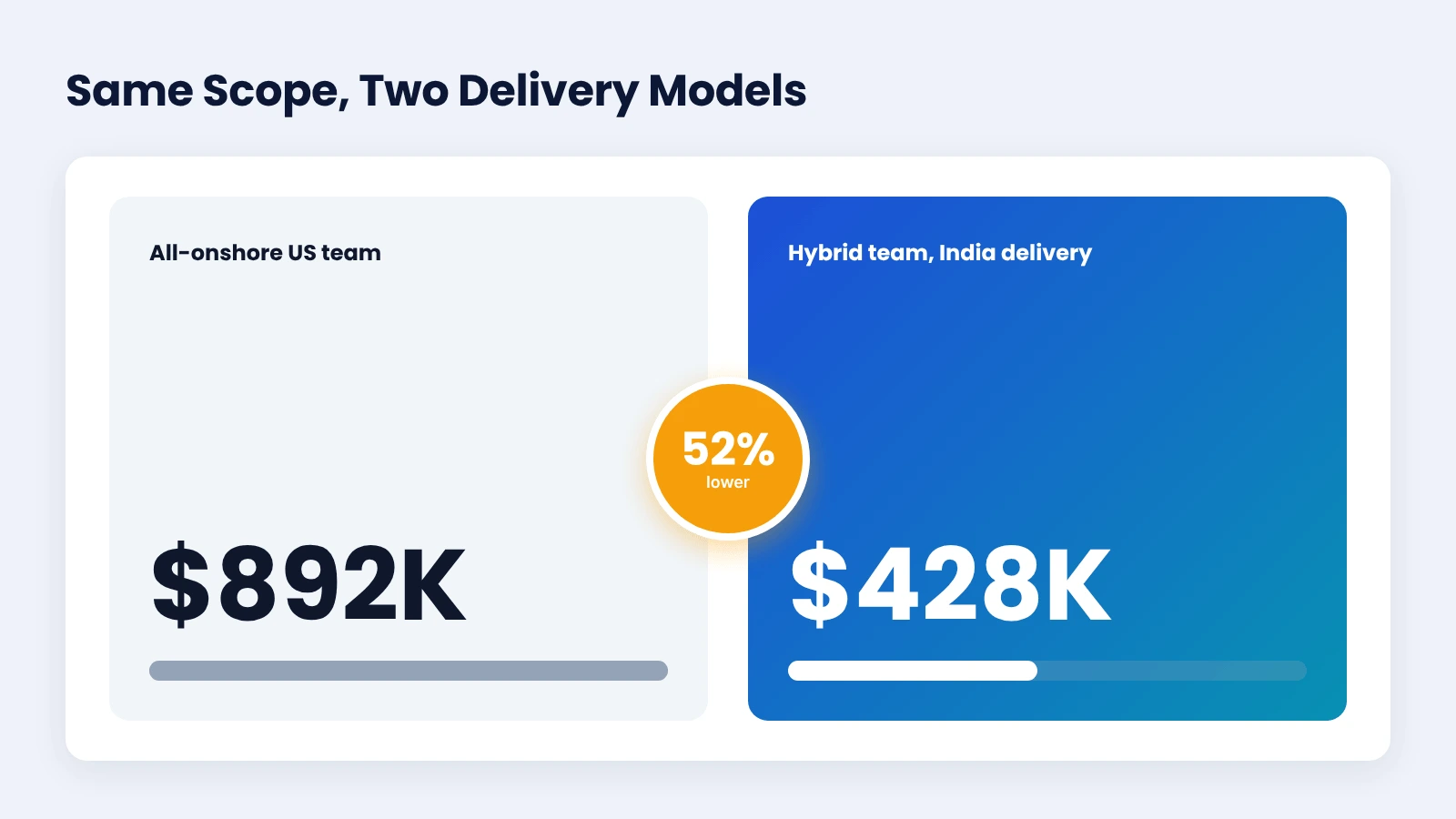
Here is what that does to total cost on the same scope. Assume a build that needs 2,800 hours from an all-US team at $165 per hour. A hybrid team at a blended $60 per hour needs more hours, because handoffs and documentation cost time, so plan around 3,200 hours.
Even after adding 14 percent more hours for coordination, the hybrid base effort is about 58 percent lower. Once complexity, compliance, integrations, migration and contingency are added (see Sample A below), the full program comes to about $428,000 for the hybrid team against about $892,000 all-onshore, roughly 52 percent lower.
The commercial model decides who carries scope risk, which makes it as important as the rate. The figures below are typical market ranges for enterprise-grade teams.
| Model | How it is priced | Typical cost | Best fit |
|---|---|---|---|
| In-house US hiring | Salary, benefits, recruiting, equipment | About $14,000 to $20,000 per engineer per month, fully loaded | Core, long-lived systems with a continuous roadmap |
| Fixed price | Price per defined scope | Scope cost plus a 15 to 25% risk premium | Well-defined, self-contained releases |
| Time and materials | Hourly rate x actual effort | Regional rates above | Evolving scope with active buyer-side product ownership |
| Dedicated offshore team | Monthly fee per team | $22,000 to $40,000 per month for a five-person team with PM and QA | Multi-year programs that need continuity |
| Staff augmentation | Monthly fee per engineer | $3,500 to $8,000 per engineer per month offshore | Filling a specific skill or capacity gap |
The in-house figure starts from the US median wage for software developers, which the U.S. Bureau of Labor Statistics puts above $130,000 a year, then adds 25 to 40 percent for benefits, payroll taxes, recruiting and equipment. Senior and specialist roles cost more.
Most enterprises combine models: an internal product owner and architect, a dedicated partner team for the main build, and short-term augmentation for specialist gaps. If you need to scale capacity quickly, you can hire dedicated software developers with onboarding in as little as 48 hours instead of waiting through a hiring cycle.
Want this formula applied to your scope? Xicom’s engineers can map your integrations, compliance requirements and team model into a phase-level estimate before you go to market. Request a scoped estimate.
AI changes enterprise application development cost in two directions. Adding AI capabilities raises the budget and creates a new monthly run cost. Using AI-assisted engineering tools can trim build effort, though by less than vendor marketing suggests.
| AI scope | Typical build cost | Typical timeline |
|---|---|---|
| AI feature in an existing system (search, summarization, document extraction) | $40,000 to $150,000 | 6 to 12 weeks |
| AI agent connected to enterprise workflows (CRM, ERP, ticketing) with approvals | $80,000 to $300,000 | 3 to 6 months |
| Custom AI platform, retrieval system or fine-tuned model with its own infrastructure | $150,000 to $600,000+ | 4 to 12 months |
Four factors decide where an AI initiative lands:
On the efficiency side, AI-assisted coding and test generation speed up well-understood tasks. A sensible planning assumption is a 10 to 20 percent reduction in development-phase effort, not in architecture, review, security testing or integration work. Our AI agent development cost guide goes deeper on agent-specific budgets, and an experienced AI development services team can tell you early whether your data is ready.
Ranges are useful for a first conversation. A formula turns them into a number you can defend in a budget review:
Total cost = (Base effort hours x Blended rate) x Complexity factor x Compliance factor + Integrations + Data migration + Contingency
| Input | Planning values |
|---|---|
| Complexity factor | Low 1.0, medium 1.3, high 1.6, very high or mission-critical 2.0 |
| Compliance factor | None 1.0; one lighter framework such as SOC 2 or GDPR 1.1 to 1.2; HIPAA or PCI DSS 1.25 to 1.4; two or more frameworks 1.35 to 1.6 |
| Integrations | Priced individually using the ranges in the cost drivers section |
| Data migration | Priced from source count and data quality, often 5 to 12% of build |
| Contingency | 15% for well-scoped work, 20% for regulated or AI-heavy builds, 25% for multi-year programs |
The same method covers enterprise app development cost for mobile and web clients: treat each client app as added base effort. Three worked examples show how custom enterprise software cost builds up in practice.
Medium complexity, SOC 2 scope, four integrations, hybrid team, six to seven months.
The same scope delivered all-onshore (2,800 hours at $165, same factors, integrations and migration) comes to about $892,000.
High complexity, HIPAA scope, five integrations, one AI feature, hybrid team, 10 to 13 months.
Mission-critical, SOC 2 and GDPR scope, seven integrations, ten years of history from three systems, hybrid team, 20 to 24 months.
How each budget splits across phases:
| Phase | Sample A ($428K) | Sample B ($1.25M) | Sample C ($3.4M) |
|---|---|---|---|
| Discovery and architecture | 10% / $42,800 | 11% / $137,500 | 12% / $408,000 |
| UX and UI design | 9% / $38,520 | 9% / $112,500 | 7% / $238,000 |
| Development | 45% / $192,600 | 42% / $525,000 | 44% / $1,496,000 |
| QA and security testing | 17% / $72,760 | 20% / $250,000 | 18% / $612,000 |
| DevOps and infrastructure | 6% / $25,680 | 7% / $87,500 | 7% / $238,000 |
| Project management | 9% / $38,520 | 8% / $100,000 | 9% / $306,000 |
| Deployment and cutover | 4% / $17,120 | 3% / $37,500 | 3% / $102,000 |
Notice how QA rises with regulation in Sample B, and discovery rises with migration risk in Sample C. Those shifts are signs of a careful estimate, not padding.
Also Read: Software Development Trends
Large programs miss budgets often. Research by McKinsey and the University of Oxford on more than 5,400 IT projects found that large ones ran 45 percent over budget on average. Most of that gap comes from costs that were never in the first estimate:
The cost of enterprise software development does not stop at launch, so approve programs against a three-year number. Annual maintenance typically runs 15 to 25 percent of build cost, rising with integration count and regulation. For Sample A, a $428,000 build plus three years of maintenance at an average of about $75,000 a year puts total ownership near $650,000 before cloud and license fees. Architecture shortcuts that lower the build price usually raise that three-year figure.
| Ask | A strong answer | A red flag |
|---|---|---|
| How is each integration priced? | Per-integration estimates with stated API assumptions | One bundled “integration allowance” |
| Which compliance frameworks have you delivered under? | Named frameworks with delivered examples | “We can handle that” |
| How is budget split by phase? | Phase-level allocation with QA at 15% or more | A single number |
| How are changes priced after sign-off? | A written change process with agreed rates | “We will be flexible” |
| Who owns the code, data and documentation? | You do, in writing, with a defined handover | “To be agreed” |
| What is the three-year cost? | Build plus run cost, in writing | Reluctance to discuss post-launch costs |
Xicom has delivered enterprise software for more than 20 years, across 1,800+ projects for 750+ clients in over 50 countries. A team of 350+ IT professionals works from New Delhi, with a presence in San Francisco for US clients, and the company holds a 4.8 rating on Clutch.
Delivery runs under ISO 9001 quality management, ISO/IEC 27001 information security, ISO/IEC 42001 AI management and SOC 2 Type II controls, which keeps security and audit work inside the process rather than bolted on before a review. Clients use our custom software development services for full builds, or dedicated teams that can reduce cost by up to 65 percent compared with in-house hiring.
Note: How we estimated these figures: cost ranges, rates and sample budgets in this guide are planning estimates based on typical market rates and program scopes for senior enterprise delivery teams. Actual costs depend on your scope, compliance requirements, team model and region. Facts drawn from published research are linked where they appear.
Enterprise software development cost ranges from about $120,000 for a focused internal tool to $5 million or more for a core platform replacement. Most department and mid-sized systems cost $300,000 to $1.5 million. Integrations, compliance scope and data migration decide where a project lands within that range.
Custom enterprise builds usually cost between $300,000 and $1.5 million, depending on complexity, integration count and regulation. A medium-complexity workflow platform with SOC 2 scope can land near $430,000 with a hybrid team, while a HIPAA-regulated portal with AI features can exceed $1.2 million.
Quotes vary because requirements documents describe features, while cost sits in integrations, compliance and data migration. Vendors reading the same document assume different integration counts and regulatory obligations. Naming every system of record, data source and compliance framework upfront makes quotes from different vendors directly comparable.
Yes, when it is run as a hybrid model with a US-facing product and architecture core. Even after adding 10 to 15 percent more hours for coordination, a hybrid team with India-based engineering typically costs about half as much as an all-onshore team on the same scope. Weak governance erodes that saving quickly.
A single AI feature such as search or document summarization typically costs $40,000 to $150,000. AI agents connected to enterprise workflows run $80,000 to $300,000, and custom AI platforms start around $150,000. Budget separately for monthly model usage fees, which grow with adoption.
Plan for 15 to 25 percent of the original build cost every year. That covers bug fixes, security patches, dependency updates, monitoring and minor improvements. Regulated and high-availability systems sit at the upper end. New features, cloud hosting and third-party licenses are usually budgeted separately.
Internal tools take three to six months, portals and CRM or ERP extensions six to twelve months, and legacy modernization nine to twenty-four months. Core platform replacements often run eighteen to thirty-six months. Timeline length is a major driver of enterprise application development cost, so phased releases deliver value earlier and reduce overrun risk.

Based on this article's topic
MVP development cost explained: realistic ranges by complexity, platform and product type, AI MVP budgets, three worked examples and ways to reduce cost.
Compare the top SaaS development companies on multi-tenant expertise, AI capability, security and pricing, with cost benchmarks and checks before you sign.
Latest PHP vulnerability (October 2026): PHP2Shell, CVE-2026-109618 & 109619, enables remote code execution. See affected versions and how to patch.