How Much Does it Cost to Develop a Fintech App?
Nov 12, 2026 App Development
Nov 12, 2026 App Development
Nov 12, 2026 App Development
Quick Answer
Building a fintech app typically costs $35,000 to $450,000+. A data-only budgeting MVP falls between $35,000 and $80,000, a payments, lending or wallet app between $80,000 and $200,000, and a multi-product investment or trading platform between $200,000 and $450,000 or more. Whether the app handles customer money is the factor that moves the number most.
Founders who request quotes for a fintech product often receive figures that differ by a factor of five or more. The gap rarely reflects one vendor overcharging. More often, each firm has made different assumptions about what the product must do, which markets it will serve and how much risk it must handle.
This guide explains fintech app development cost the way delivery teams actually estimate it. It covers price ranges by complexity, product type and individual feature, the budget impact of AI, regional compliance and labor rates, and the running costs that appear after launch. Every range here is an estimate meant to support planning, not a fixed quote.
The most reliable way to place your product in a price band is to answer one question first: will the app only show financial information, or will it hold, transfer or lend money?
Data-only apps connect to accounts a user already holds elsewhere. They import transactions, categorize spending, track goals and present insights. Because they never take custody of funds, they avoid settlement logic, chargebacks and most money transmission obligations.
Money-handling apps are a different engineering problem. Storing a balance or sending a payment requires a double-entry ledger, idempotent APIs so that a repeated request never moves money twice, reversal and refund logic, daily reconciliation against partner records, identity verification and fraud controls. Two apps with identical screens can differ in cost by three to four times because of this hidden layer.
Once that question is answered, scope, timeline and team size become much easier to estimate.
The ranges below assume a blended team, with product and architecture leadership close to the client and an offshore engineering core. A team staffed entirely in the US will typically price the same scope 1.8 to 2.5 times higher.
| Complexity level | Representative product | Typical scope | Estimated cost | Timeline |
|---|---|---|---|---|
| Starter (data-only MVP) | Expense tracker, savings goal app | Account linking, categorization, dashboards, notifications, secure sign-in | $35,000 to $80,000 | 3 to 5 months |
| Growth (money-handling) | P2P payments, wallet, BNPL, micro-lending | Ledger, transfers, KYC, payment gateway, admin console, fraud rules | $80,000 to $200,000 | 5 to 9 months |
| Scale (multi-product, multi-market) | Trading platform, wealth app, fintech super app | Several products and user roles, real-time data, AI models, multi-region compliance, audit-ready logging | $200,000 to $450,000+ | 9 to 18 months |
Also Read: How Much Does It Cost to Develop an AI App
Each product category comes with its own integrations, regulatory exposure and data demands, so the category sets the starting point for any estimate.
| Fintech app type | Estimated cost | What drives the price |
|---|---|---|
| Personal finance and budgeting | $35,000 to $90,000 | Account aggregation, data refresh, insight logic |
| Payments, P2P and digital wallets | $80,000 to $200,000 | Ledger accuracy, PCI scope, fraud prevention |
| Lending and BNPL | $90,000 to $220,000 | Credit decisioning, repayment schedules, disclosures |
| Investment, trading and robo-advisory | $110,000 to $350,000 | Live market data, order handling, securities rules |
| Wealth management | $100,000 to $300,000 | Portfolio analytics, advisor tools, client reporting |
| Insurtech | $70,000 to $200,000 | Quoting and underwriting rules, claims workflows |
| Crypto wallets and exchanges | $100,000 to $400,000+ | Key custody, blockchain integration, AML screening |
| RegTech and compliance software | $80,000 to $300,000 | Rules engines, case management, audit trails |
| Embedded finance (BaaS-powered) | $60,000 to $180,000 | Depth of partner APIs, per-account platform fees |
The interface of a wallet is simple. The engineering underneath is not. Most of the effort goes into keeping balances correct when a webhook arrives twice, a partner rail times out or a user retries a transfer on a weak connection.
A rules-based scorecard can be built quickly. A machine learning credit model needs clean training data, an explainability layer to produce clear decline reasons, and ongoing checks for drift and bias. Repayment schedules, late fees and regulatory disclosures add further logic that must be tested across many edge cases.
Streaming prices, executing orders with low latency and recalculating portfolios in real time make the backend demanding. Market data licensing is also a recurring cost that is easy to miss during early budgeting.
Category estimates help with early planning. Feature estimates help when you are deciding what belongs in the first release. The figures below cover production-grade implementation by a blended team and exclude third-party usage fees.
| Feature | Scope of work | Est. hours | Est. cost |
|---|---|---|---|
| Secure onboarding and authentication | Registration, MFA, biometrics, device binding, session controls | 150 to 250 | $5,000 to $12,000 |
| KYC and identity verification | Vendor integration, document and liveness checks, manual review queue | 120 to 250 | $5,000 to $15,000 |
| Double-entry ledger and reconciliation | Account model, idempotency, reversals, scheduled reconciliation | 500 to 1,000 | $20,000 to $60,000 |
| Peer-to-peer transfers | Contacts, limits, notifications, failure recovery | 200 to 400 | $8,000 to $25,000 |
| Payment gateway integration | Cards, ACH or UPI, webhooks, refunds, dispute handling | 150 to 300 | $6,000 to $18,000 |
| Card issuing and controls | Issuer API, virtual cards, freeze, spend limits | 250 to 450 | $10,000 to $30,000 |
| Open banking and account aggregation | Account linking, consent management, scheduled sync | 150 to 300 | $6,000 to $18,000 |
| Fraud and transaction monitoring | Velocity rules, risk scores, alerts, case handling | 250 to 600 | $10,000 to $40,000 |
| Admin and operations console | User management, support tools, approvals, reports | 300 to 600 | $12,000 to $40,000 |
| Audit logging and reporting | Tamper-evident logs, exports, scheduled regulatory reports | 150 to 300 | $6,000 to $20,000 |
If budget pressure forces trade-offs, the ledger is the component to protect. Every balance, statement and reconciliation report depends on it, and correcting a flawed ledger after launch is one of the most expensive fixes in financial software.
Users increasingly expect intelligent features in financial products, yet many cost estimates still treat AI as a vague add-on. It deserves its own line, because AI adds a recurring operating cost on top of the initial build.
| AI capability | Common build approach | Est. build cost | Ongoing cost |
|---|---|---|---|
| Fraud and anomaly detection | Vendor scoring plus custom rules, or a model trained on your own transactions | $20,000 to $80,000 | Retraining, monitoring, false-positive tuning |
| Credit scoring and underwriting | Custom model with an explainability layer for decision reasons | $40,000 to $120,000 | Bias audits, drift checks, model governance |
| LLM support assistant or financial copilot | Hosted LLM with retrieval over policies and account data, plus guardrails | $15,000 to $60,000 | Per-token inference, prompt and guardrail updates |
| Document AI for onboarding | OCR with custom field extraction and validation | $15,000 to $50,000 | Per-document processing fees |
| Personalized insights | Rules combined with ML segmentation of spending patterns | $15,000 to $45,000 | Data pipeline maintenance |
| Compliance monitoring | Transaction screening with ML-based alert prioritization | $30,000 to $90,000 | Rule and model updates as regulations evolve |
A sensible approach is to validate each AI feature with a hosted model first, then invest in fine-tuning or a custom model only when transaction volume, accuracy targets or data residency rules justify it. This staged path is common in AI development services for regulated products, because it limits upfront spend while the model proves its value. For LLM assistants in particular, generative AI development in finance also calls for strict guardrails, so the assistant cannot expose account data or give advice it is not permitted to give.
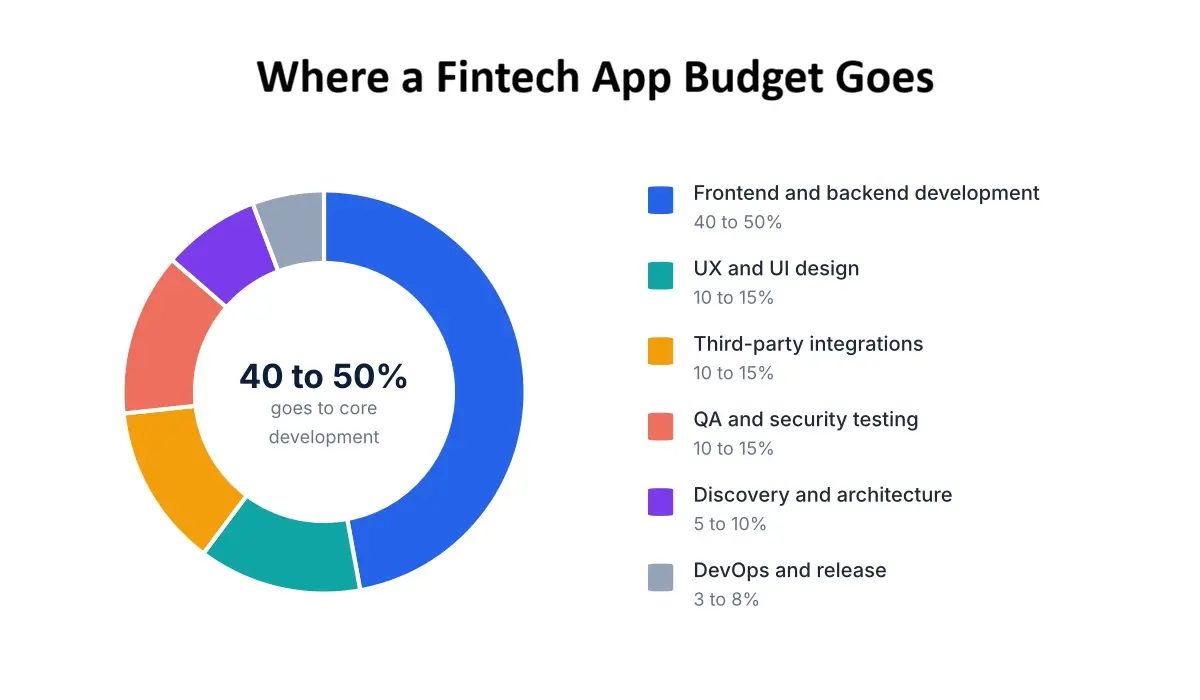
Most money-handling fintech projects follow a similar spending pattern across delivery phases:
| Phase | Share of budget | Why it matters |
|---|---|---|
| Discovery and architecture | 5 to 10% | Maps the flow of funds and compliance scope before any code is written |
| UX and UI design | 10 to 15% | Clear disclosures and error states build user trust |
| Frontend and backend development | 40 to 50% | Includes the ledger and core business logic |
| Third-party integrations | 10 to 15% | Payment rails, KYC, aggregation and data providers |
| QA and security testing | 10 to 15% | Functional, performance and penetration testing, plus fixes |
| DevOps and release | 3 to 8% | Environments, CI/CD, monitoring and incident runbooks |
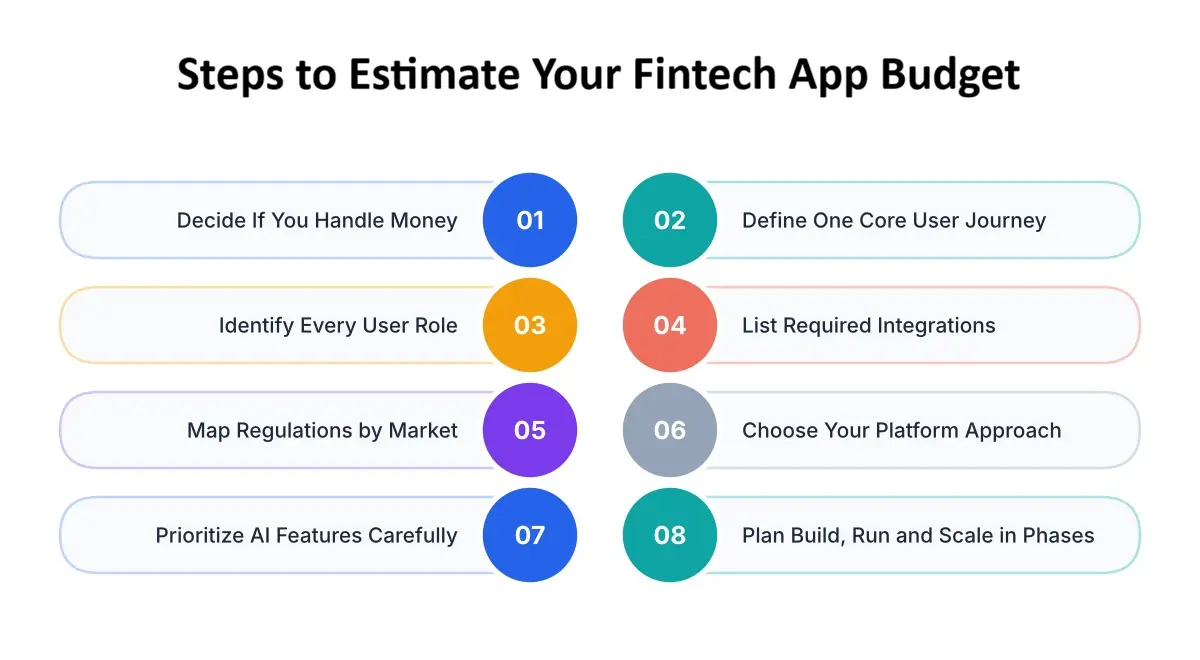
Two vendors can review the same feature list and still arrive at very different numbers. The difference usually comes down to how each one weighs the factors below, which together account for most of the variation in the cost to develop fintech app products.
Effort is driven less by how many screens exist and more by what must happen when something fails. Timeouts, partial transfers, duplicate requests and reversals each need deliberate design and thorough testing.
A single cross-platform codebase in Flutter or React Native generally costs 25 to 40 percent less than separate native iOS and Android apps, and it suits most fintech MVPs. Native development remains the better choice for products that rely heavily on NFC, advanced biometrics or demanding performance. Our mobile app development team can help you compare both routes for your use case.
Encryption, multi-factor authentication, role-based access, secrets management and audit logging are baseline expectations in financial software. The financial case for them is clear: according to IBM’s Cost of a Data Breach Report 2025, breaches in the financial industry averaged $5.56 million, roughly 25 percent above the global average of $4.44 million, while the average breach in the United States reached $10.22 million across industries. Designing security in from the start is far cheaper than responding to an incident.
Established providers for payments, identity verification and sanctions screening already solve problems that would take months to rebuild. Custom development is worth it only where a vendor cannot meet your product, cost or control requirements.
Where your engineers are based has the largest single effect on price. The rate comparison later in this guide shows how much.
Regulations affect how a product is architected, not only how it is documented. The table below outlines the rules that most often add engineering work in each market. It describes technical scope only, so confirm your specific obligations with qualified legal counsel.
| Market | Rules to plan for | Effect on the build |
|---|---|---|
| United States | PCI DSS v4.0.1, SOC 2, GLBA privacy and safeguards rules, state money transmitter licenses, CFPB oversight | Card data scope and multi-state licensing shape both architecture and launch timing |
| UK and EU | FCA authorization, PSD2 strong customer authentication, GDPR, DORA | Authentication flows, data residency, ICT risk management and incident reporting |
| India | RBI directions on digital lending and payments, NPCI rules for UPI, Account Aggregator framework, DPDP Act | Consent management, data localization and lending disclosures |
| Middle East | Central Bank of the UAE, DFSA and ADGM regimes, SAMA in Saudi Arabia | Licensing and localization; regulatory sandboxes can shorten early testing |
Several deadlines directly affect products in development today. Under PCI DSS, the requirements that were once marked as future-dated became mandatory after March 31, 2025. The EU’s Digital Operational Resilience Act has applied to financial entities since January 17, 2025. In India, the DPDP Rules were notified on November 13, 2025, and most core obligations, including security safeguards, notices and breach reporting, take effect on May 13, 2027. Any app targeting Indian users that launches before that date should already be designed to meet those requirements.
Also Read: How to Hire Fintech App Developers
Hourly rates depend on seniority, specialization and engagement model, so the ranges below are indicative agency rates for mid to senior engineers. For reference, SecondTalent’s hiring benchmark places a mid-level US full-stack developer at $85 to $135 per hour and reports India at about 76 percent below that level.
| Region | Indicative hourly rate | Typical strength |
|---|---|---|
| United States and Canada | $85 to $180 | Product leadership, regulated architecture, onsite collaboration |
| UK and Western Europe | $60 to $150 | EU market expertise and GDPR-heavy work |
| Eastern Europe | $40 to $80 | Strong backend and QA capability |
| Latin America | $40 to $75 | Working-hour overlap with US teams |
| India | $25 to $50 | Full-cycle delivery and dedicated teams at scale |
A worked example: consider a payments app that needs about 2,400 engineering hours. At an average US rate of $110 per hour, labor comes to $264,000. At an average India-based agency rate of $30 per hour, the same hours cost $72,000. The real difference narrows once you account for product oversight, overlapping working hours and additional QA. Even so, a well-run blended team commonly reduces total build cost by 40 to 60 percent while keeping engineering standards intact. Many companies take this route and hire dedicated developers offshore while keeping product ownership in-house.
The development invoice is only the first expense. These costs begin once real customers start using the product:
| Cost component | Three-year estimate |
|---|---|
| Initial build (growth-level payments app) | $140,000 |
| Maintenance at 20% per year ($28,000 x 3) | $84,000 |
| Cloud infrastructure at $1,800 per month (36 months) | $64,800 |
| Security testing and third-party services at $18,000 per year | $54,000 |
| Total cost of ownership | $342,800 (about 2.4 times the build) |
| Delivery model | Advantages | Limitations | Best suited for |
|---|---|---|---|
| In-house team | Full control and long-term knowledge retention | Slow hiring, high fixed cost, limited senior fintech talent | Well-funded companies where fintech is the core business |
| Development partner | Faster start, experience across projects, flexible capacity | Requires clear ownership and strong communication | Most startups and enterprises launching a new product |
| BaaS or white-label platform | Quickest and cheapest route to launch, many controls pre-built | Per-account fees, vendor limits, less differentiation | Testing demand, or adding finance as a feature rather than the product |
Many teams combine these options. They launch on a BaaS provider to validate demand, but design and own the ledger and data model from the start so they can change providers later without rebuilding the core.
Xicom has more than 20 years of software engineering experience, with 1,800+ projects delivered for 750+ clients in 50+ countries. Our team of 350+ IT professionals includes 150+ dedicated AI engineers and data scientists, which is valuable when fraud detection, credit models or LLM assistants are part of the roadmap.
Our delivery follows CMMi Level 3 processes, and we hold ISO/IEC 27001, ISO/IEC 42001 and SOC 2 Type II certifications, so information security and AI governance are built into how we work. Clients rate us 4.8 on Clutch. Every fintech app development engagement begins with a scoping session that maps your flow of funds, compliance needs and integrations, so you receive a grounded estimate before development starts.
There is no universal fintech app development cost, but there is a defensible estimate for your product once a few decisions are made: whether you handle money, which markets you serve, which features belong in the first release and how your team is structured. Settle those early, and budgeting becomes a planning exercise rather than guesswork.
A fintech app usually costs between $35,000 and $450,000 or more. Data-only budgeting MVPs cost $35,000 to $80,000, payments, lending or wallet apps cost $80,000 to $200,000, and multi-product investment or trading platforms cost $200,000 to $450,000 or more. Handling customer money is the biggest cost driver.
A focused fintech MVP typically costs $35,000 to $80,000 if it only displays financial data, and $80,000 to $150,000 if it moves money. Limiting the first release to one core user journey and using a cross-platform framework keeps the cost at the lower end.
A data-only MVP takes about 3 to 5 months, a payments or lending app 5 to 9 months, and a multi-product investment or trading platform 9 to 18 months. Licensing and partner approvals can take longer than development, so start them early and in parallel.
Fintech apps need a reliable transaction ledger, reconciliation, identity verification, fraud controls, audit logging and compliance with financial regulations. A data-only fintech app may cost about the same as a standard app, but one that handles money often costs several times more.
Each major AI feature typically adds $15,000 to $120,000 to the build. An LLM support assistant is usually at the lower end, while a custom credit scoring model with explainability is at the higher end. AI features also bring ongoing costs for inference, monitoring and retraining.
Yes. Engineering rates in India are commonly 60 to 75 percent lower than in the US. After accounting for product oversight and quality assurance, a well-managed blended team often reduces total build cost by 40 to 60 percent without lowering engineering standards.
Plan for 15 to 25 percent of the original build cost each year, plus cloud hosting, third-party usage fees, security testing and compliance audits. Over three years, the total cost of ownership is often 2 to 3 times the initial development cost.
Apps that hold or transfer customer funds, issue cards or provide loans generally require identity verification and AML screening. Data-only apps often do not. The exact requirements depend on your product and target markets, so confirm them with qualified legal counsel.
At a minimum, a fintech app should include encryption in transit and at rest, multi-factor and biometric authentication, role-based access control, secure API design, secrets management, tamper-evident audit logs and fraud monitoring. Apps that process card data must also comply with PCI DSS v4.0.1.
For a new product, working with an experienced development partner is usually faster and less risky. An in-house team makes sense when fintech is your core business and you can fund a full team over the long term. Many companies use a blended model that combines both.
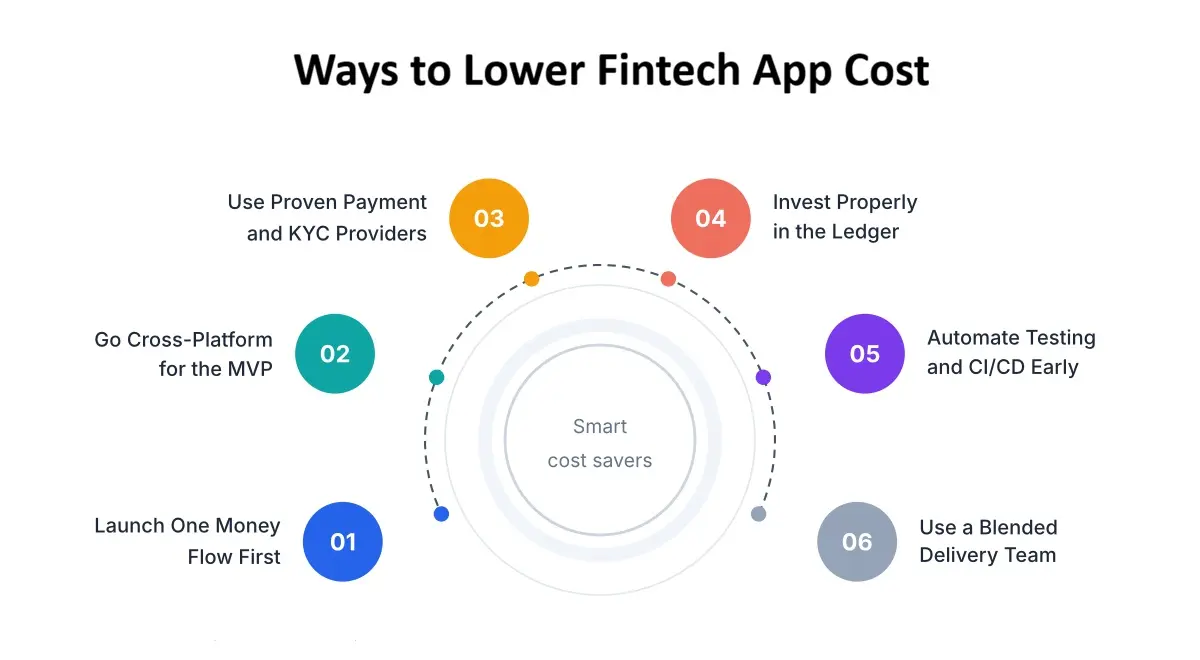
Start with one core money flow, use a cross-platform framework, integrate proven payment and KYC providers rather than building them, automate testing early and work with a blended team. Avoid cutting corners on the ledger or security, as fixing them later costs far more.

Based on this article's topic

Explore 17 healthcare business ideas for 2027, from AI scribes and remote monitoring to small business ideas, plus steps to start a healthcare business.
AI app development cost ranges from $30,000 to $300,000+. See costs by complexity and use case, running costs, timelines, and tips to cut your budget.

Hotel booking app development cost runs $21,000 to $200,000+ offshore. See costs by app type and phase, PMS integration, running costs and OTA savings.