AI Cost Optimization: Strategies to Cut AI Spend Without Losing Quality
Learn how to calculate AI cost per request and apply 10 practical AI cost optimization strategies to cut AI spend without losing quality.
Nov 11, 2026 Artificial Intelligence
Most LLM projects do not fail at the demo. They fail in the weeks after launch, when real users ask questions nobody tested, a prompt fix for one customer breaks answers for another, and the API bill climbs with no clear owner. LLMOps is the discipline that stops this from happening.
Across the LLM applications we have built and supported, from support assistants and document processing tools to AI agents, the same pattern shows up again and again: the model is rarely the weak point. The gaps sit around it, in prompt versioning, evaluation, monitoring and cost control.
This guide explains what LLMOps is, how it differs from MLOps, the stages of the lifecycle, the tools used at each stage and a practical place to start. Facts link to their original documentation, and tools are grouped by category rather than ranked.
LLMOps (large language model operations) is the practice of building, deploying, monitoring and improving applications powered by large language models in production. It covers prompt management, model selection, retrieval, evaluation, serving, observability, cost control and governance, so that LLM features stay accurate, safe and affordable as usage grows.
Most teams do not train their own foundation models. They start from an API model such as GPT, Claude or Gemini, or from an open-weight model, and build an application around it. LLMOps is the operating discipline for that application layer: the prompts, data, retrieval pipelines and guardrails that sit between the model and your users.
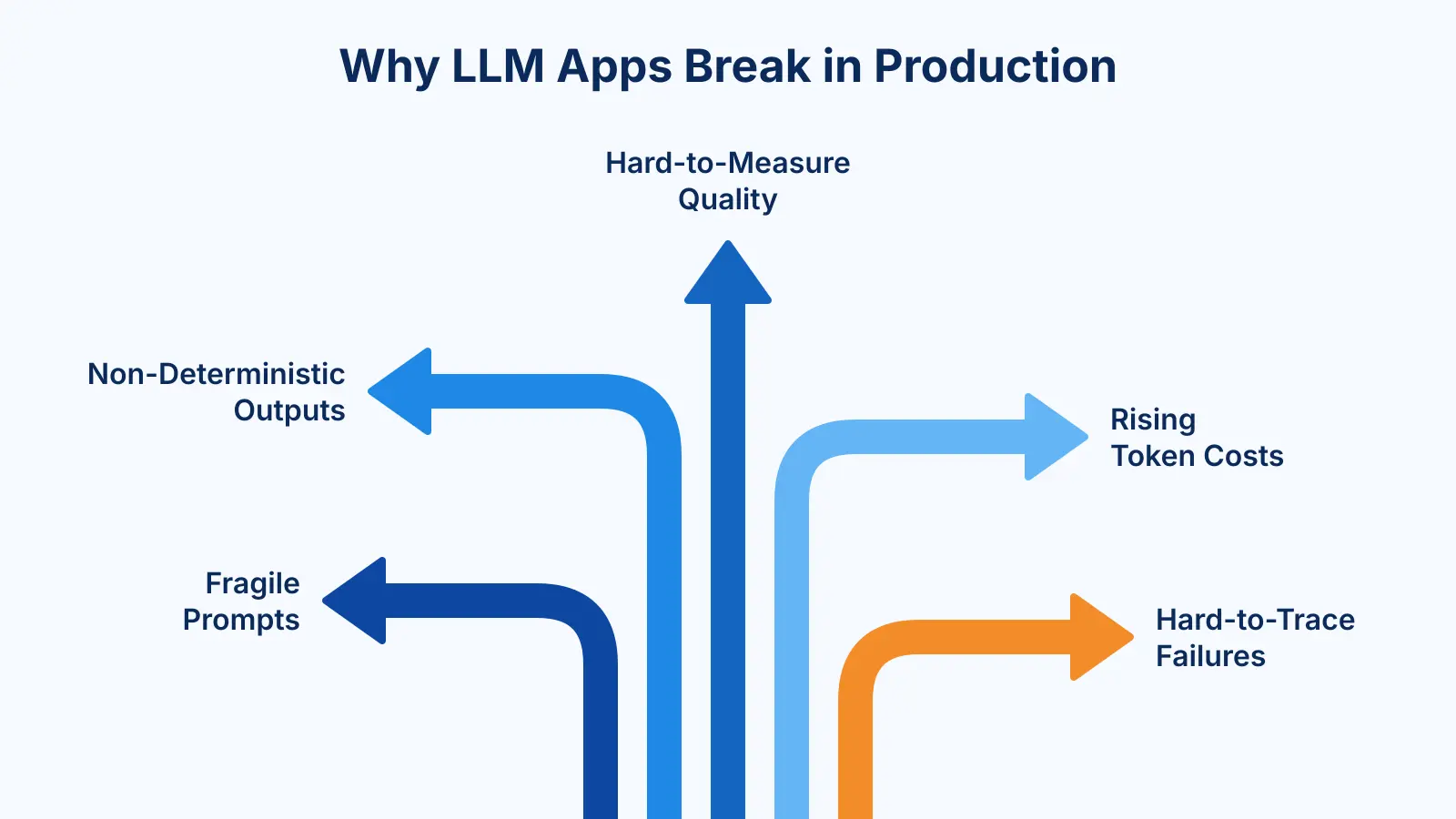
A prototype only has to work for the person demoing it. A production system has to work for thousands of users asking questions nobody planned for. Five problems show up again and again.
Ask the same question twice and you may get two different answers. Traditional software tests check for an exact expected output, which does not work here. You need evaluation methods that judge whether an answer is correct and useful, not whether it matches a fixed string.
A small wording change can improve one type of answer and quietly break another. Without version control for prompts, teams cannot tell which change caused a regression or roll back safely.
There is no single accuracy score for a chatbot or a summarization feature. Quality depends on correctness, relevance, tone and safety, and each one needs its own check.
LLM APIs bill per token, and AI agents may call a model many times for a single request. Costs can rise far faster than user numbers if nobody tracks them by feature and team.
When an answer is wrong, the cause could be the prompt, the retrieved documents, the model, a tool call or the user’s input. Without a trace of each step in a request, debugging turns into guesswork.
MLOps was built for models you train yourself, such as fraud scores, demand forecasts or recommendation engines. LLMOps deals with applications built on top of large pre-trained models. The table shows where the two differ in practice.
| Factor | MLOps | LLMOps |
|---|---|---|
| Starting point | Train a model on your own data | Start from a pre-trained foundation model |
| Core asset | The trained model and its features | Prompts, retrieval pipelines and model configuration |
| Main workflow | Data prep, training, deployment, retraining | Prompt design, RAG or fine-tuning, evaluation, serving |
| Evaluation | Accuracy, precision and recall on labeled data | Correctness, relevance and safety, using LLM-as-judge and human review |
| Monitoring focus | Data drift and prediction accuracy | Output quality, hallucinations, latency and token usage |
| Main cost driver | Training compute | Inference tokens and GPU serving |
| Data needs | Large labeled datasets | Smaller curated sets for evaluation, fine-tuning and retrieval |
| Key roles | Data scientists, ML engineers | AI engineers, prompt engineers, evaluators, platform teams |
LLMOps extends MLOps rather than replacing it. Versioning, CI/CD and monitoring still apply. What changes is the thing being managed: less model training, and much more prompt, retrieval and behavior management.
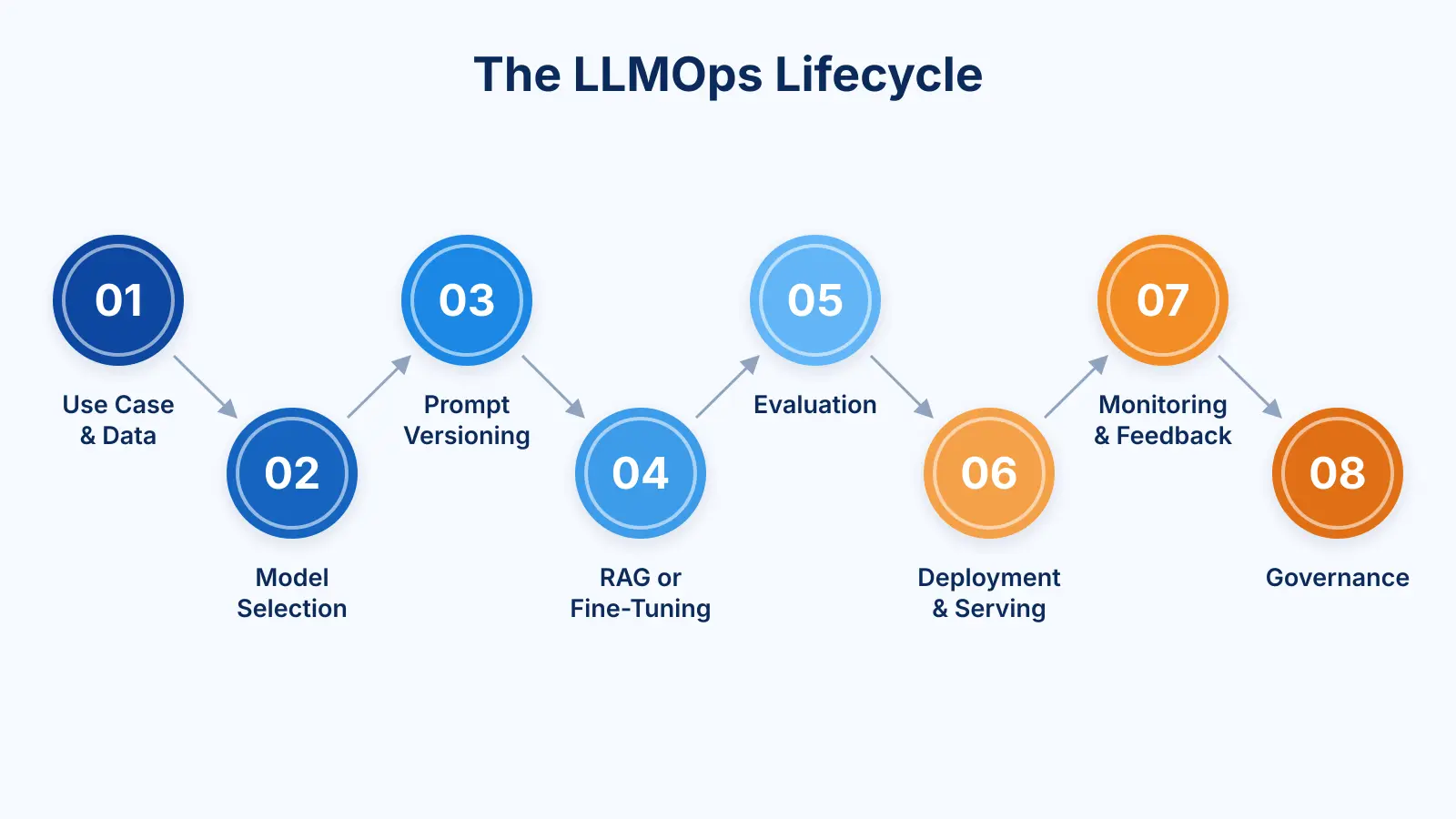
The LLMOps lifecycle is a loop, not a straight line. What you learn in production feeds back into prompts, data and tests. Red Hat describes a similar sequence, from data preparation through to monitoring with human feedback. Here is how the stages look in practice.
Start with one clear job, such as answering support questions from the help center, summarizing contracts or extracting invoice fields. Gather the documents the model will need and collect real examples of what users ask.
Tip: Write down what a good answer looks like before you pick a model. That definition becomes your evaluation criteria.
Choose between an API model, an open-weight model you host yourself, or a small language model for narrow tasks. Weigh quality, latency, cost per request and where your data is allowed to go. For teams that need models inside their own environment, this step is often part of a wider LLM development project.
Tip: Test two or three candidates on the same 50 to 100 real examples instead of relying on public benchmarks.
Treat prompts like code. Store them in a prompt registry or repository, give each version an ID, and log which version produced each response.
Tip: Change one thing at a time and re-run your test set after every change.
Use retrieval-augmented generation (RAG) when the model needs facts that change often or must be cited. Use fine-tuning when you need a consistent format, tone or domain behavior. Many production systems use both.
Tip: Fix retrieval quality before reaching for fine-tuning. In RAG applications, poor retrieval is one of the most common causes of wrong answers.
Also Read: RAG vs Fine-Tuning
Run every prompt, model or retrieval change against a fixed test set before release. Combine automated checks with human review for high-risk outputs. The evaluation section below covers this in detail.
Tip: Block a release automatically if scores drop below your current baseline.
Applications that use API models need an AI gateway for routing, authentication, rate limits and fallbacks between providers. Self-hosted models need an inference server such as vLLM or Hugging Face TGI, plus autoscaling to match traffic.
Tip: Set a fallback model so a provider outage does not take your feature down.
Trace every request in production: the input, retrieved context, prompt version, model, output, latency and token cost. Capture user feedback, such as thumbs up or down, and send low-rated answers for review.
Tip: Pull a sample of real conversations each week and review them by hand. Dashboards miss problems that a person spots in minutes.
Keep audit logs, access controls and data retention rules, and review prompts and models for bias, safety and compliance. Feed failures found in monitoring back into the test set so the same mistake is caught next time.
Tip: Give every LLM feature a named owner, not just the platform it runs on.
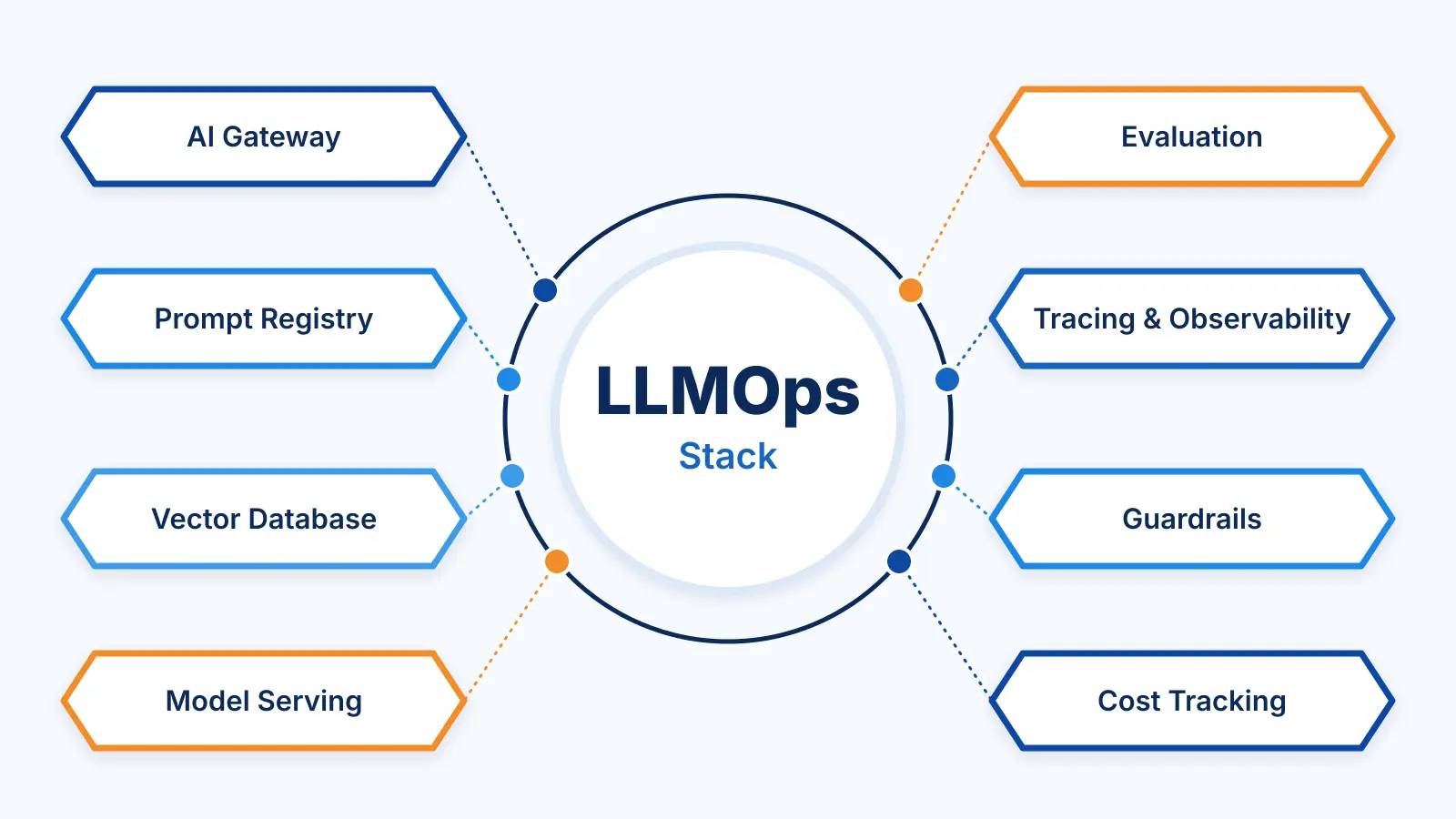
An LLMOps stack is a set of building blocks, each handling one part of the lifecycle. The tools listed are common examples, not endorsements. The right choice depends on your cloud, your data rules and the skills on your team.
| Component | What it does | Example tools |
|---|---|---|
| AI gateway | Routes requests across models and providers, handles authentication, rate limits and fallbacks | LiteLLM, Kong AI Gateway, cloud provider gateways |
| Prompt registry | Stores, versions and deploys prompts | MLflow Prompt Registry, Langfuse, LangSmith |
| Vector database and retrieval | Stores embeddings and finds relevant context for RAG | pgvector, Weaviate, Pinecone, Qdrant |
| Model serving | Runs self-hosted models efficiently on GPUs | vLLM, Hugging Face TGI, NVIDIA Triton |
| Evaluation | Scores outputs against test sets and quality criteria | Ragas, DeepEval, Promptfoo, MLflow |
| Tracing and observability | Records every step of each request | Langfuse, Arize Phoenix, LangSmith, MLflow Tracing |
| Guardrails | Filters unsafe input and output, enforces formats | Guardrails AI, NVIDIA NeMo Guardrails |
| Cost tracking | Attributes token and GPU spend to teams and features | Gateway logs, observability tools, cloud billing |
You do not need every component on day one. A small team can start with prompt versioning, tracing and an evaluation set, then add a gateway, guardrails and dedicated serving as traffic grows.
In our experience, evaluation is where most LLM projects either mature or stall. Teams that skip it end up debating every change based on a handful of screenshots. A practical approach has five parts.
Every failure found in production should become a new test case. Over time, the test set becomes one of the most valuable assets in your LLMOps setup, because it captures exactly how your users break things.
AI agents plan tasks, call tools and loop until the job is done, which multiplies both risk and cost. MLflow describes this extension of LLMOps as AgentOps. On top of standard LLMOps, agents need:
Teams working on AI agent development should build these controls in before launch. Adding them after an agent has misbehaved in front of customers is far more expensive.
Cost belongs inside LLMOps, not in a separate finance report. Track token usage and spend per feature, team and model, then act on what you see: route simple requests to smaller models, cache repeated prompts and answers, and move stable, high-volume tasks to fine-tuned or small language models. NVIDIA, for example, recommends using small language models for routine agent subtasks and calling larger models only when broader reasoning is needed.
Also Read: AI Cost Optimization
Most LLMOps tools come in two forms: open-source projects you run yourself, and managed platforms run by a vendor. Each suits a different kind of team.
| Factor | Open-source tools | Managed platforms |
|---|---|---|
| Cost | No license fee; you pay for infrastructure and engineering time | Subscription or usage-based fees |
| Data control | Runs in your own cloud or on-premise | Data often passes through the vendor |
| Setup effort | Higher | Lower |
| Maintenance | Your team handles upgrades and scaling | Handled by the vendor |
| Flexibility | Full control and customization | Limited to the vendor’s features |
| Best for | Regulated industries and teams with platform engineers | Small teams that need to move fast |
Many teams mix both, using managed tools for tracing and evaluation and open-source serving in their own cloud for sensitive workloads.
LLMOps does not have to arrive all at once. Most teams move through three stages.
Version prompts in a repository, log every request and response, build a first test set of at least 50 examples, and track token spend per feature.
Add an AI gateway with fallbacks, automated evaluation in your CI/CD pipeline, production tracing, user feedback capture and guardrails.
Run continuous evaluation on samples of live traffic, route requests across models by cost and quality, fine-tune or distill models for high-volume tasks, and keep full audit trails and regular governance reviews.
Shipping without an evaluation set. Without one, nobody can say whether the next change made things better or worse.
Editing prompts directly in production. An untested prompt change is an untested code change, and it can break answers for every user at once.
Monitoring uptime but not quality. A feature can return fast, error-free responses that are simply wrong.
Over-engineering the stack too early. Adding a dozen tools before the first use case is stable slows teams down. Start with the basics and add tools when a real problem calls for them.
Ignoring cost until the invoice arrives. By then, the expensive patterns are already built into the product.
LLMOps is what turns an impressive LLM demo into a dependable product. The model is only one part of the system. Prompts, retrieval, evaluation, monitoring, cost control and governance decide whether users can trust the answers.
Start with the basics: version your prompts, build a test set from real questions, trace every request and track cost per feature. Add gateways, automated evaluation and agent controls as usage grows. Teams that treat LLMOps as part of the product from day one spend less time firefighting and more time improving what users actually see. If you want a second opinion on your current setup, our AI consulting team is happy to take a look.
LLMOps stands for large language model operations. It refers to the practices and tools used to build, deploy, monitor and improve applications powered by large language models in production, including prompt management, evaluation, serving, observability, cost control and governance.
MLOps focuses on training, deploying and retraining machine learning models on your own data. LLMOps starts from pre-trained foundation models and focuses on prompts, retrieval, evaluation of open-ended outputs, token costs and model behavior. LLMOps builds on MLOps practices like versioning and CI/CD rather than replacing them.
A typical LLMOps lifecycle has eight stages: defining the use case and preparing data, selecting a model, engineering and versioning prompts, adding knowledge with RAG or fine-tuning, evaluating and testing, deploying and serving, monitoring with user feedback, and ongoing governance and improvement.
LLMOps tools fall into categories: AI gateways such as LiteLLM, prompt registries, vector databases such as pgvector or Weaviate, serving engines such as vLLM, evaluation tools such as Ragas or Promptfoo, and tracing tools such as Langfuse, Arize Phoenix or MLflow. The right mix depends on your stack and data rules.
Yes. Even without hosting a model, you still manage prompts, retrieval, evaluation, monitoring, costs and data privacy. The API provider runs the model, but you are responsible for how your application uses it and whether its answers are correct and safe for your users.
AgentOps is the extension of LLMOps to AI agents that plan tasks, call tools and make multiple model calls per request. It adds step-by-step tracing, evaluation of tool calls, step limits, token budgets and human approval for high-risk actions.
Trace every request, including the input, retrieved context, prompt version, model, output, latency and token cost. Combine automated quality scores, user feedback and regular human review of sampled conversations, and set alerts for drops in quality, spikes in cost or rising error rates.

Based on this article's topic
Learn how to calculate AI cost per request and apply 10 practical AI cost optimization strategies to cut AI spend without losing quality.
SLM vs LLM explained: learn the difference between SLM and LLM in cost, speed, accuracy and privacy, with real examples and an easy way to choose the right one.
RAG vs fine tuning explained: key differences, costs, and when to use each or both. A practical decision framework for teams building real LLM products.