AI in Business Process Optimization: Methods, Applications and ROI
Learn how AI in business process optimization cuts cycle times and costs. Explore methods, use cases, ROI metrics and an implementation roadmap.
Nov 27, 2026 Artificial Intelligence
Pricing directly influences revenue, profit margins, market competitiveness, and customer purchasing decisions. However, fixed pricing strategies often struggle to account for changing demand, competitor activity, inventory availability, and operating costs. Businesses operating across multiple products, markets, and sales channels need pricing strategies that can respond to these changing conditions without relying entirely on manual analysis and periodic adjustments.
AI-powered dynamic pricing addresses this challenge by using machine learning, predictive analytics, and optimization algorithms to evaluate market conditions and recommend appropriate price changes. By analyzing historical transactions, real-time demand signals, customer behavior, competitor prices, and business constraints, these systems help organizations make faster, data-driven pricing decisions. A McKinsey survey found that 65 to 85 percent of surveyed B2B pricing executives expect their organizations to adopt generative AI or agentic AI in pricing over the next one to three years, highlighting the growing role of AI in commercial decision-making.
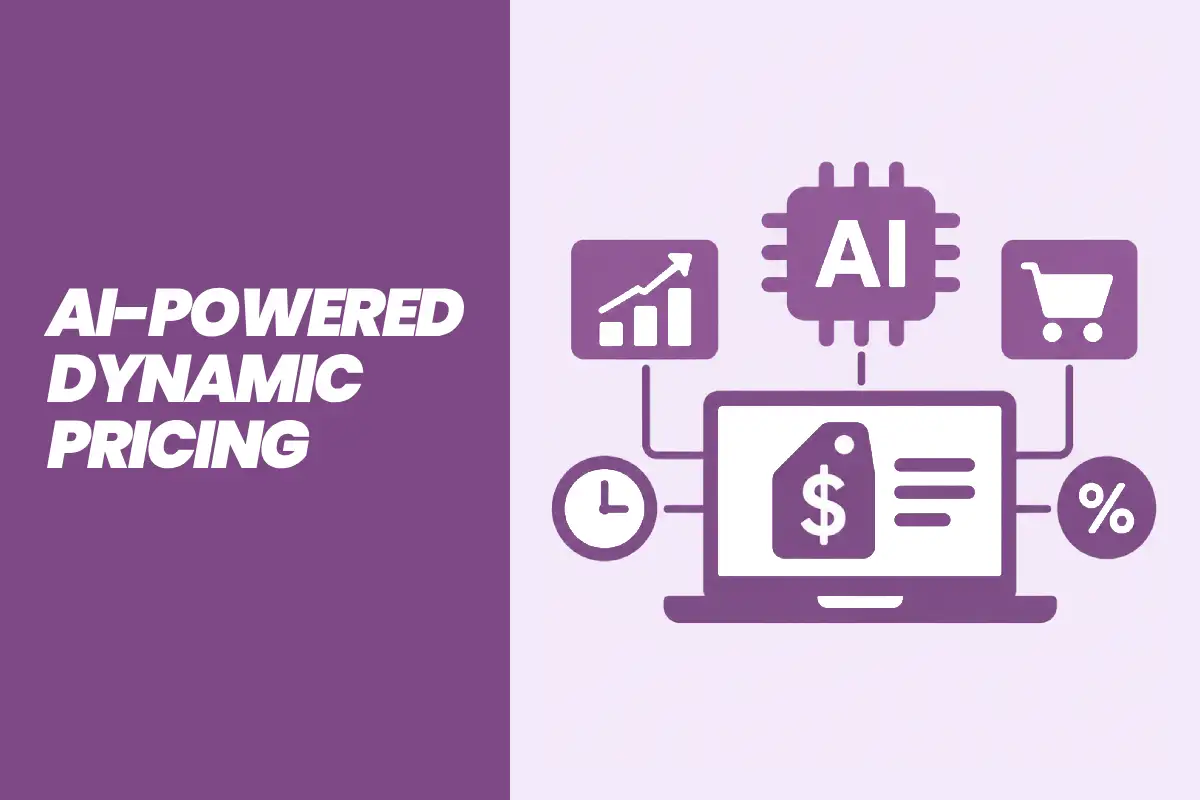
AI-powered dynamic pricing refers to the use of artificial intelligence and machine learning to determine and adjust product or service prices based on changing business and market conditions. Unlike traditional pricing methods that rely on fixed markups, competitor benchmarks, or periodic manual reviews, AI-driven systems continuously analyze data such as customer demand, purchasing patterns, inventory levels, competitor prices, and operating costs to recommend suitable price points.
These systems combine predictive models and optimization algorithms to estimate how different prices may influence demand, revenue, and profit margins. For example, an e-commerce business can use AI to identify products with rising demand, monitor competitor prices, and evaluate available inventory before adjusting prices. The objective is not simply to increase prices when demand rises or offer discounts when sales decline, but to identify prices that align with specific business goals, such as maximizing revenue, protecting margins, improving inventory turnover, or increasing capacity utilization.
An AI-powered dynamic pricing system combines business data, predictive models, optimization algorithms, and pricing rules to generate and implement price recommendations. The process typically involves four stages.
The system collects information from internal and external sources, including transaction histories, product catalogs, inventory management systems, customer relationship management platforms, competitor feeds, and market data providers.
Relevant inputs may include:
Data integration allows the pricing system to evaluate multiple factors together rather than making decisions based on isolated indicators.
Machine learning models analyze historical transactions and market signals to forecast demand under different pricing conditions. They also estimate price elasticity, which measures how customer demand changes when prices increase or decrease.
For example, a retailer may discover that demand for a product is relatively insensitive to small price increases during periods of limited availability. The pricing system can use this information to recommend a higher price while remaining within predefined business limits.
The pricing engine combines demand forecasts, price elasticity estimates, business costs, inventory constraints, and commercial objectives to calculate suitable prices.
The optimization process may target different outcomes, such as maximizing revenue, improving gross margins, increasing inventory turnover, or utilizing available capacity. The recommended price must also satisfy constraints such as minimum margins, contractual rates, and permitted price-change limits.
Once approved, price recommendations are distributed to relevant business systems, including e-commerce platforms, point-of-sale applications, booking systems, and sales tools.
The system then monitors metrics such as revenue, conversion rates, average selling prices, gross margins, and inventory movement. These results provide feedback for evaluating pricing decisions and updating the models as market conditions change.
Different models perform different functions within a dynamic pricing system. Some predict demand, others estimate customer price sensitivity, while optimization algorithms determine which prices best meet business objectives.
| Model or algorithm | Primary function | Practical application |
|---|---|---|
| Regression models | Estimate relationships between price, demand, and sales | Predicting sales volume at different price points |
| Time-series forecasting | Predict future demand using historical patterns and trends | Forecasting seasonal demand and booking volumes |
| Price elasticity models | Estimate how demand responds to price changes | Identifying opportunities for price increases or discounts |
| Tree-based models | Identify complex relationships across multiple pricing variables | Evaluating the combined impact of inventory, competitor prices, and demand |
| Reinforcement learning | Improve pricing decisions through feedback from repeated actions | Optimizing pricing in changing, high-volume environments |
| Multi-armed bandit algorithms | Test different pricing options and learn which perform better | Comparing promotional prices or alternative price points |
| Optimization algorithms | Calculate prices that meet defined business objectives and constraints | Maximizing margin while maintaining minimum stock or capacity requirements |
Regression models help estimate how changes in price influence sales volume, revenue, and demand. Price elasticity models build on this analysis to quantify the relationship between price changes and customer purchasing behavior.
Businesses can use these models to distinguish between products with high and low price sensitivity. A product with relatively inelastic demand may support a price increase without a significant reduction in sales, while a highly price-sensitive product may require more careful pricing.
Time-series models analyze historical sales, booking patterns, seasonal fluctuations, and other time-dependent variables to predict future demand. Techniques such as ARIMA, Prophet, and Long Short-Term Memory (LSTM) networks can support forecasting at different levels of complexity.
Demand forecasts help businesses anticipate periods of high or low demand and adjust prices before market conditions change.
Reinforcement learning trains an agent to select pricing actions based on observed outcomes and a defined reward, such as revenue or profit. The model learns from repeated interactions with the pricing environment and can account for the longer-term effects of pricing decisions.
Multi-armed bandit algorithms are useful when businesses want to test different price points while learning which options perform better. They balance exploration, or testing alternatives, with exploitation, or using the currently best-performing option.
These techniques require careful experimentation and constraints. Uncontrolled price testing can affect customer trust, revenue, and market stability.
Optimization algorithms translate model predictions into actionable prices. They evaluate possible price points against business objectives and constraints, including cost, margin, inventory, capacity, and competitive positioning.
For example, a hotel pricing engine may use demand forecasts and remaining room availability to determine rates that maximize expected revenue without exceeding acceptable price limits.
AI-powered dynamic pricing is useful wherever demand, supply, competition, or operating conditions change frequently. Its implementation varies by industry because the relevant data and pricing objectives differ.
Retailers and e-commerce businesses use AI to adjust product prices based on demand, inventory availability, competitor prices, customer purchasing patterns, and promotional activity.
A pricing engine can identify products with declining sales, excess inventory, or strong demand and recommend appropriate price adjustments. It can also evaluate the effect of discounts on sales volume and margins before a promotion is launched.
For example, an online retailer may reduce the price of slow-moving seasonal inventory while maintaining margins on products experiencing strong demand. Competitor monitoring can further help the retailer respond to market changes without automatically matching every price reduction.
Airlines, hotels, and travel platforms use dynamic pricing to manage limited capacity and changing booking demand.
AI models analyze booking pace, remaining seats or rooms, advance purchase windows, cancellations, seasonal trends, local events, and competitor rates. The system can then recommend prices based on expected demand and available capacity.
For instance, a hotel may increase room rates when occupancy forecasts indicate strong demand during a major event. During periods of lower demand, it may introduce targeted discounts to improve occupancy without reducing prices unnecessarily across all room categories.
Ride-hailing and transportation platforms use dynamic pricing to balance customer demand with available vehicle capacity.
Pricing models consider pickup locations, trip requests, driver availability, traffic conditions, time of day, and weather. When demand exceeds available supply, the system may adjust fares to encourage additional drivers to serve the area or manage demand.
AI can improve these decisions by forecasting demand across locations and time intervals rather than relying only on current request volumes.
Manufacturers and equipment rental businesses can use AI to optimize prices for spare parts, equipment rentals, maintenance services, and service contracts.
Relevant inputs include equipment utilization, product availability, procurement costs, maintenance expenses, regional demand, and customer contract terms. A rental company, for example, may adjust equipment rental rates based on fleet availability, seasonal construction activity, and demand in a particular region.
For manufacturers, pricing models can also support decisions about discounts, customer-specific quotations, and product configurations while accounting for production and delivery costs.
Energy providers can use AI-based pricing models to respond to changes in electricity demand, generation capacity, weather conditions, and energy market prices.
Forecasting models help estimate consumption patterns and identify periods when demand may exceed available supply. Pricing and incentive mechanisms can then encourage consumers to shift consumption toward periods of lower demand or greater renewable energy availability.
These systems must operate within applicable tariff structures, market regulations, and consumer protection requirements.
Also Read: AI in Business Process Optimization
The effectiveness of a pricing model depends on the quality, relevance, and freshness of its input data. Businesses need to combine commercial, operational, and market information to understand the factors influencing prices and demand.
| Data category | Relevant information | Contribution to pricing |
|---|---|---|
| Transaction data | Historical prices, sales volumes, discounts, returns, and timestamps | Identifies pricing patterns and demand response |
| Customer data | Purchase frequency, customer segments, preferences, and browsing behavior | Supports demand analysis and customer segmentation |
| Inventory data | Stock levels, replenishment schedules, product availability, and warehouse locations | Helps manage prices based on supply and inventory |
| Competitor data | Market prices, promotional offers, and competitor product availability | Supports competitive price positioning |
| Cost data | Procurement, production, shipping, labor, and operating costs | Establishes price floors and margin requirements |
| External market data | Seasonality, weather, holidays, local events, and economic indicators | Helps explain changes in demand |
Pricing decisions can become unreliable when input data is incomplete, outdated, inconsistent, or duplicated. For example, an inventory system that reports incorrect stock availability may cause a pricing engine to recommend discounts for products that are already in short supply.
Organizations should implement data validation, standardization, deduplication, and anomaly detection across pricing data pipelines. They should also define update frequencies based on the business context. An e-commerce platform may require frequent updates to competitor prices and inventory, while a manufacturer may rely on scheduled cost and demand updates.
Historical data should cover enough demand cycles to capture seasonality, promotions, and unusual market conditions. Businesses must also distinguish genuine demand changes from temporary effects caused by stockouts, marketing campaigns, or one-time events.
Also Read: AI Data Engineering
Implementing dynamic pricing requires more than training a machine learning model. Businesses need to define commercial objectives, prepare data, develop pricing logic, integrate the system with operational platforms, and establish controls for ongoing use.
Start by reviewing how prices are currently determined, approved, and updated. Identify whether pricing relies on fixed markups, manual reviews, competitor monitoring, negotiated rates, or rule-based automation.
The assessment should identify:
A focused initial scope, such as a product category or a specific geographic market, makes it easier to test the system and measure its impact.
The pricing objective determines which models and optimization techniques the business should use. Maximizing revenue, improving gross margins, increasing sales volume, and clearing excess inventory require different pricing strategies.
Organizations should establish measurable targets and constraints before model development. These may include:
Clear constraints prevent the pricing engine from recommending commercially unsuitable prices even when its predictions suggest a potential revenue opportunity.
Integrate relevant data from ERP, CRM, inventory, transaction, e-commerce, and external market systems. Build data pipelines to clean, transform, validate, and consolidate this information into a consistent pricing dataset.
Next, select models based on the pricing objective. Regression and elasticity models can estimate demand response, time-series models can forecast sales, and optimization algorithms can calculate suitable price points. More advanced approaches, such as reinforcement learning, may be appropriate when pricing decisions involve repeated interactions and complex market responses.
Train models using historical data and evaluate their performance on data that was not used during training. The evaluation should examine forecasting errors, price sensitivity estimates, and the commercial impact of recommended prices.
Before enabling automated price changes, test model recommendations through historical simulations and controlled experiments.
Backtesting applies the pricing strategy to historical business data to estimate how it might have performed under past conditions. A/B testing can compare different pricing strategies across suitable customer groups, products, or locations, provided the experiment is designed to avoid unfair or misleading outcomes.
Compare the results with the existing pricing approach using metrics such as revenue, gross margin, conversion rate, and sales volume. Testing should also verify that recommendations comply with price limits, contractual terms, and business rules.
Integrate the validated pricing model with the systems responsible for managing and publishing prices. Depending on the business, these may include e-commerce platforms, point-of-sale systems, booking applications, marketplaces, and sales quotation tools.
Establish an execution workflow that defines how prices move from recommendation to publication. Some businesses may begin with human-approved recommendations, while mature systems may automate low-risk price changes within predefined limits.
The deployment should also include fallback pricing. If data feeds fail, model predictions become unreliable, or integration services are unavailable, the system should revert to approved prices rather than publish unvalidated recommendations.
After deployment, continuously monitor model performance and commercial outcomes. Track prediction accuracy, pricing changes, revenue, margin, conversion rates, and customer response.
Retrain models when demand patterns, cost structures, competitor behavior, or product characteristics change significantly. Model updates should be tested and validated before replacing production versions.
| Implementation stage | Key activities | Expected output |
|---|---|---|
| Assessment | Review pricing processes, objectives, data sources, and constraints | Defined scope and business requirements |
| Data preparation | Integrate, clean, validate, and standardize pricing data | Reliable pricing dataset |
| Model development | Select, train, and evaluate forecasting and optimization models | Validated pricing models |
| Testing | Conduct backtesting, simulations, and controlled experiments | Measured model performance |
| Deployment | Integrate pricing engine with enterprise systems and workflows | Operational pricing solution |
| Monitoring | Track KPIs, detect model drift, and retrain models | Sustained pricing performance |
Also Read: AI Consulting Cost
An AI pricing engine must exchange information with enterprise applications to make its recommendations operational. Integration ensures that pricing decisions reflect current business conditions and are consistently applied across relevant channels.
Organizations can use API-based integrations for direct communication between applications and event-driven architectures when pricing decisions need to respond to changes such as inventory updates or sudden demand increases.
Integration controls should prevent conflicting prices across channels. Businesses also need to manage update failures, delayed synchronization, duplicate requests, and pricing changes that have not received the required approval.
Automated pricing can affect customer trust, profitability, regulatory compliance, and market competition. AI Governance controls are therefore essential, particularly when systems make frequent price adjustments or use detailed customer and market data.
Frequent price changes can confuse customers and create unpredictable purchasing experiences. Businesses should establish limits on how much and how often prices can change. Minimum intervals between updates, price floors, ceilings, and manual approval thresholds can help control excessive fluctuations.
Models trained on historical transactions may reproduce existing pricing biases. Businesses should evaluate pricing outcomes across customer segments and ensure that sensitive personal characteristics are not used to produce unfair or discriminatory prices.
Dynamic pricing should also be distinguished from personalized pricing. Dynamic pricing adjusts prices in response to market and operational conditions, while personalized pricing may use individual customer information to determine different prices. The latter requires particular scrutiny around data use, transparency, and applicable regulations.
Pricing systems may process customer records, transaction histories, and commercially sensitive information. Apply role-based access controls, encryption, data masking, and audit logging to protect this information. Data collection and processing should follow applicable privacy requirements and organizational retention policies.
Businesses should define which price changes can be automated and which require human approval. Pricing teams need access to recommendation histories, model inputs, decision rules, and performance reports to investigate unexpected outcomes.
Audit trails should record recommended prices, approved changes, execution timestamps, and overrides. These records support accountability and help identify problems when pricing outcomes differ from expectations.
Also Read: AI Development Cost
Organizations should evaluate dynamic pricing against defined business objectives rather than measuring success by the number of price changes or the speed of automation.
Key performance indicators include:
Performance should be compared with a baseline established before deployment. Where possible, controlled experiments can help isolate the effect of the pricing strategy from other factors, such as seasonal demand, marketing campaigns, competitor activity, and changes in supply.
Businesses should also monitor operational indicators, including model prediction errors, recommendation acceptance rates, price-update failures, and the frequency of manual overrides. These metrics help determine whether the system is functioning reliably as well as delivering commercial value.
AI-powered dynamic pricing enables businesses to respond to changing demand, competition, inventory, and operating conditions through data-driven price recommendations and automated adjustments. Regression, forecasting, elasticity, reinforcement learning, and optimization models support different stages of the pricing process, from predicting demand to selecting profitable price points. Successful implementation requires reliable data pipelines, clearly defined pricing objectives, integration with enterprise systems, and controls for price changes, fairness, and regulatory compliance. By combining these capabilities, organizations can make pricing decisions more responsive while maintaining commercial discipline and customer trust.
Businesses need pricing systems that can respond to changing demand, market conditions, and operational costs while maintaining profitability. Xicom’s AI development services help businesses build dynamic pricing solutions that combine predictive modeling, demand forecasting, price optimization, and enterprise data integration to support informed pricing decisions.
AI-powered dynamic pricing uses machine learning, demand forecasting and optimization algorithms to adjust prices automatically as market conditions change. The system looks at demand, competitor prices, inventory, costs and customer behavior together, then recommends the price that fits a business goal, such as higher revenue, protected margins or faster inventory turnover.
No. A well-built pricing engine might hold prices steady on a high-demand product to keep customers loyal, cut prices on slow-moving seasonal stock, or skip matching a competitor’s discount that would hurt margins. The aim is the right price for a defined goal, not simply the highest price the market will bear.
Price elasticity measures how much demand changes when price changes. If a 5% price increase barely affects sales, demand is inelastic and there’s room to raise prices. If sales drop sharply, demand is elastic and pricing needs more care. AI estimates elasticity for each product, segment or channel, so you’re not relying on one rule for the whole catalog.
Any industry where demand or supply changes quickly. Retailers and e-commerce stores use it for product pricing and markdowns. Airlines and hotels price seats and rooms by booking pace. Ride-hailing apps balance riders and drivers. Equipment rental firms price by fleet availability. Energy providers shift consumption to off-peak hours through tariff-based incentives.
At minimum, it needs transaction history (prices, volumes, discounts), inventory levels and cost data, because cost data sets your price floors. Competitor prices, customer segments and external factors such as seasonality, weather and local events make forecasts sharper. Freshness matters too: an e-commerce store may need updates every hour, while a manufacturer can work with weekly updates.
Compare performance against a pre-launch baseline on revenue, gross margin, conversion rate, average selling price, price realization, inventory turnover, capacity utilization and customer retention. Also track how often teams accept recommendations and how often they override them. A high override rate usually means the model needs more work. Xicom builds custom AI pricing engines that connect with your ERP, CRM and e-commerce systems.

Learn how AI in business process optimization cuts cycle times and costs. Explore methods, use cases, ROI metrics and an implementation roadmap.
Learn how AI data engineering builds reliable pipelines for ML, generative AI and RAG, covering ingestion, data quality, storage, governance and scaling.

Learn how AI in energy management forecasts demand, cuts energy costs, optimizes buildings and industrial sites, and integrates renewables and storage.