AI-Powered Contract Analysis: Lifecycle Applications, Industry Use Cases, and Data Security
Learn how AI-powered contract analysis extracts clauses, flags risks and tracks obligations, plus industry use cases and data security best practices.
Nov 25, 2026 Artificial Intelligence
Quick Answer
Based on published hourly rates and typical team hours, an AI strategy roadmap costs roughly $8,000 to $60,000 with an AI agency and $45,000 to $155,000 with a US specialist firm. A pilot runs about $18,000 to $160,000 at agency rates, and a production system usually lands between $50,000 and $500,000, with specialist firms charging well above that. For a market reference point, the average AI project reviewed on Clutch costs $120,594.
AI consulting cost is one of the hardest numbers to pin down before a project starts. Two firms can quote the same brief at $40,000 and $400,000, and both quotes can be honest. The gap usually comes from who does the work, where they sit, how the engagement is priced and how much of the build is folded into the advice.
This guide breaks down how much AI consulting costs by engagement type, provider, pricing model and company size. It also covers the parts most pricing guides skip: offshore and hybrid delivery, the running costs that start after the consultants leave, and how compliance changes the scope of the work.
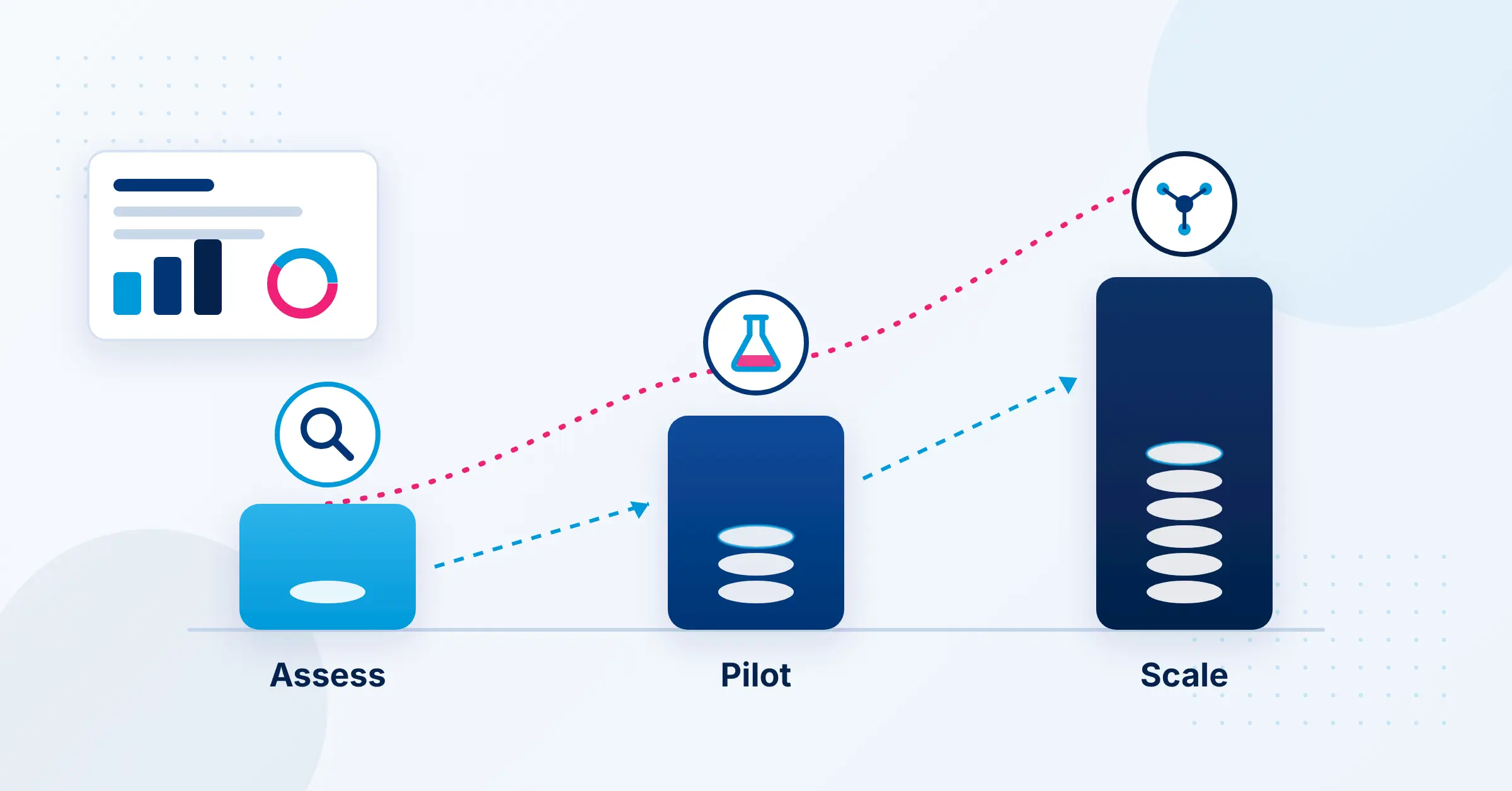
Most buyers do not buy “AI consulting” as one thing. They buy a stage of work, and each stage needs a different number of hours. We built the ranges below by multiplying typical team effort for each stage by three published rate bands: AI agencies in India and in the US as reported by Clutch, and US specialist firms based on the middle 50% of AI labor rates in GSA’s CALC+ federal contract database.
| Engagement stage | Typical effort | Offshore or India AI agency ($25 to $49/hr) | US AI agency ($50 to $99/hr) | US specialist firm ($142 to $258/hr) |
|---|---|---|---|---|
| Readiness assessment | 120 to 200 hours (1 to 3 weeks) | $3,000 to $10,000 | $6,000 to $20,000 | $17,000 to $52,000 |
| Strategy and roadmap | 320 to 600 hours (3 to 6 weeks) | $8,000 to $29,000 | $16,000 to $59,000 | $45,000 to $155,000 |
| Pilot or proof of concept | 720 to 1,600 hours (6 to 12 weeks) | $18,000 to $78,000 | $36,000 to $158,000 | $102,000 to $413,000 |
| Production implementation | 2,000 to 5,000 hours (3 to 6 months) | $50,000 to $245,000 | $100,000 to $495,000 | $284,000 to $1.29 million |
| Ongoing advisory or support | 20 to 80 hours per month | $500 to $3,900 per month | $1,000 to $7,900 per month | $2,800 to $20,600 per month |
How we calculated this: rates come from the Clutch AI pricing guide (India and US hourly bands) and the 25th to 75th percentile of 184 “artificial intelligence” labor ceiling rates in GSA CALC+, queried in November 2026. Effort ranges reflect typical team sizes for each stage. Real quotes move with data quality, integrations and compliance needs, so treat these as planning ranges, not prices.
The jump between strategy and implementation is the part that surprises most teams. A roadmap is mostly senior thinking time. Implementation adds data engineering, integration with existing systems, security reviews and testing, and that is where the AI consulting services cost starts to climb.
A practical pattern is to treat each stage as a decision point. Many firms that offer AI consulting services will scope a short assessment first, then quote the pilot once the data and use case are clear. If a pilot is the right next step, a dedicated AI PoC and MVP engagement keeps that phase tightly scoped before you commit to a full build.
Hourly rates explain most of the spread in any AI consulting price. The same eight-week engagement can cost several times more at a global strategy firm than at an offshore delivery partner, mainly because of the rate card.
| Provider type | Typical hourly rate (USD) |
|---|---|
| AI agencies in India | $25 to $49 |
| Freelance AI engineers on marketplaces | $35 to $60 (median range) |
| AI agencies in the United States | $50 to $99 |
| Freelance machine learning engineers | $50 to $200 (median range) |
| US federal contractors, AI labor categories | $142 to $258 (middle 50%), median about $194 |
| US federal contractors, data scientist categories | $139 to $206 (middle 50%), median about $170 |
| Top strategy firm, analyst to senior partner | $339 to $1,194 |
| Top strategy firm, state contract ceiling | $422 to $1,587 |
A few notes on reading this table. The Clutch figures reflect agencies that both advise and build, which is why they sit below pure strategy firms. The GSA CALC+ figures are awarded not-to-exceed ceiling rates on US federal contracts, published so government buyers can check that prices are reasonable, so they are a solid benchmark for US specialist rates. The McKinsey figures come from the firm’s own public government price lists, and commercial rates are not published, but these show where the top of the market sits.
It also helps to know what in-house talent costs. The US Bureau of Labor Statistics puts the median annual wage for data scientists at $120,230 as of May 2025, before benefits, recruiting and tooling. For many companies that salary, plus the time it takes to fill the role, is the real comparison point when weighing the cost to hire AI developers against an outside team.
When you compare quotes, ask each firm for its blended hourly rate and the planned hours per role. Multiplying the two gives you a number you can compare across a freelancer, a boutique and a large firm, even when their proposals look nothing alike.
The pricing model decides who carries the risk when the scope moves. Pick it based on how well you can define the work today.
Hourly or time and materials: You pay for the hours used. This suits early discovery, research-heavy work and projects where requirements will change. The risk sits with you, so cap the hours per phase and ask for weekly burn reports.
Fixed fee: One agreed price for a defined deliverable, such as a readiness report or a scoped pilot. It is usually the safer choice for a first engagement because the consultant absorbs overruns. Expect a contingency to be built into the price.
Monthly retainer: A set fee for ongoing access to advisors or a fractional AI lead. Retainers work well after launch, when the job is monitoring, tuning and planning the next use case. At 20 to 80 hours a month, our rate model puts a retainer at about $1,000 to $8,000 a month with a US AI agency and $2,800 to $20,600 with a US specialist firm. For context, Clutch reports average monthly spend of $11,553 across the AI projects it has reviewed.
Hybrid: Many engagements now mix models: a fixed fee for strategy, time and materials for the build, and a retainer for support. The largest firms are moving the same way. McKinsey told Business Insider that about a quarter of its global fees now come from outcome-based pricing, with some fixed cost components kept in place.
Whatever the model, tie payments to milestones you can verify, such as an approved roadmap, a pilot that meets its success metrics, or production acceptance. Be cautious of any structure that asks for most of the fee upfront.
Company size changes the budget because it changes how many stages, systems, teams and approvals are involved. The table below shows what each size of company typically buys in its first year, priced using the same rate model as the engagement table above.
| Company size | Typical first-year scope | Estimated budget at agency rates | Estimated budget at US specialist rates |
|---|---|---|---|
| Small business | Readiness assessment plus one pilot | $21,000 to $178,000 | $119,000 to $464,000 |
| Mid-market | Roadmap, one pilot and a first production rollout | $76,000 to $712,000 | $431,000 to $1.86 million |
| Enterprise | Roadmap, several pilots, production rollouts across units, compliance work | Usually $500,000 and up | Often $1 million and up |
The low end of each agency range assumes an offshore or India-based team; the high end assumes a US agency at the top of its rate band. Small and mid-market rows are sums of the stage ranges in the engagement table.
Small businesses usually get the most value from a fixed-fee assessment and one tightly scoped pilot. The goal is a working result on one process, not an enterprise roadmap.
Mid-market companies tend to fund a roadmap, one or two pilots and the first production rollout in the same year. This is where the choice of provider matters most, because the same scope can differ by several hundred thousand dollars depending on the rate band.
Enterprises pay more for reasons that have little to do with the model itself. Enterprise AI consulting cost rises with the number of business units involved, legacy system integration, security reviews, procurement cycles and change management across large teams. Programs often run 12 to 24 months and are usually funded in phases rather than as one contract. For a wider view of what large organizations spend beyond the consulting fees, see this breakdown of enterprise AI cost across build, infrastructure and operations.
AI automation consulting cost follows a different logic from general AI strategy work. The output is not a roadmap. It is a working process: invoices read and routed, support tickets triaged, reports generated, approvals moved along without someone copying data between systems.
Using the same rate model, a single workflow on modern SaaS tools (roughly 200 to 600 hours) comes to about $5,000 to $59,000 at agency rates. Multi-department automation that touches legacy systems (roughly 1,000 to 3,000 hours) runs about $25,000 to $297,000 at agency rates, and roughly two to five times that at US specialist rates. The hours, more than the rate, decide where a project lands.
Three things set the price of an automation engagement:
Because automation projects touch daily operations, process mapping before any build is worth paying for. Teams that want both the process design and the build from one partner often look at AI automation consulting so the people who design the workflow are the ones accountable for running it.
Offshore delivery is the single largest lever on AI consulting cost, yet most pricing guides give it one line. For US companies it deserves a closer look, because the trade-offs are specific and manageable.
The price gap is real. Clutch lists typical AI agency rates of $25 to $49 an hour in India against $50 to $99 in the United States. Against US specialist rates the gap widens. A four-person team working eight weeks (1,280 hours) costs about $32,000 to $63,000 at India agency rates, compared with $182,000 to $330,000 at the middle band of US federal AI contract rates in GSA CALC+.
What offshore teams usually cover well:
Where US buyers often keep work close to home:
Sending the whole engagement abroad is rarely necessary. A common pattern is a hybrid: a US-facing lead or solution architect owns discovery, stakeholder alignment and acceptance, while an offshore team carries the engineering. This keeps the cost advantage on the hours that make up most of the budget, while decisions stay close to the business.
| Risk | What to ask for in the contract or plan |
|---|---|
| Time zone gaps | A fixed daily overlap window and named US-hours contacts |
| Communication quality | Direct access to the engineers doing the work, not only an account manager |
| Data access and residency | Clear rules on where data is stored and processed, and who can access it |
| IP ownership | Code, prompts, models and documentation assigned to you on payment |
| Security assurance | Evidence of certifications such as ISO/IEC 27001 or SOC 2 reports |
| Continuity | Documentation and handover terms if the team or the vendor changes |
Handled with these controls in place, offshore and hybrid delivery lets a mid-market budget fund work that would otherwise only fit an enterprise one.
A consulting quote covers the work to design and launch a system. It rarely covers what the system costs to run. Gartner found that at least half of generative AI projects were abandoned after proof of concept, with escalating costs among the main reasons, so these numbers belong in the business case from day one.
Model usage. Generative AI systems are billed per token, and prices vary widely by model. On OpenAI’s current API pricing, a high-end model such as gpt-6.2-astra costs $8 per million input tokens and $40 per million output tokens, while a small model such as gpt-5-nano costs $0.05 and $0.40. Embedding models used for search and retrieval cost as little as $0.02 per million tokens. Choosing the smallest model that meets the quality bar is often the biggest saving available.
Hosting and infrastructure. Vector databases, application hosting, GPU capacity for self-hosted models, logging and backups all add a monthly line. These costs scale with traffic and data volume, so ask for an estimate at your expected usage, and again at two to three times that, before you sign off on the design.
Maintenance and improvement. Models drift, source data changes and users ask for new features. Plan for a small retained team after launch. At 20 to 80 hours a month, that is the ongoing support line in the engagement table: about $1,000 to $8,000 a month with a US AI agency, and less with an offshore team.
Evaluation and oversight. Someone has to review outputs, track accuracy and handle escalations. This is often internal staff time rather than a vendor invoice, which is why it gets missed.
When these costs start to grow faster than usage, a short round of AI cost optimization consulting can pay for itself through model routing, caching, prompt trimming and right-sizing infrastructure.
Regulated work costs more because it adds tasks, not because the rate card changes. When an AI system touches health records, personal data or high-stakes decisions, the consulting scope grows to include:
In practice, compliance work shows up as extra weeks in discovery, additional review cycles before launch and more documentation in the deliverables. Ask any consultant to list these tasks separately in the proposal so you can see what they cost. If governance is the main focus of the engagement, this breakdown of AI governance consulting cost goes deeper into how that work is priced.
The honest answer to “how much does AI consulting cost for us?” comes from your own scope, not a market average. Five steps get you to a defensible number before you talk to vendors.
If the plan already includes a build, the separate guide to AI development cost helps you size the engineering side alongside the advisory fees.
Proposals rarely use the same format, so normalize them before you compare the totals.
A strong proposal includes:
Red flags to watch for:
AI consulting cost is easiest to justify when it is measured against a specific outcome rather than a general ambition. A simple way to frame the return:
ROI (%) = (Annual value created − Annual total cost) ÷ Annual total cost × 100
The value side should only include things you can measure: staff hours saved, faster cycle times, fewer errors, lower churn or new revenue. The cost side should include the consulting fees, the build, model usage, hosting, maintenance and the internal time your own team spends. Most failed business cases count the first two and forget the rest.
Consulting tends to pay off in three situations:
It pays off less when the problem is already well understood and your team can build it, or when an off-the-shelf tool already solves it. In those cases, a short review is often enough. The same logic applies to newer systems such as autonomous agents, where the AI agent development cost depends heavily on how much decision-making the agent is trusted with.
Planning an AI initiative and want a realistic budget? Xicom’s consultants can review your use case, data and systems and give you a phased estimate covering strategy, pilot and production.
There is no single AI consulting price, but there is a clear structure behind every quote. The stage of work sets the band, the provider sets the rate, the pricing model sets who carries the risk, and your data and compliance needs set how much effort sits underneath. Running costs decide whether the project is still worth it a year later.
The most reliable way to control AI consulting cost is to start with one measurable problem, buy one stage at a time, and insist on proposals that separate data work, integration, compliance and support. If the roadmap leads to a build, choose a partner whose AI development services can carry the plan into production without a handover gap.
Get a phased AI consulting estimate. With 20+ years in software engineering, 1,800+ projects delivered and CMMI Level 3, ISO/IEC 27001 and ISO/IEC 42001 certifications, Xicom helps US and global companies plan and deliver AI with clear scope and transparent pricing.
Based on published hourly rates and typical team hours, AI consulting cost ranges from about $8,000 to $60,000 for a strategy roadmap with an AI agency, or $45,000 to $155,000 with a US specialist firm. Pilots run about $18,000 to $160,000 at agency rates, and production systems usually cost $50,000 to $500,000 or more. The average AI project reviewed on Clutch costs $120,594.
AI agencies on Clutch charge about $25 to $49 an hour in India and $50 to $99 in the US. US federal contract rates for AI roles in GSA CALC+ have a median of about $194 an hour, while McKinsey’s public government rate card runs from $339 to $1,194 an hour. Ask for a blended rate and planned hours to compare quotes fairly.
Enterprise AI consulting cost usually starts around $500,000 in the first year at agency rates and often passes $1 million at US specialist rates, because enterprises buy several pilots, multiple production rollouts and compliance work at once. Programs are usually funded in phases. Legacy integration, security reviews and change management drive most of the extra cost.
A single automated workflow on modern SaaS tools typically takes 200 to 600 hours, or about $5,000 to $59,000 at agency rates. Multi-department automation with legacy systems takes 1,000 to 3,000 hours, or about $25,000 to $297,000 at agency rates. The number of connected systems, the judgment the workflow needs and exception handling set the final price.
A fixed fee is usually better for a first, well-defined engagement such as an assessment or a scoped pilot, because the consultant absorbs overruns. Hourly pricing suits open-ended discovery where requirements will change. Many engagements combine both, with milestone payments tied to verified deliverables.
Ongoing costs include model usage billed per token, hosting and monitoring, and a retained support team. At 20 to 80 hours a month, support costs about $1,000 to $8,000 a month with a US AI agency. Internal time to review outputs and handle exceptions should also be in the business case before the project starts.
Offshore and hybrid models can cut AI consulting cost significantly, since AI agency rates in India on Clutch are about half of US agency rates. They work best when a US-facing lead owns discovery and acceptance while the offshore team handles engineering. Contracts should cover overlap hours, data handling, IP ownership and security certifications.

Based on this article's topic
Learn how AI-powered contract analysis extracts clauses, flags risks and tracks obligations, plus industry use cases and data security best practices.
Explore synthetic data generation for AI, including key techniques, real-world applications, benefits, limitations, and data quality considerations.
LLM hallucination detection explained: black-box to white-box methods, detector metrics, benchmarks, self-hosted tools and a production rollout plan.