Sep 21, 2026 Artificial Intelligence
Conversational AI development cost in 2026 ranges from about $31,500 for a single-channel text assistant to more than $300,000 for an enterprise platform that serves web, messaging and voice from one dialogue layer. The range is wide because the term covers text assistants, voice agents and multi-channel platforms, and each adds different engineering work and a different running cost.
Most published estimates quote a build range and stop. The larger part of the bill often arrives after launch, when every conversation is billed by the message, the token or the minute. This guide separates the build from the run cost, models both with published vendor prices, and shows how to calculate the cost savings that decide whether the project pays for itself.
Figures from outside Xicom are linked to their sources. Planning ranges are built from a stated effort and a stated hourly rate, so readers can rerun the arithmetic with their own inputs. Xicom, an AI development company with 20+ years of enterprise delivery experience, applies the same method to help businesses scope, build and run conversational AI within a defined budget.
Quick Answer: How Much Does It Cost to Build a Conversational AI Platform?
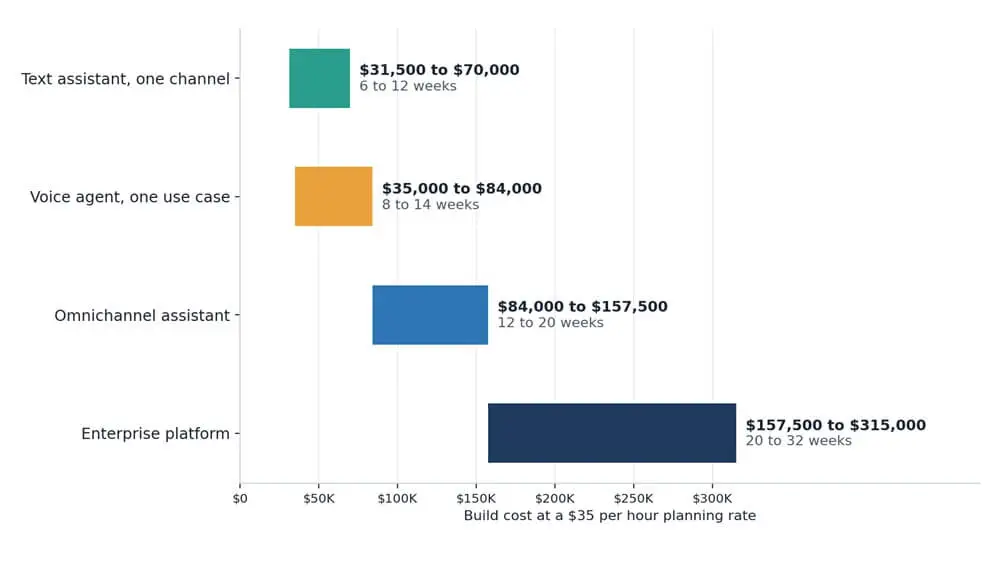
At a planning rate of $35 per hour, the cost to build conversational AI ranges from about $31,500 to $70,000 for a single-channel text assistant, and $35,000 to $84,000 for a voice agent covering one use case. An omnichannel assistant costs about $84,000 to $157,500, and an enterprise conversational AI platform $157,500 to $315,000. Running costs are additional. On Retell’s published rates, a voice conversation costs roughly $0.09 to $0.17 per minute to run, and about 80% of usage spend in the illustration in section 7 comes from voice.
Key takeaways
- Conversational AI cost depends on channels, integrations and knowledge sources more than on the model.
- Voice adds a per-minute cost across several components, and a voice conversation costs several times more than a text one.
- Build cost is about a third of three-year spend in the illustration below.
- Cost savings depend on two numbers you can measure: the share of conversations the system resolves, and the cost of a human-handled conversation.
- Building beats buying only above a volume that can be calculated in advance.
What Conversational AI Includes
Conversational AI is software that understands language in text or speech and responds in context, often while reading from or writing to business systems. Four solution types account for most projects.
| Solution type | Channels | Typical use | Main cost driver |
|---|---|---|---|
| Text assistant | Website chat, in-app chat | Support questions, guided journeys | Knowledge base and integrations |
| Voice agent | Phone, web calling | Inbound support, scheduling, outbound follow-up | Speech pipeline, telephony, latency |
| Omnichannel assistant | Web, messaging apps and voice on one dialogue layer | Consistent service across channels | Shared context and channel connectors |
| Agentic assistant | Any | Completes tasks in other systems, such as refunds or bookings | Covered in the AI agent development cost guide |
Scripted and intent-based bots sit below these tiers and are priced in the AI chatbot development cost guide.
Conversational AI Development Cost by Solution Type
The table shows the effort behind each range and the cost at a $35 per hour planning rate. These are planning estimates, not quotations. The effort column is what a reader can check against a vendor’s proposal.
| Solution type | What is delivered | Effort (hours) | Cost at $35/hr | Typical timeline |
|---|---|---|---|---|
| Text assistant, one channel | LLM assistant with knowledge base, one or two integrations, handoff to staff | 900 to 2,000 | $31,500 to $70,000 | 6 to 12 weeks |
| Voice agent, one use case | Speech pipeline, telephony integration, call flows, escalation, voice simulation testing | 1,000 to 2,400 | $35,000 to $84,000 | 8 to 14 weeks |
| Omnichannel assistant | Web, messaging and voice on one dialogue layer, two or three integrations, analytics | 2,400 to 4,500 | $84,000 to $157,500 | 12 to 20 weeks |
| Enterprise conversational AI platform | Several business units, shared knowledge layer, role-based access, audit trail, high availability | 4,500 to 9,000 | $157,500 to $315,000 | 20 to 32 weeks |
The hourly rate moves the total as much as the scope does. A provider billing $100 per hour needs the same 900 to 2,000 hours for a text assistant, which comes to $90,000 to $200,000. That gap explains most of the difference between quotes for the same work, so ask any vendor for the hours and the rate, not only the total.
For cost ranges across all AI project types, see Xicom’s AI development cost guide.
What Drives Conversational AI Cost
| Driver | What changes | Effect on cost |
|---|---|---|
| Number of channels | Web only, or also messaging, mobile app and phone | Each channel adds interface work and consistency testing |
| Voice requirements | Speech recognition, synthesis, latency, interruptions, telephony | Adds a speech pipeline and per-minute running cost |
| Knowledge sources | Volume, format and quality of content | Poor content adds cleanup and lowers answer accuracy |
| Integrations | CRM, ERP, ticketing, payment and order systems | Each system adds mapping, authentication and error handling |
| Language coverage | One language or several | Each language needs prompts, content and test cases |
| Compliance and security | Access control, audit logs, data residency, regulated data | Adds review, documentation and control work |
| Analytics and evaluation | Dashboards, quality scoring, test sets | More measurement costs more to build and to run |
| Scale | Concurrent conversations and peak volume | Raises hosting, concurrency and licensing cost |
Conversational AI Implementation Cost by Phase
Conversational AI implementation cost is the work between an approved design and a working system. The shares below are planning proportions and vary by project.
| Phase | Share of effort | What it covers |
|---|---|---|
| Discovery and conversation strategy | 10% | Use cases, success metrics, dialogue design, escalation rules |
| Knowledge and data preparation | 16% | Content cleanup, indexing, permissions, retrieval setup |
| Dialogue, model and retrieval | 20% | Prompts, orchestration, guardrails, fallbacks |
| Channels and voice | 14% | Web and messaging connectors, speech pipeline, telephony |
| Integrations | 16% | Connectors, authentication, data mapping, error handling |
| Evaluation and simulation testing | 14% | Test scenarios, accuracy checks, difficult-caller simulation |
| Deployment, analytics and monitoring | 10% | Hosting, logging, dashboards, alerts |
Knowledge preparation and integrations together take about a third of the effort. Evaluation is the phase most often compressed under schedule pressure, and it is the cheapest place to find problems.
Conversational AI Cost After Launch: Per-Message and Per-Minute Pricing
How much conversational AI costs to run depends on the channel. Text is billed by the token or the message, and voice by the minute.
Text conversations
Anthropic’s published rates are $1 and $5 per million input and output tokens for Claude Haiku 4.5, and $2 and $10 for Claude Sonnet 5. (Anthropic pricing documentation, checked September 21, 2026.) Using the six-turn support conversation modelled in the chatbot cost guide (15,510 input and 900 output tokens, with history resent each turn), the model cost per conversation is:
| Model setup | Cost per conversation | Monthly at 15,000 conversations |
|---|---|---|
| Haiku 4.5 for all turns | $0.020 | $300 |
| Sonnet 5 for all turns | $0.040 | $600 |
| Routed: 70% Haiku, 30% Sonnet | $0.026 | $390 |
Token counts differ by model, and Anthropic notes that its newer models use a tokenizer that produces about 30% more tokens for the same text, so measure real counts before budgeting.
Voice conversations
Voice is billed across a stack of components. Retell publishes each one.
| Component | Retell published rate |
|---|---|
| Voice infrastructure | $0.055 per minute |
| Text-to-speech, Retell platform voices | $0.015 per minute |
| Text-to-speech, ElevenLabs voices | $0.040 per minute |
| LLM, Claude 5 Sonnet | $0.064 per minute |
| LLM, GPT 5.6 Luna | $0.0064 per minute |
| Telephony, United States via Twilio | $0.015 per minute |
(Retell pricing, checked September 21, 2026.) Combining components gives three illustrative stacks and the cost of a four-minute call:
| Stack | Per minute | Four-minute call |
|---|---|---|
| Economy: platform voice, GPT 5.6 Luna, US telephony | $0.091 | $0.37 |
| Standard: platform voice, Claude 5 Sonnet, US telephony | $0.149 | $0.60 |
| Premium voice: ElevenLabs voice, Claude 5 Sonnet, US telephony | $0.174 | $0.70 |
Bland prices differently. Its published rate is $0.14 per minute on the Start plan and $0.12 per minute on the Build plan ($299 a month), and that single rate covers the LLM, speech-to-text and text-to-speech. Telephony is billed separately, and transfer time to a human costs $0.05 or $0.04 per minute depending on plan. (Bland pricing, checked September 21, 2026.)
On Retell’s own rates, a six-message chat with Claude 5 Sonnet costs $0.12 at $0.02 per AI message, against $0.60 for the four-minute standard voice call. Voice costs about five times as much per conversation on the same vendor and model.
Several billing rules affect the total:
- Silence is billed. Retell charges for the whole call because speech recognition stays active during silence and hold.
- Transfers change the bill. On Retell, the AI fee stops at transfer while telephony continues. Bland bills transfer minutes at its own rate.
- Add-ons stack. Retell lists a knowledge base add-on at $0.005 per minute, safety guardrails at $0.005, PII removal at $0.01, and AI quality assurance at $0.10 per minute after the first 100 free minutes.
- Fixed fees exist. Retell charges $2 a month per phone number and $8 a month for each concurrent call above 20.
Ongoing and Hidden Costs
| Cost | Why it appears | How to plan |
|---|---|---|
| Maintenance and updates | Prompts, flows, integrations and models change | A common planning heuristic is 15% to 25% of the build cost per year |
| Knowledge base upkeep | Products, prices and policies change | Assign an owner and a review schedule |
| Quality monitoring | Answer quality drifts as usage changes | Keep a test set and review sampled conversations |
| Human handoff | No system resolves every conversation | Budget staff time for escalated cases |
| Telephony and concurrency | Numbers, minutes and simultaneous calls are billed | Model peak concurrency, not only averages |
| Recording and storage | Calls and transcripts must be kept and protected | Set retention and consent rules early |
| Security and compliance review | Conversations contain personal data | Schedule periodic reviews in regulated sectors |
| Model migration | Providers retire and replace models | Keep prompts and tools portable |
Conversational AI Price Estimation: Three-Year TCO
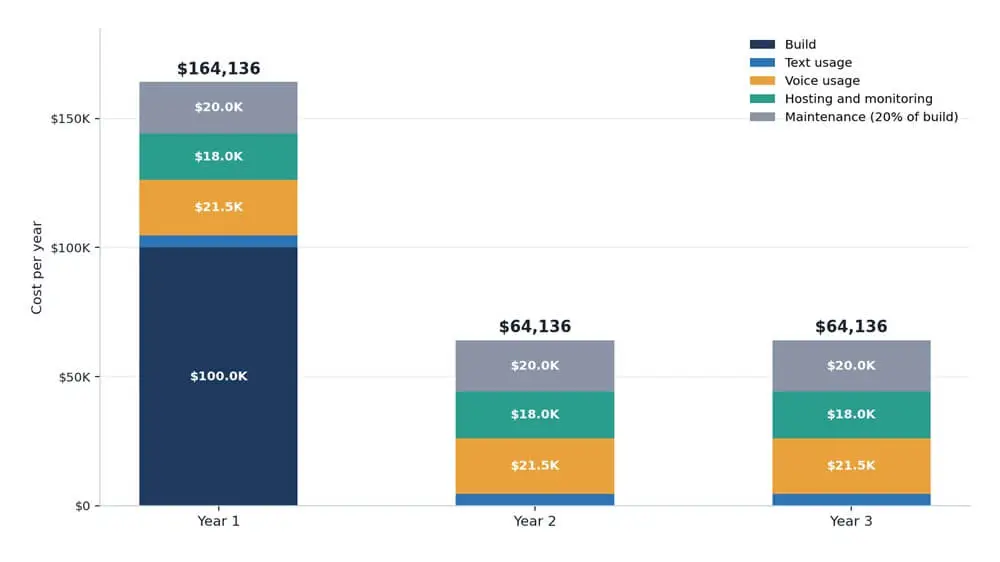
Three-year total cost of ownership is the most reliable basis for conversational AI price estimation, because it puts build and run cost side by side.
Three-year TCO = build + 3 × (text usage + voice usage + hosting and monitoring + maintenance)
The illustration uses an omnichannel assistant and these assumptions:
- Build of $100,000, about 2,860 hours at $35, inside the omnichannel range.
- 15,000 text conversations a month on the routed model setup at $0.026 each ($390 a month).
- 3,000 voice calls a month of four minutes each on the standard Retell stack at $0.149 per minute (12,000 minutes, or $1,788 a month).
- $1,500 a month for hosting, orchestration and monitoring.
- Maintenance at 20% of the build cost per year, a planning heuristic.
- Volume held flat, with human handoff staffing excluded.
| Cost line | Year 1 | Year 2 | Year 3 | Three-year total |
|---|---|---|---|---|
| Build | $100,000 | $0 | $0 | $100,000 |
| Text usage | $4,680 | $4,680 | $4,680 | $14,040 |
| Voice usage | $21,456 | $21,456 | $21,456 | $64,368 |
| Hosting and monitoring | $18,000 | $18,000 | $18,000 | $54,000 |
| Maintenance (20% of build) | $20,000 | $20,000 | $20,000 | $60,000 |
| Total | $164,136 | $64,136 | $64,136 | $292,408 |
The build is about 34% of three-year cost. Voice makes up about 17% of the conversations in this mix but about 82% of usage spend, so the voice share of volume is the assumption that moves the total most.
Conversational AI Cost Savings
Cost savings come from conversations the system resolves without a person. Two formulas cover most cases.
- Monthly net saving = conversations per month × resolution rate × cost of a human-handled conversation − monthly run cost
- Payback period in months = build cost ÷ monthly net saving
A useful benchmark is what vendors charge per resolved conversation. Intercom’s pricing page lists its Fin agent from $0.99 per outcome, and Zendesk charges $1.50 per automated resolution. (Intercom pricing; Zendesk) Automation only pays if a human-handled conversation costs clearly more than the resolved-conversation cost of the system.
The table applies the formulas to the section 7 illustration: 18,000 conversations a month, a monthly run cost of about $5,345 ($64,136 ÷ 12), and a $100,000 build. Each cell shows net monthly saving, with payback in brackets. The cost per human-handled conversation is an assumption, so replace it with your measured figure.
| Human cost per conversation | Resolution rate 20% | Resolution rate 40% | Resolution rate 60% |
|---|---|---|---|
| $3 | $5,455 (18.3 months) | $16,255 (6.2 months) | $27,055 (3.7 months) |
| $6 | $16,255 (6.2 months) | $37,855 (2.6 months) | $59,455 (1.7 months) |
| $9 | $27,055 (3.7 months) | $59,455 (1.7 months) | $91,855 (1.1 months) |
Payback swings from about one month to more than a year and a half, which is why measured inputs matter more than any benchmark. The savings are only real if staffing hours or overtime fall as a result. They are not real if the same team simply handles a lighter queue.
For context, Gartner forecasts that by 2029 agentic AI will autonomously resolve 80% of common customer service issues without human intervention, leading to a 30% reduction in operational costs. (Gartner, March 5, 2025) This is a forecast, not a measure of what current systems deliver.
Build vs Buy
| Option | How it is priced | Example from published prices |
|---|---|---|
| Packaged text agent, per resolution | Fee per resolved conversation | Intercom Fin from $0.99 per outcome; Zendesk $1.50 per automated resolution |
| Voice platform, per minute | Fee per minute across components | Retell $0.07 to $0.31 per minute depending on components; Bland $0.12 to $0.14 per minute plus telephony |
| Custom build | Fixed build cost plus usage and hosting | Tiers in section 2, with run cost from section 5 |
- Buy when the use case is standard, volume is modest and speed matters more than control.
- Build when workflows are unique, systems are proprietary, data control is mandatory or volume makes per-outcome fees costly.
- Go hybrid when a platform can prove the use case first and custom work follows.
For text, the break-even volume can be calculated. In the chatbot cost guide’s illustration, a custom build became cheaper than $0.99 per resolution at about 3,400 resolved conversations a month, and cheaper than $1.50 at about 2,200.
An experienced AI chatbot development company can run this comparison against your volume, channels and systems before any build is committed.
How to Reduce Conversational AI Cost
- Start with one use case and one channel. A narrow scope reaches production sooner and produces real usage data.
- Fix the knowledge base first. Clean, current content raises answer quality and cuts rework.
- Route across models. Match model size to question difficulty.
- Keep voice calls short. Silence and hold are billed, so tight call flows and quick transfers reduce spend.
- Add channels in phases. Extend to messaging and voice once the core works.
- Choose the voice stack deliberately. In the Retell example, a premium voice and LLM raise the per-minute cost from $0.091 to $0.174.
- Track cost per resolved conversation. Visibility comes before optimization.
For a step-by-step view of a voice build, see Xicom’s guide on how to build an AI voice agent.
What to prepare before requesting an estimate
- The use cases, monthly conversation volume and mix of text and voice
- The measured cost and resolution rate of your current human-handled conversations
- Knowledge sources, with format and owner
- Systems to connect and the state of their APIs
- Channels required at launch and later
- Security, data residency and compliance constraints
How Xicom Helps Businesses Control Conversational AI Cost
Strategy and Use Case Discovery
Our conversational AI consulting team assesses use cases against business value, feasibility and data availability, then sets the solution type and effort before any build commitment.
Chatbot and Assistant Build
We builds text assistants and omnichannel assistants that connect to company knowledge and systems. Xicom has delivered 1,800+ projects for 750+ clients across 50+ countries and holds ISO 9001 certification.
Voice Agent Build
Xicom’s AI voice agent development work covers conversation flow design, speech recognition and synthesis integration, escalation logic and simulation testing before launch.
Knowledge and Integration
RAG development and AI integration connect assistants to documents, CRM, ticketing and internal systems, with access control that follows existing permissions.
Run-Cost Governance
Assistants are designed with model routing, conversation length limits and cost-per-resolved-conversation reporting, so spend is visible from the first release.
Engagement Models
We offers fixed price, time and material, and dedicated team models, with AI staff augmentation for teams that need to extend an in-house group. Businesses that want to add engineers directly can hire AI developers from Xicom.
Endnote
Conversational AI cost is set by channels, knowledge, integrations and the hourly rate at build time, and by messages, tokens and minutes after launch. Voice raises the running cost several times over text, so the mix of channels shapes the total more than the build price does. Whether the project saves money depends on two measurable numbers, the resolution rate and the cost of a human-handled conversation. Estimates that show their hours, rates and usage assumptions can be checked and adjusted, and those that do not should be treated with caution.
FAQs
1. How much does conversational AI cost?
At a $35 per hour planning rate, a single-channel text assistant costs about $31,500 to $70,000 to build and a voice agent for one use case $35,000 to $84,000. Omnichannel assistants cost $84,000 to $157,500 and enterprise platforms $157,500 to $315,000. Running costs are additional.
2. What is the conversational AI development cost for an enterprise?
An enterprise platform with several business units, a shared knowledge layer, role-based access and an audit trail costs about $157,500 to $315,000 at the planning rate and takes 20 to 32 weeks. Scope, integrations and compliance requirements move the figure within that range.
3. How much does it cost to build a conversational AI platform for voice?
A voice agent for one use case costs about $35,000 to $84,000 to build and takes 8 to 14 weeks. Running it adds a per-minute cost, roughly $0.09 to $0.17 per minute on Retell’s published component rates, or $0.12 to $0.14 per minute on Bland’s plans plus telephony.
4. What is the conversational AI implementation cost?
Implementation covers knowledge preparation, dialogue design, channel and voice setup, integrations, testing and deployment. In the phase model, knowledge preparation takes 16% of effort and integrations 16%, so they together account for about a third of the build.
5. How is conversational AI priced after launch?
Text is billed per token, per message or per resolved conversation. Voice is billed per minute across speech, language model and telephony components, and some platforms bundle several into one rate. Examples include Intercom from $0.99 per outcome and Retell from $0.07 per minute.
6. How do I do a conversational AI price estimation?
Multiply the effort for your solution type by the hourly rate, then add run costs: text conversations times cost per conversation, voice minutes times the per-minute rate, hosting and maintenance. Compare the three-year total with packaged pricing at your volume.
7. How much can conversational AI save?
Savings equal resolved conversations multiplied by the cost of a human-handled conversation, minus run cost. In the section 8 illustration, payback ranges from about 1.1 months to 18.3 months depending on the resolution rate and human cost, so measure both before committing.
Sources
- Anthropic, Claude Platform pricing documentation: platform.claude.com
- Retell AI pricing: retellai.com/pricing
- Bland pricing: bland.ai/pricing
- Intercom pricing: intercom.com/pricing
- Zendesk, outcome-based pricing: zendesk.com
- Gartner, “Gartner Predicts Agentic AI Will Autonomously Resolve 80% of Common Customer Service Issues Without Human Intervention by 2029,” March 5, 2025: gartner.com
- Xicom, AI Development Cost Guide 2026: xicom.biz

Make your ideas turn into reality
With our AI & mobile app solutions
Explore related services
Based on this article's topic