RAG vs Fine Tuning: How to Choose the Right Approach for Your AI Product
RAG vs fine tuning explained: key differences, costs, and when to use each or both. A practical decision framework for teams building real LLM products.
Nov 10, 2026 Artificial Intelligence
SLM vs LLM is the choice between a specialist and a generalist. A small language model (SLM) is compact enough to run on a single GPU, a laptop or a phone, and it handles narrow, repeatable tasks quickly and cheaply. A large language model (LLM) brings broad knowledge and stronger reasoning, at a higher cost for every request it serves.
Both model classes are built on the same transformer architecture. What separates them is scale, and scale changes what a model knows, how fast it answers, what it costs and where it can run. This guide answers the SLM vs LLM in AI question one decision at a time, with verified examples and sourced numbers, so you can choose the right model for each part of your generative AI development roadmap.
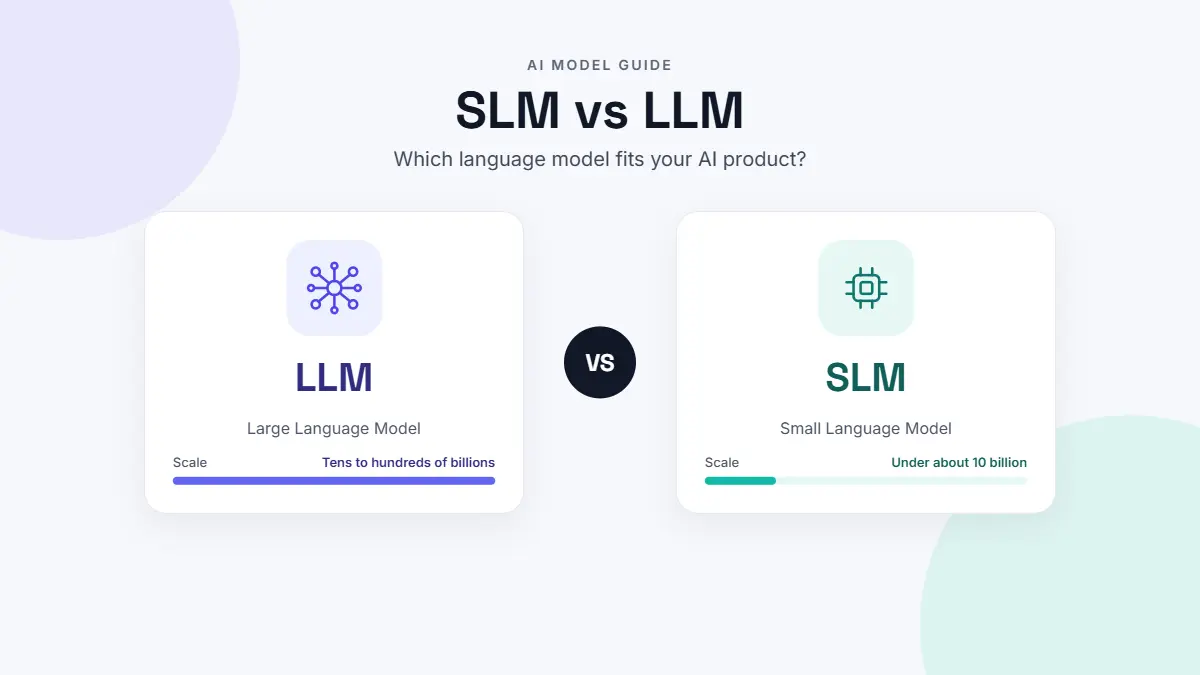
A small language model is a transformer-based language model compact enough to run on modest hardware, such as a single GPU, a laptop or a phone. SLMs are usually trained on curated data or fine-tuned for specific tasks, which lets them deliver fast, low-cost results on well-defined work like classification, extraction and routing.
There is no official size cutoff. By common convention, models from a few hundred million to roughly 10 to 15 billion parameters count as small. A more practical test is deployment: if a model runs on a single GPU, a laptop or a phone fast enough to serve one user well, it behaves like an SLM.
Small does not mean weak. Microsoft’s Phi-3-mini has 3.8 billion parameters, and Microsoft reports that it outperforms models twice its size on key benchmarks. It supports a context window of up to 128K tokens and can run on-device, including on mobile hardware.
Not always. Many small language models are the smallest members of an LLM family, such as the 1B and 3B versions of Meta’s Llama 3.2. Size alone makes a model small. Using it for a defined job, tuned on the right data and deployed close to that data, is what makes it a practical SLM. A general 7B chat model on a laptop is simply small. A 7B model tuned to extract invoice fields is an SLM doing what SLMs do best.
A large language model is a transformer-based model trained on broad, internet-scale data with tens to hundreds of billions of parameters. That scale gives LLMs wide general knowledge, strong multi-step reasoning and the ability to handle new tasks from instructions alone, without retraining. Most are accessed through vendor APIs.
Frontier LLMs such as OpenAI’s GPT models, Anthropic’s Claude and Google’s Gemini do not have publicly disclosed parameter counts. Open-weight models show the scale involved: DeepSeek-V3 has 671 billion total parameters and uses a mixture-of-experts design that activates 37 billion of them for each token.
Running a model of that size yourself takes multi-GPU infrastructure and a dedicated team. For companies that need an LLM inside their own environment, it is a full LLM development project rather than a simple integration.
Also Read: SGLang vs vLLM
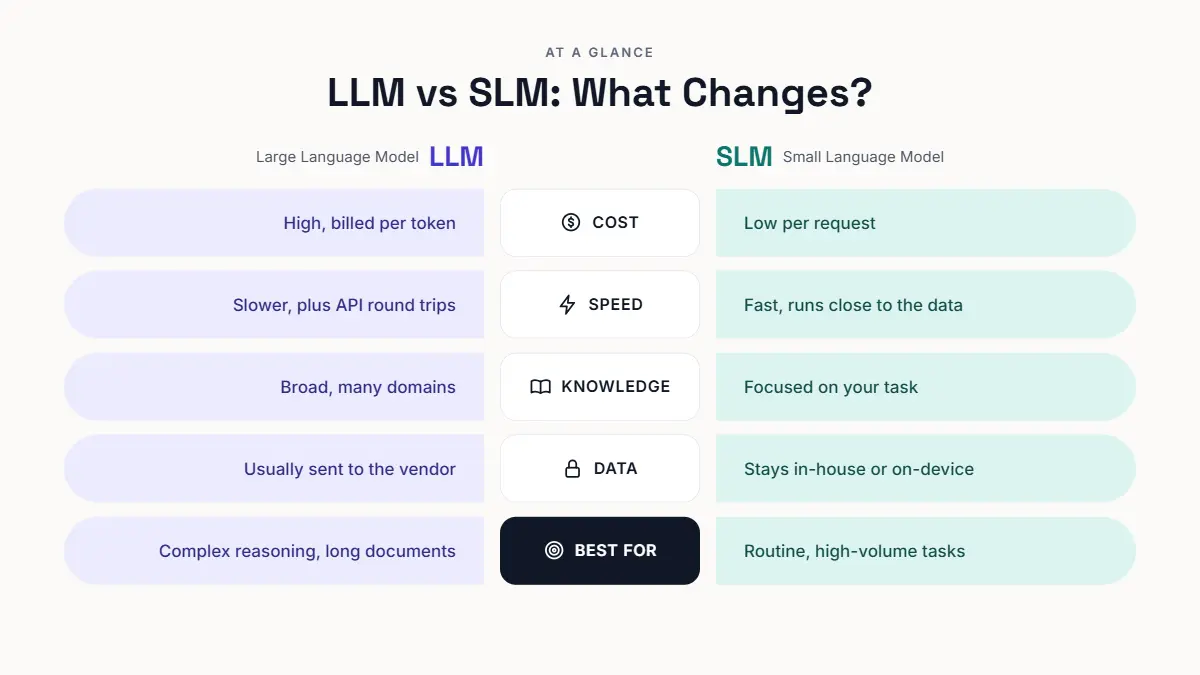
The difference between SLM and LLM is scale and scope. A small language model has fewer parameters, runs on modest hardware and performs best on narrow tasks. A large language model has tens to hundreds of billions of parameters, needs data-center hardware or a vendor API, and handles open-ended questions and complex reasoning across many domains.
The table below compares the two model classes on the factors that matter in a production decision.
| Factor | Small Language Model (SLM) | Large Language Model (LLM) |
|---|---|---|
| Parameter size | A few hundred million to roughly 10-15 billion | Tens to hundreds of billions, often undisclosed |
| Knowledge breadth | Narrow, strongest in its trained domain | Broad, across many domains and languages |
| Reasoning | Good on defined tasks, weaker on open-ended problems | Strong on multi-step and open-ended reasoning |
| Latency | Low, especially on local hardware | Higher, plus network round trips for API calls |
| Cost per request | Low, with fixed hosting costs | Higher, billed per token |
| Hardware | Single GPU, CPU, laptop or phone | Multi-GPU clusters or a vendor API |
| Deployment | On-device, edge, on-premise or private cloud | Mostly vendor APIs; open-weight models need large clusters |
| Data privacy | Data can stay inside your environment | Data usually goes to the vendor |
| Fine-tuning effort | Fast and affordable with LoRA | Costlier, and limited on closed models |
| Best for | Classification, extraction, routing, on-device features | Complex chat, analysis, code, broad knowledge work |
Three differences drive most decisions. Cost decides the budget once request volume grows. Control decides whether sensitive data can stay in-house. Task fit decides quality: on a narrow, stable task a tuned small model often holds its own, while on open-ended work the large model’s breadth is hard to replace.
Each comparison below opens with a verdict, followed by the evidence behind it.
SLMs win on cost at volume. NVIDIA says running a small Llama model can be 10 to 30 times cheaper than running Llama 3.3 405B, the largest model in the same family. API-based LLMs bill every token, so spend grows with each user and each long prompt. A self-hosted SLM carries fixed GPU and engineering costs but a very low cost per request, and an on-device model removes the server cost entirely.
SLMs respond faster. Fewer parameters mean less computation per token, and running locally removes the network round trip to an API. For autocomplete, voice features, real-time agents and on-device AI, users feel the difference.
LLMs win on breadth, and tuned SLMs win on focus. Large models handle open-ended questions and multi-step reasoning better. On narrow tasks, the gap closes or reverses after fine-tuning: in Predibase’s LoRA Land project, 25 of 27 task-specific adapters fine-tuned on Mistral-7B matched or beat GPT-4 on their tasks, at under $8 of training cost each on average. Outside its trained task, a tuned SLM loses that advantage.
SLMs give you more control. A small model can run on-premise, in your own VPC or on the user’s device, so sensitive data never has to leave your environment. Meta built its Llama 3.2 1B and 3B models for this, keeping data such as messages and calendar details on the device. With an API-based LLM, data goes to the vendor, and the vendor controls model updates and retirement.
SLMs are easier to customize and own. Fine-tuning a small model with LoRA is fast and affordable, and the resulting weights are yours. LLMs can be fine-tuned too, but at a higher cost, and closed models limit what you can change. In the LLM vs SLM decision, ownership matters most when a model sits at the center of a product you plan to run for years.
Well-known SLM vs LLM examples include Microsoft Phi-3-mini, Meta Llama 3.2, Mistral 7B and Google Gemma on the small side, and OpenAI GPT, Anthropic Claude, Google Gemini and DeepSeek-V3 on the large side. The table lists each model’s developer and size, taken from the developer’s own documentation or paper.
| Model | Developer | Size | Class | Known for |
|---|---|---|---|---|
| Phi-3-mini | Microsoft | 3.8B | SLM | Runs on-device; beats models twice its size on key benchmarks |
| Llama 3.2 1B and 3B | Meta | 1B, 3B | SLM | Edge and mobile use, 128K-token context |
| Mistral 7B | Mistral AI | 7.3B | SLM | Outperforms Llama 2 13B on all benchmarks Mistral reported |
| Gemma (small variants) | From 270M | SLM | Smallest sizes target phones and laptops | |
| DeepSeek-V3 | DeepSeek | 671B total, 37B active | LLM | Open-weight mixture-of-experts model |
| GPT, Claude, Gemini (frontier tiers) | OpenAI, Anthropic, Google | Not disclosed | LLM | Broad reasoning, offered mainly through APIs |
Model lineups change quickly, so treat these as illustrations of each class. The right model is the one that handles your task at acceptable quality, cost and latency, whatever its release date.
The main advantage of SLM vs LLM is efficiency: the quality a specific task needs, at a fraction of the running cost, on infrastructure you control. Small language models bring five practical benefits:
An LLM is the better choice when the task is open-ended, unpredictable or not yet defined. If you cannot describe the job in one sentence, start with a large model. LLMs are the stronger fit for five kinds of work:
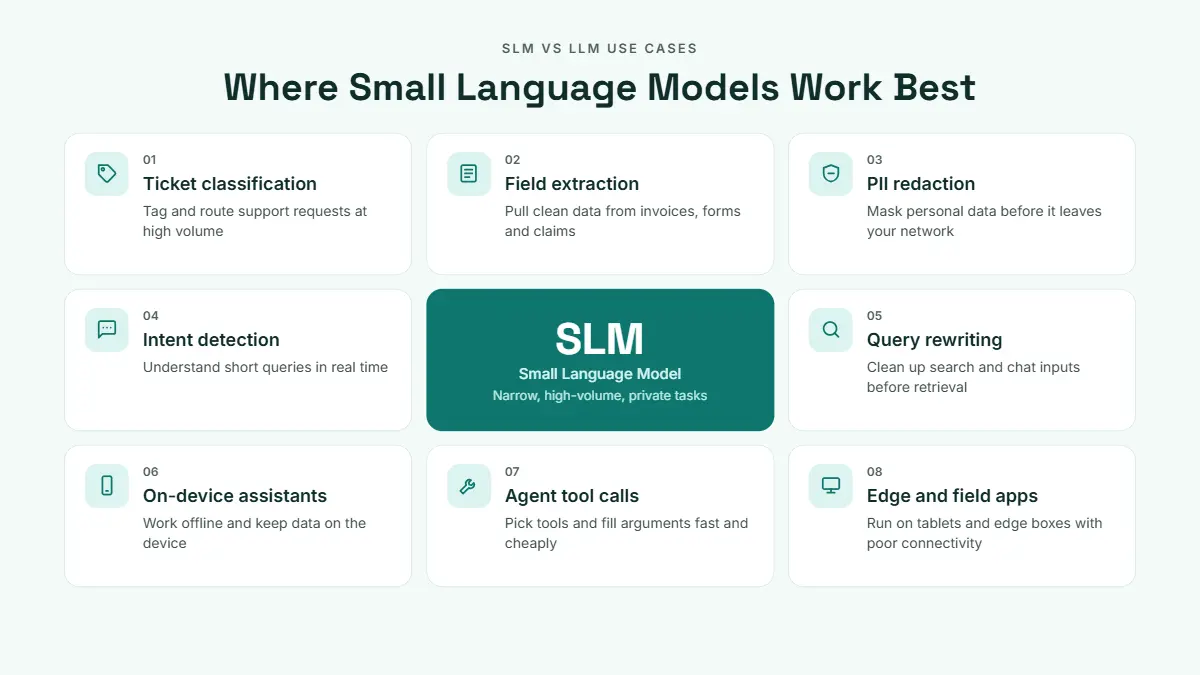
The best SLM vs LLM use cases follow the shape of the task: narrow, frequent and structured tasks suit a small model, while open-ended and knowledge-heavy tasks suit a large one. The table maps common tasks to the model class that fits them.
| Task | Best fit | Why |
|---|---|---|
| Support ticket classification | SLM | Fixed labels, high volume, low latency needed |
| Document field extraction | SLM | Structured output that fine-tuning makes reliable |
| PII redaction | SLM | Runs in-house before any text reaches an external API |
| Intent detection and query rewriting | SLM | Short inputs, real-time response |
| On-device assistant | SLM | Works offline and keeps data on the device |
| Long-document analysis | LLM | Needs broad knowledge and long-context reasoning |
| Multi-turn customer chat | Both | SLM handles routine questions, LLM handles complex ones |
| Code generation across files | LLM | Requires reasoning over many interacting parts |
| Research and summarization | LLM | Benefits from wide general knowledge |
| AI agent workflows | Both | LLM plans, SLMs execute repetitive steps |
LLM and SLM models work together by splitting a workload so each request goes to the cheapest model that can handle it well. NVIDIA recommends this mixed design for AI agents: SLMs handle most operational subtasks, and LLMs are called selectively when broader reasoning is needed. Three patterns cover most systems.
A small classifier reads each request and sends simple ones to an SLM and complex ones to the LLM.
The SLM answers first. When its confidence is low, the request escalates to the LLM.
The LLM plans the task, and SLMs execute the steps: choosing tools, filling arguments, extracting values and formatting results. For teams in AI agent development, this split is usually where the largest cost and latency savings come from.
Here is how a claims-processing workflow uses the agentic split:
Also Read: Conversational AI vs Generative AI
Fine-tuning, quantization and RAG turn a general small model into a reliable production component. Each one addresses a different gap.
Fine-tuning trains the model on examples of your task, usually with parameter-efficient methods such as LoRA, so it produces the right output format and domain language every time. AI model fine-tuning services cover data preparation, training and evaluation in one workflow. A related technique, distillation, uses a large model to generate training data that a small model then learns from.
Quantization stores model weights at lower precision, such as 8-bit or 4-bit, which cuts memory use so the model fits on a smaller GPU or a device. Test quality after quantizing, since some tasks lose accuracy.
RAG fills the knowledge gap. A small model holds less information, so pair it with retrieval-augmented generation for facts that change or need citations. Our guide to RAG vs fine-tuning explains when to use each.
Choose an SLM for narrow, high-volume, private or real-time tasks, and an LLM for open-ended reasoning or tasks you have not yet defined. Make the call per use case, not once for the whole product. The table below gives a starting point.
| If your use case… | Choose |
|---|---|
| Is narrow and repeatable, such as classify, extract or route | SLM |
| Runs at thousands of requests a day or more | SLM, or route most traffic to one |
| Handles data that must stay in your servers, VPC or device | SLM |
| Needs real-time or offline responses | SLM |
| Requires open-ended reasoning or long documents | LLM |
| Is still being defined, with no training examples yet | LLM first, then collect data |
| Mixes routine and complex work | Both, with routing |
When the answers point both ways, an AI consulting engagement that benchmarks candidate models on your own data settles the SLM or LLM question faster than internal debate.
The SLM vs LLM decision is made task by task. Large language models earn their cost on open-ended reasoning and broad knowledge. Small language models win wherever volume, speed, cost and data control matter, and many products need both.
Start with a large model to learn what users actually ask, then move the narrow, frequent and stable tasks to tuned small models. That path keeps quality high while costs stay predictable.
There is no official cutoff. By common convention, a small language model has from a few hundred million to roughly 10 to 15 billion parameters. In practice, a model counts as small when it runs on a single GPU, a laptop or a phone fast enough to serve a single user well.
ChatGPT runs on OpenAI’s GPT models, which are large language models. OpenAI does not publish their parameter counts, but they are trained at far larger scale than small language models and are delivered through the ChatGPT app and API, rather than running on a phone or a single GPU.
Yes. Several small language models are built for phones. Microsoft reports that Phi-3-mini, with 3.8 billion parameters, can run on-device, including on mobile hardware. Meta designed its Llama 3.2 1B and 3B models for mobile and edge devices, so data such as messages can stay on the device.
SLMs are not secure by default, but they give you more control. A small language model can run on-premise, in your VPC or on a device, so sensitive data does not have to leave your environment. An API-based LLM sends data to the vendor. Security still depends on access controls, monitoring and deployment.
An SLM is better for narrow, high-volume tasks where speed, cost and data privacy matter, such as classification, extraction and routing. An LLM is better for open-ended reasoning, long documents and broad knowledge. A fine-tuned SLM can match or beat a general LLM on one well-defined task, but not across many.
In AI, an SLM is a compact language model that runs on a single GPU, a laptop or a phone and works best on narrow, repeatable tasks. An LLM is a much larger model, usually accessed through an API, built for open-ended reasoning and general knowledge. The difference between SLM and LLM is scale and cost, not the underlying technology.
LLM means large language model and SLM means small language model. MLM has two meanings. Some people use it for a medium language model, a mid-sized class between the two. In NLP research, MLM usually means masked language modeling, the training method behind BERT, which predicts hidden words in a sentence.

Based on this article's topic
RAG vs fine tuning explained: key differences, costs, and when to use each or both. A practical decision framework for teams building real LLM products.
Learn how to evaluate AI models with the right metrics for ML, LLMs, RAG and AI agents, proven testing methods, common mistakes, and best practices.
AI app development cost ranges from $30,000 to $300,000+. See costs by complexity and use case, running costs, timelines, and tips to cut your budget.